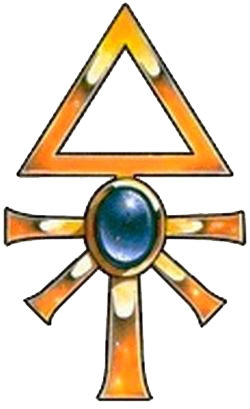
Vaul
| Vaul | |
|---|---|
| God of smiths and craftsmen in the Aeldari pantheon | |
| Domain | Smithing, crafting and all artisans |
| Pantheon | Aeldari gods, under Asuryan |
| Relatives | |
| Worshippers | A small sect of the Bonesingers |
| Works | The palace of Asuryan; the swords of Khaine; the Blades of Vaul; Anaris |
| Opponent | Kaela Mensha Khaine |
| Fate | Maimed and bound to his anvil by Khaine in the War in Heaven; lost at the Fall of the Aeldari |
Vaul is the Aeldari god of smiths and of all craftsmen, brother of Asuryan, the Phoenix King who ruled the Aeldari pantheon. He was the architect and chief engineer of Asuryan's palace in the First Age of the Aeldari, and the patron of all artisans. A small sect of the Bonesingers, the psychic craftsmen of the Aeldari, still worships him.[1]
In Aeldari myth Vaul bargained with Khaine for the freedom of Isha and Kurnous, and cheated him over the last of a hundred promised swords. The quarrel began the mythic War in Heaven among the gods, in which Khaine maimed Vaul and bound him to his own anvil. Vaul's greatest blade, Anaris, passed to the mortal hero Eldanesh.[1]
The smith of the gods
[edit]Before Asuryan raised the barrier between the gods and mortals, the barrier that split the Materium from the Immaterium, Vaul was always at work. He made swords for Khaine, the god of war, made and mended the Needles of Fate for the crone goddess Morai-Heg, kept the hunting gear of Kurnous, and did all the other divine craftwork the gods required. He also made musical instruments to accompany the dream songs of Lileath and the life-giving songs of Isha.[1]
The Blades of Vaul
[edit]Isha, grieving at the slaughter of her children by Khaine, had inspired Asuryan to separate gods and mortals. When Asuryan learned that his decree had been broken, he gave Isha and her husband Kurnous to Khaine, who tortured them in a burning pit. Vaul, their uncle, was moved by their suffering. He agreed to make Khaine a hundred enchanted swords within a year if Khaine would free them.[1]
Vaul finished every blade but the last, which lay incomplete on his anvil when the year ran out. He put a mortal sword in its place and delivered the hundred. Khaine released his captives, and the three gods departed, but Khaine soon found the trick, called Vaul a cheat and swore revenge.[1]
War in Heaven
[edit]The conflict that followed divided the gods between Khaine's faction and Vaul's. Gods changed sides, deeds of heroism and evil were done on both, and the war was mirrored among the mortal Aeldari. Asuryan took no side and watched, coming slowly to regret his sentence on Isha and Kurnous.[1]
Vaul reforged the unfinished blade into the greatest of all his swords, Anaris, and went out to fight Khaine. Even with it he was no match for the war god, who cast him down, maimed him and chained him to his own anvil. Faolchú, the falcon who had fought for Vaul, carried Anaris to Eldanesh, greatest of the mortal Aeldari. Eldanesh too was killed by Khaine, and from his blood the war god took the name Khaela Mensha Khaine, "Khaine of the Bloody Hand". Asuryan then declared the war over.[1]
The Fall
[edit]The Farseer Eldrad Ulthran has argued that if Vaul had been freed from his chains, his skill in craft and engineering might have rallied the defences of the gods, and they would not have fallen to the newborn Slaanesh at the Fall of the Aeldari in the late 30th millennium.[1]
Legacy and relics
[edit]Aeldari tradition holds that the first Spirit Stones were made from Isha's tears so that gods and mortals could speak through the barrier; one stone was given to Isha and the rest to the Aeldari.[1] Other tellings credit Vaul himself with shaping the stones from those tears.[a]
The Aeldari call the great black star fortresses made by the Old Ones in their ancient war with the C'tan and the Necrons the "Talismans of Vaul". The Imperium knows them as Blackstone Fortresses. Together they can make a star go supernova.[1]
An Aeldari artefact called The Awakening, recovered by Imperial forces on Rahe's Paradise in 724.M41, bore the inscription "the Vaul-Moon shall bring forth the Dragon". Sister Superior Meritia of the Orders Dialogous, who studied it, concluded that a "Vaul-Moon" was the Aeldari equivalent of a Forge World, and that the text concerned the ancient Necrontyr.[1]