
Necrons
| Necrons Formerly the Necrontyr | |
|---|---|
 Ankh of the Triarch, the sigil of the Necron race Artwork © Games Workshop | |
| Classification | Xenos; undying machine-intelligences in living-metal bodies |
| Origin | The Necrontyr, a short-lived species of the Halo Stars region, transformed by biotransference |
| Original ruler | The Silent King Szarekh, last of the Triarch |
| Territory | Tomb Worlds scattered across the galaxy; the crownworld of Mandragora; the hidden dynasties |
| Enemies of old | The Old Ones, the Aeldari, the C'tan (their former masters) |
| Sleep | About sixty million Terran years (the Great Sleep) |
| Leaders in the Era Indomitus | |
| Szarekh, the Silent King; Imotekh the Stormlord (Sautekh); Trazyn the Infinite; Anrakyr the Traveller; Orikan the Diviner; Illuminor Szeras | |
| Principal wars against the Imperium | |
| Sanctuary 101 (897.M41); the Imotekh campaigns; the Damnos wars (973.M41–); Borsis (926.M41); the Era Indomitus awakenings | |
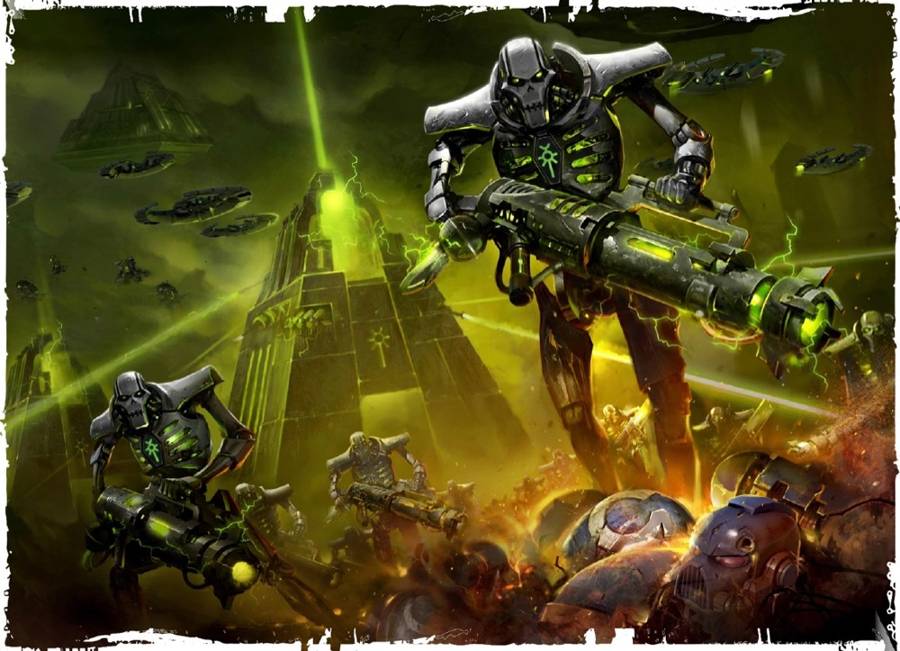
The Necrons are an ancient xenos race of living-metal warriors. They are the remains of the Necrontyr, a short-lived organic species that gave up its flesh for immortality at the price of its souls, and they are served by a stratified court of lords, immortals and warriors who have slept for some sixty million Terran years. They lie in the great Tomb Worlds across the galaxy, and in the 41st millennium these have begun to wake. To the Imperium the Necrons are the most ancient of the galaxy's hostile powers, and one of its most mysterious: they do not parley, do not need to eat or breathe, are not subject to fear and cannot be starved or weakened by attrition.[1][2]
The Imperium has met Necrons for many centuries without recognising them for what they were. Hundreds of colony worlds are lost every year, the Administratum rarely learns why, and no single record of such encounters is kept; the Inquisition has meanwhile tried to suppress what is known of the Necrons' return. The Necrons have since proven a serious war power, with undying warriors and a technology far beyond the Imperium's, although they are divided into separate dynasties with their own aims.[3][4]
In the Era Indomitus the Tomb Worlds have been awakening in greater numbers than at any time in recorded history. The return of the Silent King and the pressure of the Tyranids have drawn many Necron dynasties out of hiding, and the Imperium finds itself at war with them in many places.[5]
Origins
[edit]The Necrontyr
[edit]The Necrontyr were a species native to the Halo Stars region, bathed in the radiation of a scourging sun, and they lived brief lives. Imperial scholars, working from Aeldari and Necron sources, describe a people who built their cities in expectation of early death and who took to the stars in torch-ships clad in living metal. They met the Old Ones, who had mastered immortality and the Warp and refused to share the gift, and they came to hate them. Their own dynasties, ruled by the Triarch of three phaerons whose head was the Silent King, fell into the Wars of Secession. The Szarekhan Silent King declared war on the Old Ones to unite his people against a common foe.[1]
The C'tan and biotransference
[edit]The Necrontyr's rulers, a council called the Triarch, were approached by the first of the C'tan, entities of pure energy who fed on stars. Imperial accounts of this meeting, which are based on Necron records and are for that reason contradictory, hold that the one called the Deceiver offered the Necrontyr the immortality they craved. The price was biotransference: the whole species was to be transferred into bodies of a metal that could not die, and the C'tan would feed on the energies of their souls. The last of the Silent Kings, Szarekh, accepted, and his people marched into the bio-foundries. The result was the Necrons, a people with immortal bodies and without souls.[1]
The War in Heaven
[edit]The Necrontyr fought the Old Ones in the War in Heaven, and for a long time they lost, for the Old Ones commanded the Webway and the Warp. With the C'tan and the undying Necrons fighting together the war turned: the Necrons breached the Webway through their dolmen gates, and the Old Ones were driven back. In their desperation the Old Ones raised psychic servant species, among them the ancestors of the Aeldari, and these broke the C'tan's dominion. The slaughter of the war, however, stirred up the entities of the Warp, and the Old Ones were scattered and destroyed, whether by the Enslavers or by the C'tan. According to the Necron account, the Silent King then led a revolt against his masters, with weapons made to unmake C'tan, and shattered them into thousands of fragments, the C'tan shards, each of which was bound in a tesseract vault. His last command to his people was that they were to sleep in their Tomb Worlds for sixty million years, until the Aeldari, who had inherited the galaxy from the Old Ones, had faded, and then awaken to take the galaxy back. He then left the galaxy, and the Necron dynasties went to sleep.[1][4]
The Great Sleep and the awakening
[edit]The Great Sleep lasted some sixty million Terran years. Not all the Tomb Worlds survived it: many suffered radiation damage, stasis failures or the intrusion of mortal species, and the Necrons that woke from them were incomplete. Some dynasties have lost the memory of why they exist. The first Tomb Worlds are recorded to have stirred in the late 30th millennium, as the Great Crusade spread across the galaxy, and others woke later, among them one that stirred during the wars of the Apostles of the Blind King in the 37th millennium. The awakening has not been exact: the Necrons have arisen not as one people but in fitful starts over scattered millennia, and in places the sleepers have lost their minds altogether.[1][2]
Awakened Necrons find a galaxy that is not as they left it. Their stasis-crypts lie beneath worlds that have been settled by the Imperium or by the Aeldari, or that have been built over by mankind. Their lords regard the new races as intruders on their property and, as the warning of one crownworld lord runs, grant a single month to withdraw before they move to cleanse them.[3]
Wars against the Imperium
[edit]First contacts
[edit]Some Imperial scholars hold that the slaughter of the Sisters of Battle stationed at Sanctuary 101 in 897.M41 was the first contact between mankind and the Necrons. Others point out that millions of encounters earlier than this went unrecorded, since there were no survivors, or were dismissed as legend. The first naval clash is dated to 666.M41, when a small Imperial fleet was destroyed in the Yuctan System near the Eastern Fringe. In 805.M41, on the hive world of Morrigar, began when a fight between hive gangs woke a tomb. The Imperium lost contact with the whole planet, and a regiment of Cadian Shock Troops that landed some months later found no trace of its people.[1][4]
The Sautekh and the Stormlord
[edit]The greatest Necron threat to the Imperium in the 41st millennium is the Sautekh Dynasty and its phaeron, Imotekh the Stormlord. Imotekh took control of the crownworld of Mandragora in 781.M41 and set out to conquer the galaxy, beginning with the eastern border of the Imperium. His forces are noted for their skilful use of weather and storm and for their tactical subtlety. In 798.M41, at Somonor, he turned back an Aeldari host of Craftworld Alaitoc and drew the Tomb World's lord into his dynasty. In 910.M41 his campaign was held for several months by the defence of the Forge World Hypnoth, and in 930.M41 his army fell on the ice world of Schrödinger VII. The Black Templars Marshal Helbrecht, who had sworn an oath of vengeance after Schrödinger VII, caught the Sautekh fleet in 985.M41 near the dynasty's core world Davatas, where the battle barge Sigismund crippled the Sautekh flagship.[4][1]
The World Engine of Borsis
[edit]The Neokhares Dynasty ruled the artificial Tomb World Borsis, known to the Imperium as the World Engine. In 926.M41 the Imperium launched an assault on it with task forces drawn from fifteen Chapters of the Adeptus Astartes and the Imperial Navy, but even the heaviest weapons of the Imperial fleet could not harm it. It was brought down only when the entire Astral Knights Chapter gave itself to breach the construct and sabotage its command arrays, which dropped its void shields and let the fleet open fire. The assault on Borsis is regarded as proof that the Imperium cannot fight the larger Necron war machines directly and must find another way.[4]
Damnos
[edit]The Mining World of Damnos became, over three wars, the best known battlefield of the Necron war. In 973.M41 the Tomb World beneath the settlement woke with unusual speed and overran the human settlers, and in 974.M41 a counterattack by the Second Company of the Ultramarines failed. The Necrons of Damnos awakened their dolmen gates and reconquered a spur of the Webway, from which their raiders struck across the Ultima Segmentum. In 999.M41, in what the Imperium calls the Second Battle of Damnos, an Ultramarines force came back against a Tesseract Vault that held a C'tan shard. The Third War for Damnos, which the Imperium dates only as the Era Indomitus, began when a Szarekhan Dynasty force invaded; the planet again appealed to the Ultramarines, who had many other duties.[4][5]
Other conflicts
[edit]There are more recorded Necron conflicts with the Imperium than can be set out here. In 900.M41, on Shemnoch, the Shemnoch Dynasty fought the Iron Hands and Brazen Claws Chapters. In 955.M41, at Devil's Crag on the world of Gehenna, the Silent King and the 3rd Company of the Blood Angels under Dante fought each other to a standstill for three weeks, until a Tyranid splinter fleet entered orbit and forced them to break off.[4][1]
The Silent King
[edit]The most important development in Necron history in recorded times was the return of the Silent King. According to Necron sources the Silent King, Szarekh, travelled beyond the galaxy after he gave his last order, and encountered the Tyranids in the intergalactic void. He saw that a devouring species that threatened all life would destroy the Necrons' hope of returning to flesh, and he returned to the galaxy, according to the accounts, in about 744.M41, at a time that coincides with the first contact between the Imperium and the Tyranids. He has appeared at several points of the Imperium's wars, and his dynasty, the Szarekhan, has taken part in fights against the Tyranids and at Damnos.[1][4]
The Silent King's aims are not fully known to the Imperium. By Necron accounts he returned to rally his people against a threat that would leave them no living bodies to inhabit, and he found that most of them were sunk in torpor. At Devil's Crag he reluctantly made common cause with the Blood Angels against the Tyranids, though the Necrons keep no bargain that does not serve them.[5][3]
The Great Rift and the Era Indomitus
[edit]The opening of the Great Rift has weakened the Imperium's capacity to meet the Necron war. The Necrons' own blackstone pylons, the unfinished Great Work by which the C'tan meant to seal the material universe from the Warp, stood on Cadia and on many other worlds, and the destruction of the Cadian pylons at the Fall of Cadia was one of the events that loosed the Eye of Terror.[5][1]
Imperial fleets have found that the greatest danger of the Necron dynasties is their tactical flexibility. A Necron army can use its dolmen gates to arrive in the middle of an Imperial force and withdraw unharmed, and its warriors rise again after they have been struck down. The Necrons' reanimation protocols return many fallen warriors to the fight.[5]
Society and technology
[edit]Necron society is organised in dynasties, each ruled by a phaeron and organised in a strict hierarchy of nobles, Immortals and Warriors, with the Crypteks as a class of scientists and the Lychguard and Praetorians as their elite. The Necron machine bodies are made of a living metal that repairs itself, and a Necron warrior who is struck down will often rise again within a few moments. Their principal weapon is the gauss flayer, which strips matter at the atomic level, and their scarab swarms and their Canoptek constructs maintain the Tomb Worlds. Their ships cross the galaxy by quantum-phase technology without entering the Warp, and no younger species has matched their technology.[1]
Necrons are not wholly without personality. The biotransference left some of their high-ranking members with a shadow of their original selves, and these give the dynasties a character. Imotekh is a strategist with a love of storms, Trazyn the Infinite collects the works and peoples of the galaxy in his galleries on Solemnace, and Orikan the Diviner pursues a mad plan to alter the future. The dynasties' goals vary, from restoring the Triarch to avenging the Necrontyr, from conquering the galaxy to recovering lost parts of themselves. The Imperium finds it difficult to treat them as a single enemy, and has often been surprised by the differences between the dynasties.[1][4]
Imperial policy
[edit]The Imperium's attitude towards the Necrons is one of near-total secrecy. The Inquisition has worked to suppress knowledge of their return, but the policy has failed: the news that the xenos had overcome both the Imperial Guard and the Ultramarines at Damnos spread across the galaxy and shook the Imperium's faith in its military supremacy, and after 974.M41 the Adeptus Mechanicus and the High Lords of Terra ordered the Ultramarines back to Damnos.[5][3]
Timeline
[edit]| Date | Event |
|---|---|
| Over sixty million years ago | The Necrontyr fight the Old Ones in the War in Heaven, undergo biotransference at the hands of the C'tan, and are put to sleep after the Silent King's revolt. |
| Late M30 | The first Tomb Worlds awaken as the Great Crusade sweeps across the galaxy. |
| 550.M37 | A Tomb World stirs during the wars of the Apostles of the Blind King. |
| 052.M40 | The Oltep Dynasty wakes on the Tomb World of Cocholos. |
| 666.M41 | The Yuctan Incident: the first naval clash between Necrons and the Imperial Navy. |
| c. 744.M41 | The Silent King Szarekh returns to the galaxy. |
| 781.M41 | Imotekh the Stormlord takes control of the crownworld of Mandragora. |
| 897.M41 | The Sisters of Battle at Sanctuary 101 are slaughtered. |
| 926.M41 | The assault on the World Engine of Borsis. |
| 973–974.M41 | The Damnos Incident. |
| 999.M41 | Belisarius Cawl and Trazyn the Infinite learn the function of the Cadian Pylons during the Fall of Cadia; the Second Battle of Damnos. |
| Era Indomitus | The Third War for Damnos begins when the Szarekhan Dynasty invades. |
See also
[edit]

Notes
[edit]References
[edit]- ^ a b c d e f g h i j k l Codex: Leagues of Votann (9th Edition), pg. 30. Games Workshop. Codex: Space Marines (9th Edition), pg. 58. Games Workshop.
- ^ a b Codex: Necrons (8th Edition), pp. 69, 100, 113. Games Workshop. Counter, Ben. The World Engine (novel). Black Library.
- ^ a b c d Rath, Robert. The Infinite and The Divine (novel). Black Library. Codex: Necrons (7th Edition), pp. 9, 15, 40, 54, 230, 236, 238, 256. Games Workshop.
- ^ a b c d e f g h i Codex: Necrons (5th Edition), pp. 5-53. Games Workshop. Warhammer 40,000: Planetstrike (5th Edition), pg. 55. Games Workshop.
- ^ a b c d e f Apocalypse (6th Edition), pg. 174. Games Workshop. Warhammer 40,000: Rulebook (6th Edition), pg. 210. Games Workshop.