
Horus Heresy
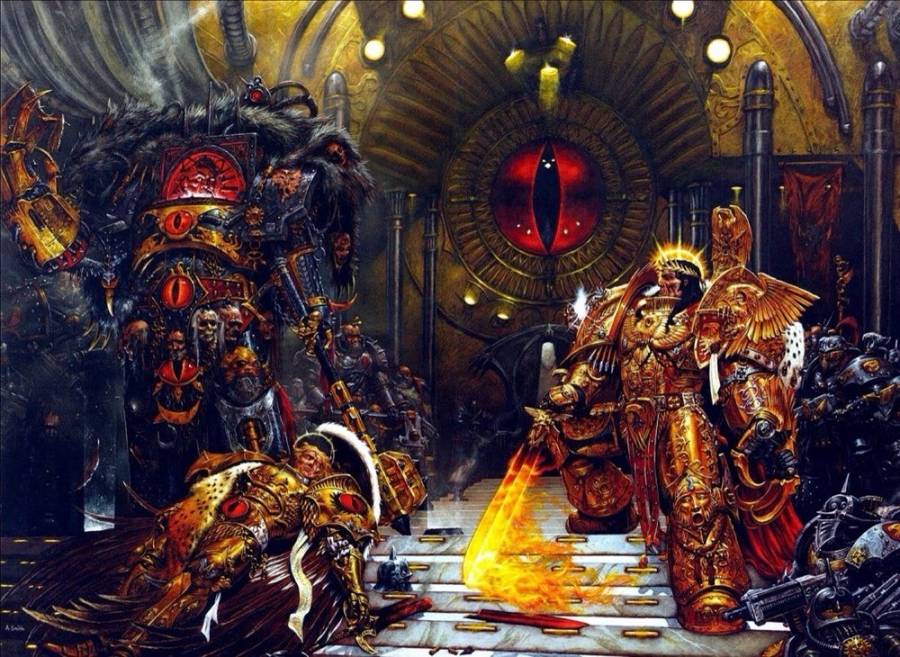

The Horus Heresy, also called the Heresy and, in poetic usage, the Age of Darkness, was a galaxy-wide civil war that split the Imperium of Mankind in the early 31st millennium. It began when the Warmaster Horus, first and most trusted of the primarchs, turned on the Emperor of Mankind under the influence of the powers of the Warp. Nine of the eighteen known Space Marine Legions followed him, together with a large part of the Mechanicum, two Titan Legions in every three that fought, and a great portion of the Imperial fleets and armies. The war lasted some nine standard years: two of open betrayal and manoeuvre, and seven of Horus's advance on Terra.[1][2]
The revolt opened with the Isstvan III atrocity in 005.M31, when Horus ordered the virus-bombing of an Imperial world and of the loyalist warriors in his own Legions who were fighting on it. It continued with the Drop Site Massacre of Isstvan V, in which three loyalist Legions were all but destroyed by their own supposed reserve, and spread to Mars, to Prospero, to the Realm of Ultramar and to the Signus Cluster. The fighting ended in 014.M31 at the Siege of Terra, where Horus was killed by the Emperor in single combat aboard the flagship Vengeful Spirit. The Emperor himself was mortally wounded and was interred on the Golden Throne, where he remains.[1][3]
The Heresy is the founding catastrophe of the present age. It destroyed the secular Imperium of the Great Crusade, left the loyalist Legions shattered, and produced both the Codex Astartes and the Imperial Cult in the form known today. Its traitors, the "Heretic Astartes", survive in the Eye of Terror and have never ceased to make war on the Imperium. Imperial scholars regard it as the single most studied, most censored and most disputed event in human history.[2]
Background
[edit]The Great Crusade and the primarchs
[edit]The Emperor launched the Great Crusade in about 798.M30, after the Unification Wars on Terra and the Treaty of Olympus with Mars. His principal instruments were twenty primarchs, genetically engineered sons of unmatched strength and intellect, each of whom had been scattered across the galaxy as an infant by the powers of the Warp. As the crusade rediscovered them, each took command of one of the Space Marine Legions, the armies of Astartes that had been raised from his genetic template. Two Legions, the Second and the Eleventh, are absent from Imperial records, and their names and primarchs are expunged under sealed edict.[4]
The war was fought as an expansion of the "Imperial Truth", a doctrine of rational secularism that denied the existence of gods and treated the Warp as a physical hazard. Primarchs governed what they conquered, built fleets and raised vast armies of auxiliaries, and often regarded one another as rivals. By the time the crusade reached its height, the Emperor had named his most gifted commander as its master, an elevation that set the stage for the Heresy.[5]
The Triumph at Ullanor and the Warmaster
[edit]The high point of the crusade was the destruction of the Ork empire at Ullanor, where a force of around a hundred thousand Astartes, millions of soldiers and hundreds of warships broke the greatest greenskin host the Imperium had ever met. After the victory the Emperor held a Triumph, named Horus his Warmaster, and gave him command over all the Legions and expeditionary fleets. The Emperor himself then returned to Terra, leaving the crusade in Horus's hands, and set about a private project beneath the Imperial Palace: the opening of the Webway to human use.[5][3]
Mankind's civil government was handed to the Council of Terra, a body of mortal officials under the regency of Malcador the Sigillite. Many primarchs read this as a slight. They had won the galaxy with the sword, and had been replaced as the Emperor's confidants by clerks and by a project they were forbidden to know. Horus's own resentment was real, though sources disagree on whether it was the cause of his fall or merely the means by which it was exploited.[5]
Religion, sorcery and the Council of Nicaea
[edit]Two other quarrels weakened the Emperor's household. The first concerned worship. Lorgar, primarch of the Word Bearers, had come to revere the Emperor as a god, and his Legion had built a temple-city, Monarchia, on the world of Khur on that conviction. The Emperor rebuked him and ordered the city razed, an act carried out by the Ultramarines. Lorgar, humiliated, turned to older and darker teachers and concluded that the gods the Emperor denied did in fact exist.[4] The second concerned psykers. At the Council of Nicaea the Emperor's court, led by Malcador the Sigillite and the delegate of the Mechanicum, ruled that the unsanctioned use of the Warp, sorcery in all but name, was to end. Magnus the Red and his Thousand Sons were singled out for rebuke, and Magnus's reliance on such arts brought him to the brink of open defiance.[4]
Origins
[edit]Davin
[edit]The turn of Horus himself is best documented at Davin. The Sixty-third Expedition, led by Horus, brought the desert world of Davin to compliance with the help of contingents of the Word Bearers, some sixty years before the Heresy. From the natives the Luna Wolves took the custom of the warrior lodge, a fraternity of warriors that the Legion kept secret from the Emperor and that the Word Bearers, led by Lorgar and the Chaplain Erebus, later used as a tool for corrupting Horus. The governor Horus had left behind, Eugen Temba, fell to the worship of Nurgle and raised a plague of undead on one of Davin's moons. When the Luna Wolves were recalled there, Horus was struck down by the poisoned Kinebrach anathame, a blade stolen from the Interex by Erebus and given to Temba. The wound was beyond the skill of the expedition's surgeons.[2][6]
Horus was carried to the Temple of the Serpent Lodge. There, while his Legion believed him to be dying, the powers of the Warp offered him a vision of the future: the Emperor enthroned as a god, the primarchs forgotten, the Imperium turned into a vast and ravenous bureaucracy. In return for his service Horus would be given the galaxy. He recovered, and was seen to have changed. Few at the time could say how. The testimony of the Remembrancers present is among the most important and most heavily redacted evidence on the subject.[6][2]
The first moves
[edit]Horus spent the next period preparing. He renamed his Luna Wolves the Sons of Horus, drew the Warrior Lodges into the Legions' officer corps, and began to recruit the other primarchs, one by one, by flattery, by appeals to grievance, and by the offer of a share in the new order. The first to join, according to Imperial records, were Fulgrim of the Emperor's Children, Angron of the World Eaters and Mortarion of the Death Guard. Others were won by the Word Bearers, by their own wrath, or, in the case of the Alpha Legion, by methods that no loyalist scribe has ever fully reconstructed.[1]
The first blow of the war, in the strictest sense, was struck by loyalists. After Nicaea the Emperor ordered the capture of Magnus the Red and his return to Terra for judgement. Horus, by means that the surviving sources do not agree on, persuaded Leman Russ and his Space Wolves to carry out the order as a punishment rather than an arrest. The Space Wolves burned Prospero, the Thousand Sons' homeworld and its capital, Tizca, and slew nine in ten of the Legion. Magnus, believing himself abandoned by the Emperor, swore himself to the Changer of Ways, and the survivors were swept into the Eye of Terror, from which they would later emerge as traitors.[4][1]
The opening of the war (005–006.M31)
[edit]
Isstvan III
[edit]The first open act of the Heresy was the destruction of Isstvan III. The planetary governor, Baron Vardus Praal, had risen in revolt against the Imperium, apparently under the influence of Slaanesh. Horus was sent to put the revolt down with four Legions: his own Sons of Horus, Fulgrim's Emperor's Children, Mortarion's Death Guard and Angron's World Eaters. The Warmaster used the expedition to rid his forces of every officer he suspected of loyalty to the Emperor. Those warriors were deployed to the surface in drop-pods, denied their gunships and cut off from fleet communications, and Horus ordered a bombardment of the planet with a virus weapon known as the Life-Eater. The virus killed the world's eight billion inhabitants and all of the loyalist Astartes who could not reach airtight shelter.[7]
A few hundred loyalists survived in the ruins of the capital, the Choral City, under captains such as Saul Tarvitz of the Emperor's Children, Garviel Loken and Tarik Torgaddon of the Sons of Horus and Ehrlen of the World Eaters. Together they fought the traitors for some two months across a world under firestorm and hurricane, and cost the Warmaster dearly. Meanwhile a handful of loyalists under the Death Guard Battle-Captain Nathaniel Garro seized the frigate Eisenstein and fled into the Warp to warn Terra, a voyage that cost most of the ship's crew and ended in the Emperor's hearing of Horus's treachery.[7][8]
Mars
[edit]While the Legions fought at Isstvan, the Mechanicum on Mars was torn in two. The Fabricator-General, Kelbor-Hal, declared for the Warmaster and unleashed a faction of hereteks, later called the Dark Mechanicum, against the loyalist tech-priests of the Mechanicum. The Schism of Mars lasted from 005 to 006.M31 and ended with the red planet held by the traitors and the loyalists withdrawing to Terra with such arms, armour and knowledge as they could carry. Several forge worlds followed Mars, and a number of Titan Legions with them. Four Titan Legions, including Legio Ignatum, Legio Astorum, Legio Defensor and Legio Solaria, remained at the Emperor's side.[2]
The Drop Site Massacre
[edit]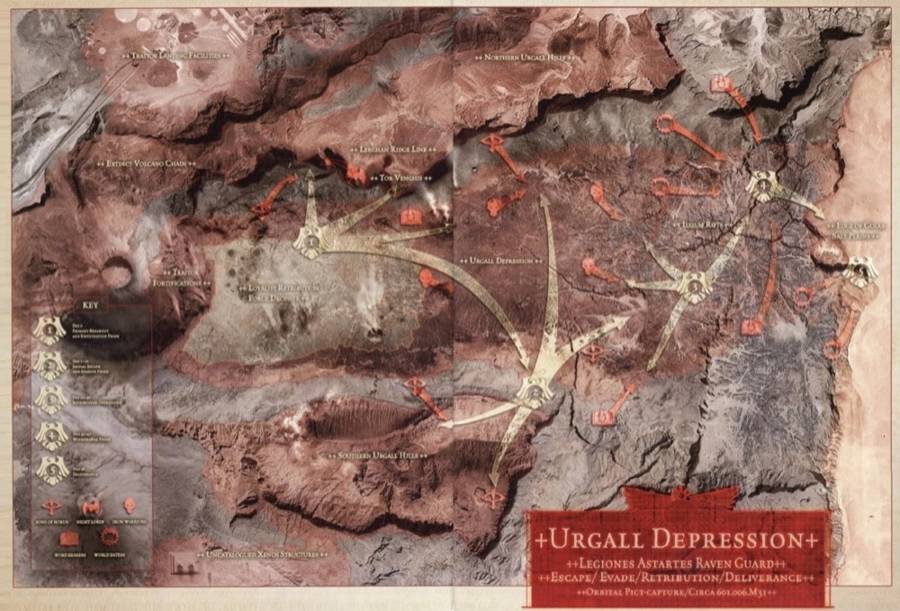
On receiving Garro's warning, the Emperor and his regent resolved to bring Horus to account. Rogal Dorn, the Praetorian of Terra, ordered seven Legions to the Isstvan system: the Iron Hands, Salamanders and Raven Guard as a first wave, and the Iron Warriors, Alpha Legion, Word Bearers and Night Lords in reserve. The first wave was led by Ferrus Manus, accompanied by Vulkan and Corvus Corax. What the Emperor and Dorn did not know was that all four reserve Legions had already pledged themselves to the Warmaster.[7]
The loyalists landed at a prepared drop site on the dead world of Isstvan V and advanced against the Warmaster's positions in the Urgall Depression. At the moment their lines were extended the reserve Legions turned their guns on them. Ferrus Manus was slain in single combat by his brother Fulgrim. Corax was gravely wounded and withdrew with a handful of his Raven Guard. Vulkan, struck by a tactical nuclear assault, vanished, and was presumed dead. Three Legions survived only as bands of several thousand each, the so-called "Shattered Legions", who escaped the system to wage a war of raids and sabotage. By the end of 006.M31 Horus commanded the strength of eight Legions in open revolt, and the Thousand Sons were soon to make nine.[7][2]
The war across the galaxy (006–013.M31)
[edit]Signus
[edit]While the traitors consolidated, Horus took steps to remove those loyalists he feared most. The Blood Angels and their primarch Sanguinius were sent, apparently on a routine order from the Warmaster, to purge the Signus Cluster of an alien infestation. The Legion fought a brutal campaign against xenos and against a daemonic force fed by Word Bearers cultists, with Space Wolves and Custodians in support. Signus was declared "forever dead" and quarantined, almost all of its human population was lost, and the Blood Angels' genetic flaw, the Black Rage, first appeared among its survivors. The campaign kept the Legion out of the war for years and made it a victim of Horus's strategy.[4][1]
The Shadow Crusade and Calth
[edit]The Word Bearers had a larger task. Lorgar's Legion, joined by Angron's World Eaters, entered the Realm of Ultramar, the stellar domain of Roboute Guilliman and the Ultramarines, and launched the campaign known as the Shadow Crusade in 007–008.M31. Twenty-six worlds were destroyed in rapid succession, and on Nuceria Angron's Legion exterminated the entire population. It was a brutal strategic victory for the traitors, whose purpose was to deny the Ultramarines, the largest Legion, to the defence of Terra.[1]
The decisive battle was fought on Calth in 007.M31. The Word Bearers, who had been invited to join an Ultramarines muster in the Veridian system, turned on their hosts at the signal of the Chaplain Erebus, and the Ultramarines were forced into a protracted underworld war beneath Calth's surface. The Word Bearers also raised a vast warp storm, the Ruinstorm, which cut the galaxy into isolated pockets and prevented loyalist fleets from reaching one another. Guilliman's Legion won on Calth but lost four-fifths of its fleet and years of time; the Veridian sun was poisoned and the surface of the world became uninhabitable.[1][2]
Phall and Davin
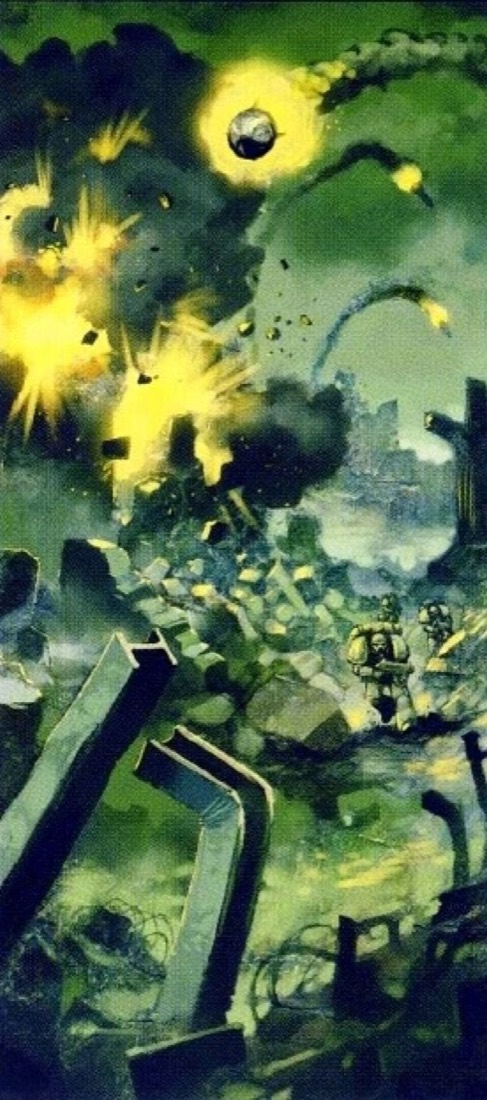
[edit]Rogal Dorn, anticipating the strength of the traitors, dispatched a Retribution Fleet of the Imperial Fists to reinforce the survivors on Isstvan III. In 007.M31 the Iron Warriors, under Perturabo, ambushed it in the Phall system with the whole of their war fleet. The Imperial Fists broke the ambush, destroyed several Iron Warriors capital ships and escaped to Terra to await the siege, a pyrrhic outcome for both sides.[2] Elsewhere the Night Lords under Konrad Curze raided the Eastern Fringe and the Dark Angels fought the traitors on the edges of the Ruinstorm.[4]
The world of Davin, where Horus had been healed, became a centre of the cults that followed the traitor Legions. In the late stages of the war, in about 011.M31, a fleet of the Ultramarines, Dark Angels and Blood Angels returned to Davin and destroyed the world by Exterminatus. The battle for Davin broke the cult's hold on the region, and the Ruinstorm began to wane. This was the first sign that the loyalists could reach Terra in time to defend it.[2][1]
Attempt on the Warmaster
[edit]The Emperor's regent attempted a final remedy. The Officio Assassinorum, under Malcador's orders, sent a force of four assassins, the Execution Force, to kill Horus himself. The mission was prepared in great secrecy, and included an experimental weapon, a Vortex device, and the services of a "pariah", a human whose soul does not cast a reflection in the Warp. The attempt reached the Warmaster, but failed, and its few survivors were destroyed. Imperial archives acknowledge only that an attempt was made.[1]
The march to Terra (013–014.M31)
[edit]Preparations
[edit]In the last year before the Siege the shape of the war became clear. Horus gathered the Sons of Horus, Death Guard, Emperor's Children, World Eaters and parts of the Word Bearers at Mars, where the Dark Mechanicum had been working to raise a vast host of war machines. The Thousand Sons, whose homeworld lay in ruins, were drawn into the Warmaster's plan and given a part in the assault. The rest of the Word Bearers, together with the Iron Warriors and the Night Lords, rejoined the fleet at the last moment. The Alpha Legion, true to form, had spent the war working in the shadows, harrying the Space Wolves and the White Scars and sowing confusion within Imperial command.[1]
On Terra, Rogal Dorn and Malcador recalled every loyalist force that could be reached. The Imperial Fists, Blood Angels and White Scars came home; the Space Wolves, Ultramarines and Dark Angels were delayed by the Ruinstorm and by traitor blockades, and reached Terra only in the last days of the Siege or just after it. The Palace was transformed into a fortress. Dorn raised walls, laid minefields and rearranged garrisons, and Constantin Valdor, Captain-General of the Adeptus Custodes, took charge of the Emperor's personal defence. The Sisters of Silence and units of the Mechanicum prepared the inner Palace.[2][3]
The blockade and Beta-Garmon
[edit]The decisive naval engagement before the Siege was fought at Beta-Garmon, a system on the approaches to Sol. Horus had foreseen the failing of the Ruinstorm and placed a blockade fleet across the loyalist route to Terra. The Ultramarines and Dark Angels, under Guilliman and the Lion, fought the blockade fleet to a standstill while Sanguinius and the entire Blood Angels Legion, guided by a vision he had had of the future, slipped past towards the Throneworld. They arrived in time to play a key role in the defence of the Palace.[2][4]
Siege of Terra
[edit]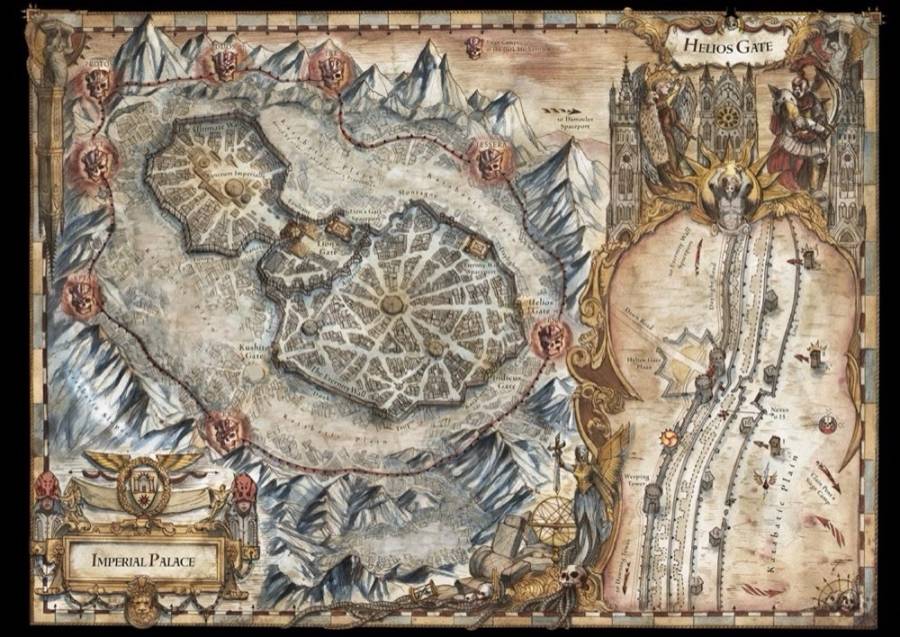
The Siege opened with the arrival of the traitor fleets in the Sol system. Terra's orbital defences, long neglected during the crusade, were destroyed in days. The traitor Legions landed outside the Palace and began a siege that lasted fifty-five days, during which they pressed the outer defences with massive ordnance, with Titans and with sorcery, while loyalist defenders under Dorn held the Eternity Wall and the Lion's Gate. The Imperial Fists, Blood Angels and White Scars defended the walls; the Custodians guarded the inner Palace; the Sisters of Silence and four Titan Legions stood with them. The attackers added to their own host the daemons that burst into the Palace through the broken wards of the Webway.[2][3]
The account accepted by the Logos Historica Verita since the opening of the Siege archives in the late 41st millennium runs as follows. As the traitors broke through the outer Palace, the Emperor rose from his work beneath it and led a strike force of his Praetorian Rogal Dorn, his Angel Sanguinius, his Captain-General Constantin Valdor and a picked company of Custodians and Astartes against the Vengeful Spirit, the Warmaster's flagship, where Horus waited. The Warmaster had by then drawn so deeply on the powers of the Warp that he stood at the threshold of a godhood of his own, and the boarding was in no small part his design. The strike force was scattered through the ship by the warp-sorcery that surrounded it. Sanguinius, already wounded in the defence of the Eternity Gate, reached Horus first. He refused the Warmaster's last offer, fought him and was killed. The Blood Angels on the Palace walls, feeling the death of their primarch, were seized by the rage that has since been known as the Black Rage.[9]
The Emperor then came to the Warmaster. Father and son fought in the material realm and in the Warp, and the Emperor was grievously wounded. In the presence of the Emperor's ancient companion, whom the Ecclesiarchy venerates as Saint Ollanius Pius and whom the sealed records of the Emperor's court name Ollanius Persson, the Emperor put aside the human compassion that had held his hand and struck Horus down, destroying his soul entire so that it could not be raised again by the Ruinous Powers. Persson, who stood between the Emperor and the Warmaster at the last, died in the act. The destruction of the Warmaster broke the daemonic hold upon the Sol system, and the traitor host, leaderless, fled.[9][3]
Earlier Imperial records, and the form of the story still told in most Imperial Cult liturgies, differ in a number of details. They hold that Horus himself lowered the shields of the Vengeful Spirit out of a last flicker of regret or as a challenge, that Sanguinius was strangled by the Warmaster, and that the warrior who held the line at the last was an unnamed soldier, a Custodian or an Imperial Fists Terminator, depending on the teller. The Imperial Fists have long maintained their own tradition. These versions are now treated as earlier or disputed recensions.[2]
Elsewhere in the Palace the siege went on to the end. Malcador the Sigillite took his seat on the Golden Throne in the Emperor's stead and held the Webway wards against the daemonic tide until his body burned away. A vanguard of Dark Angels under the Seneschal Corswain, sent ahead of Lion El'Jonson and arriving through the failing Ruinstorm in the closing days, held the Hollow Mountain against the Death Guard and its sorcerer Typhus, and the Space Wolves arrived in the same hours. Roboute Guilliman and the Ultramarines came last, as the traitors were already withdrawing. Dorn carried the broken Emperor from the Vengeful Spirit to the Throne, where Malcador's seat was taken.[9][3]
The Siege is described in full in the article Siege of Terra.
Aftermath
[edit]Great Scouring
[edit]With the death of the Warmaster the traitors lost their cohesion. The loyalist Legions that had been cut off by the Ruinstorm, among them the Ultramarines and Space Wolves, reached Terra in the following weeks and months and went on the offensive. The campaign, known as the Great Scouring, hunted the traitors to the edge of Imperial space and drove them into the Eye of Terror. The Ultramarines, who had suffered the least, bore much of the fighting. Roboute Guilliman oversaw the first drafts of the reforms that would follow.[10]
The Golden Throne and the new Imperium
[edit]The Emperor, his body shattered, was placed on the Golden Throne, a machine devised beneath the Palace for the Webway project and first occupied by Malcador. The Throne preserves him in a state between life and death, and sustains the Astronomican, the psychic beacon without which interstellar travel is impossible. He has not spoken since. The Council of Terra's successors, the High Lords of Terra, took over the government of the Imperium in his name, and the Administratum and the Adeptus Mechanicus were established on the foundations of the older orders.[3][11]
The Codex Astartes and the Second Founding
[edit]The Heresy taught the Imperium that no commander could be trusted with an army the size of a Legion. Guilliman wrote the Codex Astartes in the years that followed, and under it the Legions were broken up into Chapters of about a thousand warriors, each independent of the others. The Second Founding implemented the reform, over the objections of some of the surviving primarchs, and the old Legion structure survives only among the traitors. The Imperial armed forces were likewise divided into separate services so that no one hand could command them all.[11]
The Imperial Cult
[edit]The Imperial Truth died with the Heresy. The Emperor's divinity, denied in life, was proclaimed after his death by the Ecclesiarchy, and the Imperial Cult became the state religion in due course. The cult had existed in secret during the crusade as the Lectitio Divinitatus, and its adherents regarded the Emperor's survival on the Throne as proof of divine will. Imperial doctrine today holds that the Emperor is a god. Scholarship of the Administratum records the event more cautiously.[12]
Combatants
[edit]The following table lists the Legions as recorded in the archives of Terra. Two Legions, the Second and the Eleventh, are expunged.[4]
| No. | Legion | Primarch | Allegiance | Notes |
|---|---|---|---|---|
| I |  Dark Angels | Lion El'Jonson | Loyalist | Events on their homeworld are sealed by Inquisitorial edict; the Lion reached Terra in the last days |
| II | [data expunged] | [data expunged] | Unknown | Erased from the records |
| III |  Emperor's Children | Fulgrim | Traitor | Joined Horus at Isstvan III; killed Ferrus Manus at Isstvan V |
| IV |  Iron Warriors | Perturabo | Traitor | The reserve at Isstvan V; fought at Phall and the Siege |
| V |  White Scars | Jaghatai Khan | Loyalist | Recalled to Terra; defenders of the Palace |
| VI |  Space Wolves | Leman Russ | Loyalist | Burned Prospero; reached Terra late in the Siege |
| VII |  Imperial Fists | Rogal Dorn | Loyalist | Fortified the Palace; fought at Phall |
| VIII |  Night Lords | Konrad Curze | Traitor | Part of the Isstvan V reserve |
| IX |  Blood Angels | Sanguinius | Loyalist | Fought at Signus; reached Terra before the Siege; lost their primarch |
| X |  Iron Hands | Ferrus Manus | Loyalist | Shattered at Isstvan V; primarch killed |
| XI | [data expunged] | [data expunged] | Unknown | Erased from the records |
| XII |  World Eaters | Angron | Traitor | Fought at Isstvan III; atrocities in Ultramar |
| XIII |  Ultramarines | Roboute Guilliman | Loyalist | Fought the Word Bearers at Calth |
| XIV |  Death Guard | Mortarion | Traitor | Attacked Isstvan III; the loyalist warriors of the Legion fled in the Eisenstein |
| XV |  Thousand Sons | Magnus the Red | Traitor | Destroyed at Prospero; later joined Horus |
| XVI |  Sons of Horus | Horus | Traitor | Formerly the Luna Wolves; the Warmaster's own Legion |
| XVII |  Word Bearers | Lorgar | Traitor | Instigators of the Shadow Crusade; raised the Ruinstorm |
| XVIII |  Salamanders | Vulkan | Loyalist | Shattered at Isstvan V; primarch missing |
| XIX |  Raven Guard | Corvus Corax | Loyalist | Shattered at Isstvan V; primarch wounded |
| XX |  Alpha Legion | Alpharius Omegon | Traitor | A fifth column at Isstvan V; infiltrators throughout the war |
Of the Titan Legions, four stood with the Emperor and a larger number joined the Dark Mechanicum, among them Legio Mortis, Legio Fureans and Legio Tempestus. The loyal Legio Atarus fought and was nearly destroyed at Isstvan V.[2]
Casualties
[edit]The Administratum's reconciled figures count some 2.3 trillion dead among the combatants and civilian populations of the war, and twice that if the worlds purged in the Great Scouring are included. Entire Legions were reduced to a fraction of their strength. The Iron Hands, Salamanders and Raven Guard survived at the scale of a few thousand warriors, and the Thousand Sons lost nine of every ten. The Ultramarines lost more than a hundred thousand Astartes at Calth alone, and the Blood Angels more than ten thousand at Signus. In all, the war cost the Imperium the greater part of the Astartes generated during the Great Crusade.[1]
Legacy and historiography
[edit]In Imperial doctrine
[edit]Imperial teaching treats the Heresy as the archetype of betrayal. Its traitors, whose names are used as curses, are commemorated by the term Heretic Astartes, and the Imperium's attitude to its own Space Marines is shaped by distrust learned in the war. It is said that every new Chapter founded since the Second Founding is created with the Heresy in mind, and its doctrine of dividing authority reflects that.[11]
Disputed accounts
[edit]The documentary record is thin, because the Administratum, the Ecclesiarchy and the Inquisition have each suppressed parts of it. Large portions of the Terran archives are sealed, and surviving accounts differ in important details. Imperial accounts disagree over the order of events at Prospero, over the number of daemons present at Terra, over the role of the Emperor's Webway and over the Emperor's final words to Horus. The principal works, by the Remembrancers Sindermann and Oliton and by later historiarchs, were written under various pressures and are often contradictory.[2][13]
Remembrance
[edit]The Imperial Cult honours the Emperor's sacrifice on the Throne and the martyrdom of Sanguinius, Malcador and Ferrus Manus. The Space Marine Chapters keep their own commemorations. In the Ultramarines' realm the day of Calth is kept as a day of mourning, and the Raven Guard and the Salamanders keep the memory of Isstvan V. Horus himself is remembered as the Arch-Traitor, and his name is spoken only in condemnation.[12]
Timeline
[edit]| Date | Event |
|---|---|
| 000.M31 | Horus named Warmaster at the Triumph of Ullanor. |
| 001.M31 | The Council of Nikaea bans sorcery. |
| 004.M31 | Horus wounded and turned on Davin; the Burning of Prospero; the Webway War begins. |
| 005.M31 | The Isstvan III atrocity; the Schism of Mars begins. |
| c. 005–006.M31 | The Signus Campaign. |
| 006.M31 | The Drop Site Massacre; Ferrus Manus slain. |
| 007.M31 | The Battle of Calth and birth of the Ruinstorm; the Battle of Phall; the Shadow Crusade begins. |
| 007–009.M31 | The Thramas Crusade. |
| 008.M31 | Battle of Nuceria; Angron ascends. |
| 009.M31 | The Battle of Molech; the Imperium Secundus proclaimed. |
| 010.M31 | Battle of Pluto; Alpharius slain. |
| 010–012.M31 | The Battle of Tallarn. |
| c. 011.M31 | Second Battle of Davin; the Ruinstorm fails; the Imperium Secundus dissolved. |
| 010–013.M31 | The Grand Imperial Muster and the Battle of Beta-Garmon (the Titandeath). |
| 013.M31 | The Solar War. |
| 014.M31 | The Siege of Terra; Sanguinius and Horus slain; the Emperor placed on the Golden Throne. |
| 014–c. 021.M31 | The Great Scouring. |
| 021.M31 | The Codex Astartes and the Second Founding. |
See also
[edit]
Notes
[edit]- ^ Imperial dating of the war is approximate. Records on Terra, Mars and Macragge use different reckonings, and warp storms scrambled the logs of many fleets. The years given here follow the Administratum's reconciled chronology.
- ^ The traitor Titan Legions were led by Legio Mortis.
- ^ Nine Legions. Estimated from the Legions' nominal strength of about one hundred thousand Astartes each; Imperial records give no exact figure.
- ^ Four loyal Titan Legions fought on Terra.
- ^ Estimated; Imperial records give no figure.
- ^ Nine Traitor Legions. Estimated from the Legions' nominal strength of about one hundred thousand Astartes each; Imperial records give no exact figure.
- ^ Engines and Titans. Estimated; Imperial records give no figure.
- ^ Estimated; Imperial records give no figure.
- ^ Sanguinius and Ferrus Manus.
- ^ Reduced to the "Shattered Legions".
- ^ Estimated; Imperial records give no figure.
- ^ Horus and Alpharius.
- ^ Double if the worlds purged after the Great Scouring are counted. Prospero, Calth and Isstvan III were destroyed.
References
[edit]- ^ a b c d e f g h i j k l m Haley, Guy. Dark Imperium (Second Edition) (novel). Black Library, Ch. 1. Wraight, Chris. Rebirth (novella). Black Library.
- ^ a b c d e f g h i j k l m n o Wraight, Chris. Brotherhood of the Storm (novel). Black Library. Abnett, Dan. Horus Rising (novel). Black Library.
- ^ a b c d e f g McNeil, Graham. The Wolf of Ash and Fire (novella). Black Library. Kyme, Nick. Promethean Sun (novella). Black Library.
- ^ a b c d e f g h Kyme, Nick. Feat of Iron (novella). Black Library. McNeill, Graham. False Gods (novel). Black Library.
- ^ a b c Counter, Ben. Galaxy In Flames (novel). Black Library. Swallow, James. Flight of the Eisenstein (novel). Black Library.
- ^ a b McNeill, Graham. Fulgrim (novel). Black Library. McNeill, Graham. The Reflection Crack'd (novella). Black Library.
- ^ a b c d Scanlon, Mitchel. Descent of Angels (novel). Black Library. Abnett, Dan. Legion (novel). Black Library.
- ^ Counter, Ben. Battle For the Abyss (novel). Black Library. McNeill, Graham. Mechanicum (novel). Black Library.
- ^ a b c Lee, Mike. Fallen Angels (novel). Black Library. McNeill, Graham. A Thousand Sons (novel). Black Library.
- ^ Swallow, James. Nemesis (novel). Black Library. Dembski-Bowden, Aaron. The First Heretic (novel). Black Library.
- ^ a b c Abnett, Dan. Prospero Burns (novel). Black Library. Sanders, Rob. The Iron Within (novella). Black Library.
- ^ a b French, John. The Last Remembrancer (novella). Black Library. Thorpe, Gav. The Face of Treachery (novella). Black Library.
- ^ Swallow, James. Liar's Due (novella). Black Library. Abnett, Dan. Little Horus (novella). Black Library.
Further reading
[edit]- Chronicles of the Heresy (sealed). Logos Historica Verita. The principal Terran history of the war.
- Sindermann, Kyril (c. 004.M31). Remembrances of the 63rd Expedition. An eyewitness view of Horus's expedition before the fall.
- Guilliman, Roboute (c. 021.M31). Codex Astartes. The reforms that grew from the war.
- Liber Primarchus (M32, revised M41). The primarchs and their Legions.