
Codex Astartes
| Codex Astartes | |
|---|---|
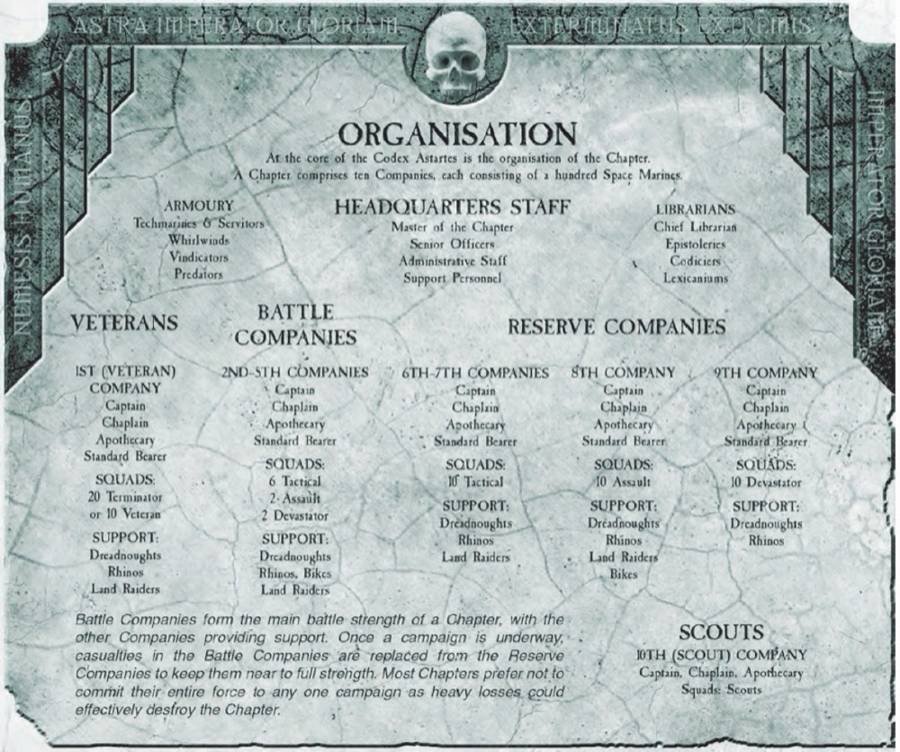 Plate of Chapter organisation from the Codex Astartes, in the edition current before the Ultima Founding Artwork © Games Workshop | |
| Author | Roboute Guilliman, primarch of the Ultramarines |
| Written | c. 014–021.M31[a] |
| Place | Terra and Macragge |
| Subject | Organisation, recruitment, doctrine, conduct and heraldry of the Adeptus Astartes |
| Result | The Second Founding |
| Status | In force; revised in the Era Indomitus |
The Codex Astartes is the great treatise on the organisation, strategy and conduct of the Adeptus Astartes, written by the primarch Roboute Guilliman of the Ultramarines in the first decades after the Horus Heresy.[1] It is the foundational text of the Space Marines. Its purpose was to restructure the Imperium's most powerful warriors so that a civil war of the Heresy's kind could not happen again.
The Codex is best known for its most contentious decree, that the Space Marine Legions be divided into Chapters of a thousand battle-brothers. This was carried out in the Second Founding. Beyond it, the Codex sets out the internal structure of a Chapter, the manner of recruiting and training its members, the tactical doctrines it should follow, the colours and badges by which its warriors are known, and the principles by which a Chapter relates to the Imperium.[1]
Few complete copies of the original text exist. Most of it, however, survives in the training of the Space Marines themselves, and a Chapter that follows its precepts is called Codex-compliant. Several of the most famous Chapters, including the Space Wolves, Blood Angels, Dark Angels and Black Templars, follow its spirit but diverge from its letter.[2]
History
[edit]Origins
[edit]The ultimate source of the Codex lies in the war on Calth. When the Word Bearers attacked the Ultramarines in 007.M31, the fighting devolved into a long struggle in the tunnels and holds of the poisoned world, in which small, mobile units of Ultramarines hunted down the Traitors. A veteran sergeant, Aeonid Thiel, formed one such task force, the Red Marked. When Thiel reported to Guilliman on Macragge after the battle, in about 007–008.M31,[b] the primarch is said to have destroyed the notes on which his old doctrine of the Legion as a horde under a warlord had been written, and to have resolved that the Ultramarines would henceforth be "hundreds of thousands of individual Legionaries each in support of the other".[1]
Composition
[edit]After the Heresy, Guilliman was named Lord Commander of the Imperium and Imperial Regent, and carried out the reorganisation of the armed forces. The Codex Astartes was the principal product, and was written in the years between about 014 and 021.M31, the year that saw the division of the Legions.[a][1] It was Guilliman's response to the Heresy as a whole: a detailed attempt to remove its causes. Chief among these was the concentration of power in the hands of a primarch, but a second concern was the quality of the Space Marines themselves.
The haste of the Great Crusade had caused some Legions to accept recruits and gene-seed of poor quality, and the Heresy exposed latent weaknesses. The Codex therefore ordered that Space Marines be created and trained slowly. Cultured organs were to be tested to the strictest standards, young initiates were to undergo trials to prove their suitability, and only those of the sternest character were to be chosen.[1]
Contents
[edit]Organisation of a Chapter
[edit]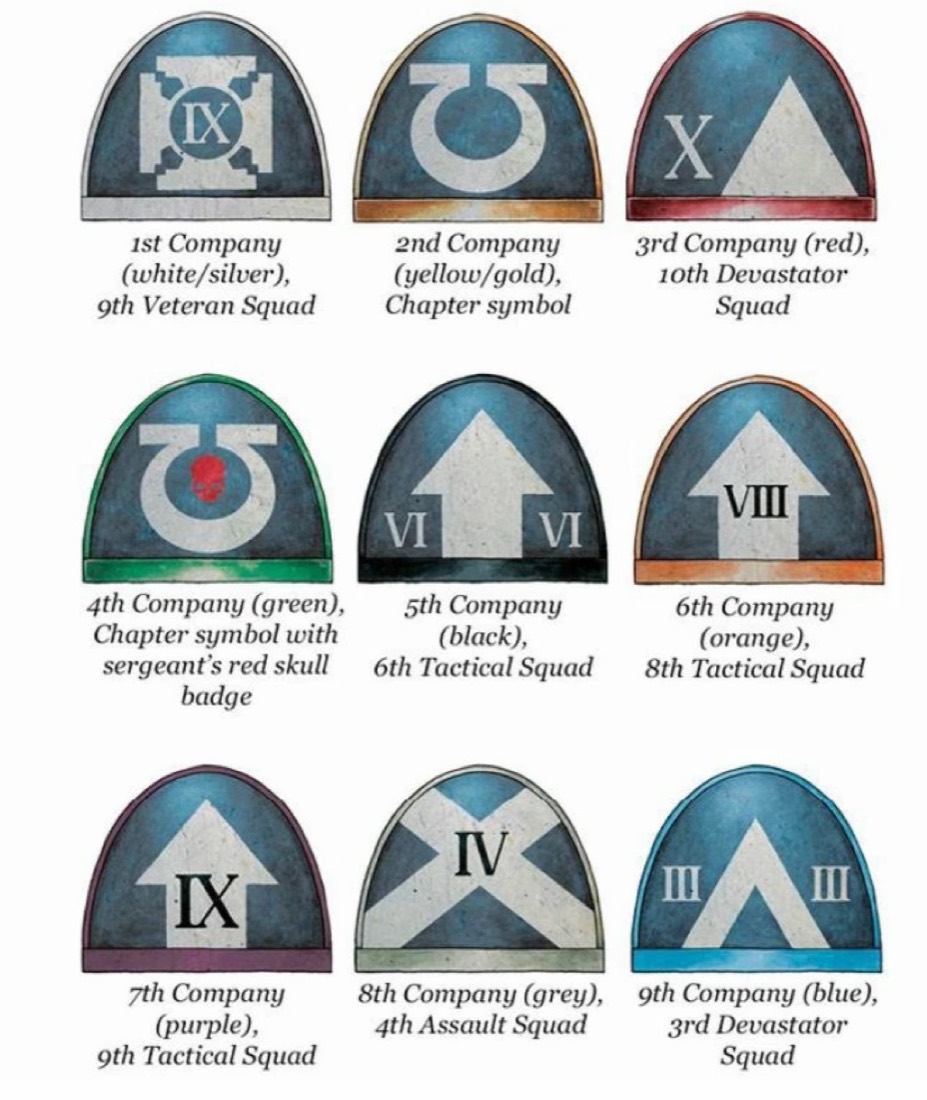
The Codex requires a Chapter to consist of ten companies, each of a hundred battle-brothers, together with a headquarters, an armoury, and the specialist officers of the Librarius, the Apothecarion and the Reclusiam. The pattern is as follows.[1]
| Formation | Composition | Role |
|---|---|---|
| Headquarters | Chapter Master and his staff, Chief Librarian, Master of the Forge, other senior officers | Command and administration |
| 1st Company | Veterans, many in Terminator armour; led by a Captain with Chaplain, Apothecary and Standard Bearer | Elite; first into the heaviest fighting |
| 2nd to 5th Companies | Battle Companies: six Tactical squads, two Assault squads and two Devastator squads each, with vehicles and Dreadnoughts | The Chapter's main battle strength |
| 6th and 7th Companies | Tactical squads, with support | Reserve, replacing losses in the Battle Companies |
| 8th Company | Assault squads | Reserve; close assault |
| 9th Company | Devastator squads | Reserve; heavy fire support |
| 10th Company | Scouts: neophytes in training | Reconnaissance and the Chapter's recruit stock |
The Codex expects most Chapters to avoid committing the whole force to a single war, since heavy losses could destroy the Chapter. Casualties in the Battle Companies are to be replaced from the Reserve, and those in the Reserve by promotion from the Scouts.[1]
Doctrine
[edit]Tactical doctrine is built around the Tactical squad of ten battle-brothers, which is meant to be able to fight almost any foe. Specialised squads, such as Assault, Devastator and Scout squads, provide heavier firepower or manoeuvre, and the Dreadnoughts, vehicles and Terminators of the Chapter provide support. The Codex advocates speed, flexibility, the combination of arms and the strike at the weakest point of an enemy line. It teaches that a campaign should rarely be risked on a single battle.[1]
Command and authority
[edit]Each Chapter is commanded by a Chapter Master. He answers directly to the Emperor, acting through the High Lords of Terra, and to no other, not even the primarch of his Legion (except in the single Chapter that keeps the Legion's name). The High Lords alone may order the creation of a Chapter, and every Chapter must tithe five per cent of its gene-seed to the Adeptus Terra and the Mechanicum so that the Imperium may monitor and, if necessary, replace it.[1] The Codex also makes provision for every Chapter to keep its own fleet, and some Chapters are based wholly in their ships rather than in a fortress-monastery.
Heraldry
[edit]The Codex also prescribes the markings by which a Chapter's warriors are known. The company is identified by a colour on the pauldron trim, and the squad by a badge in a standard pattern, with the Chapter symbol on the left shoulder. Campaign honours, the Chapter's role in a war, and its vehicle numbers are recorded in the same system.[1] Chapters that follow the Codex closely, such as the Ultramarines, use these markings almost to the letter; others, such as the Space Wolves, ignore them.
Reception
[edit]The Codex was resisted from the start. Many of the primarchs railed against the decree that broke up their Legions. Lord Commander Guilliman nevertheless enforced it, and almost all of the surviving primarchs came to accept the need for it.[1] Through the Age of the Imperium it became the standard of Space Marine conduct. A Chapter is judged by how closely it keeps to it, and even those that depart are expected to explain why.
Some Chapters hold it as sacred, others as an ideal to be adapted. The Space Wolves, whose primarch Leman Russ is said to have disliked it, follow their own customs. The Blood Angels and their successors, bearing the Legion's gene-seed flaws, deviate from its pattern in several ways. The Black Templars have been recorded keeping a very different structure, with a Chapter far larger than the thousand-warrior limit.[2]
Revisions
[edit]The Codex has not been unchanged. The surviving editions differ, and the Apocrypha of Skaros, one of the earliest, is held to preserve an older form. Guilliman himself, restored to the Imperium in 999.M41, has overseen a revision of the text in the early Era Indomitus.[3] The revised Codex accounts for the Primaris Space Marines of the Ultima Founding created by the Archmagos Belisarius Cawl. It adds Primaris squads, such as the Intercessor, Hellblaster and Aggressor squads, to the structure of a company, and permits a Chapter to be reinforced by Primaris warriors in numbers beyond the old limit of one thousand.[4] Many Chapters have organised new Battle Companies in this pattern, and the Ultramarines have adopted it more thoroughly than any other.
The older chart of the Codex, still taught in the Chapters' libraries, is accordingly treated as a historical standard, no longer the sole pattern. Guilliman has said that the principle, not the numbers, is what matters, and that the Imperium's present need justifies departures that the Codex of the 31st millennium would have forbidden.[3]
Timeline
[edit]| Date | Event |
|---|---|
| 007.M31 | Battle of Calth; the Underworld War teaches the Ultramarines small-unit warfare. Aeonid Thiel forms the Red Marked. |
| c. 007–008.M31 | Thiel reports to Roboute Guilliman on Macragge; Guilliman destroys his old doctrine.[c] |
| 014.M31 | The Siege of Terra ends; Guilliman named Lord Commander and Regent and begins the text. |
| c. 014–021.M31 | The Codex is written in the years after the Siege of Terra and the Great Scouring. |
| c. 021.M31 | The Second Founding divides the Legions into Chapters of a thousand. |
| 121.M31 | Guilliman wounded at Thessala and placed in stasis. |
| M31–M41 | Editions diverge; the Apocrypha of Skaros preserves an early form. |
| 999.M41 | Guilliman returns; the Ultima Founding of the Primaris Space Marines. |
| Early M42 | The revised Codex adds Primaris formations. |
See also
[edit]


Notes
[edit]- ^ a b The records do not date the writing exactly. It is placed after the end of the Siege of Terra in 014.M31 and before the Second Founding, which put it into effect in about 021.M31.
- ^ Date estimated from the sequence of events.
- ^ Date estimated from the sequence of events.
References
[edit]- ^ a b c d e f g h i j k Codex: Space Marines (9th edition). Games Workshop. pp. 7-41. Dembski-Bowden, Aaron. Armageddon (novel). Black Library. p. 464.
- ^ a b Codex Adeptus Astartes - Space Marines (8th Edition), pp. 8-10, 14, 73, 84, 93, 100. Games Workshop. Codex: Space Marines (8th Edition) (Revised Codex), pp. 6-21, 184-185. Games Workshop.
- ^ a b Codex: Space Marines (8th edition, revised Codex). Games Workshop. pp. 6-21, 184-185.
- ^ Codex: Space Marines (6th Edition), pp. 8-15, 246. Games Workshop. Warhammer 40,000: Rulebook (6th Edition), pp. 168, 187, 225, 389, 403. Games Workshop.