
Chaos
| Chaos The Ruinous Powers | |
|---|---|
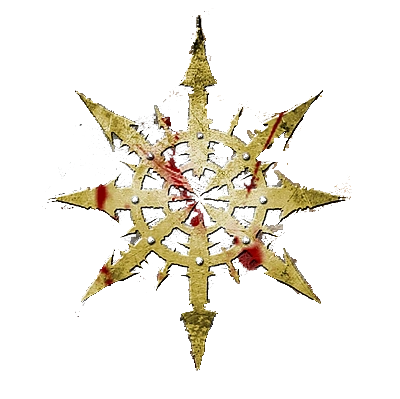 The eight-pointed Star of Chaos, the mark of Chaos Undivided Artwork © Games Workshop | |
| Nature | Sentient powers of the Warp, born of mortal thought and emotion |
| Also called | The Ruinous Powers, the Dark Gods, the Primordial Truth, the Great Enemy |
| Principal Powers | Khorne, Nurgle, Tzeentch, Slaanesh |
| Servants | Daemons, Heretic Astartes, cultists, mutants, renegade Titan Legions, corrupted Mechanicum and Guard |
| Realm | The Realm of Chaos, the deep Warp |
| Foothold in realspace | The Eye of Terror; the Cicatrix Maledictum since 999.M41 |
| Imperial status | Heresy to speak of; the declared enemy of every Imperial institution |
| Opposed by | |
| Inquisition (Ordo Malleus), Grey Knights, Adeptus Astartes, Imperial Cult, the Emperor of Mankind | |
Chaos, formally the Ruinous Powers and in lesser usage the Chaos Gods, the Dark Gods or the Great Enemy, is the name the Imperium of Mankind gives to the collective of sentient forces that inhabit the Warp and feed upon the passions of living minds. Four of these forces are known to Imperial scholars by name and are worshipped by mortals under many titles: Khorne, Nurgle, Tzeentch and Slaanesh. The word is also used of everything they touch: the daemons they spawn, the warriors who serve them, the mutations and storms that accompany them, and the ruin brought to any world that comes under their influence.[1]
Imperial doctrine treats Chaos as the oldest and gravest threat to mankind. It is older than the Imperium, older than the human species, and, in the view of the Inquisition, older than the Emperor's own labours. It is not an army that can be destroyed by a single victory, nor a territory that can be taken, for its strength is drawn from the minds of the living and rises with every war, plague, hope, vice and ambition across the galaxy. The loss of the Horus Heresy to its influence, the long war of the Black Crusades and the opening of the Cicatrix Maledictum in 999.M41 are the three events most often cited by scholars as proof of its patience and reach.[2]
The Ruinous Powers are served by those who choose them and by those who never knew they had a choice. A pit-worker who prays to a god of violence, a scholar who barters a forbidden name for a single answer, a noble who sinks into excess: each makes an offering, and each offering is a thread by which the Powers may pull. Most such servants are discovered and destroyed by the Inquisition, the Adeptus Arbites or their neighbours. A few rise to command warbands, cults and even fleets. At the summit of this ladder stand the Heretic Astartes, the Traitor Legions who followed Horus and who now dwell in the Eye of Terror.[3]
Nature and terminology
[edit]The Powers and the Warp
[edit]The Ruinous Powers are not gods in the manner the Imperial Cult means when it speaks of the Emperor. They have no mortal birth, and Imperial theology denies them the title of creator. Instead they are described by the Ordo Malleus as emergent intelligences: structures of thought and emotion that took on will and appetite in the Warp, the dimension that lies beneath ordinary space and mirrors the feelings of every living creature. The Mechanicus uses the stricter phrase aetheric predators. The Cult has no official term, and its priests refer to them in sermon only as "the Enemy".[1]
What distinguishes the four Powers from the countless lesser entities of the Warp is the scale of their feeding. Every war, every act of murder, every plague, every scheme and every indulgence in the material universe leaves an echo in the Warp, and each of the Powers takes the echoes proper to its nature. Khorne feeds on rage and the bloodshed it produces. Nurgle feeds on despair, decay and the tenacity of those who persist in the face of both. Tzeentch feeds on ambition, hope, change and the working of plots. Slaanesh feeds on lust, pride, craving and every sensation pursued to excess. The harvest is vast, because mankind has more wars, plagues, schemes and appetites than any species in the galaxy, and the Powers have grown fat on it.[2]
Because the Powers are born of mortal feeling, scholars have long debated whether mankind and the other species of the galaxy bear responsibility for their existence. Most Inquisitors regard the question as idle. The Ordo Malleus holds that the Powers cannot be understood or reasoned with, only resisted, and that any attempt to bargain with them is a trap the Powers themselves set. Chaos is not in itself evil, and some of its devotees serve freedom and change, though the Inquisition holds that to dwell long on the Powers is to learn their way of thinking.[4]
Names and symbols
[edit]The Powers have many names, and the multiplicity is itself a mark of their power. Khorne is the Blood God, the Skull Lord, the Lord of Battle. Nurgle is Grandfather Nurgle, the Plague God, the Lord of Decay. Tzeentch is the Changer of Ways, the Architect of Fate, the Great Conspirator. Slaanesh is the Dark Prince, the Prince of Pleasure, the Lord of Excess. Cultists often use the names as titles, and those of the Powers' mortal champions are frequently chosen to echo them.[2]
Each Power has a mark. Khorne's is a brass-bound cross of skulls, red and brass, set with a horned daemon's face. Nurgle's is three circles joined by points, green and sickly. Tzeentch's is a crescent flaring from a many-eyed disc, in shifting colours. Slaanesh's is a sphere or orb crossed by a crescent, purple and silver. These marks are cut into armour, tattooed on cultists' flesh and burned into the walls of the shrines they raise. Warriors and cults that serve all four, or none in particular, wear the eight-pointed star shown at the head of this article, called the Star of Chaos or the Mark of Chaos Undivided.[1]
The eight aspects
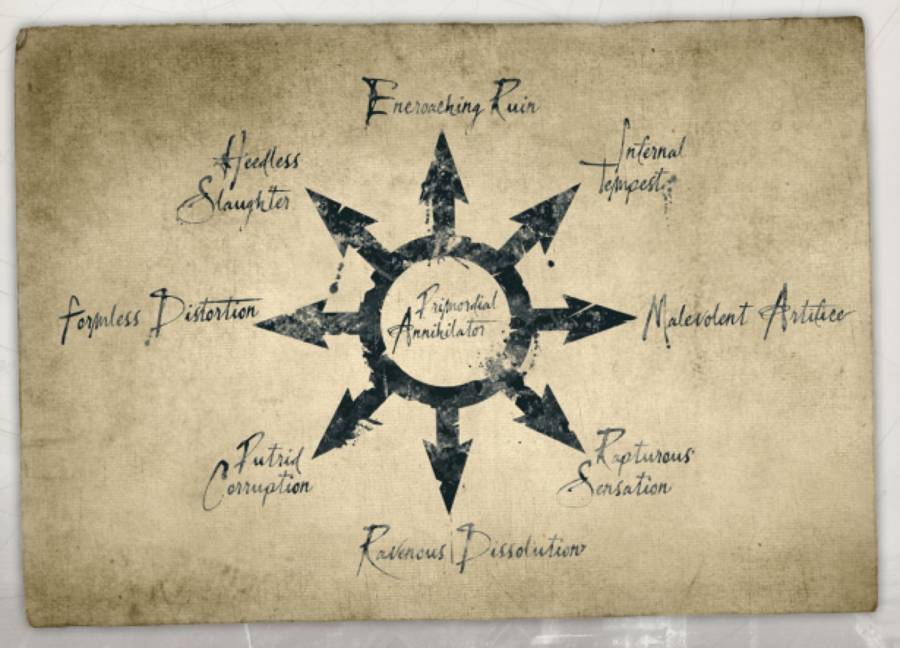
[edit]The eight arrows of the star are held in Inquisitorial lore to correspond to eight primal dispositions of the Warp, called in older Mechanicus tracts the Eight Winds or the Dominions. Four of them are generally identified with the four known Powers: Heedless Slaughter with Khorne, Putrid Corruption with Nurgle, Infernal Tempest with Tzeentch and Rapturous Sensation with Slaanesh. Encroaching Ruin, the pure and undivided form of Chaos, belongs to Chaos Undivided, Ravenous Dissolution to the minor power Malice, and Malevolent Artifice to the greater daemon Vashtorr the Arkifane. The last, Formless Distortion, is the shifting essence of Chaos that no single Power embodies. At the centre of the diagram stands the name Primordial Annihilator, which the servants of Chaos also use as a name for the whole. Scholars disagree on whether the lesser dispositions belong to Powers in their own right or are only philosophical categories. The cult of Malal, which worships a fifth power as the god of rebellion and anarchy, is regarded by the Ordo Malleus as a lesser and unstable offshoot of the Chaos Undivided.[1]
History
[edit]Before the Imperium
[edit]The Imperium has no complete history of Chaos, and what it has is built from the fragments of other species. The Aeldari hold that their own long age of indulgence gave birth to the youngest of the four Powers, Slaanesh, at the end of their empire in the closing centuries of the Age of Strife (see Eye of Terror and the section on the Fall). Before that they say there were three Powers, and an older Warp, with its own gods. The Necrons, whose records go back much further, are said to preserve a memory of the War in Heaven, in which they and the C'tan fought the Old Ones, who raised the first psychic species to oppose them. Fragmentary Mechanicus records from the Age of Strife mention that human psykers were attacked by creatures of the Warp long before the Emperor founded the Imperium.[2]
The human record is poorer still. In the last centuries before the Great Crusade, the Warp-storms of the Age of Strife isolated the worlds of Terra's region and filled them with possession, sorcery and cults. The Emperor ended much of this by force and silence, and the Council that governed in his name suppressed what remained. The only civilisation of the age to leave a complete study of the Powers was the Mechanicum of Mars, whose archives were later folded into the sealed vaults of the Ordo Malleus.[1]
The Great Crusade and the Imperial Truth
[edit]The Emperor launched the Great Crusade in about 798.M30 on the principle of the Imperial Truth, a doctrine that denied the existence of gods and treated the Warp as a physical hazard to be navigated, not a realm of spirits. The doctrine was not simple ignorance. The Emperor and his closest counsellors knew what the Warp contained; the Truth was a policy of denial, adopted so that mankind should not give the Powers the worship they needed. Crusade fleets burned shrines, outlawed rites and punished those who spoke of gods. Lorgar, the primarch of the XVII Legion, was publicly rebuked for erecting a religious cult in the Emperor's honour, an event that Imperial scholars regard as one of the first decisive steps toward the Heresy.[5]
Chaos stirred through the whole of the Crusade. Warp-storms scattered fleets, whole expeditions went missing, and individual commanders reported dreams and voices. Magnus the Red, the most gifted psyker among the primarchs, spent decades studying the Warp and eventually bargained with its powers, for reasons he believed were good. The Emperor's attempt to constrain these studies and the Council of Nikaea's decision to forbid unsanctioned sorcery were responses to the pressure the Powers were already applying.[6]
The Horus Heresy
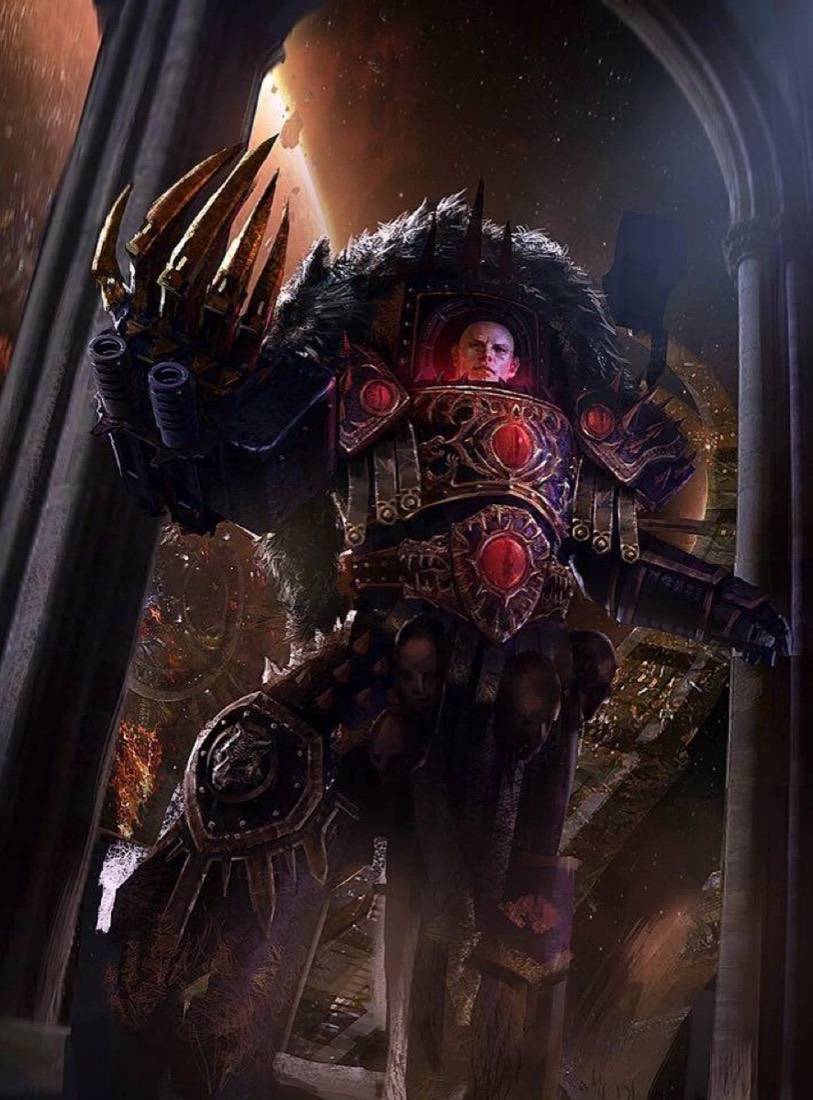
[edit]The decisive moment in the history of Chaos and the Imperium was the Horus Heresy, which began in 005.M31 when the Warmaster Horus turned against the Emperor. The surviving evidence, most of it sealed, shows that the Powers had worked patiently to bring this about. The Word Bearers, taught by Lorgar to seek a god worthy of worship, found in the Warp a pantheon that offered them one. Erebus of that Legion, working as an agent of the Powers, brought Horus to a shrine on Davin, where the Warmaster was wounded by a cursed blade and carried to a place from which his corruption began. Over the following years the Powers drew nine Legions into rebellion: the Sons of Horus, the World Eaters, the Emperor's Children, the Death Guard, the Thousand Sons, the Word Bearers, the Alpha Legion, the Night Lords and the Iron Warriors.[3]
The Powers' influence did not end with their human servants. The Traitor primarchs themselves were remade by their patrons, becoming in time Daemon Primarchs bound to individual Powers: Angron to Khorne, Mortarion to Nurgle, Magnus the Red to Tzeentch and Fulgrim to Slaanesh. The Alpha Legion, the Night Lords and the Iron Warriors stand in a less clear relationship. The Alpha Legion maintains its own aims, the Night Lords serve all Powers or none, and the Iron Warriors serve the Powers as a matter of convenience.[6]
The war was ended at the Siege of Terra in 014.M31, when the Emperor slew Horus aboard the flagship Vengeful Spirit and was himself mortally wounded. The Powers did not retreat in defeat. They consolidated. Horus's body and soul had been the key to their next assault, and while he fell, they preserved the greater part of his work. The traitors who survived retreated to the Eye of Terror, where they began the long war that continues to this day.[7]
The long war
[edit]The ten thousand years after the Heresy are called by Imperial historians the long war, a period of continuous raiding, infiltration and invasion in which the Traitor Legions struck out from the Eye of Terror against the Imperium. The most formal expressions of this war are the Black Crusades, the major assaults led by the Despoiler Ezekyle Abaddon, of which the Imperium counts thirteen. They are not the only form the long war has taken. Cults arise in every sector, nobles are corrupted by courtly intrigue, and renegade space hulks emerge from the Warp to disgorge armies on defenceless worlds.[2]
The Great Rift
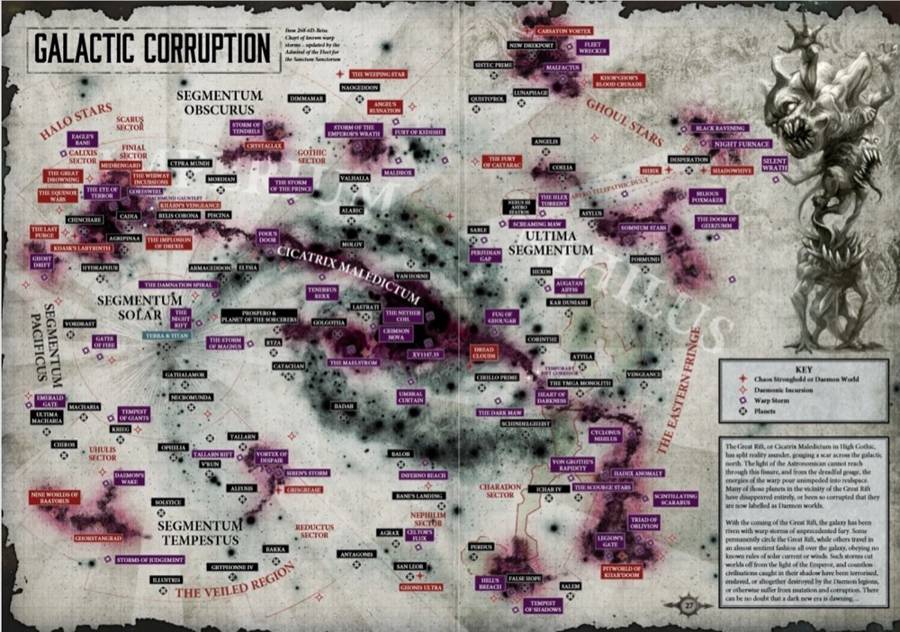
[edit]The last of the Black Crusades, the thirteenth, ended with the Fall of Cadia in 999.M41. The destruction of Cadia, and of the Necron-built pylons that had held the Warp rift of the Eye in check, was followed by the opening of the Cicatrix Maledictum, also called the Great Rift: a vast wound in the fabric of reality that runs across the galactic plane and floods the Imperium with the energies of the Warp. The Astronomican, the psychic beacon by which the Imperium navigates, was obscured across half the galaxy. The far side of the Rift, the Imperium Nihilus, was cut off from Terra, and the near side became the Imperium Sanctus. Warp storms, daemon incursions and worlds consumed or transformed by Chaos have followed ever since. Since the Rift opened the daemonic incursions have grown in scale and frequency, though the Powers, true to their natures, pursue their own ends and so cannot fully overcome the resistance of the galaxy's peoples. The return of Roboute Guilliman has galvanised the Imperium.[8]
Worship and servants
[edit]Cults and the corrupted
[edit]Chaos is worshipped by more mortals than the Imperium is willing to admit. The Ordo Malleus distinguishes between the deliberate servant, who knows what he does and has sworn himself to the Powers, and the corrupted, who has been drawn into their orbit by despair, ambition or fear. The first is usually found in secret cults. Such cults have been discovered in every part of the Imperium: among the nobility of hive cities, in the guilds of the Adeptus Mechanicus, in the ranks of the Astra Militarum, within the Adeptus Arbites and even within the cathedrals of the Ecclesiarchy. A typical cult begins as a small group that shares a grievance, adopts the rites of a Power and swells as it recruits; by the time of its discovery it may have infiltrated the civil government of a whole world.[1]
The Heretic Astartes
[edit]The principal armies of Chaos are the nine Traitor Legions and their descendants, the Heretic Astartes, formerly the Space Marines of the Great Crusade. Their war-bands, known in the Imperium as Chaos Space Marines, operate from the Eye of Terror and from daemon worlds on its fringes. The Legions have fragmented over ten thousand years into a mass of bands, cults and fleets of varying loyalty, though the greatest of these, the Black Legion of Abaddon, claims to speak for all. Heretic Astartes take their gods in different measures: some are sworn to one Power, others bear the star of Chaos Undivided, and some serve nothing but their own ambition.[2]
Daemons
[edit]The daemons are the direct servants and fragments of the Powers. They are creatures of the Warp, sustained by its energies and bound to the nature of the Power that spawned them. They have no true bodies in the material universe, and when they manifest they do so by means of rites, possession or the weakening of the barrier between the realms. Each Power commands a host of its own: Khorne's Bloodletters and Bloodthirsters, Nurgle's Plaguebearers and Great Unclean Ones, Tzeentch's Pink Horrors and Lords of Change, and Slaanesh's Daemonettes and Keepers of Secrets. Daemons that manifest in the materium are driven back to the Warp when they are slain, and are said by Inquisitors to reform and return, sometimes with memories of the one who banished them.[1]
Beyond the great daemons lies a class of entities known as Daemon Princes, mortals who have ascended through service to a Power and been made immortal in the Warp's image. A Daemon Prince is usually a former sorcerer, champion or Traitor Astartes, and some, such as the Daemon Primarchs, are far greater in power than any normal prince. The Grey Knights, the secret chapter of the Ordo Malleus, were raised specifically to fight them.[2]
Relations between the Powers
[edit]The Powers are not allies. Each seeks to grow at the expense of the others, and many of the conflicts of the Warp are conflicts between them. Khorne despises Slaanesh above all the others, for the Prince of Pleasure's indulgence is an affront to the god of war, and he distrusts Tzeentch and the use of sorcery, though the two are not sworn enemies. Nurgle is the age-old enemy of Tzeentch, since the one draws strength from despair and defiance and the other from hope and changing fortune. Occasional alliances are recorded, but they are temporary and are broken by the first change in advantage.[1]
This rivalry is the Imperium's one strategic advantage. Warbands bound to opposed Powers will fight each other in the middle of a campaign, and a Daemon Prince of one Power has been known to destroy a worlds-long invasion launched by another. Inquisitors are warned, however, against relying on the enmities. The Powers also play a long game, and an invasion that is stopped by their rivalry may be a strike that has done its work.[4]
Chaos Undivided, the worship of all four Powers together or of the star as a whole, is a separate current. Its followers hold that the Powers are stronger in unison, and that the Great Enemy's war is best waged by those who do not choose among them. The Black Legion is the largest force of Chaos Undivided, and Abaddon himself preaches the unity of the Powers as the means to destroy the Imperium. The more devout followers of individual Powers regard this view with suspicion, and the rivalries between them have often broken Abaddon's armies.[2]
Corruption and its signs
[edit]The Inquisition teaches that Chaos is spread by exposure, and the stages of exposure are known. The first is temptation: an idea, a dream or a convenient coincidence that leads the victim toward the Power's domain. The second is bargain, in which the victim accepts a gift or makes a vow and with it a debt. The third is mutation, the visible change that follows a long association with the Warp, which takes forms proper to the Power: swollen flesh for Nurgle, extra limbs and warped skeletons for Tzeentch, heightened senses and grotesque grace for Slaanesh, and horns, hardened hides and a berserker's strength for Khorne. The last is transformation, in which the servant becomes a Chaos Spawn, a Daemon Prince or an empty vessel for a daemon.[1]
Defence against Chaos
[edit]The Imperium's defences against the Powers are of three kinds. The first is vigilance: the screening of psykers at the Black Ships, the surveillance of cults by the Inquisition and the Arbites, and the daily oaths and litanies of the Ecclesiarchy. The second is force: the Grey Knights, the Ordo Malleus's inquisitorial retinues, the Sisters of Battle of the Adepta Sororitas, and the Space Marine Chapters, most of which maintain traditions of fighting Chaos. The third is the barrier of the Emperor of Mankind himself. The Emperor's psychic presence on the Golden Throne holds the Astronomican alight and, in the view of the Imperial Cult, prevents the Warp from overrunning Terra. Both the Cult and the Inquisition teach that every soul loyal to the Emperor adds to that barrier, and that every soul lost to the Powers weakens it.[9]
Timeline
[edit]| Date | Event |
|---|---|
| Age of Strife | The Chaos Gods are worshipped by mortal cults and Daemons stalk the Warp.[a] |
| M30 | The Fall of the Aeldari: the birth of Slaanesh, youngest of the four Powers. |
| 001.M31 | The Council of Nikaea forbids sorcery. |
| 004.M31 | The Burning of Prospero: Magnus the Red and the Thousand Sons fall to Chaos. |
| 005.M31 | The Horus Heresy begins at Isstvan III; the Traitor Legions swear to the Ruinous Powers. |
| 013–014.M31 | The Siege of Terra ends the Heresy with Horus's death. |
| 781.M31 | The First Black Crusade and the First Battle of Cadia. |
| 597.M32 | The Second Black Crusade strikes the Belis Corona Sector. |
| 909.M32 | The Third Black Crusade. |
| 001.M34 | The Fourth Black Crusade, the El'Phanor War: the Black Legion storms the Citadel of Kromarch. |
| 723.M36 | The Fifth Black Crusade, the Tide of Blood, in the Elysia Sector. |
| 901.M36 | The Sixth Black Crusade. |
| 811.M37 | The Seventh Black Crusade, the Ghost War, in which the forces of Chaos pass out of the Eye and vanish. |
| 999.M37 | The Eighth Black Crusade, a ritual of death in the name of Tzeentch across the Segmentum Obscurus. |
| 537.M38 | The Ninth Black Crusade against Cancephalus and Antecanis. |
| 001.M39 | The Tenth Black Crusade, with Perturabo, strikes the Helican Sub-sector of the Scarus Sector. |
| 301.M39 | The Eleventh Black Crusade is warped into the path of the Orks at Relorria. |
| 139–160.M41 | The Twelfth Black Crusade, the Gothic War. |
| 999.M41 | The Thirteenth Black Crusade and the Fall of Cadia; the Great Rift opens. |
| Era Indomitus | Daemonic incursions grow in scale and frequency as the Great Rift divides the Imperium Nihilus from the Imperium Sanctus. |
See also
[edit]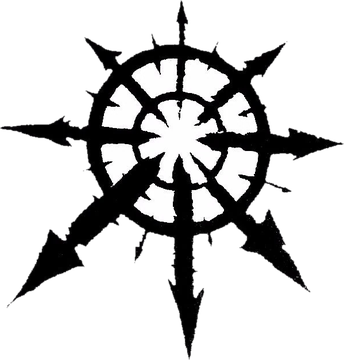
Notes
[edit]- ^ Estimated; no record gives an exact year.
References
[edit]- ^ a b c d e f g h i Arks of Omen: Abaddon (9th Edition), pp. 16, 19-23. Games Workshop. Arks of Omen: Vashtorr (9th Edition), pg. 5. Games Workshop.
- ^ a b c d e f g h Warhammer 40,000: Core Book (9th Edition), pg. 60 (Quote). Games Workshop. Codex: Chaos Daemons (8th Edition), pp. 6-9. Games Workshop.
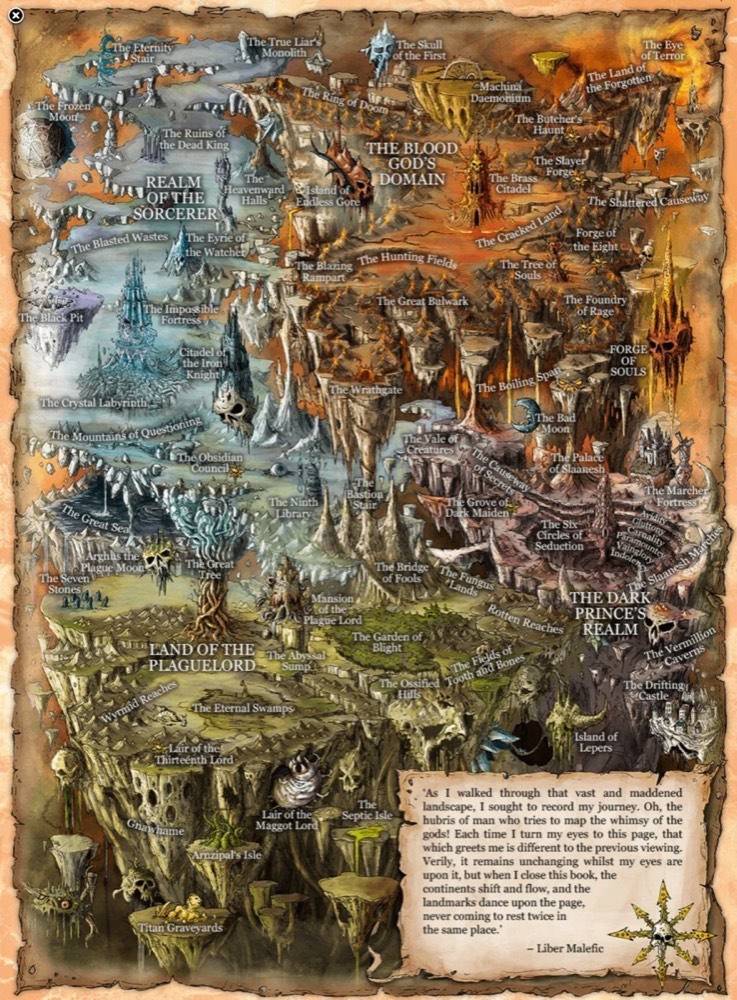
- ^ a b Warhammer Armies: Chaos Daemons (8th Edition), pg. 13 (Map of the Realm of Chaos). Games Workshop. Haley, Guy. Avenging Son (novel). Black Library.
- ^ a b Codex: Chaos Space Marines (6th Edition). Games Workshop. Codex: Chaos Daemons (6th Edition), pp. 6-20, 24. Games Workshop.
- ^ Codex: Chaos Space Marines (4th Edition), pg. 10. Games Workshop. Warhammer 40,000: Rulebook (6th Edition). Games Workshop.
- ^ a b Codex: Grey Knights (5th Edition). Games Workshop. Codex: Chaos Space Marines (3rd Edition). Games Workshop.
- ^ Codex: Chaos Space Marines (3rd Edition, 2nd Codex). Games Workshop. Warhammer 40,000: Rulebook (5th Edition). Games Workshop.
- ^ Codex: Chaos (2nd Edition). Games Workshop. Warhammer 40,000: Rulebook (4th Edition). Games Workshop.
- ^ Realm of Chaos: Slaves to Darkness (1st Edition). Games Workshop. Realm of Chaos: The Lost and the Damned (1st Edition), pg. 176. Games Workshop.
Further reading
[edit]- Realm of Chaos: Slaves to Darkness (1988). Games Workshop. The Powers, their servants and their realm.
- Abnett, Dan (2006). Horus Rising (novel). Black Library. The opening of the Horus Heresy.
- Haley, Guy (2017). Dark Imperium (novel). Black Library. The Imperium in the Era Indomitus.