
Traitor Legions
| Traitor Legions Legiones Traditorum | |
|---|---|
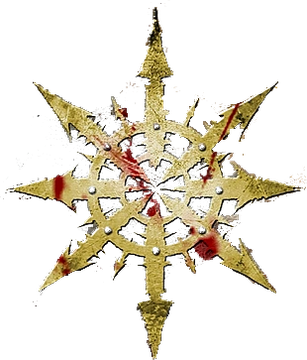 The eight-pointed star of Chaos, sign of the Traitor Legions Artwork © Games Workshop | |
| Active | 005.M31 to the present; the Legions as units were broken between 014.M31 and the Second Founding of 021.M31 and later in the Eye of Terror |
| Allegiance | Warmaster Horus (005–014.M31); thereafter Chaos, the Chaos Undivided or one of the Chaos Gods |
| Number | Nine of the eighteen Legions present at the Great Crusade's height, drawn from the Space Marine Legions |
| Primarchs | Fulgrim, Perturabo, Konrad Curze, Angron, Mortarion, Magnus the Red, Horus, Lorgar, Alpharius Omegon |
| Base | The Eye of Terror; the Maelstrom; the Great Rift |
| Notable campaigns | The Isstvan III betrayal (005.M31); the Battle of Calth (007.M31); the Siege of Terra (014.M31); the Legion Wars; the Black Crusades; the Thirteenth Black Crusade (999.M41) |
| Successors | The Chaos Space Marines of the Long War; the Black Legion; the Emperor's Children, Death Guard and other warbands |
| The nine Legions | |
| Emperor's Children (III), Iron Warriors (IV), Night Lords (VIII), World Eaters (XII), Death Guard (XIV), Thousand Sons (XV), Sons of Horus (XVI), Word Bearers (XVII), Alpha Legion (XX) | |
The Traitor Legions were the nine Space Marine Legions that turned against the Emperor of Mankind in the Horus Heresy of the 31st millennium. Their primarchs and their warriors followed the Warmaster Horus, whose rebellion was declared at Isstvan III in 005.M31. The Legions that remained loyal, the Loyalist Legions, went on to found the Space Marine Chapters of the Imperium of Mankind after the Second Founding in 021.M31.[1]
The Traitors lost the war at the Siege of Terra in 014.M31, when Horus was slain aboard the Vengeful Spirit. The surviving Legions fled into the Eye of Terror during the Great Scouring. There the Legions fought one another for decades in the Legion Wars, and by the end of the 31st millennium they had broken into warbands. Their descendants have fought the Imperium ever since in the Long War, and in the Era Indomitus they have been among the principal enemies of the Imperium Nihilus and the Imperium Sanctus.[2]
The name "Traitor Legions" is an Imperial term. The Traitors themselves rarely used it. The Legions that followed Horus called themselves by their Legion names, and many still do. Imperial teaching describes them as heretics, and Imperial records of the Heresy are sealed by the Inquisition.[2]
Background
[edit]The Great Crusade
[edit]The Traitor Legions were raised in the First Founding of about 700.M30, when the Emperor of Mankind created twenty primarchs and gave each one a Legion.[a] The Legions conquered and reclaimed worlds across the galaxy in the Great Crusade. By the 30th millennium's close the Legions were the Imperium's chief military arm, and their primarchs were its most senior commanders.[1]
The Legions were not uniform. Each had its own homeworld, its own doctrine and its own rivalries, and their primarchs had been separated as infants by the Warp before being found again between 801.M30 and 981.M30. Some Legions, such as the Ultramarines, had settled into the Imperial system quickly. Others, such as the World Eaters and the Night Lords, carried the marks of their primarchs' youths into the Legion. The gap between Legions was a constant source of friction long before 005.M31.[1]
Davin and the Monarchia
[edit]The Emperor's treatment of the Legions changed in the years around 004.M31. Horus was recovered from the Feral World of Davin in that year, after he had been wounded in a battle there. Remembrancer accounts of Davin record that the Warmaster's loyalty had begun to shift before he returned to the Great Crusade, and that his Legion, the Sons of Horus, had been renamed for him.[3] Some Imperial historians put Davin at the start of the Heresy, while others place the decisive change later.[1]
The Emperor's administration of the Crusade was known as the Monarchia, a system of Imperial governance that the Legions' commanders resented. Many Legionaries believed that the Emperor preferred to govern through the Terran administrators and the Council of Terra rather than through the primarchs, and that the Legions were being prepared for disbandment. Imperial accounts describe this as the principal grievance that the Traitors shared, though each Legion had its own.[3]
The Warmaster had long been the most senior of the primarchs. His position gave him access to the Legions and the Emperor's plans in equal measure, and he used that access to win over his brothers.[1]
Lorgar, Erebus and the Word Bearers
[edit]The first Legion to turn was the Word Bearers, under their primarch Lorgar. Lorgar had been raised on the world of Colchis and had been a devoted missionary of the Imperial Truth before the Heresy. His Legion's Chaplains and Dark Apostles had worshipped the powers of Chaos in secret for some decades. The Word Bearers' Chaplain, Erebus, was their chief architect of the betrayal. Imperial investigators hold that Erebus had made his choice long before Horus did, and that Lorgar's conversion was the decisive event of the early Heresy.[2]
Erebus and the Word Bearers' Dark Apostles are recorded as the Legion's first faithful servants of the Dark Gods. Their Legion would later be among the most fervent of the Traitor Legions, and it was the Word Bearers who first preached the worship of Chaos openly to the other Legions.[2]
The turn
[edit]Isstvan III
[edit]The rebellion was declared on Isstvan III in 005.M31. The Warmaster had gathered loyal Legions on the world for a joint operation under the Emperor's orders. The Traitor Legions turned on their brothers during the engagement, and many loyal Legionaries were destroyed in the first hours.[1]
The Legions that took part in the betrayal were the Emperor's Children, the Iron Warriors, the Night Lords, the World Eaters, the Thousand Sons, the Sons of Horus, the Word Bearers, the Alpha Legion and the Death Guard. Imperial accounts describe the Death Guard among the Legions that struck first at the loyal forces, although the Legion's exact role in the betrayal is disputed.[1]
The Drop Site Massacre
[edit]The next stage of the betrayal was the Drop Site Massacre at Isstvan V, where loyal warriors who had landed on the surface were trapped and destroyed by their own Legions. Some Traitor Legionaries refused the order, and the Massacre was the act that ended any chance of reconciliation. The Loyalist Legions that survived Isstvan V, among them the Ultramarines, the Imperial Fists and the Iron Hands, swore to hunt the Traitors wherever they went.[1]
Imperial accounts record the loyalist Legionaries of the Traitor Legions who were killed or driven out at Isstvan. They are sometimes called the "Lost and the Damned" in later records. The term refers to the loyalist warriors of the Traitor Legions who were cut off, and it is one of the reasons why Imperial scholars speak of divided Legions rather than of nine simple traitors.[1]
Course of the Heresy
[edit]The war between the Traitor Legions and the Loyalist Legions lasted nine years. It was fought on more than a hundred worlds, in the Segmentum Solar, Ultramar and the Segmentum Obscurus, and in the Warp. The campaign was marked by sieges, purges, planetary bombardments and the first wide use of Legion-scale warships against Imperial worlds.[1]
Calth and the Shadow Crusade
[edit]In 007.M31 the Traitor Legions attacked Ultramar at the Battle of Calth. The attack failed, and the Ultramarines drove the Traitors from the Calth system. Its failure did not end the Traitor campaign in Ultramar. The Word Bearers and the World Eaters launched a Shadow Crusade against the Five Hundred Worlds from 007.M31 to 009.M31, which was marked by mass atrocities against the civilian populations of the realm.[4]
The Iron Warriors
[edit]The Iron Warriors, under Perturabo, fought mostly as besiegers and fortifiers. Their Legion's doctrine was to break fortresses and to hold them, and they built their Traitor strongholds in the Heresy as they had built Imperial ones. Their campaigns against the loyal forces were long and slow, and their Legion became among the most feared in the Traitor Legions for its discipline.[1]
The Emperor's Children and the Night Lords
[edit]The Emperor's Children, under Fulgrim, took part in the Traitor campaigns with a taste for ritual and spectacle. Their Legion had been changed by Fulgrim's Slaaneshi pacts, and the Legion became increasingly devoted to pleasure and cruelty as the war went on. The Night Lords, under Konrad Curze, were feared for their terror tactics, and their Legion had carried its primarch's violence into the galaxy since the Great Crusade.[1]
The World Eaters and Angron
[edit]The World Eaters followed Angron, whose Legion had been conditioned with the Butcher's Nails, neural implants that drove its warriors into battle-rage. Angron had been raised as a gladiator on Nuceria, and he had carried a deep hatred of the Emperor since his rescue from that world. His Legion's rage made it one of the most effective and most destructive of the Traitor Legions.[1]
The Thousand Sons and the Sorcerers
[edit]The Thousand Sons, under Magnus the Red, were driven to rebellion in part by the Burning of Prospero, which the Imperium had ordered after the Thousand Sons had been accused of sorcery and of breaching the Edict of Nikaea. The Legion's Sorcerers were the most accomplished psykers among the Traitors. Their Legion was among those most deeply committed to the worship of Tzeentch.[1]
The Death Guard and Mortarion
[edit]The Death Guard, under Mortarion, were the most resolute of the Legions in their loyalty to the Emperor before the Heresy. Their loyalty before the Heresy was long remembered, and their turn is among the most debated in Imperial records. Their Legion's later worship of Nurgle is one of the most complete of any Traitor Legion's.[1]
The Alpha Legion
[edit]The Alpha Legion, under Alpharius Omegon, is the Traitor Legion about which Imperial records are least certain. Its warriors fought in many campaigns and in many guises, and its primarch is known to Imperial records mainly through rumour. The Legion's reasons for the Heresy are still debated, and Imperial scholars record that some of its warriors may have served the Emperor to the end.[5]
Sons of Horus and Horus
[edit]The Sons of Horus were the Warmaster's own Legion. They were the largest of the Traitor Legions in the Heresy's early years and were at the centre of the rebellion's strategy. Horus led them from the Vengeful Spirit during the Siege of Terra, and he was killed aboard it in 014.M31.[1]
The Siege of Terra
[edit]The Traitor Legions converged on Terra in 014.M31, and the Siege of Terra began that year. The Traitors' fleets and warbands attacked the Imperial Palace from orbit and from the surface, while the Loyalist Legions raced through the Warp to relieve the defenders. The defence of the Palace fell to the loyal Space Marine Legions and to the Adeptus Custodes, and the Traitor assault was held back for a year.[6]
In 014.M31 the Traitors made their last assault. Horus met the Emperor aboard the Vengeful Spirit and was killed there. His death ended the Traitors' unity and their hope of taking the Palace, and the surviving Traitor forces retreated from Terra. The Emperor himself was grievously wounded in the battle, and the Imperium's Cult holds that His sacrifice in that hour saved Mankind.[6]
Retreat into the Eye of Terror and the Scouring
[edit]After Terra the surviving Traitor forces fled into the Eye of Terror and other warp rifts. The Loyalist Legions pursued them in the Great Scouring, a campaign that lasted from 014.M31 to 021.M31. The Scouring destroyed many of the Traitor Legions' homeworlds and bases, and the loyal Legions are recorded as having destroyed several of them with the Emperor's authority. Imperial scholars continue to debate how much of this destruction was deliberate.[7]
Once inside the Eye the Traitors were beyond the reach of the Loyalist Legions, and the Traitor Legions lost access to the Imperial worlds they had once commanded. Their survivors were cut off from their homeworlds and from the Imperial gene-seed banks, and the Legions began to fragment.[2]
Legion Wars and the breaking of the Legions
[edit]In the Eye, the Traitor Legions turned on one another. The Legion Wars are recorded in Imperial and captured accounts as centuries of fighting over worlds, slaves, gene-seed and relics. The fighting was fiercest where the Legions' rivals shared a warp rift or a daemon world.[8]
The Emperor's Children and the World Eaters fought for the daemon world of Skalathrax. There Khârn the Betrayer broke his own Legion's oaths and was cast out of the World Eaters. The Sons of Horus were driven from their own stronghold, and Horus's cloned body was destroyed in the fighting. From the ruin, Ezekyle Abaddon built the Black Legion, a new Legion that absorbed warriors from every Traitor Legion.[8]
By the end of the 31st millennium the Traitor Legions no longer existed as single armies. Some Legions survived intact in name, among them the Death Guard, the Thousand Sons, the World Eaters and the Emperor's Children, each following one god or one primarch. Others were absorbed into warbands, most of them mixing warriors of several Legions with renegades and cultists.[8]
The Long War
[edit]The Traitors have raided the Imperium throughout the 32nd to 41st millennia. Their most visible campaigns are the Black Crusades. The first, launched by Abaddon in 781.M31, did not win lasting territory, but it established the Black Legion as the Traitors' leading force. The later Black Crusades were larger and more destructive, and each was judged by Imperial commanders by the Traitors' ability to hold the worlds they took.[2]
Between the Black Crusades, warbands struck at Imperial worlds on their own account. The Badab War of 901–913.M41 saw the renegade Chapter of the Red Corsairs rebel against the Imperium, and its leader Huron Blackheart was among the Traitors' best-known allies of the period.[9]
The Thirteenth Black Crusade and the Era Indomitus
[edit]In 999.M41 Abaddon launched the Thirteenth Black Crusade. The Traitor Legions, renegades and daemons broke through the Cadian Gate, and the Fall of Cadia destroyed the pylons that had held back the Eye of Terror. The Great Rift opened across the galaxy, and the Imperium Nihilus and Imperium Sanctus were cut off from one another. The Traitors' presence in the Imperium has grown ever since.[10]
The Era Indomitus that followed has been marked by renewed war. The Plague Wars saw the Death Guard fight against Ultramar, and the daemon primarch Mortarion led his Legion into the realm. The World Eaters, under the daemon primarch Angron, have been recorded on a crusade aimed at Terra. The Black Legion pursued the Arks of Omen campaign, in which Abaddon sought the daemon-smith Vashtorr the Arkifane and the hidden Blackstone Fortresses.[10]
Current state of the Legions (M42)
[edit]The table below summarises the nine Legions as Imperial records describe them in the early 42nd millennium. Some entries are uncertain, and the Traitors' own organisation is fluid.[1]
| Icon | Legion | Primarch | Primarch's fate | Homeworld | Patron | Status (M42) |
|---|---|---|---|---|---|---|
 | Emperor's Children (III) | Fulgrim | Became a Daemon Primarch of Slaanesh | Chemos | Slaanesh | Scattered warbands in the Eye of Terror; some fight in the Rift |
 | Iron Warriors (IV) | Perturabo | Reported to rule the Legion's fortress-world | Olympia | Chaos Undivided | Fortress-world of Medrengard; warbands of siegecraft and walls |
 | Night Lords (VIII) | Konrad Curze | Slain in the Heresy[b] | Nostramo | Chaos Undivided | Warbands scattered across the Eye of Terror |
 | World Eaters (XII) | Angron | Reborn as a Daemon Primarch of Khorne | Nuceria | Khorne | Crusade under Angron toward Terra; scattered across the Eye |
 | Death Guard (XIV) | Mortarion | Became a Daemon Primarch of Nurgle | Barbarus | Nurgle | Plague Wars against Ultramar; a Daemon world in the Eye |
 | Thousand Sons (XV) | Magnus the Red | Became a Daemon Primarch of Tzeentch | Prospero | Tzeentch | Sorcerers' world of Sortiarius; led by Ahzek Ahriman |
 | Sons of Horus (XVI), now the Black Legion | Horus | Slain aboard the Vengeful Spirit in 014.M31 | Cthonia (destroyed) | Chaos Undivided | Largest Traitor force; led by Abaddon the Despoiler |
 | Word Bearers (XVII) | Lorgar | Daemon primarch; ruled by a Dark Council | Colchis | Chaos Undivided | Ruling Dark Council in the Eye; a Hell-Forge in the Maelstrom |
 | Alpha Legion (XX) | Alpharius Omegon | Unknown; disputed | Unknown | Nominal Chaos Undivided | Hidden bases across Imperial space; true loyalty uncertain |
Disputed loyalties and the Loyalist counterpart
[edit]Not every warrior of a Traitor Legion served the Warmaster. Imperial records of the Heresy and the Era Indomitus describe a range of loyalist warriors inside the Traitor Legions. Some were captured and turned back. Others fought for the Emperor in secret, and some were executed by their own Legions for refusing the Dark Gods.[1]
The most cited case is Nathaniel Garro, a Dark Angels Space Marine who was captured and interrogated by the Traitors and later returned to the Emperor's cause. Other loyalists who served inside the Traitor Legions are recorded in Imperial accounts. Their testimonies are contested, and some Imperial archivists doubt parts of them.[11]
The loyal counterpart to the Traitor Legions is the Shattered Legions, the Legions that were broken by the Heresy and whose survivors were absorbed into the Loyalist Chapters. The Shattered Legions' surviving warriors are recorded as having been given into the care of the Imperial Fists, the Ultramarines and the Dark Angels after the Second Founding.[1]
The Alpha Legion presents the greatest difficulty. Its warriors have been recorded in service to the Emperor, in service to the Traitors, and in neither. Imperial scholars do not agree on whether the Legion was a Traitor Legion from the first, or whether its loyalties were concealed until the Heresy. Some sources hold that its primarch had a twin, while others deny that any such twin existed.[5]
Timeline
[edit]| Date | Event |
|---|---|
| c. 001.M31 | The Council of Nikaea issues the Edict of Nikaea, banning psykers from the Legions[c] |
| 004.M31 | Horus is recovered from Davin; the Sons of Horus are renamed |
| 004.M31 | Burning of Prospero; the Thousand Sons are forced into rebellion |
| 005.M31 | Rebellion declared at Isstvan III; Drop Site Massacre at Isstvan V |
| 006.M31 | Loyalist defence of the Segmentum Solar organised |
| 007.M31 | Battle of Calth; the Shadow Crusade against Ultramar begins |
| 007–009.M31 | Shadow Crusade by the Word Bearers and the World Eaters |
| c. 011.M31 | Traitor fleets gather in the Segmentum Solar[d] |
| 014.M31 | Siege of Terra begins; Traitor fleets converge on Terra |
| 014.M31 | Horus is slain aboard the Vengeful Spirit; the Traitors retreat from Terra |
| 014–021.M31 | The Great Scouring |
| c. 015–c. 100.M31 | The Legion Wars in the Eye of Terror; the Sons of Horus are reforged as the Black Legion before 781.M31[e] |
| 021.M31 | The Second Founding; Loyalist Legions reformed as Chapters |
| 781.M31 | The First Black Crusade is launched by Abaddon |
| 901–913.M41 | The Badab War; the Astral Claws become the Red Corsairs |
| 999.M41 | The Thirteenth Black Crusade; the Fall of Cadia; the Great Rift opens |
| 999.M41 | Siege of the Fenris System; Magnus the Red's revenge on the Wolves[f] |
| M41–M42 | The Traitors' presence in the Imperium Nihilus grows |
| Early M42 | The Plague Wars begin, with the Death Guard in Ultramar |
| Early M42 | The Arks of Omen campaign; Abaddon seeks Vashtorr the Arkifane |
| M42 | Angron's crusade toward Terra; the Battle of Lion's Gate |
See also
[edit]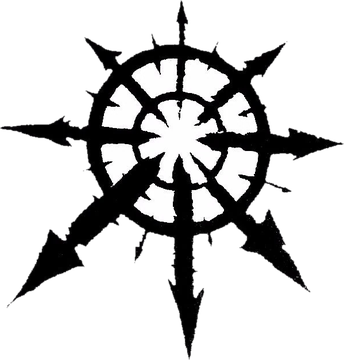
Notes
[edit]- ^ Estimated from the sequence of events; no surviving record gives the exact year.
- ^ Imperial accounts differ on the details of Curze's death.
- ^ Estimated; no record gives an exact year.
- ^ Estimated from the sequence of events.
- ^ Estimated; no record gives an exact year.
- ^ Date given in the Imperial accounts of the Fenris campaign; the exact day is disputed.
References
[edit]- ^ a b c d e f g h i j k l m n o p q r s Codex Adeptus Astartes - Space Marines (8th Edition), pp. 18-19, 62, 128. Games Workshop. Codex Heretic Astartes - Chaos Space Marines (8th Edition) (Revised Codex), pp. 6-16, 18-25, 62, 128. Games Workshop.
- ^ a b c d e f Codex Heretic Astartes - Chaos Space Marines (8th Edition), pp. 12-16, 20-21, 22-25, 67, 162-163. Games Workshop. Psychic Awakening - Faith & Fury (8th Edition), pg. 59. Games Workshop.
- ^ a b (novel), Dan Abnett. Eisenhorn. Black Library. McNeill, Graham. Dead Sky, Black Sun (novel). Black Library.
- ^ Codex: Chaos Space Marines (6th Edition), pp. 5-20, 22-25, 28-64. Games Workshop. Codex: Space Marines (5th Edition), pp. 5-50. Games Workshop.
- ^ a b Codex: Chaos Space Marines (4th Edition), pp. 6-22, 25-58. Games Workshop. Codex: Chaos Space Marines (3rd Edition, 2nd Codex), pp. 2-12, 21-38. Games Workshop.
- ^ a b Codex: Eye of Terror (3rd Edition), pp. 4-16. Games Workshop. Bligh, Alan. The Horus Heresy - Book One: Betrayal. Black Library, pp. 10-30, 64-120.
- ^ Bligh, Alan. The Horus Heresy - Book Two: Massacre. Black Library, pp. 48-60, 92-113, 136-155. Bligh, Alan. The Horus Heresy - Book Three: Extermination. Black Library, pp. 78-129.
- ^ a b c Bligh, Alan. The Horus Heresy - Book Five: Tempest. Black Library, pp. 104-115. Realms of Chaos: Slaves to Darkness (1st Edition), pp. 209-276. Games Workshop.
- ^ Realms of Chaos: The Lost and the Damned (1st Edition), pp. 161-184. Games Workshop. Dawn of War II - Chaos Rising (PC Game).
- ^ a b Deathwatch: First Founding, pp. 76-94. Index Astartes I, pp. 24-39.
- ^ Index Astartes II, pp. 20-29. Index Astartes III, "Chosen of Khorne: The World Eaters Space Marine Legion," "The Lost and the Damned: The Death Guard Space Marine Legion," "Sons of Horus - The Black Legion Space Marine Chapter".