
Planetary Governor
| Planetary Governor | |
|---|---|
 Seal of planetary governance, used on the warrants of Imperial Commanders Artwork © Games Workshop | |
 40,000 Wiki | |
| Incumbent Varies by world Notable holders: Gerontius Helmawr on Necromunda; Marneus Calgar on Macragge | |
| Imperium of Mankind Sector Governors Administratum | |
| Style | Imperial Commander; Lord Governor; Imperial and local titles |
| Type | Imperial Commander of a world of the Imperium of Mankind |
| Answers to | Lord Sector; Segmentum command; the Administratum |
| Appointer | The High Lords of Terra, through the Administratum; often hereditary in practice |
| Term length | For life, or at the pleasure of the High Lords of Terra |
| Formation | No founding date is recorded[a] |
| Obligations | The Imperial tithe; the Astra Militarum founding; the psyker tithe |
| Overseen by | The Adeptus Arbites; the Inquisition |
| Notable holders | Gerontius Helmawr (Necromunda); Herman von Strab (Armageddon); Marneus Calgar (Macragge) |
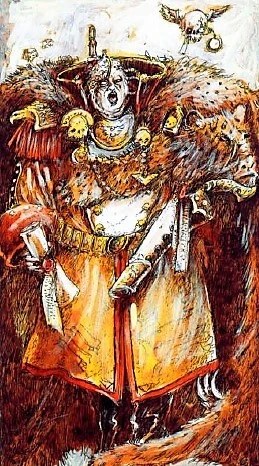
A Planetary Governor, formally styled Imperial Commander, is the ruler of a world of the Imperium of Mankind on behalf of the Emperor of Mankind. He has almost complete authority over the internal affairs of his world, its laws, its armies, its industry and its people, provided that he pays the world's tithes to the Administratum, raises regiments for the Astra Militarum when required, surrenders its psykers to the Black Ships, and keeps the world loyal to the Imperium and to the Imperial Cult.[1][2]
The post is often hereditary, and its holder is usually addressed as a lord. The governor of an especially important world may also serve as a sub-sector, sector or even segmentum governor, and the greatest governors rule whole subsectors or realms.[1]
The Imperium relies on the loyalty of its governors more than on any other single office, and their rebellions have caused some of its worst wars. A governor who fails in his duties may be removed by the Administratum, dealt with by the Inquisition, or deposed by the Imperium's forces.[1]
History
[edit]The Great Crusade
[edit]During the Great Crusade (c. 798.M30 – 005.M31) the expeditionary fleets brought tens of thousands of worlds into the Imperium. Imperial accounts hold that a world brought to compliance was given a ruler answerable to the Emperor, either its own leaders confirmed in power or an officer left behind when the fleets moved on. Early in the Imperium's history a governor's duty was a pledge to supply troops and to fight in person when required. As the Imperium grew, the pledge proved too uneven: some worlds gave too few troops, and others gave so many that their economies suffered. It was replaced by the tithe, including the raising of Astra Militarum regiments.[1]
The Age of Apostasy and later millennia
[edit]Governors who break with the Imperium are a recurring danger. Imperial records describe rulers whose arrogance leads them to secede, sometimes drawing their neighbours after them, especially in regions cut off by great distances or Warp storms. The Imperium answers with a crusade to reclaim the lost worlds, often accompanied by agents of the Inquisition. The Second War for Armageddon in 941.M41 show a governor failing in his duty from incompetence rather than treason: Overlord Herman von Strab of Armageddon dismissed the warnings of Commissar Sebastian Yarrick and sent him away from the seat of government, and his forces were swept aside by the Orks of Ghazghkull Thraka. He was later taken into custody by Dante and the Blood Angels as a heretical governor.[3]
The opening of the Great Rift in 999.M41 left the governors of the Imperium Nihilus cut off from Terra. Many have ruled alone since, raising their own forces and in some cases their own creeds, and the Indomitus Crusade has had to restore Imperial authority over worlds whose governors had become all but independent.[4]
Powers and obligations
[edit]An Imperial Commander's rights over his own world are close to absolute. He makes its laws, sets its taxes, commands its Planetary Defence Force and decides its religion within the limits of the Imperial Cult. The Imperium does not ask how he governs, only that he meet his obligations:[1]
- The tithe. The Administratum assigns every world a tithe grade, set by its population and industry, and the governor must pay it in goods, materials, soldiers or labour.
- The founding. When the Departmento Munitorum requires it, the governor must raise regiments for the Astra Militarum, trained and equipped at the world's cost.
- The psyker tithe. The governor must gather the world's psykers and surrender them to the Black Ships of the Adeptus Astra Telepathica.
- Defence. The governor must defend his world against invasion until relieved, and report any threat to Imperial authorities.
- Loyalty. He must permit the Imperial Cult and the presence of the Adepta, and suppress heresy and mutation.
Variant forms
[edit]- Hereditary rule. Most governorships pass within a noble house, such as House Helmawr, whose ancestors are known to have ruled Necromunda for at least seven thousand standard years.
- Sector and subsector governors. A Lord Sector rules a sector of worlds, with the governors of its worlds below him; his authority is political and military, and he may raise armies from his sector in a crisis.
- Chapter rule. On worlds held by the Adeptus Astartes, the Chapter Master is usually recognised as Imperial Commander. The master of the Ultramarines is the Lord of Macragge and rules the realm of Ultramar.
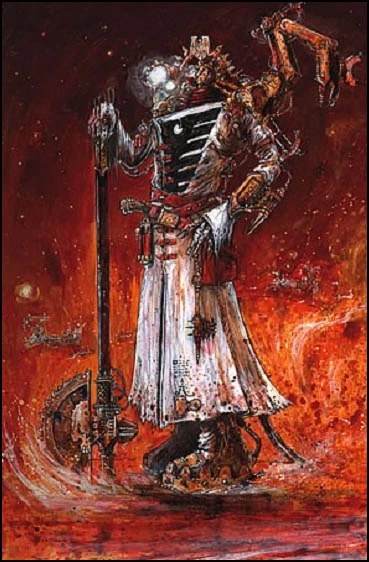
- Ecclesiarchal and Mechanicus worlds. On shrine worlds a cardinal or other priest may rule, and on forge worlds the ruler is a Fabricator of the Adeptus Mechanicus, who answers to Mars, not to the Administratum.
- Military governors. Worlds under martial law, such as fortress worlds, may be governed by a military officer; Cadia was held in its last years by its Lord Castellan, Ursarkar Creed, until its fall in 999.M41.
Notable governors
[edit]| Name | World or realm | Title | Tenure | Known for |
|---|---|---|---|---|
| Gerontius Helmawr | Necromunda | Lord Governor | Present | Ruler of the hive world; his line has governed for at least seven millennia |
| Herman von Strab | Armageddon | Overlord | 941.M41 | Disastrously inept leadership in the Second War; later captured by Dante |
| Marius Hax | Scintilla, Calixis Sector | Planetary governor and Lord Sector | Present | Governs Scintilla and serves as sector governor of the Calixis Sector |
| Marneus Calgar | Ultramar | Lord Macragge | Present | Chapter Master ruling a realm |
Timeline
[edit]| Date | Event |
|---|---|
| 941.M41 | The Second War for Armageddon; Herman von Strab is overwhelmed |
| 999.M41 | The Great Rift cuts off the governors of the Imperium Nihilus |
See also
[edit]Notes
[edit]- ^ Imperial accounts tie the office to the expansion of the Imperium in the Great Crusade (c. 798.M30 – 005.M31), but no surviving record names its first holder or the year of its creation.