
Aeldari
| Aeldari Imperial designation: Eldar | |
|---|---|
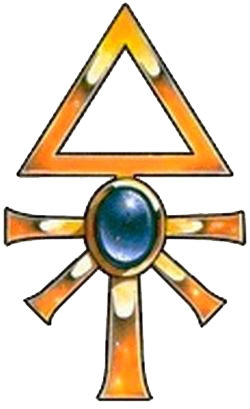 Rune used by Imperial scribes for the Aeldari Artwork © Games Workshop | |
| Classification | Xenos; psychic, long-lived, Webway travellers |
| Origin | Created by the Old Ones in the War in Heaven era |
| Former seat | The Aeldari Empire, centred on the Maiden Worlds and the galactic core |
| Present seats | Craftworlds; Commorragh in the Webway; Exodite worlds; the Black Library |
| Major branches | Asuryani, Drukhari, Exodites, Harlequins, Ynnari, corsairs and outcasts |
| Patron powers | The Aeldari pantheon, Khaine, Isha, Cegorach; the new god Ynnead |
| Enemy | Slaanesh ("She Who Thirsts") |
| Leaders in the Era Indomitus | |
| Eldrad Ulthran (exiled from Ulthwé), Yvraine and the Visarch (Ynnari), Yriel (Iyanden), Asdrubael Vect (Commorragh), the Yncarne | |
| Principal wars against the Imperium | |
| Great Crusade encounters; the Black Crusades; the defence of Iyanden; the Fall of Cadia; the war of the Great Rift | |
The Aeldari (Imperial: Eldar) are an ancient psychic xenos species, the dominant power of the galaxy before mankind and the cause, through their own decadence, of the birth of the Chaos god Slaanesh. Their former empire, which the Imperium's scholars estimate to have spanned the stars for millions of Terran years, was broken by that event, called the Fall. Its survivors now live in several scattered and mutually suspicious peoples: the craftworld-dwelling Asuryani, the Webway-dwelling Drukhari of Commorragh, the pastoral Exodites, the masked Harlequins and the recent Ynnari.[1][2]
The Imperium has regarded the Aeldari with a mixture of suspicion and unwilling respect since the Great Crusade. Aeldari craftworlds have fought beside mankind and against it, sometimes in the same decade. Their seers have manipulated Imperial affairs at least as often as they have helped them, and Imperial inquisitors disagree on whether the Aeldari are the Imperium's best temporary allies or its most dangerous, because they are the only xenos who understand the full scale of what Chaos is. The Ordo Xenos classes them as a major xenos race, hostile by default, and the Imperium's official policy forbids any parley with them.[3]
In the Era Indomitus the Aeldari have been shaken by the opening of the Great Rift and the failure of the craftworlds' old hope that their dead could be sheltered from Slaanesh. The birth of a god of death, Ynnead, is the most important event in Aeldari history since the Fall, and its consequences for the Imperium are not yet understood.[4]
Origins and the Fall
[edit]Creation and the War in Heaven
[edit]Imperial scholars, following the account that the Mechanicus and the Ordo Xenos have settled on since the Era Indomitus, hold that the Aeldari were bred by the Old Ones, a reptilian elder race that had been fighting the Necrontyr and their star-god masters, the C'tan, in the War in Heaven. The Old Ones made several psychic servant species for that war, among them the Aeldari, and the Aeldari were made to be talented in the use of the Warp, the one weapon in which the Necrons were weak. The Old Ones lost the war and mostly vanished, while the Aeldari were left to build an empire in the ruins of their makers' civilisation.[1]
The Aeldari account, which is partly myth, is that they were reared on the Maiden Worlds, grew proud and powerful, and filled the galaxy with a civilisation of art, psychic science and constructed worlds. They mastered the Webway, the labyrinth dimension that the Old Ones had made, to move between their worlds, and its remnants are still used. The Imperium keeps only fragments of this history. A good part of what it holds comes from sealed testimony of Inquisitors of the Ordo Xenos, and much of that cannot be checked.[3]
The Fall
[edit]The Aeldari empire was the work of a people who had lost the habit of necessity. Its citizens lived for millennia and lacked any serious rivals, and so devoted themselves to experience for its own sake. Imperial accounts of this decadence, which are drawn from Aeldari sources and are probably exaggerated, describe a culture of pleasure cults, ritual arenas and ever more extreme pursuits. The emotions of the Aeldari had a reflection in the Warp, where they gathered into a new power, which grew over thousands of years and, at the end of the 30th millennium, woke with a scream that destroyed the Aeldari heartland. The Imperium names that power Slaanesh. The Aeldari call her She Who Thirsts.[1][2]
The Fall killed nearly the whole species in a single moment. The newborn god devoured the souls of the dead and the living, and its birth opened a permanent wound in the fabric of reality, the Eye of Terror, which lies in the Segmentum Obscurus near the former Aeldari homeland. The date is placed in the late 30th millennium, contemporary with the opening years of the Great Crusade, but sources on Terra and on Aeldari craftworlds do not agree on its precise year, and the Inquisition has sealed several of the older records.[3][2]
The survivors fled in the few ships and worlds that had escaped the catastrophe. The Exodites had already left the empire for the open frontier and kept their distance. Those who stayed with the machine-civilisation took refuge in the Webway, while the most farsighted of the Aeldari seers built craftworlds, vast spaceborne cities in which the remains of the people could drift away from Slaanesh's reach. This was the beginning of the long age in which the Aeldari have lived as a diaspora, and it coincided with the Imperium's own early expansion into the stars.[1]
The Aeldari after the Fall
[edit]Asuryani
[edit]The Asuryani are the Aeldari of the craftworlds, which the Imperium numbers at several dozen and has named: Ulthwé, Biel-Tan, Alaitoc, Iyanden, Saim-Hann and Mymeara among the best known. Each craftworld is a self-contained civilisation with its own customs. The Asuryani avoid the fate of the Fall by following the Path, a discipline in which an individual chooses a martial or a civil way of life, devotes it fully for a time, and then leaves it in favour of another. Those who fail to leave a Path become lost to it, and the warriors who follow the Path of the Warrior as Aspect Warriors, taking the guise of a god of war, are the most visible face of the Asuryani to the Imperium.[1]
Craftworlds are governed by their Seers, whose psychic gifts guide every important decision. The Farseers, the greatest of them, walk the skeins of possible futures, and their motives are rarely clear. The Imperium's inquisitors have repeatedly found that an Aeldari intervention that appeared to serve mankind was in fact intended to preserve a different future that suited the craftworld. The Asuryani are also unique in carrying a soul-store called the Infinity Circuit, in which the spirits of the dead are preserved and kept from Slaanesh, and the loss of a craftworld is a loss of a whole people's afterlife.[3]
Drukhari
[edit]The Drukhari, once called the dark Eldar by Imperial scribes, are the Aeldari who chose to hide in the Webway rather than take to the craftworlds. They live in Commorragh, a city of the Webway that is also the greatest known xenos power on the edge of the Imperium's maps. Without a soul-store, they feed on the pain of other creatures to keep Slaanesh from claiming them, and their raiding parties, the Kabals, Wych Cults and Haemonculus Covens, emerge from the Webway to take slaves from Imperial worlds. Many an Imperial world has lost thousands in a single night to a Drukhari raid, and the Imperium has little defence against an enemy that can arrive through a hole in the world's own shadow.[1][2]
Exodites, Harlequins and others
[edit]The Exodites are the descendants of the Aeldari who left the empire before its decline. They live on distant worlds, a pastoral people with a kinship to the land, and the Imperium has often misread them as a primitive species. When the Imperium has attacked an Exodite world, it has found its inhabitants far better armed than it expected. The Harlequins are the players of the Laughing God, Cegorach, who walk the Webway and perform the mythic dramas that preserve what is known of the Fall. Corsairs and outcasts, lastly, live as pirates and mercenaries in the shadows of the Imperium's trade lanes.[1]
Relations with the Imperium
[edit]Great Crusade and Heresy
[edit]The first Imperial contacts with the Aeldari came during the Great Crusade, when expeditions and the Emperor's own agents encountered Aeldari worlds and the remains of their empire. According to the records the Ordo Xenos has recovered from the Imperial Palace, the Emperor of Mankind had dealings with the Aeldari seers even before the Crusade began, and respected their knowledge of the Warp while distrusting them. Several of the Space Marine Legions fought Aeldari raiders and fleets in the Crusade.[5][3]
The Aeldari played a part in the Horus Heresy, although the Imperium's records of it are sparse. The Farseer Eldrad Ulthran of Ulthwé is said to have tried to warn the Imperium of Horus's treachery, but the primarch he warned, Fulgrim, was already corrupted, and the warning came to nothing. After the Heresy and the Great Scouring, the Aeldari lost interest in humanity's internal affairs and returned to their own survival.[6]
The long war
[edit]From the 31st millennium to the present, the Imperium and the Aeldari have clashed constantly and mostly without result. Their conflicts are of three kinds. The first is the border war, in which an Imperial colony or fleet crosses into a space the Aeldari value, for example an Exodite world or a Maiden World, and is destroyed by a rapid, precise strike of the local craftworld's war host. The Imperium usually records such strikes as unprovoked xenos aggression and has seldom understood what it had disturbed. The second is the raid, which is the specialty of the Drukhari and the corsairs, who prey on Imperial trade. The third is the intervention, in which an Aeldari seer and war host appear on a world to prevent a larger disaster, such as a Chaos incursion or a Tyranid landing, and withdraw as soon as it is done, leaving Imperial commanders who have been saved by a xenos to reconcile themselves to the fact.[3][7]
The Asuryani are not allies of the Imperium, and the Imperium has never regarded them as such, but in the late 41st millennium the two have fought the same enemies on more than a few occasions. Iyanden, one of the largest craftworlds, barely survived the attack of Hive Fleet Kraken, which killed four-fifths of its population. It was saved from destruction by the exiled corsair prince Yriel, once its high admiral, and his outcast raiders.[8]
Ulthwé and the Black Crusades
[edit]Ulthwé, the craftworld that sits closest to the Eye of Terror, has fought the Imperium's greatest enemy more than any other xenos. Its Black Guardians stand ready for the day the Eye opens, and when the thirteenth Black Crusade of Abaddon the Despoiler began in the late 41st millennium Ulthwé's farseers saw it clearly. Imperial scholars disagree on whether the High Farseer Eldrad Ulthran acted in the Imperium's interest or his own. A minority of inquisitors hold that the Aeldari foresaw Cadia's fall and chose not to prevent it, but no evidence for this has been put before the Inquisition's courts.[4][9]
The Fall of Cadia and the Great Rift that followed it were, according to the Aeldari, a disaster they had half foreseen. Cadia was the cork in the neck of the Eye of Terror, and it was a loss for the Aeldari as well. The Rift cut through the Aeldari home of the Webway and spilled warp energies into several craftworlds, and the Asuryani, who had always relied on being able to hide, found that hiding was now impossible. The Imperium treated the Rift as proof that Eldrad's plans, whatever they were, had failed.[4]
The Era Indomitus
[edit]The Ynnari
[edit]The most important single result of the opening of the Rift was the awakening of Ynnead, the Aeldari god of death. For millennia the craftworlds had held that the Infinity Circuits' stored souls were destined to form a god who could defeat Slaanesh. In 999.M41, at the Battle of Port Demesnus on the moon of Coheria, Eldrad attempted to complete the awakening of this god too early. The Deathwatch interrupted the ritual before it was finished, but it kindled a presence that the Aeldari call the Whispering God. In the same period, at the Night of Revelations in Commorragh, a fragment of the god woke in the body of a Drukhari wych, and a new priesthood was formed around her, the Ynnari.[4][10]
The Ynnari are led by the Yncarne, a being of Ynnead's essence, and by Yvraine, Emissary of Ynnead, and the Visarch, Yvraine's champion. They believe that Ynnead will appear fully when enough Aeldari have died and that this is the only means by which the Aeldari can be saved from Slaanesh. In Aeldari terms this is the end of a long myth, called Rhana Dandra, the final reckoning, in which the gods of the Aeldari will take the field one last time. The craftworlds are divided on whether to join the Ynnari or fight them, and many Asuryani have declared against the new faith.[10]
The Imperium has met the Ynnari on several occasions. After the Fall of Cadia, the Ynnari helped the survivors of the Celestinian Crusade escape through the webway, and Yvraine aided Belisarius Cawl in restoring Roboute Guilliman to life at Macragge. The Ynnari have since been dealt with as an enemy by most Imperial authorities, and as an ally of convenience by a few.[11][4]
Imperium and Aeldari in the new age
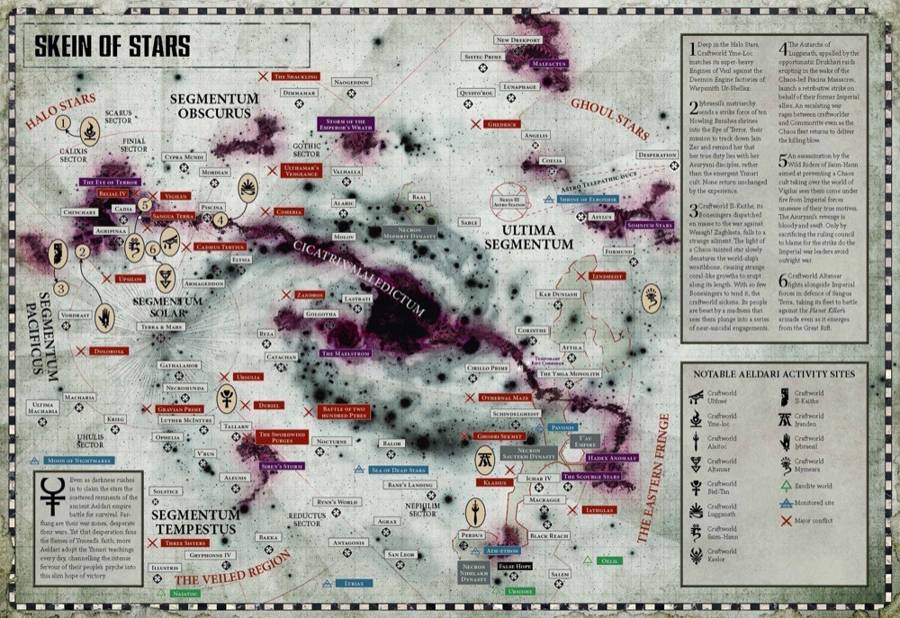
[edit]The Indomitus Crusade has brought the Imperium into renewed contact with the Aeldari across the galaxy, and with fewer rules on either side. Craftworld Biel-Tan, whose Avatar of Khaine was awakened as the Great Rift opened, has gone to war with Imperial and Chaos forces on the Imperium's borders in an attempt to protect the remaining Aeldari spaces. Ulthwé has exiled Eldrad for his support of the Ynnari. Commorragh has become more dangerous to the Imperium, as the Rift has made Webway passage uncertain and the Drukhari have extended their raids. In the Segmentum Obscurus, the Imperium has reported attacks by Aeldari forces on its own garrisons, and its authorities have had to treat them separately from the Chaos attacks that surround them.[4]
At the same time, the Aeldari are fighting for survival against forces that threaten them as much as they threaten the Imperium. The Tyranids prey on craftworlds and Maiden Worlds, and the Necrons are said to have an ancient hatred of the Aeldari that is older than the Fall. In some theatres, such as the Ultima Segmentum, Imperial and Aeldari forces have fought each other on one flank and the Tyranids on another. Most Imperial commanders prefer not to record such episodes.[3]
Military and technology
[edit]The Aeldari do not field armies of the Imperium's kind. A craftworld's war host consists of a small number of Guardians, who are citizens called up in an emergency, a few Aspect Warrior shrines and the Rangers, solitary scouts. The Aeldari's key advantage is the speed with which it can move through the Webway to strike an isolated point, and the quality of its equipment, which is made of wraithbone, a psychically responsive material grown rather than built. The Aeldari also field constructs: Wraithguard and Wraithblades, in which the spirit of a dead Aeldari is housed in a wraithbone body, and the great Wraithknights, which Imperial analysts compare with the Imperial Knights.[1]
The Aeldari have been consistently small in number, and they fight accordingly. Every craftworld loss is a catastrophe, and every war host that falls takes away part of the species. As a result, the Aeldari fight to keep casualties low, and a typical Imperial engagement with them has the character of a sudden strike followed by a rapid withdrawal. Imperial tacticians have found that a prolonged siege of an Aeldari position usually fails, because the Aeldari always have another path out.[7]
Imperial attitudes
[edit]Imperial law classes the Aeldari as xenos and as heretics by their very nature, and the Imperial Cult holds that their downfall was a just punishment for their rejection of the Emperor's Truth, although they were doomed long before the Emperor rose. The Inquisition is more divided. The Ordo Xenos regards the Aeldari as the most dangerous of the major xenos peoples because they are intelligent, patient and willing to manipulate others. Certain inquisitors, notably those of the Radical faction, have used Aeldari agents, even the corsairs of the Webway, and some have gone so far as to attempt a formal alliance. None of these have lasted, and several have ended in the destruction of the inquisitor concerned.[3]
The Space Marines' Chapters also have a long record of fighting the Aeldari. The Ultramarines, Dark Angels, Blood Angels and Space Wolves have all fought them in the Imperium's war records, and the Raven Guard and Salamanders have a tradition of respect for their tactical skill. The Deathwatch's records list Aeldari warlocks and seers as priority targets.[7]
Timeline
[edit]| Date | Event |
|---|---|
| Before the Age of Technology | The Aeldari Empire spans the galaxy for millions of years.[a] |
| ca. M18 | Commorragh becomes the primary nodal port of the Webway. |
| ca. M18–M20 | The Twilight Cults spread among the Aeldari who worship the Dark Muses. |
| ca. M29–M30 | The Fall of the Aeldari: the birth of Slaanesh tears the core of the Aeldari Empire from the galaxy. |
| ca. M30 | The worshippers of Cegorach flee into the Webway at the Fall. |
| 641.M33 | The Harlequins return from the Webway and the Aeldari War begins. |
| ca. M37 | Asdrubael Vect causes the portals of the Webway to breach in the Breaching. |
| 514.M38 | Craftworld Ulthwé and the Jade Knife Kabal of Commorragh fight in the Webway. |
| 998.M41 | The Thousand Sons and the Aeldari clash in the Webway's twilight realm. |
| 999.M41 | Yvraine, the Daughter of Shade, helps Belisarius Cawl resurrect Roboute Guilliman at Macragge. |
| Early M42 | The Aeldari remain split among the Craftworlds, Commorragh and the Harlequins, and they watch the Great Rift.[b] |
See also
[edit]Notes
[edit]References
[edit]- ^ a b c d e f g h Codex: Craftworlds (8th Edition), pp. 4-9, 11, 21-22, 42. Games Workshop. Codex: Drukhari (8th Edition), pp. 8-9, 42-43, 47, 55, 86. Games Workshop.
- ^ a b c d Codex: Harlequins (8th Edition), pp. 6-9, 12-13. Games Workshop. Psychic Awakening: Phoenix Rising (8th Edition), pp. 7-12, 16-17, 22-23, 70, 74, 80. Games Workshop.
- ^ a b c d e f g h Thorpe, Gav. Path of the Seer (novel). Black Library. Image), Nick Kyme (Cover. Promethean Sun (novella). Black Library.
- ^ a b c d e f Codex: Dark Eldar (7th Edition) (Digital Edition), pp. 23-40, 90-91, 158-160, 200-232. Games Workshop. The Gathering Storm - Part Two - Fracture of Biel-Tan (7th Edition), pp. 4-101. Games Workshop.
- ^ Codex: Eldar (6th Edition), pp. 7-8, 11-14, 20, 40-51, 62-71. Games Workshop. Codex: Dark Eldar (5th Edition), pp. 5-6, 20, 26, 35, 43, 56-63, 89. Games Workshop.
- ^ Iyanden: A Codex: Eldar Supplement (6th Edition) (Digital Edition), "Iyanden's Rise and Fall". Games Workshop. Codex: Eldar (4th Edition), pp. 4, 7, 11, 13-15, 20, 27, 51. Games Workshop.
- ^ a b c Codex: Dark Eldar (3rd Edition), pp. 10, 15. Games Workshop. Codex: Craftworld Eldar (3rd Edition), pp. 3, 5, 22, 26-27, 38, 40, 42, 45, 48, 60, 62-65. Games Workshop.
- ^ Codex: Eldar (2nd Edition), pp. 5-7, 16-17, 30, 76. Games Workshop. Warhammer 40,000: Wargear (2nd Edition), pp. 6, 8-9, 31-32, 44, 67, 72. Games Workshop.
- ^ Spurrier, Simon. Xenology (Background Book). Black Library, pp. 25-26. Warhammer 40,000 Compilation (1st Edition), pp. 35-77. Games Workshop.
- ^ a b White Dwarf 126 (UK), "Space Marine - Knights," by Andy Chamber, pp. 28-29. White Dwarf 191 (US), "Tyranid Invasion: GW Campaign of Ichar IV Defense by Ultramarines, Imperial Guard and Eldar", pp. 76-81.
- ^ White Dwarf 127 (US), "Eldar" by Rick Priestley, Jes Goodwin, William King & Lindsey D. Le Doux Paton, pp. 13-52. White Dwarf 105 (US), "Harlequins" by Graeme Davis, pp. 35-46.