
Lex Imperialis
| Lex Imperialis | |
|---|---|
| Civil and criminal code of the Imperium of Mankind | |
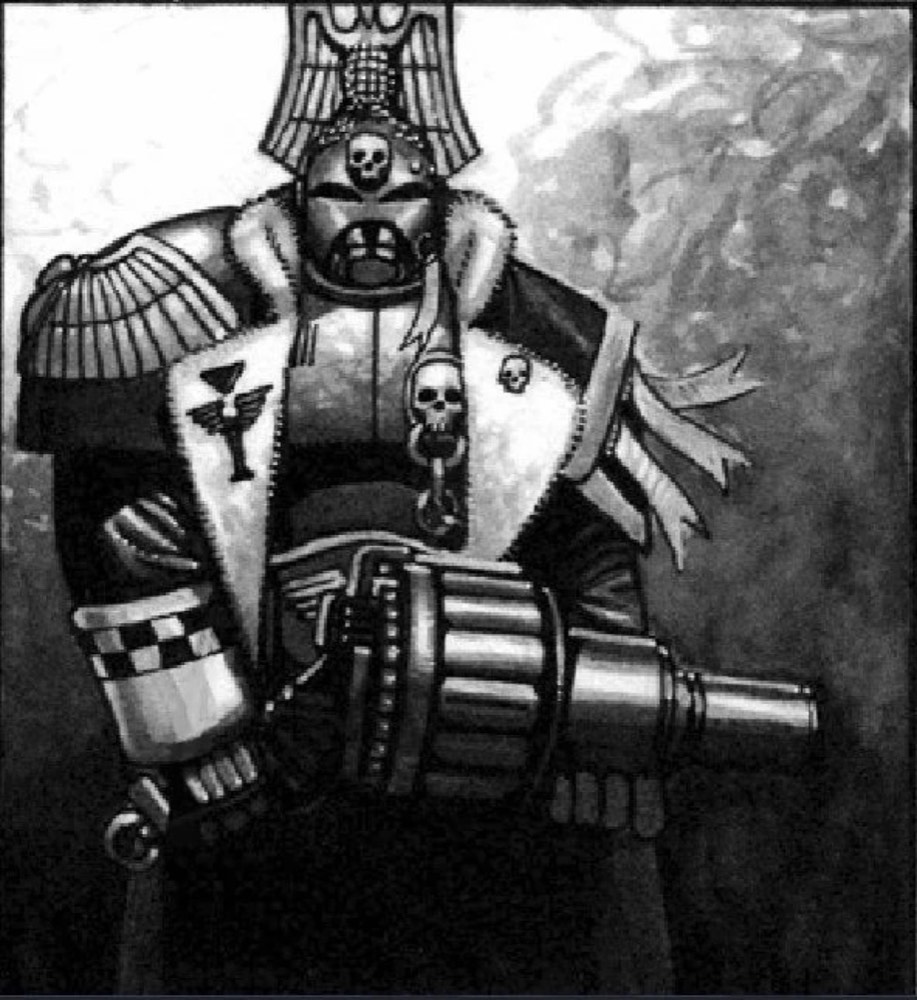 A Marshal of the Adeptus Arbites, the chief enforcers of the code Artwork © Games Workshop | |
 Artwork © Games Workshop | |
| Also called | Dictates Imperialis; Imperial Law |
| Language | Low Gothic (older articles in High Gothic and lost tongues) |
| Origin | Decrees of the Emperor of Mankind in the Great Crusade (from 798.M30), added to by the High Lords of Terra |
| Reformed | The Time of Rebirth under Roboute Guilliman (from 014.M31) |
| Repository | The Hall of Judgement, Terra |
| Enforced by | Adeptus Arbites; the Inquisition where heresy or the alien is concerned |
| Age | About ten thousand standard years |
The Lex Imperialis, also called the Dictates Imperialis or simply Imperial Law in Low Gothic, is the civil and criminal code of the Imperium of Mankind. It is a vast body of laws, decrees, rulings and precedents compiled over ten thousand standard years. It binds every world, Chapter and institution within the Imperium and is enforced chiefly by the Adeptus Arbites and, where heresy, xenos or Chaos is concerned, by the Inquisition.[1][2]
The code is believed to be the word of the Emperor of Mankind Himself. Much of it derives from the decrees issued during the Great Crusade, and it has been enlarged by every ruling of the High Lords of Terra since. Its present form took shape after the Horus Heresy, when Roboute Guilliman, as the first Lord Commander of the Imperium, reshaped the law in the Time of Rebirth and imposed the Codex Astartes on the Legions.[3][1]
The Imperium is in the last resort a theocracy, and religious concepts form the bedrock of its law. To break the Lex Imperialis is not only to defy a secular statute but to violate a divine order, since the code states that the God-Emperor rightfully expects the service and obedience of every human being. The Arbites do not therefore recognise a petty crime. The code is also so vast that no one can master it: the entire body is held in the Hall of Judgement on Terra, and the Imperial courts use abridged collections for everyday work.[2][1]
History
[edit]The Great Crusade
[edit]The first laws of the Imperium were issued in the years of the Great Crusade, which began in 798.M30. These decrees governed the conquered worlds, set the duties of the Legions and fixed the relations between the Legions and the Imperial administration. The oldest articles survive on crumbling parchment in the archive on Terra, written in tongues that have since been lost by the nameless functionaries of a forgotten age.[2][4]
The Heresy and the Time of Rebirth
[edit]The Horus Heresy (005–014.M31) tested the code as nothing had before. After the death of Horus and the enthronement of the Emperor on the Golden Throne in 014.M31, Roboute Guilliman took the offices of Imperial Regent and Lord Commander and reshaped the law during the Time of Rebirth. Under his direction the Codex Astartes was promulgated and the Legions were divided into the smaller Chapters of the Adeptus Astartes. Imperial scholars count this conciliatory act as a measure that kept the peace between the Space Marines and the Adeptus Terra.[3][1]
Guilliman also issued the Edict of Restraint, in consultation with the Captain-General of the Adeptus Custodes, Constantin Valdor. It required the Custodian Guard to remain on Terra as guardians of the enthroned Emperor, and it held them there until the opening of the Great Rift and the start of the Era Indomitus in 999.M41, ten thousand standard years later, when they began to play a more active part in the affairs of the Imperium.[5]
The Era Indomitus
[edit]In 999.M41 Guilliman returned to Terra and resumed his offices. The end of the Edict of Restraint has changed the role of the Custodes in the Imperium.[1]
The Hall of Judgement
[edit]The body of law is kept in the Hall of Judgement on Terra. The Hall began as a chamber and has been extended many times, so that it is now a complex covering many acres, with kilometres of corridors, levels and rooms. Ornate bookcases fill it, each row holds ten thousand volumes, and the shelves rise a hundred metres towards the vaulted ceilings. A hundred new volumes of encoded holoscript and hand-illuminated lettering are added every day. Every decree and ruling of the High Lords of Terra is held there, along with the words of the Emperor Himself.[2]
Scholars, scribes and law lords walk the marble floors, while legal assistants and low-ranking functionaries climb the gantries and ladders above them, searching for solar weeks and months for a single reference. Every Judge of the Arbites attempts, at some time in a career, a pilgrimage to the Hall, there to study the code in its full intricacy. Many remain for years, since the most subtle or far-reaching crimes require a long process of research.[2]
The mass of precedent and the occasional contradiction between rulings can make a correct judgement hard to find. In the most complex cases, a ruling may take standard centuries. A Judge may pass a lifetime on a single matter and hand it on, unfinished, to a successor, and the judgement may fall millennia later on the distant descendants of the accused.[2]
Because no one can read the whole code, the Imperial courts rely on abridged collections. Most precinct fortresses keep a cogitator stack containing a short selection of rulings and precedents, drawn from the judgements of segmentae Judges, High Marshals and the Lords Marshal, and used to speed the work of an individual Arbitrator. These collections are the form in which most Imperial citizens meet the law, and it is to such a volume that the title Book of Judgement most often refers.[2]
Principles
[edit]The code does not distinguish clearly between civil law and doctrine. It holds that the Emperor expects service and obedience from every human being, and that within the Imperium this expectation is made manifest in the scripture of His laws. The Arbites who enforce it hold that its letter is immaculate. Those who claim to follow the "spirit" of the law over its letter are accused of the heresy of abstractionism, since to claim access to the spirit is to claim equality with the Emperor. Abstractionism is regarded as a blasphemy that no Arbiter may countenance.[2]
The code treats crimes under several broad heads. Crimes of destabilisation are committed on the scale of whole populations, such as riots, panics and the collapse of discipline in a disaster or famine, or a religious fervour that sweeps a hive or continent into flagellant processions and hysterical confessions. When a planetary governor cannot restrain such disorder, the Arbites take the lead, and the governor is later called to account for the loss of control. Few survive the verdict.[2]
Crimes of sedition are held to be graver. The code accepts that destabilisation may arise from raw passions, but sedition results from a cold and careful intention to strike at the machinery of the Imperium. Blasphemy, heresy, the spreading of freethinking propaganda, the knowing defiance of the law and physical or moral assaults on its instruments are all seditious, and their punishments are ruthless. The most severe sentence in the code is the declaration of Excommunicate Traitoris.[2][1]
Enforcement
[edit]The Adeptus Arbites
[edit]The Adeptus Arbites are the galactic police force of the Imperium and enforce the code on every human-settled world. Their Judges must confer constantly with archive-savants and librarium cogitation engines, since few individuals know every secret and loophole of the code. At trials, which are rare, the Arbites work with a small class of legal experts who spend solar decades learning its nuances for planetary enforcers and nobles.[2]
The Inquisition
[edit]The Inquisition also upholds the code, though in spirit more than in letter. It stands outside the ordinary administrative hierarchy of the Imperium and the Adeptus Terra and hunts the threats to the realm: corruption by Chaos, heretics, mutants and rebels, and alien species. Its agents are not trained to a single doctrine, and the Inquisition is divided into factions that fall into two broad camps. The Puritans uphold the dictates of the Emperor to the letter and share the traditional values of the Ecclesiarchy. The Radicals feel free to enforce the intent of the Emperor's judgements, and the methods they use are subordinate in their eyes to the achievement of their goals. Most citizens would call them heretics, though some Inquisitor Lords accept that their arguments have force. The Arbites are told to watch both extremes lest they turn into a self-destructive obsession.[1][2][4]
Timeline
[edit]| Date | Event |
|---|---|
| c. 798.M30 | The first decrees of the Emperor are issued in the Great Crusade |
| 005–014.M31 | The Horus Heresy tests the code |
| 014.M31 | Roboute Guilliman becomes Imperial Regent and Lord Commander |
| 021.M31 | The Codex Astartes is completed and the Second Founding divides the Legions into Chapters, in the Time of Rebirth |
| c. M31 | The Edict of Restraint binds the Adeptus Custodes to Terra |
| 999.M41 | The Great Rift opens and the Edict of Restraint lapses |
| From 999.M41 | Guilliman resumes his offices and reforms the law in the Era Indomitus |
See also
[edit]For those who enforce the code, see Adeptus Arbites and Inquisition. For its source, see Emperor of Mankind and High Lords of Terra. For the figures who shaped it, see Roboute Guilliman and Imperial Regent. For the persons it condemns, see Heretic and Traitor.

References
[edit]- ^ a b c d e f g Wraight, Chris (2017). Watchers of the Throne: The Emperor's Legion (novel). Black Library.
- ^ a b c d e f g h i j k l Dark Heresy: The Book of Judgement (roleplaying game). Fantasy Flight Games. pp. 7, 9, 14-15, 22, 38, 48.
- ^ a b Dark Heresy: The Book of Judgement (roleplaying game). Fantasy Flight Games. pp. 7, 9, 14-15, 22, 38, 48.
- ^ a b Inquisitor: Rulebook (roleplaying game). Games Workshop. p. 6.
- ^ Wraight, Chris (2017). Watchers of the Throne: The Emperor's Legion (novel). Black Library.