
Astra Militarum
| Astra Militarum Imperial Guard | |
|---|---|
| Mortal armies of the Imperium | |
 Winged skull of the Astra Militarum Artwork © Games Workshop | |
| Overview | |
| Established | As the Excertus Imperialis, c. 798.M30; reconstituted as the Astra Militarum in the Time of Rebirth, early M31[a] |
| State | Imperium of Mankind |
| Leader | Lord Commander Militant, with a seat among the High Lords of Terra |
| Departments | Departmento Munitorum (supply and tithe); Officio Prefectus (the Commissariat) |
| Staff | Billions; the exact figure is unknown to any single office |
| Parent body | Adeptus Terra |
| Recruited from | Tithed regiments of every Imperial world |
| Motto | Cadia stands (adopted by regiments across the Imperium after its fall) |
| Notable regiments | |
| Cadian Shock Troops, Catachan Jungle Fighters, Armageddon Steel Legion, Valhallan Ice Warriors, Vostroyan Firstborn, Mordian Iron Guard, Death Korps of Krieg, Tallarn Desert Raiders, Elysian Drop Troops | |
| Adeptus Terra Lord Commander Militant Departmento Munitorum | |
The Astra Militarum, called the Imperial Guard in Low Gothic and, before the Heresy, the Imperial Army, is the largest fighting force in the Imperium of Mankind. Its soldiers are the tithed sons and daughters of a million worlds, armed with the lasgun, backed by massed armour and artillery, and committed to every war the Imperium fights. Individually they are unremarkable beside a Space Marine or a Custodian. Their value lies in numbers, in the great logistic machine that moves them across the Warp, and in the stubbornness with which they hold ground that cannot be given up.[1]
The Astra Militarum descends from the armies of the Great Crusade, when mortal regiments marched in the wake of the Space Marine Legions and garrisoned the worlds the Legions conquered. After the Horus Heresy (005–014.M31) that arrangement was judged too dangerous to keep. The Imperial Army was broken apart, its regiments were taken out from under the Legions and the fleets, and the force that emerged was held together instead by a chain of political officers, a bureaucracy of supply and a faith in the Emperor that the Ecclesiarchy was glad to supply. Its soldiers are the Imperium's shield, and the Imperium has never been wholly easy about handing them so much power.[2]
In the early 42nd millennium the Astra Militarum is under greater strain than at any time since the Heresy. The fall of Cadia, the opening of the Great Rift and the long darkness of the Noctis Aeterna cost it millions of soldiers and a great part of its supply lines, and the tithe of every surviving world has been raised. It has nonetheless supplied the bulk of the armies of the Indomitus Crusade, and its regiments are today fighting on a scale not seen since the days of the Emperor.[3]
History
[edit]Genos and the Unification Wars
[edit]The first soldiers of the Emperor were not Space Marines. During the Unification Wars on Terra the Emperor raised regiments from the warring nations of the Age of Strife and strengthened some of them with genetic craft. These Genos units, among them the Strife Epoch regiments, were the testing ground for the Thunder Warriors and the later Legions, and they formed the core of the armed forces that followed the Emperor from Terra into the stars. The Imperial Army of later centuries counted them among its ancestors.[4]
The Excertus Imperialis in the Great Crusade
[edit]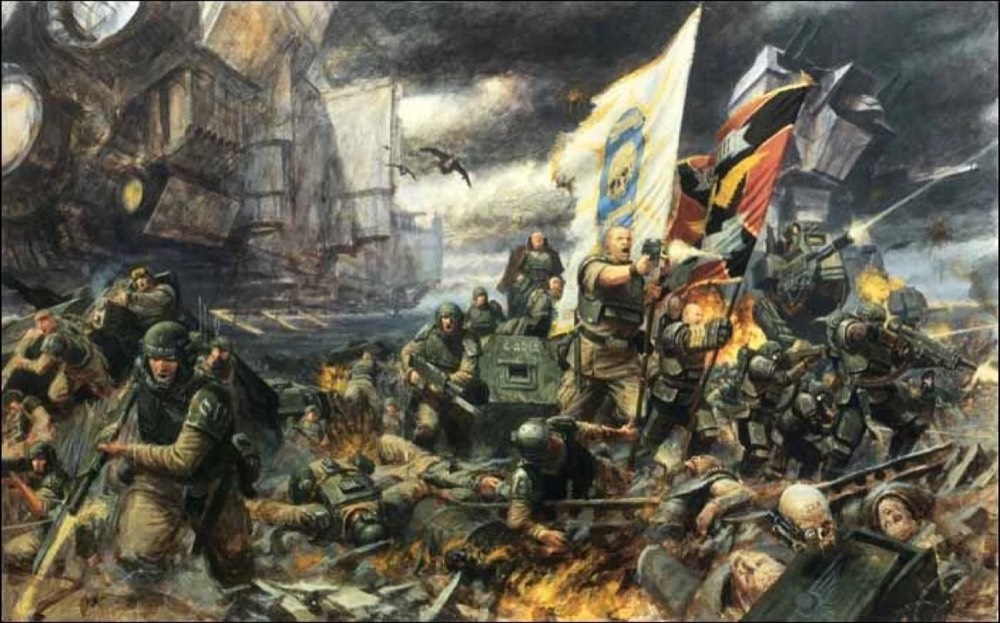
When the Great Crusade began in c. 798.M30 the Emperor could not hold in person the worlds his sons conquered. A Legion of a hundred thousand warriors was a spearhead, not a garrison. The solution was the Excertus Imperialis, the Imperial Army, drawn from worlds already brought into Imperial Compliance. Its first regiments were volunteers, survivors of native armies and levies from the Terran heartland, and their task was to keep order behind the advancing Legions. The administrators of the Corps Logisticae, forerunner of the Departmento Munitorum, surveyed each new world and set the number of regiments and the quantity of materiel it owed. That demand, known afterwards as the tithe, rose every decade of the Crusade.[2]
The Army grew steadily from a garrison into a fighting arm, with its own Warp-capable ships, and Remembrancer accounts describe it advancing in the shadow of the Legions to hold the streets after the Astartes had taken the walls.[5] A second body served beside it. The Imperialis Auxilia, called the Solar Auxilia in its Terran pattern, was an elite arm of mortal soldiers recruited from Terra and the nearest worlds, armed to a higher standard and often attached to the great expeditions under the personal authority of the Imperial court. Its regiments were the closest the Imperium of the Great Crusade came to a professional army of its own. Where the older Imperial Army was raised from local levies, the Auxilia was trained for the Emperor's service, and its soldiers fought on equal terms in the siege-works and the void-assaults of the Crusade.[6]
The Horus Heresy
[edit]The Heresy exposed the weakness in this arrangement. The mortal regiments attached to the Traitor Legions followed their masters into rebellion almost without exception, driven by fear, loyalty or ambition. Millions of trained soldiers with their own tanks, ships and artillery were suddenly turned against the Emperor. Even among the Loyalists the Army fared badly where it was commanded by Legion officers who expected too much of unaugmented men.[6] Officers of the Army, with no loyalty to either side, carved out pocket empires in the confusion, and some of the Imperium's later troubles began with their descendants. Others stayed true. A handful of regiments of the 41st millennium still claim descent from the Loyalist formations of the Heresy, though no record proves it, and tales of Ollanius Pius and the last sally of the Dharro Alpha Brigade are still told in the barracks of Terra.[2]
At the Siege of Terra the defence of the Imperial Palace was carried by the Legions, the Custodians and the mortal regiments of the Solar Auxilia and the Army together. Without the latter the walls could not have been manned.[6]
The Time of Rebirth
[edit]When the Traitors had been driven into the Eye of Terror the Loyalist leaders, among them Roboute Guilliman, set about making sure such a rebellion could never be repeated. In the Imperial Reformation the Legions were divided into Chapters by the Codex Astartes, and the Army was dissolved. A treatise called the Tactica Imperium severed the link between the armies and the fleets. Operations in the void became the task of the Imperial Navy, a separate service with its own hierarchy and interests. Operations on a planet's surface became the task of the Astra Militarum, the Imperial Guard, which was stripped of its ships and its autonomy. No ground commander could any longer borrow a fleet, and no admiral could land an army of his own.[2]
The Reformation added a further safeguard. Regiments were made small enough that no single commander could rebel with more than a single world's force, and a corps of political officers, the Commissars of the Officio Prefectus, was set among them to watch for disloyalty and to shoot cowards on the spot. The Imperial Creed, spreading rapidly through the same centuries, gave the regiments a shared faith. Priests of the Ecclesiarchy went with the armies, and the Adeptus Mechanicus sent enginseers to tend the machines of war.[2]
Ten thousand years of war
[edit]For ten thousand standard years the Astra Militarum has fought the wars of the Imperium. After the Great Scouring it hunted the Traitors and the Heretic armies of the Heresy to the borders of the Eye of Terror, and the fortress world of Cadia became the Imperium's bastion against the Eye. In the mid-32nd millennium its regiments and the Chapters together broke the Ork invasion of the War of the Beast, which had threatened Terra itself, by striking at Ullanor Prime.[2]
In the 36th millennium the Army was drawn into the Age of Apostasy. The Master of the Administratum, Goge Vandire, who had seized the office of Ecclesiarch as well, used regiments loyal to him to enforce his Reign of Blood across the Imperium. Other regiments marched under the banner of the preacher Sebastian Thor, and with the aid of the Astartes and the Custodes they brought the tyrant down. The Thorian Reformation that followed took from the Ecclesiarchy the right to maintain armies of "men under arms", which is why the Ecclesiarchy's own warriors are all women.[7]
In the 41st millennium the Astra Militarum gave the Imperium its great crusades and its worst defeats. Lord Solar Macharius led the Macharian Crusade through the Segmentum Pacificus and brought a thousand worlds into the Imperium, only to see his conquests fall into dispute on his death. The First, Second and Third Wars for Armageddon consumed whole armies in the defence of one hive world, and Commissar Yarrick's victory over the Orks became a legend of the service.[1]
The Fall of Cadia
[edit]Cadia was the pillar of the Astra Militarum. A fortress world standing guard over the Cadian Gate for ten thousand years, it supplied the Imperium with its model of the iron-willed, well-drilled soldier, and its regiments set the standard by which others measured themselves. At the end of the 41st millennium Abaddon the Despoiler's Thirteenth Black Crusade fell on it with the greatest army of the Traitors since the Heresy. The Lord Castellan, Ursarkar E. Creed, formerly colonel of the Cadian 8th Regiment, held the defence together after the Cadian High Command was assassinated, with the fortress-city of Kasr Kraf as its centre. Abaddon ended the war by hurling a captured xenos fortress into the world's surface from orbit. Of the roughly 850 million Cadians, about three million were evacuated. Creed arranged the evacuation and then disappeared.[3]
The Era Indomitus
[edit]The Great Rift tore the Imperium in two. Fleets were lost in the Warp storms, reinforcements failed to arrive, and the Noctis Aeterna cut the Astronomican from half the galaxy. Armies that had been thought safe were found to be missing or dead. When Roboute Guilliman launched the Indomitus Crusade he drew heavily on the Astra Militarum for its infantry and armour. His own bureaucracy, the Officio Logisticarum, was set up beside the Departmento Munitorum to bypass its delays, and it holds the authority to call up tithed regiments to garrison the hub-fortresses of the Crusade.[3] Officers of the Astra Militarum have been given command of whole battle groups and fleets, and the Lord Commander Solar, Arcadian Leontus, has stretched his remit beyond his segmentum in the defence of Terra.[3]
Organisation
[edit]Chain of command
[edit]The Astra Militarum is not a single army. It is the sum of the regimental contingents each world is obliged to supply, drawn together under a command structure that is deliberately fragmentary. At its head is the Lord Commander Militant, who sits among the High Lords of Terra. Beneath him are the Lord Commanders of the five Segmentae Majoris, then lords generals, and then the commanders of sectors, sub-sectors and war zones. Each commander directs the forces assigned to him, and few have the authority to move them beyond their own front.[2]
The result is a body of enormous size and little cohesion. A regiment from one world may not fight beside a regiment from another until a campaign brings them together, and the officers of each will have different customs, ranks and loyalties. That is as intended. The same separation that makes the Astra Militarum difficult to command makes it difficult to turn against the Imperium.[2]
Departmento Munitorum
[edit]The Departmento Munitorum is the department of the Administratum charged with raising, supplying and moving the Imperium's armies. It decides how many regiments each world must provide, assigns them to campaigns and arranges their transport, a task of such scale that no Munitorum official can claim to see the whole of it. It has been blamed for the loss of armies that were never told where to go, and it is also the reason that millions of soldiers reach their war zones each year with food, ammunition and a valid marching order.[2]
The tithe and recruitment
[edit]Each world pays a tithe of soldiers in proportion to its population. A sparsely settled agri-world may owe a few regiments every year. A hive world may owe hundreds. Regiments are normally raised and equipped by their home world and shipped to the Munitorum's staging points, where they are combined into larger formations. Once a regiment has left its world it is commonly never seen there again. A regiment's recruits are drawn from its home planet, which gives it a character of its own, and a regiment raised from a death world, a feral world or a hive will fight very differently from one raised on a fertile civilised planet.[1]
The Commissariat
[edit]
The Officio Prefectus, known as the Commissariat, supplies the political officers who stand in each regiment. A commissar is trained in the Schola Progenium and the schola of his own office, and his duty is to keep the troops obedient, to set an example of courage and to shoot the cowardly and the disloyal. A commissar is not subject to the orders of the regiment's colonel, and he may remove the colonel if the colonel falters. The commissar answers to the Commissariat alone. A regiment's relations with its commissar vary from deep respect to open hatred, and both are reflected in its fighting record.[2]
Forces and equipment
[edit]Infantry
[edit]The soldier of the Astra Militarum carries the lasgun, a reliable and easily repaired rifle that is the most common weapon of the Imperium. Infantry squads of ten are the core of any regiment, supported by sergeants, heavy weapons teams and special weapons squads. Their armour is flak, which stops fragments and little else. A guardsman is not expected to survive a long campaign. He is expected to hold his position until relieved, to keep firing until ordered otherwise, and to be replaced when he falls.[8]
Armour and artillery
[edit]The armour of the Astra Militarum is built around the Leman Russ battle tank, a heavy tank of ancient pattern that is produced on hundreds of forge worlds in dozens of variants. Beside it stand the Chimera armoured transport, the Basilisk, Manticore and Hydra self-propelled guns, the Sentinel walkers and the super-heavy Baneblade and Shadowsword. The Astra Militarum is strongest in the use of massed artillery, and a bombardment from a regiment of guns will level a fortress faster than any infantry assault.[1]
Elite and special units
[edit]Some formations are raised for particular tasks. The Militarum Tempestus, the Tempestus Scions, are an elite arm drawn from the Schola Progenium's finest and trained at the Scholam Tempestus in the Segmentum Tempestus. They carry hot-shot lasguns and are used as shock troops and commandos. Penal legions are made up of convicted criminals, mutineers and the condemned who have been spared on the condition that they fight, and who are normally given the most hopeless tasks. Ogryns and Ratlings, the abhuman auxiliaries of the Militarum Auxilla, serve as shock infantry and snipers respectively. Sanctioned psykers are attached to regiments with the permission of the Adeptus Astra Telepathica and are watched constantly by their commissars.[1]
Regiments
[edit]Regiments take their character from their home worlds. A few have become famous through the Imperium.
| Regiment | Home world | Character |
|---|---|---|
| Cadian Shock Troops | Cadia | Disciplined all-rounders, trained from childhood for war. The model of the service until the fall of their world. |
| Catachan Jungle Fighters | Catachan | Light infantry bred on a death world, skilled at ambush and survival in jungles. |
| Armageddon Steel Legion | Armageddon | Mechanised troops, dressed in steel-grey greatcoats and famed for their armoured warfare. |
| Valhallan Ice Warriors | Valhalla | Veterans of a frozen world, resilient in extreme cold. |
| Vostroyan Firstborn | Vostroya | Soldiers armed with heirloom weapons made by their world's gunsmiths. Their regiments are raised only from first sons. |
| Mordian Iron Guard | Mordian | Parade-ground regulars who fight in tight formations in the manner of drilled pikemen. |
| Death Korps of Krieg | Krieg | Fatalistic siege infantry who live to atone for the ancient sin of their world. |
| Tallarn Desert Raiders | Tallarn | Fast raiders and mobile infantry, heirs to the survivors of a world scoured in the Heresy. |
| Elysian Drop Troops | Elysia | Air-mobile infantry dropped by grav-chute and Valkyrie assault carrier. |
Relations with other institutions
[edit]The Astra Militarum is known as the Hammer of the Emperor, overwhelming the enemy with numbers, artillery and armour. The Chapters of the Adeptus Astartes are the Scalpel of the Emperor, less forceful but more direct and precise, and specialise in planetary assaults, special operations and decapitation strikes. The two fought side by side in the Great Crusade, when the Imperial Army was subordinate to the Legiones Astartes.[1]
Ecclesiarchy
[edit]In the centuries after the Heresy, priests of the Adeptus Ministorum accompanied Imperial armies. They found eager adherents among the regiments and used the growing faith to unify armies raised from clashing cultures.[1]
In the Age of Apostasy the Astra Militarum was the instrument of a tyrant who held both the Ecclesiarchy and the Administratum. Regiments enforced Vandire's rule on countless worlds, until loyalist regiments rallying to Sebastian Thor joined the Adeptus Astartes, the Adeptus Custodes and the Sisters of Battle in ensuring his defeat.[1]
The Navy carries the Astra Militarum to its wars. After the Horus Heresy the link between fleet and army was severed, and ground commanders were never again given direct control of interstellar warships. The two services are interdependent by design: a regiment that turned traitor could not spread its treachery beyond a single world, and a mutinous fleet could not resupply or deploy ground troops.[1]
Timeline
[edit]| Date | Event |
|---|---|
| c. 797.M30[b] | The first Genos regiments are raised during the Unification Wars, among them the forebears of the Thunder Warriors. |
| c. 798.M30 | The Great Crusade begins, and the Excertus Imperialis garrisons the worlds conquered by the Space Marine Legions. |
| 005–014.M31 | During the Horus Heresy, millions of mortal regiments follow the Traitor Legions. The Loyalist armies suffer at the Siege of Terra. |
| 014–021.M31 | The Great Scouring drives the surviving Traitor armies into the Eye of Terror. |
| Early M31 | In the Time of Rebirth the Army is dissolved and the Astra Militarum is formed, stripped of its ships and autonomy. The Tactica Imperium separates it from the Imperial Navy. |
| 544–546.M32 | The Astra Militarum and the Chapters break the Ork invasion of the War of the Beast at Ullanor Prime. |
| M36 | In the Age of Apostasy, Vandire's regiments enforce his Reign of Blood until the armies of Sebastian Thor bring him down. |
| c. 379.M36[c] | The Thorian Reformation takes from the Ecclesiarchy the right to maintain armies of "men under arms". |
| 392–399.M41 | Lord Solar Macharius leads the Macharian Crusade through the Segmentum Pacificus. |
| 999.M41 | At the Fall of Cadia, the Thirteenth Black Crusade overruns the fortress world. Lord Castellan Ursarkar E. Creed fights to the last. |
| 999.M41 | The opening of the Great Rift cuts the Astronomican from half the galaxy and leaves armies missing or dead. |
| c. 012.M42[d] | The Indomitus Crusade draws heavily on the Astra Militarum for infantry and armour. |
See also
[edit]
Notes
[edit]- ^ Imperial accounts of the exact year differ. The Departmento Munitorum dates the Tactica Imperium to the first decades after the Heresy, while the Administratum counts the Astra Militarum from the dissolution of the Legion armies. This article follows the Departmento's reckoning.
- ^ Estimated; no record gives an exact year.
- ^ Estimated; no record gives an exact year.
- ^ Estimated; no record gives an exact year.
References
[edit]- ^ a b c d e f g h i Codex: Astra Militarum (9th Edition), pp. 6-37. Games Workshop. Codex: Astra Militarum (8th Edition), pp. 6-17, 29, 30-33, 46, 52-55, 60-61, 71. Games Workshop.
- ^ a b c d e f g h i j Warhammer 40,000: Rulebook (8th Edition), pg. 71. Games Workshop. Mitchell:, Sandy. Ciaphas Cain (Novel Series). Black Library.
- ^ a b c d Abnett:, Dan. Gaunt's Ghosts (Novel Series). Black Library. Fifteen Hours (novel) by Mitchell Scanlon.
- ^ Lyons, Steve. Death World (novel). Black Library. Parker, Steve. Rebel Winter (novel). Black Library.
- ^ Soulban, Lucien. Desert Raiders (novel). Black Library. Lyons, Steve. Ice Guard (novel). Black Library.
- ^ a b c Parker, Steve. Gunheads (novel). Black Library. Dembski-Bowden, Aaron. Cadian Blood (novel). Black Library.
- ^ Sanders, Rob. Redemption Corps (novel). Black Library. Lyons, Steve. Dead Men Walking (novel). Black Library.
- ^ Williams, Richard. Imperial Glory (novel). Black Library. Warhammer 40,000: Rulebook (Digital Edition) (7th Edition), pp. 275, 283, 321, 357-364, 496. Games Workshop.