
Master of the Administratum
| Master of the Administratum | |
|---|---|
 Sigil of the Administratum, borne on the Master's seals of office Artwork © Games Workshop | |
 40,000 Wiki | |
| Incumbent Violeta Roskavler since c. 000.M42 | |
| Administratum Adeptus Terra High Lords of Terra | |
| Style | High Lord; primus inter pares of the Senatorum Imperialis |
| Type | Head of the Administratum of the Imperium of Mankind |
| Member of | High Lords of Terra (permanent seat) |
| Reports to | The Emperor of Mankind; in practice the Lord Commander of the Imperium |
| Seat | Imperial Palace, Terra |
| Appointer | Succession within the Administratum, confirmed by the High Lords |
| Term length | For life or until removed |
| Formation | Late M30, during the Unification Wars |
| Inaugural holder | Noum Retraiva (earliest recorded)[a] |
| Department | Administratum and its Departmento Munitorum |
| Notable holders | Simion Pentasian; Goge Vandire; Irthu Haemotalion |
The Master of the Administratum is the head of the Administratum, the civil bureaucracy of the Imperium of Mankind, and holds one of the permanent seats among the High Lords of Terra. Because the Administratum collects the Imperium's tithes, keeps its records and supplies its armies through the Departmento Munitorum, the Master is in name the most powerful official in the galaxy, and Imperial custom calls him the primus inter pares, the first among equals of the Senatorum Imperialis.[1][2]
The office is among the oldest of the Imperium. It descends from the Lords Civilian who governed Terra for the Emperor during the Unification Wars of the late 30th millennium, and its holder sat on the Council of Terra during the Great Crusade and the Horus Heresy. After the Heresy, when the primarch Roboute Guilliman gathered the scattered civil services into the single Administratum (c. 014–121.M31), the Master became the leading civil officer of the realm. The office lost ground to the Ecclesiarch after the rise of the Ecclesiarchy in the 32nd millennium, and in the 36th its 361st holder, Goge Vandire, seized the Ecclesiarchy as well and began the Age of Apostasy.[2][3]
In practice the Master does little of the Administratum's work. The department is too large to be directed by one person, and the office is chiefly concerned with ceremony, with the politics of the council and with the protection of the Administratum's privileges. Since the return of Guilliman as Lord Commander of the Imperium in 999.M41 the office has lost much of its independence. The Master who held it at his return, Irthu Haemotalion, was removed and later led the Hexarchy, a failed coup of early M42. The present Master is Violeta Roskavler.[4]
Powers and duties
[edit]The Master speaks for the Administratum on the Senatorum Imperialis and is the titular head of all its divisions, among them the Departmento Munitorum, the Officio Assessorum, the Departmento Exactor and the archives of the Estate Imperium. Edicts concerning the tithe, the census of worlds, the classification of planets and the raising of regiments pass through the Master's hands before they are issued in the Emperor's name. The Master shares authority over the Departmento Munitorum with the Lord Commander Militant of the Astra Militarum, and the balance between the two has shifted many times.[1][5]
The Master signs the instruments of the Administratum's gravest acts, such as the declaration of a world as Ex Imperius Rebellis, by which a governor and his officials are named traitors and their world placed outside the Emperor's protection.[1]
Imperial commentators agree that the Master's power is greater on paper than in fact. Like the other High Lords, the Master has no army, and the will of Terra reaches distant sectors only through thousands of layers of adepts, many of whom hold their posts by inheritance and answer to their own superiors first. A Master who wishes to change the Administratum's practice may find that his order is filed and never read. Masters have therefore more often used the office to protect the department than to reform it.[1]
History
[edit]Unification and the Great Crusade (late M30 – 014.M31)
[edit]The first civil servants of the Emperor's new order followed his armies across Terra during the Unification Wars. Imperial records call them the Magisters Temporal, and they were later reorganised as the Lords Civilian, overseen by four High Lords Civilian. One of the four was the Master of the Administratum, and the earliest holder named in the archives is Noum Retraiva, who held the office in the closing years of the wars, before 798.M30.[6][b]
During the Great Crusade (c. 798.M30 – 005.M31) the office was subordinate to the Regent Malcador the Sigillite, who directed the civil government of Terra while the Emperor led the armies. After the Triumph of Ullanor in 000.M31 the Emperor created the Council of Terra to govern the Imperium's civil affairs, and the Master of the Administratum, Simion Pentasian, sat on it. Pentasian held the office through the Horus Heresy (005–014.M31). He resisted the attempt of the Mechanicum envoy Vethorel to have the Martian priesthood raised to full Adeptus status with a seat on the Council, and he held the strained bureaucracy of Terra together through the Siege of Terra. He was a member of the Grand Council of Reconstruction in 014.M31.[7][2]
The Administratum of Guilliman (014–121.M31)
[edit]As Lord Commander of the Imperium after the Heresy, Guilliman merged the separate civil and military bureaucracies of the Great Crusade into the Administratum and divided the authority over fleets, armies and provinces so that no one officer could again hold all three. Under these reforms the Master of the Administratum became the leading civil officer of the Imperium and, for most of the following millennium, the most powerful member of the council that grew into the Senatorum Imperialis.[8][2]
War of the Beast and the Beheading (544–546.M32)
[edit]In the War of the Beast (544–546.M32) the Master, Tobris Ekharth, belonged to the faction of the Lord High Admiral Lansung and the Lord Commander Udin Macht Udo, which kept the council from acting against the Orks for most of the war. Ekharth changed sides several times as the war went against his allies, opposed the founding of the Deathwatch by the Imperial Fists Chapter Master Koorland, and protested when the returned primarch Vulkan used the Administratum's resources without his leave. He was killed in the Beheading of 546.M32 on the order of the Grand Master of Assassins Drakan Vangorich, and an Assassin of the Callidus Temple took his place on the council. The impostor murdered the Lord Commander Militant Abel Verreault and the Lord High Admiral Lansung and served as Master in Vangorich's council of appointees.[9]
The rivalry with the Ecclesiarchy (M32–M36)
[edit]The recognition of the Temple of the Saviour Emperor as the state church in the early 32nd millennium, and the admission of the Ecclesiarch to the Senatorum, gave the Administratum its first true rival. Over the following four millennia the Ecclesiarchy grew in wealth, armed forces and influence, and by the 36th millennium the two offices dominated the council between them.[3]
The rivalry ended in usurpation. Goge Vandire, the 361st Master, came to office in the early 36th millennium. He made the incompetent Paulis III Ecclesiarch, then had him executed for heresy and took the Ecclesiarchy himself. For almost a standard century Vandire held the two greatest bureaucracies of the Imperium at once. His rule is remembered as the Reign of Blood. When the Fabricator-General Gastaph Hediatrix demanded his trial, Vandire dissolved the Senatorum Imperialis. He was beheaded by his own bodyguard, Alicia Dominica of the Brides of the Emperor, in c. 378.M36, after the reformer Sebastian Thor led an army against Terra.[10][c]
The reforms that followed forbade any official to hold more than one of the great offices. The Ecclesiarchy lost much of its armed strength under the Decree Passive, and the Master of the Administratum recovered his place as the first among the High Lords.[10]
The late 41st millennium (M41)
[edit]Masters of the later Imperium left few marks in the record. By the close of M41 the office was held by Irthu Haemotalion, who sat on the council during the Thirteenth Black Crusade in 999.M41.[2]
Era Indomitus (999.M41 – present)
[edit]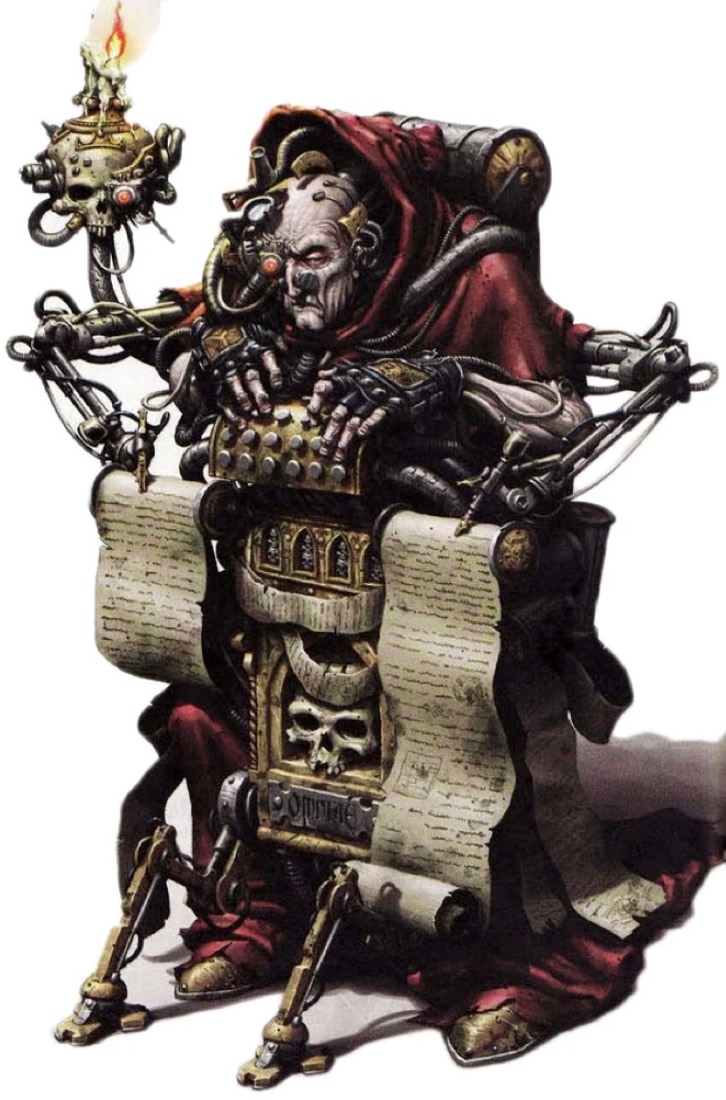
Guilliman's return to Terra in 999.M41 broke the independence of the office. The primarch dissolved the council, ruled for a time in person, and created the Officio Logisticarum, which supplied the Indomitus Crusade directly and passed over the Administratum. Haemotalion lost his office in the purge of the bureaucracy called the Primarch's Scourge. In early M42, while Guilliman was away with the Crusade, Haemotalion led the Hexarchy, a conspiracy of serving and deposed High Lords, in an attempt to seize Terra. The coup failed when the Grand Master of Assassins, Fadix, had the conspirators killed.[4][d]
Violeta Roskavler became Master when Guilliman restored the council, c. 000.M42. She remained loyal during the coup, and the Minotaurs Chapter, summoned to Terra by the conspirators, accepted her ruling and withdrew. She is the incumbent.[4]
List of holders
[edit]The Administratum counts over four hundred Masters, but the names of most are kept only in its own sealed rolls. The table lists holders named in the public record.[2]
| Holder | Tenure | Notes |
|---|---|---|
| Noum Retraiva | Late M30, before 798.M30[b] | One of the four High Lords Civilian of the Unification Wars |
| Simion Pentasian | c. 000.M31 – after 014.M31 | Sat on the Council of Terra and the Grand Council of Reconstruction |
| Tobris Ekharth | By 544.M32 – 546.M32 | Killed in the Beheading |
| Unnamed Callidus impostor | 546.M32 – c. 626.M32 | Sat in Ekharth's name on Vangorich's council; end date estimated from Vangorich's fall |
| Goge Vandire (361st) | Early M36 – c. 378.M36 | Also Ecclesiarch by usurpation, in the early 36th millennium[c] |
| Irthu Haemotalion | By 999.M41 – c. 000.M42 | Removed by Guilliman; led the Hexarchy; killed in its coup |
| Violeta Roskavler | c. 000.M42 – present | Incumbent |
Relations with other offices
[edit]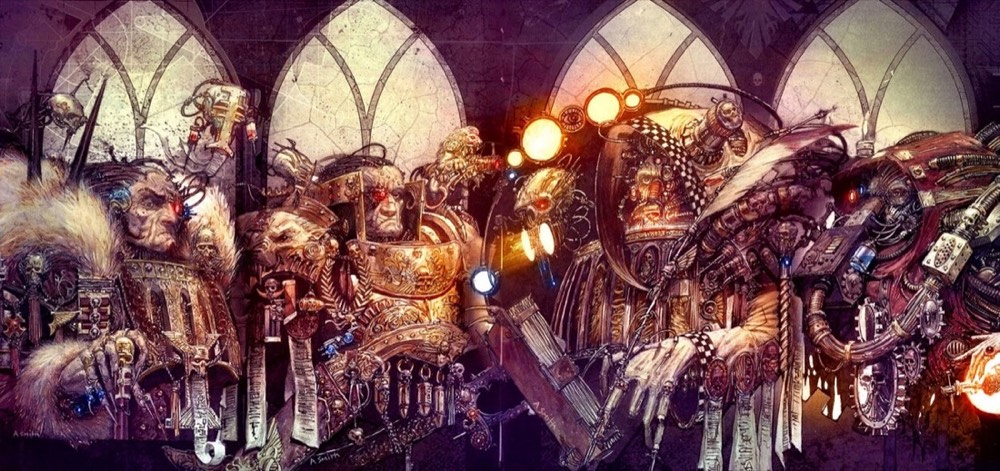
- Ecclesiarch. The Master's oldest rival. The two offices dominated the council from the 32nd millennium to the 36th, and the union of both in Vandire is the most feared precedent in Imperial government.
- Lord Commander Militant. Shares direction of the Departmento Munitorum, which raises and supplies the regiments of the Astra Militarum.
- Lord Commander of the Imperium. When the office is filled, as it has been since 999.M41, the Master answers to it, and the Lord Commander may bypass the Administratum entirely, as Guilliman did with the Officio Logisticarum.
- Grand Master of Assassins. Two Masters, Ekharth and Haemotalion, have died at the hands of the Officio Assassinorum.
Timeline
[edit]| Date | Event |
|---|---|
| Late M30 | Noum Retraiva serves as Master among the High Lords Civilian of the Unification Wars |
| 000.M31 | The Council of Terra is created after Ullanor; the Master sits on it |
| 014.M31 | Simion Pentasian sits on the Grand Council of Reconstruction |
| 014–121.M31 | Guilliman's reforms create the unified Administratum |
| 546.M32 | Tobris Ekharth killed in the Beheading and replaced by an impostor |
| Early M36 | Goge Vandire takes the office of Ecclesiarch as well |
| c. 378.M36 | Vandire killed; reforms forbid holding two great offices |
| 999.M41 | Guilliman returns to Terra; Haemotalion is later removed |
| c. 000.M42 | Violeta Roskavler becomes Master |
| Early M42 | The Hexarchy's coup fails; Haemotalion is killed |
See also
[edit]Notes
[edit]- ^ Administratum tradition counts Malcador the Sigillite as the founder of the office, since the bureaucracy of the Unification Wars answered to him. The earliest official recorded under the title of Master is Noum Retraiva.
- ^ a b Retraiva's dates are not recorded. He appears among the High Lords Civilian at the time the First Legion took the field late in the Unification Wars; the dating to before 798.M30 is inferred from the beginning of the Great Crusade.
- ^ a b The year in which Vandire became Master is unrecorded. The date of his usurpation of the Ecclesiarchy is estimated from the length of his reign as given in the Annals of the Reign of Blood.
- ^ The year of the Hexarchy's coup is not given in the records available to this article. It took place after the Crusade fleets had left Terra, c. 000–012.M42; the range is estimated.
References
[edit]- ^ a b c d Guymer, David. Echoes of the Long War (novel). Black Library, Ch. 18.
- ^ a b c d e f Abnett, Dan. I Am Slaughter (novel). Black Library, Ch. 9.
- ^ a b Sanders, Rob. Predator, Prey (novel). Black Library, Ch. 7.
- ^ a b c Thorpe, Gav. The Beast Must Die (novel). Black Library, Ch. 1.
- ^ Haley, Guy. The Beheading (novel). Black Library, Ch. 13.
- ^ Annandale, David. The Last Wall (novel). Black Library, Chs. 5, 13.
- ^ Annandale, David. Watchers in Death (novel). Black Library, Ch. 4.
- ^ Annandale, David. The Binary Succession (Audio Book). Black Library.
- ^ Annandale, David. The Hunt for Vulkan (novel). Black Library, Epilogue.
- ^ a b The Last Son of Dorn (novel) Chs. 2-3.