
Adeptus Astronomica
| Adeptus Astronomica | |
|---|---|
| Department | |
 Device of the Adeptus Astronomica Artwork © Games Workshop | |
| Overview | |
| Established | M30, before the Horus Heresy[a] |
| State | Imperium of Mankind |
| Leader | The Master of the Astronomican, a High Lord of Terra |
| Seat | The Forbidden Fortress, Imperial Palace, Terra |
| Staff | Psykers (Acolytes, Chosen, Instructors) and hereditary non-psyker servants |
| Parent body | Adeptus Terra |
| Duty | Maintaining the Astronomican |
| Choir | About 10,000 Chosen in the Chamber of the Astronomican |
| Recruits from | The Black Ships of the Adeptus Astra Telepathica |
| Serves | The Navis Nobilite, the Imperial Navy and all Imperial shipping |
| Adeptus Terra Master of the Astronomican Astronomican | |
The Adeptus Astronomica is the Adeptus of the Imperium charged with maintaining the Astronomican, the psychic beacon by which the Navigators steer the Imperium's ships through the Warp. It is an order of psykers and their hereditary servants, based in the Forbidden Fortress within the Imperial Palace on Terra, and led by the Master of the Astronomican, who sits among the High Lords of Terra.[1]
Its central duty is a sacrifice. The psykers it trains, the Chosen, join a choir of about ten thousand in the Chamber of the Astronomican, where the mind of the Emperor draws on their strength to project the beacon. A Chosen lives only a few months once called to the Chamber. The order is therefore fed constantly with new psykers by the Black Ships of the Adeptus Astra Telepathica. Since the opening of the Great Rift in 999.M41 the beacon has been hidden from half the galaxy, and the Astronomica's burden has grown heavier than at any time in its history.[1][2]
History
[edit]Founding
[edit]Before the Great Crusade left the Sol System in the late 30th millennium, the Emperor ordered the construction of the Astronomican beneath the Himalazian mountains, as a focus through which his psychic power could be projected into the Warp as a navigational beacon. At first the Emperor sustained it alone. The duty was later shifted to a choir of psykers, and the body formed to train and serve that choir became the Adeptus Astronomica. Imperial records place its founding before the Heresy, though the Adeptus Astra Telepathica, which the Emperor had created in the last months of the Unification Wars, seems to have kept charge of the beacon until the Heresy ended.[1][3]
Horus Heresy
[edit]During the Horus Heresy, the Astronomican's light failed for a time in parts of the galaxy, both through the Ruinstorm raised by the Word Bearers in 007.M31 and through the strain placed on the Emperor during the Webway War. When the Emperor rose from the Throne to fight in the last phase of the Siege, Malcador the Sigillite took his place on it and kept the beacon and the Palace wards alight at the cost of his life. Records of the Choir in those years are sealed. The Astronomican nevertheless survived the Siege of Terra in 014.M31, and the Astronomica was confirmed among the institutions of the Adeptus Terra after the Emperor's interment on the Golden Throne.[4][5]
The long millennia
[edit]For ten thousand years the Astronomica has kept the beacon burning without recorded interruption at Terra. Its psykers have died in their thousands each year in the Chamber, and its Masters have sat among the High Lords, usually silent on matters outside their charge. The Astronomica has rarely played a part in the factional struggles of the Senatorum; Imperial historians attribute this to the simple fact that no faction can rule an Imperium without the beacon.[1]
Era Indomitus
[edit]The Fall of Cadia and the opening of the Great Rift in 999.M41 hid the Astronomican from the Imperium Nihilus and made it dimmer and harder to follow across the Imperium Sanctus. During the Noctis Aeterna it could not be seen at all across much of the galaxy. The failing of the Golden Throne has made the beacon still more costly to maintain, and the Astronomica has had to call more psykers to the Chamber. Under the reforms of the Lord Commander Roboute Guilliman, the Black Ships' tithes have been increased, and the protection of the Astronomican has been made a standing priority of the Indomitus Crusade. The suppression fields of the Pariah Nexus in the early 42nd millennium posed a further threat to the psykers on whom it depends.[2]
Organisation
[edit]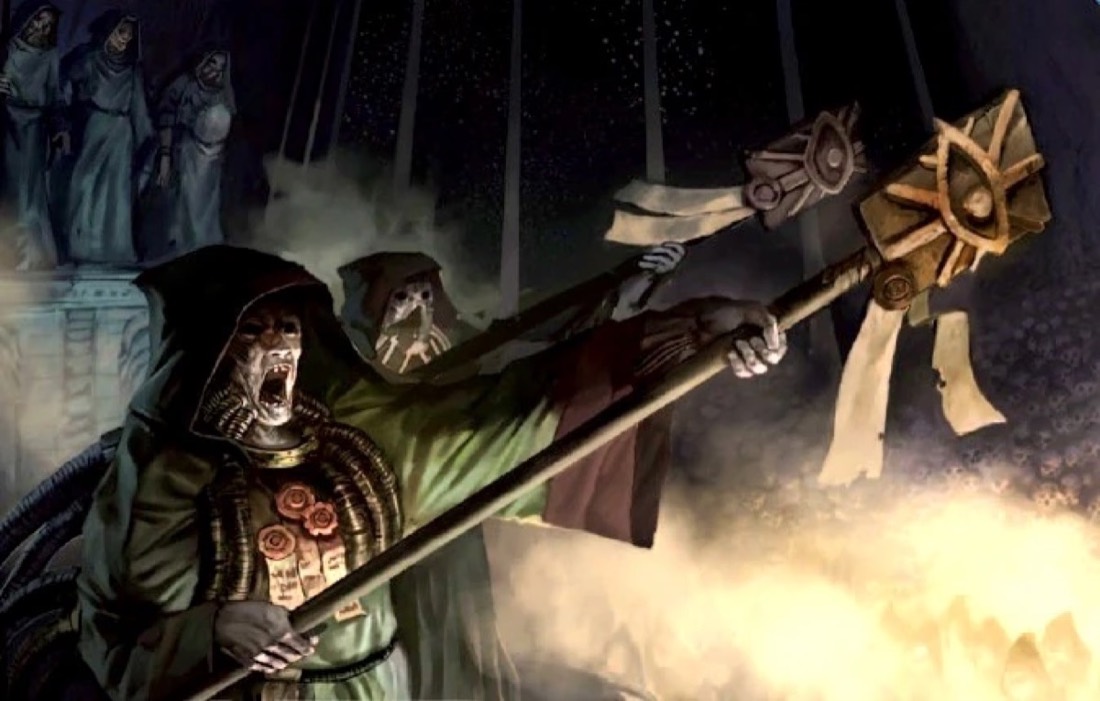
The Master
[edit]The Master of the Astronomican heads the order and represents it in the Senatorum Imperialis. Unlike most High Lords, the Master is outranked in the order's own hierarchy by the Chosen, whose sacrifice is regarded as the order's highest honour.[1]
Acolytes, Chosen and Instructors
[edit]Young psykers judged too undisciplined for the Astra Telepathica, but strong enough to serve, are handed over to the Astronomica as acolytes. They are taught to control their powers, and they study the Lore of the Astronomican, philosophy and the nature of the Warp. Those who reach the mystic state the order seeks become the Chosen. Their heads are shaved, they wear yellow robes and a scarlet badge, and they spend the rest of their lives in prayer until they are called to the Chamber. Those who fall short become Instructors and High Instructors, who run the order's training, or join the administration of the Forbidden Fortress. Members of the order otherwise wear blue hooded robes.[1]
The Chamber of the Astronomican
[edit]The Chamber lies beneath the Himalazian mountains, in the heart of the Palace. Ten thousand Chosen serve in it at a time. Their energies are drawn on by the Emperor's mind, and in a few months each is drained to a husk and dies. The Imperium also sacrifices, separately, hundreds of psykers a day to sustain the Emperor himself on the Golden Throne. The two sacrifices are often confused in popular belief; the Astronomica's own doctrine distinguishes them.[1][6]
Servants and travel
[edit]The order's day-to-day work is done by functionaries and hereditary servants who are not psykers. Instructors and functionaries may travel off Terra; the Chosen never leave it. Even the judges of the Adeptus Arbites and the agents of the Inquisition must be invited to enter the Forbidden Fortress lawfully.[1]
Relations with other Adepta
[edit]The Astronomica depends on the Adeptus Astra Telepathica for its recruits and on the Sisters of Silence and the Adeptus Custodes for the security of the Palace. Its closest client is the Navis Nobilite, whose Houses cannot cross the galaxy without the beacon. The Ecclesiarchy regards the Astronomica as a holy order and the Chosen as martyrs; the Adeptus Mechanicus treats the beacon as an engineering work beyond its understanding. The Astronomica itself, by long tradition, offers no doctrine on the Emperor's nature beyond its duty.[1][6]
Timeline
[edit]| Date | Event |
|---|---|
| Late M30 | The Astronomican built before the Great Crusade; the Adeptus Astronomica takes charge of it by the end of the Heresy |
| 007.M31 | The Ruinstorm blocks the beacon from Ultramar |
| c. 014.M31 | Malcador holds the Throne while the Emperor fights[b] |
| 014.M31 | Siege of Terra; the Emperor interred on the Golden Throne |
| 999.M41 | The Great Rift hides the beacon from the Imperium Nihilus |
| Early M42 | Black Ship tithes increased under Guilliman |
See also
[edit]
Notes
[edit]- ^ The Astronomica's founding is not dated in public records; it is inferred from the building of the Astronomican before the Crusade left the Sol System.
- ^ Date estimated from the course of the Siege of Terra.
References
[edit]- ^ a b c d e f g h i Warhammer 40,000: Rulebook (Digital Edition) (7th Edition), pp. 275, 279, 320, 379. Games Workshop.
- ^ a b Warhammer 40,000: Rulebook (6th Edition), pg. 139. Games Workshop.
- ^ Priestley, Rick. Warhammer 40,000: Rogue Trader (1st Edition). Black Library, pp. 133, 139-140.
- ^ Codex Imperialis (2nd Edition), pg. 94. Games Workshop.
- ^ Horus Heresy: Collected Visions, pp. 190, 252, 352.
- ^ a b White Dwarf 140 (US), "Space Fleet: Additional Background, Rules, Data Cards & Counters - Adeptus Astronomica," Jervis Johnson, Andy Jones, Simon Forrest & Rick Priestley, pp. 46-75.