
Ruinstorm
| Ruinstorm | |
|---|---|
| Warp storm of the Horus Heresy | |
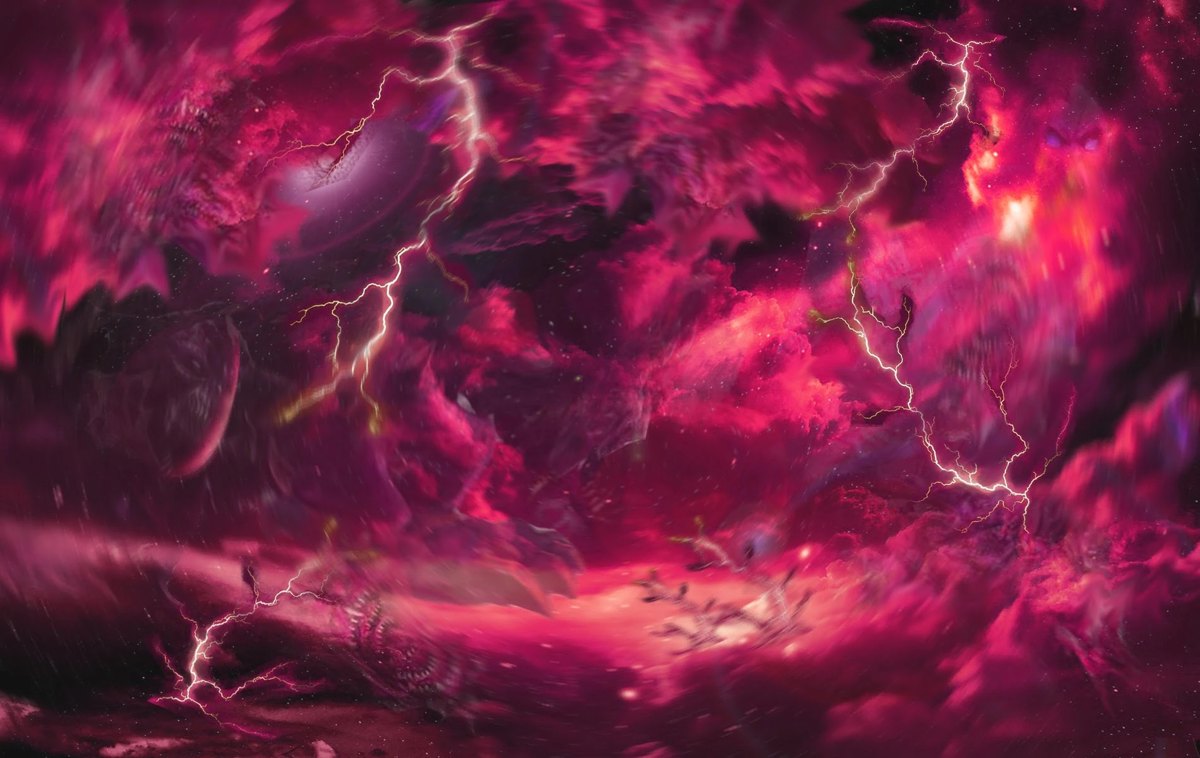 The night sky of an Eastern Fringe world under the Ruinstorm, from an Imperial Army field sketch Artwork © Games Workshop | |
| Type | Warp storm |
| Raised | 007.M31, at the Battle of Calth |
| Raised by | Erebus, First Chaplain of the Word Bearers, at the design of Lorgar |
| Extent | Large portions of the galaxy, dividing the Imperium in two |
| Breached at | Davin |
| Weakened | c. 011.M31, after the Second Battle of Davin |
| Dissipated | By the end of the Horus Heresy, after the death of Horus |
| Effects | Isolation of Ultramar, the Blood Angels and the Dark Angels; failure of astropathic communication; occlusion of the Astronomican; daemonic incursions |
| Consequences | Imperium Secundus; absence of three loyal Legions from most of the Siege of Terra |
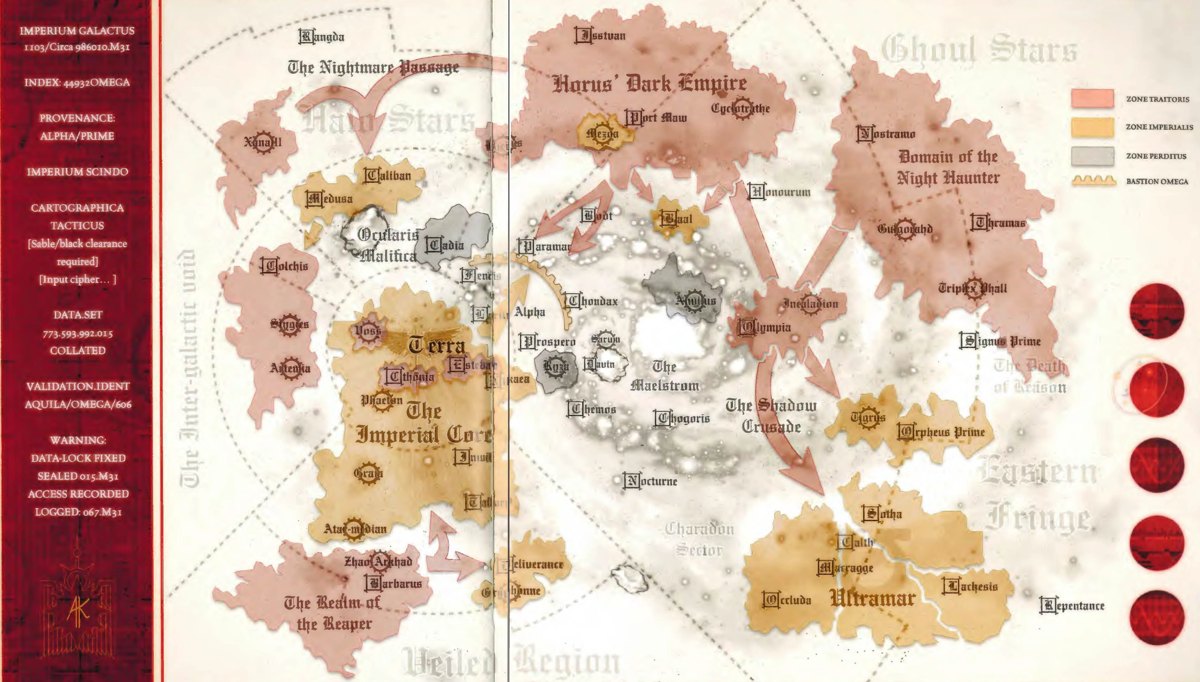
The Ruinstorm was a vast Warp storm that divided the galaxy during the Horus Heresy. It was raised in 007.M31 by the First Chaplain Erebus of the Word Bearers during the Battle of Calth, by the design of the primarch Lorgar. It grew through the years that followed, fed by the misery of Lorgar's Shadow Crusade, until it blocked off large portions of the galaxy. Within it, Warp travel became perilous and often impossible, astropaths could not send or receive, and the light of the Astronomican could not be seen.[1][2]
The storm was engineered to isolate the Emperor's loyal forces, and it served the cause of the Warmaster Horus. It kept the Ultramarines, the Blood Angels and the Dark Angels, three of the strongest loyal Legions, away from Terra while the traitors advanced on the Throneworld. The traitors themselves could pass through it by routes known to the Word Bearers. Cut off from the Emperor, Roboute Guilliman founded the Imperium Secundus at Macragge. The storm began to fail after the three loyal primarchs destroyed Davin, its anchor, in about 011.M31, and it dispersed entirely after the defeat of Horus at the end of the Heresy.[1][3]
Origin
[edit]The rite at Calth
[edit]The Ultramarines and Word Bearers mustered at Calth on the orders of the Warmaster Horus, before the massacre at Isstvan III, for a campaign against the orks of the Ghaslakh xeno-hold. The Ultramarines did not know the Word Bearers' true allegiance. The traitors' real aim was the murder of the Veridian star as an offering to the Ruinous Powers, which would bring about a Warp tempest so large that it would sever the galaxy in half and make long-range Warp travel unpredictably dangerous and trans-luminal communication all but impossible.[1][2]
Growth
[edit]The storm did not reach its full extent at once. It grew greater and more potent in the years after the destruction of Calth, fuelled by the psychic emanations released by the misery of the Shadow Crusade of Lorgar and Angron. By 010.M31 the Imperium that had been no longer existed, and civil war burned across hundreds of star systems.[1][4]
Nature and effects
[edit]In the Warp
[edit]Within the Ruinstorm the currents of the Warp were violent and unpredictable. Ships that attempted to cross it were scattered, lost, or thrown out of the Warp years after they had entered. Navigators could not see the Astronomican through it, so that long jumps were made blind. Astropaths who tried to send messages across it went mad, died, or found their messages answered by voices that were not human. In practice the Imperium was divided into two halves that could not speak to each other.[4][2]
The traitors and their allies were not bound in the same way. They could cross the storm by secret passages through the Warp that the Ruinous Powers had revealed to Lorgar, when loyal fleets could not.[1]
In realspace
[edit]Though the storm existed mainly in the Warp, it bled into the material universe on many worlds. People saw the stars swallowed, or the sky filled with colours and shapes that seemed drawn from old religious images of damnation. On the worst-affected worlds the barrier between realspace and the Warp failed and daemons walked in numbers. Many of the first encounters of the Legiones Astartes with daemons took place under the Ruinstorm, often among small detachments far from the main war, who had no doctrine and no knowledge for fighting such things.[2][4]
The orphaned forces
[edit]The storm broke the chain of command of every Legion with forces behind the storm. Detachments that had been sent to distant campaigns could neither report nor receive orders. Some remained loyal and held the worlds where they were stranded. Others, returning from the outer void to find the Imperium in flames, had to decide their allegiance for themselves. Imperial historians who later tried to reconstruct the disposition of the Legions in these years concluded that a full account is impossible. Many actions fought under the Ruinstorm are known only from the survivors, and many from none.[2]
The isolated Legions
[edit]Ultramarines
[edit]The Ultramarines were the first and worst affected. After Calth they spent 007 and 008.M31 driving the Shadow Crusade out of Ultramar, with no word from Terra and no means of sending any. As the storm grew, Guilliman feared that Terra itself was lost. The Pharos, an ancient xenos device that cast a beacon in the Warp like a weaker Astronomican, allowed the loyalists to navigate the storm and regroup on Macragge. Guilliman then founded the Imperium Secundus, in 009.M31 by most Imperial accounts.[1][5]
Blood Angels
[edit]The majority of the Blood Angels were marooned in the Signus Cluster, where they had been ordered to crush a recidivist uprising, and the storm cut them off from their homeworld of Baal. Several thousand Astartes never reached the muster at Nartaba, their ships cast across the Warp, and for almost five years many of these scattered forces believed themselves the last of their Legion. The Legion returned to contact with the wider Imperium in 010.M31.[2][6]
Dark Angels
[edit]The bulk of the Dark Angels was engaged against the Night Lords for much of the period, in the Thramas Crusade. After the Lion's victory over Konrad Curze at Tsagualsa, he sent numerous strike forces across the eastern galaxy to hunt the splintered enemy. Many did not return, and some met other isolated Legion forces and fought or joined them.[2][7]
Terra
[edit]On Terra the storm meant blindness. The War Council of the Praetorian and the Regent could not learn the state of half the Imperium. The Council sent envoys and agents in person to learn the allegiance of distant worlds, knowing that the mission would cost the lives of countless loyal servants.[1]
Breaking of the storm
[edit]Davin
[edit]The Ultramarines, Blood Angels and Dark Angels, trapped behind the storm, sought to breach it and reach Terra. In about 011.M31 Sanguinius, Lion El'Jonson and Guilliman brought their fleets to Davin, the world where Horus had been corrupted in 004.M31 and which had become a daemon world. The three Legions defeated a daemonic assault there and then destroyed the planet with cyclonic torpedoes. Where Davin had been, a breach in the Ruinstorm became visible, and it led to Terra.[1][2]
The blockade
[edit]Horus had somehow foreseen this route and had erected a large blockade of traitor warships across it. Guilliman and the Lion agreed to use their forces to distract the blockade while Sanguinius and the Blood Angels made directly for Terra. The arrival of the Blood Angels proved crucial to the Imperium's victory in the Siege of Terra, though it cost Sanguinius his life, as he had foreseen.[1][3]
Dissipation
[edit]After Davin the storm began to wane. On Terra, Rogal Dorn came to believe that the Ultramarines would be able to reach the Throneworld in time to help its defence, though Horus had foreseen the weakening and blockaded the way. After the defeat of the Warmaster at the end of the Heresy, the Ruinstorm dissipated completely, as the power of the Chaos Gods waned with the fall of their champion.[3][1]
Legacy
[edit]The Ruinstorm shaped the course of the Heresy. It kept three loyal Legions away from Terra for most of the war, and it led to the founding of the Imperium Secundus, Guilliman's own state in the cut-off east. For years the Legions in the storm fought isolated wars on their own authority, and many of their actions are known to no historian.[1][7]
Timeline
[edit]| Date | Event |
|---|---|
| 007.M31 | The storm is unleashed during the Battle of Calth. |
| 007–008.M31 | The Shadow Crusade feeds the storm. |
| 007–011.M31 | The storm cuts off the Ultramarines, Blood Angels and Dark Angels from Terra. |
| 009.M31 | Guided by the Pharos, Guilliman founds the Imperium Secundus at Macragge. |
| c. 011.M31 | The Second Battle of Davin breaches the storm; it begins to weaken. |
| 014.M31 | The storm disperses completely after the defeat of Horus at the end of the Heresy. |
See also
[edit]

References
[edit]- ^ a b c d e f g h i j k Annandale, David. Ruinstorm (novel). Black Library, Chs. 17-Epilogue.
- ^ a b c d e f g h Swallow, James. Fear to Tread (novel). Black Library.
- ^ a b c Abnett, Dan. Know No Fear (novel). Black Library.
- ^ a b c Abnett, Dan. The Unremembered Empire (novel). Black Library.
- ^ Bligh, Alan. The Horus Heresy - Book Five: Tempest. Black Library, pp. 33, 37, 41, 69, 141, 145, 154, 158, 172.
- ^ Bligh, Alan. The Horus Heresy - Book Six: Retribution. Black Library, pp. 13-14, 16, 20, 29-30, 56, 84, 88, 152, 200.
- ^ a b Merrett, Alan. Visions of Heresy - War, Darkness, Treachery and Death (Omnibus). Black Library, pp. 282-283.