
Warp
| The Warp The Immaterium | |
|---|---|
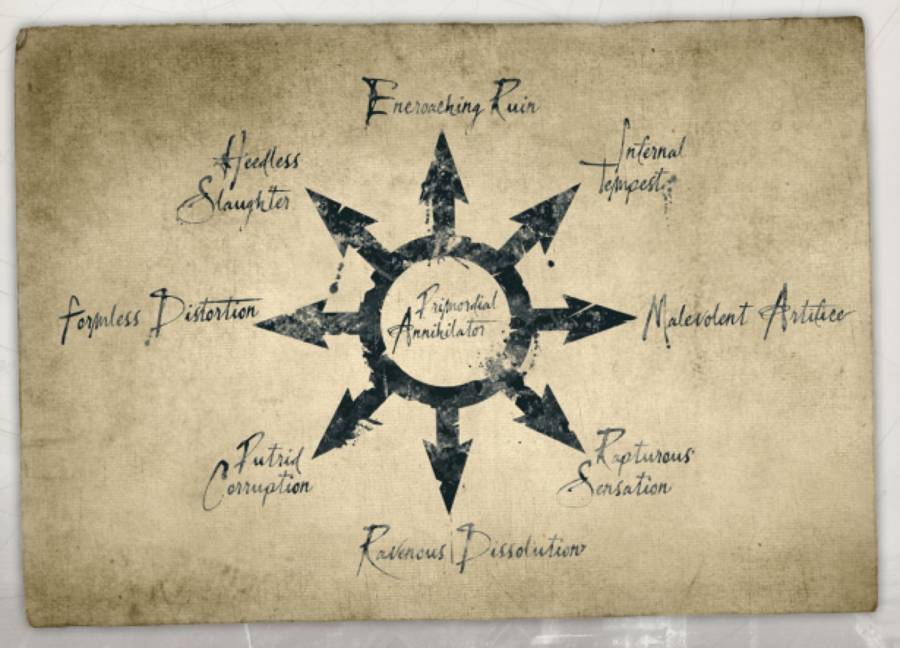 Mechanicus diagram of the eight dispositions of the Warp Artwork © Games Workshop | |
| Also called | Immaterium, Empyrean, Sea of Souls, the Realm of Chaos (of its deeper reaches) |
| Nature | An energy dimension coterminous with realspace, formed of and responsive to the thoughts and emotions of living beings |
| Inhabitants | Daemons and the Ruinous Powers, lesser entities, the Neverborn; the disembodied dead |
| Uses | Warp travel; astropathic communication; psyker powers; daemonic summoning |
| Principal hazards | Warp storms, daemonic predation, disorientation, madness, time dilation |
| Imperial safeguards | Gellar fields, Navigators, the Astronomican, Black Ships, Sisters of Silence |
| Notable features | |
| Realm of Chaos, Eye of Terror, Cicatrix Maledictum (Great Rift), Maelstrom, the Ruinstorm | |
The Warp, called the Immaterium in the formal speech of the Adeptus Terra, the Empyrean by the Aeldari and the Sea of Souls by the Imperial Cult in its more poetic liturgies, is the dimension that underlies the material universe. It is not a place in the ordinary sense. It has no fixed geography, no constant measure of time and no single law of motion. It is formed of the thoughts, emotions and dreams of every living being, and it answers them. In the Warp, feeling becomes substance, and the greatest of those feelings have taken on will and appetite. They are the Ruinous Powers and their daemon hosts.[1]
The Imperium depends on the Warp as a man depends on a river whose floods have drowned his fathers. Without it there would be no interstellar travel, no communication across the Imperium's million worlds and no Navigators to guide ships. Without the Emperor's beacon, the Astronomican, the Warp would be impassable. And yet it is the source of every psyker power, every possession, every outbreak of sorcery and every daemonic invasion in the Imperium's history. Scholars of the Ordo Malleus describe the Warp as the Imperium's road and its enemy, and teach that no one should walk the road who does not understand the enemy.[2]
Nature
[edit]Realm of thought
[edit]The Warp is coterminous with realspace, meaning that every point in the material universe has a corresponding point in the Warp, but the correspondence is not geometrical. Distances between stars may be a few moments or a thousand years of Warp-time, and a ship that crosses the Warp may arrive before, after or long after the moment it departed. For this reason the Imperium cannot synchronise its fleets by any measure. The Astronomican provides a rough common signal, and the astropaths and Navigators work from it, but arrival times remain uncertain by days, years or in extreme cases centuries.[1]
The substance of the Warp is described by the Mechanicus as aether, though the word explains little. In the Warp, strong emotion is visible and active. Great hatred forms currents, great love forms refuges, and sustained fear gathers into dark places from which predators emerge. Each living mind casts a faint light in the Warp, and the combined light of a world or a fleet is visible to those who can look. A battlefield at its height, a plague city in its last days or a festival at its zenith appears to a psyker's inner eye as a storm of colour and sound.[1]
The Warp is not fully inert in the absence of life. Even where no living mind exists, the great currents and tides of the Warp pass on, driven by the energies of the galaxy's remembered past. The Mechanicus has long held that the currents follow the great events of history and that the Warp "remembers" wars, plagues and golden ages after their physical traces have gone.[3]
Inhabitants
[edit]The Warp is inhabited by an uncountable number of entities. Most are lesser: shapeless beings of hunger, spirits born of a single emotion and fragments of the dead whose souls were not drawn into the afterlife. These are the beings most commonly encountered by psykers and astropaths, and they are the principal cause of the possession of weak minds. Above them are the daemons, which have a recognisable form and character and which serve the great Powers or act on their own account. At the summit are the Ruinous Powers themselves, Khorne, Nurgle, Tzeentch and Slaanesh, whose natures are described in the entry on Chaos.[1]
Not all things in the Warp are enemies of mankind. The Ordo Malleus records, with reluctance, the existence of entities that do not belong to the Powers and that have at times aided human or xenos agents. The Imperium discourages study of these beings. The Orks, whose psychic Waaagh! field acts as a kind of local shield against Warp predation, and the Necrons, whose bodies are devoid of souls and invisible to its denizens, are described in other entries. It is also recorded that the souls of the Imperium's dead, when they are not taken by the Powers, are drawn toward the Emperor and in some manner sustain him.[4]
The Realm of Chaos
[edit]The deep Warp, the region furthest from realspace, is known as the Realm of Chaos. It is the domain of the four great Powers, and each holds a province there. Khorne rules a landscape of battlefields and brass fortresses, with the Brass Citadel at its heart. Nurgle holds a rotting garden of vast swamps and manors. Tzeentch commands a realm of crystal and impossible architecture, centred on the Crystal Labyrinth. Slaanesh presides over a palace of ecstasy and torment, the Palace of Slaanesh. The provinces change constantly, and travellers' accounts disagree about their form.[1]
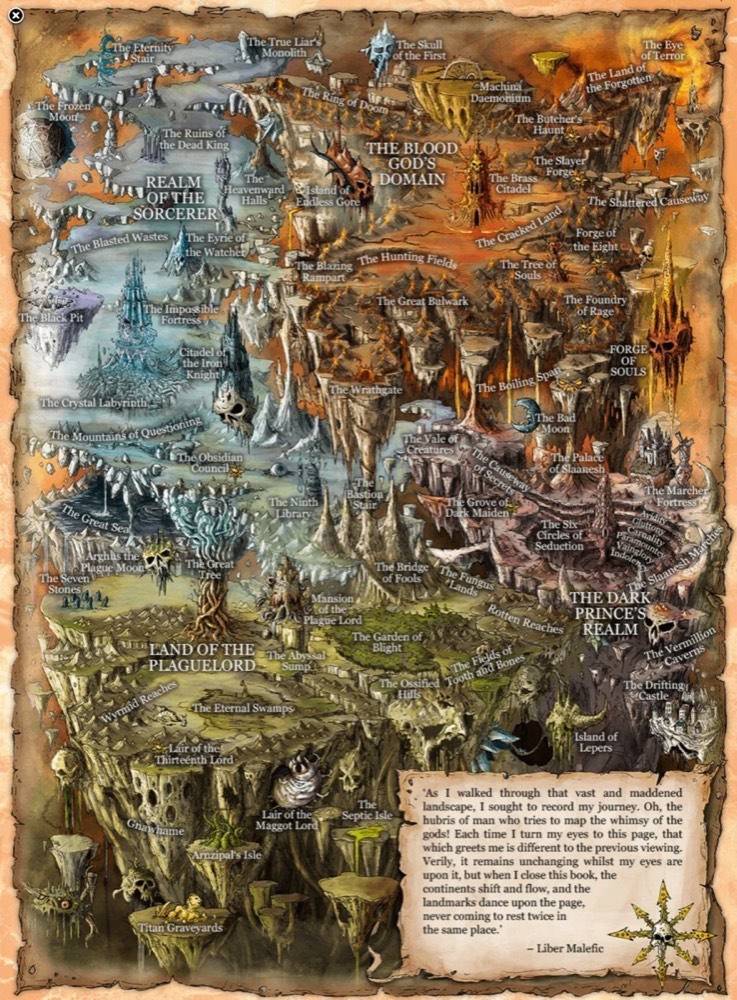
Those few mortals who have entered the Realm of Chaos and returned, whether by sorcery, by the favour of the Powers or by ill luck, describe the experience as one that cannot be remembered whole. The accounts agree that time moves differently, that the senses fail, that the traveller is greeted by beings that know his name and that every bargain offered is a snare. The Ordo Malleus records no case of a traveller who returned unchanged.[1]
Imperial use of the Warp
[edit]Warp travel
[edit]All faster-than-light travel in the Imperium takes place through the Warp. A ship equipped with a Warp drive generates a field around its hull and opens a breach in the barrier between realspace and the Warp, then follows a current that carries it toward its destination. The ship is protected by a Gellar field, a shield that holds the Warp at bay, and is guided by a Navigator, a human mutant with the unique ability to see the Warp's currents. The whole process is called a Warp jump. A voyage that would take millennia at sublight speed may be completed in days or weeks, but nothing about the journey is certain.[2]
The Warp drive is among the oldest technologies of the human race. The Mechanicus attributes its invention to the Dark Age of Technology, and its misuse is held to be a principal cause of the Age of Strife. Records of that era speak of ships that emerged with their crews mutated, of colonies lost in the Warp and of the sudden storms that cut mankind's worlds off from one another. Following the Emperor's rise, the use of the Warp drive was tightly regulated, and it remains the case that all Warp travel in the Imperium is conducted by licensed Navigators of the great Navigator Houses.[3]
The principal hazards of a Warp voyage are three. First, the Gellar field may fail, admitting daemons to the ship. A single breach has been known to destroy a vessel of ten thousand souls in a single watch. Second, the ship may become lost in the currents, arriving at the wrong place or time or not at all. Third, the Warp may turn storm, with tempests of emotion that can drive a crew mad or tear a ship apart. The Navigators' guild keeps careful records of the storms and currents, but those records are always incomplete.[1]
The Navis Nobilite
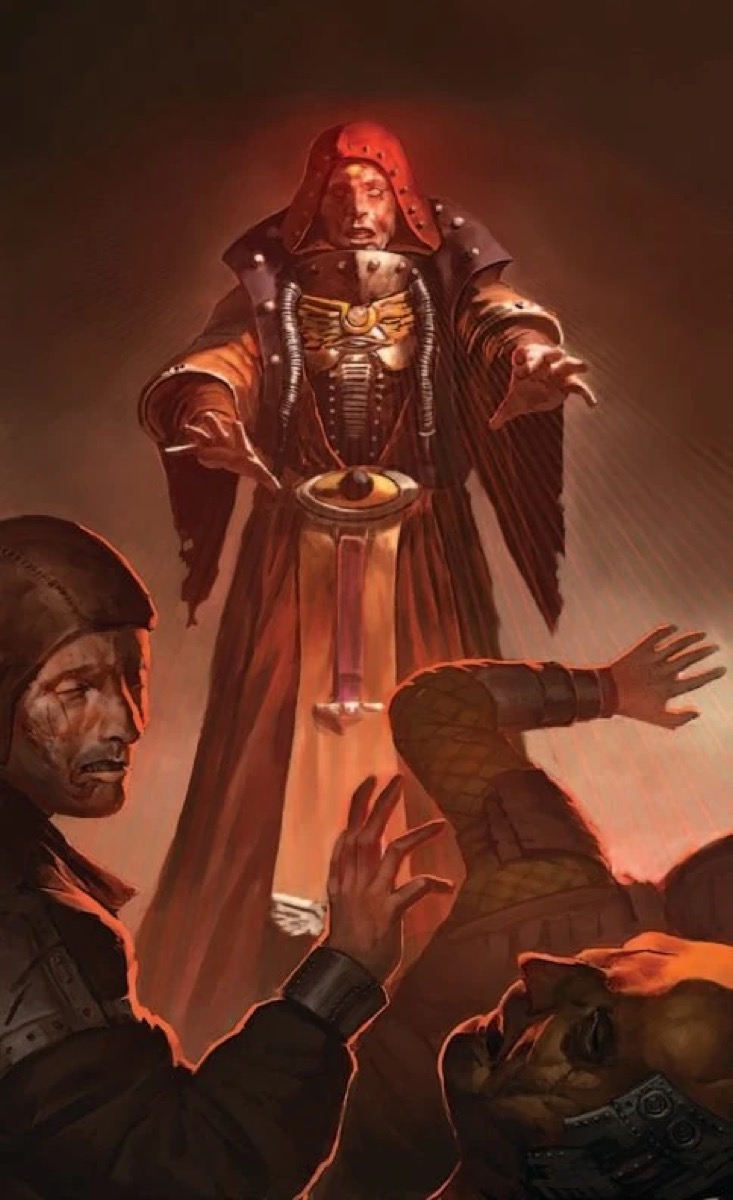
[edit]The Navigators are the mutant descendants of the great Houses that serve the Imperium's fleets. A Navigator is born with a third eye, which allows him to look at the Warp directly without succumbing to its terrors. The eye is the source of the Navigator's power and also of his danger: it can burn the minds of those who look on it, and a Navigator who loses control can unleash the Warp into the ship. The Navigators are watched closely, but the Imperium cannot do without them. The great Houses are treated as an order of nobility, with rights and privileges guarded by the Navis Nobilite's own law. The Imperium's high lords have often resented their power and sometimes feared it.[3]
Astropathy and the Astronomican
[edit]The Warp also carries thought. The Adeptus Astra Telepathica maintains the Imperium's network of astropaths, blind and psychically gifted humans who send messages across the galaxy by projecting their thoughts into the Warp. Such messages are fragile, subject to corruption and delay, and must be relayed from station to station. Their principal limit is the Warp itself: during a storm or near a daemon-haunted region, a message may arrive garbled, delayed by years or not at all. The Choir of a sector's astropaths is among the first things a besieging force tries to silence.[2]
The Astronomican is the Imperium's psychic beacon, a light projected into the Warp from Terra by the Emperor on the Golden Throne. It is fed by the souls of thousands of sacrificed psykers every day, in a rite that has not ceased since the Heresy. Navigators use it as a lighthouse, and the Imperium could not have survived ten thousand years without it. In the Era Indomitus its range has been cut: the Cicatrix Maledictum obscures it across a great portion of the galaxy, and the Imperial worlds to the north are now reached only by those ships that have a Navigator strong enough to find a path without it.[5]
Psykers
[edit]The power to draw on the Warp's energy is the psyker's gift. Psykers appear in every human population in numbers that rise and fall with the Warp's tides. The Imperium regards them as both a resource and a hazard. Their power is necessary for the Astronomican, the astropaths and the Librarians of the Adeptus Astartes. It is also the means by which the Powers corrupt mortals and enter the world. The Imperium therefore gathers psykers by means of the Black Ships of the Adeptus Astra Telepathica, tests them and either enlists them in its service, sacrifices them to the Astronomican or, if they are found to be corrupt, destroys them. The unsanctioned psyker is hunted by the Inquisition and the Arbites, and the Ecclesiarchy's preachers warn against "the witch".[4]
The counterpart of the psyker is the null, a rare human whose soul is invisible in the Warp, and who cannot be touched by daemons or psychic attack. The Sisters of Silence, a Legion-sized body of nulls, are the Imperium's most reliable guards against psychic threat.[2]
Warp storms and rifts
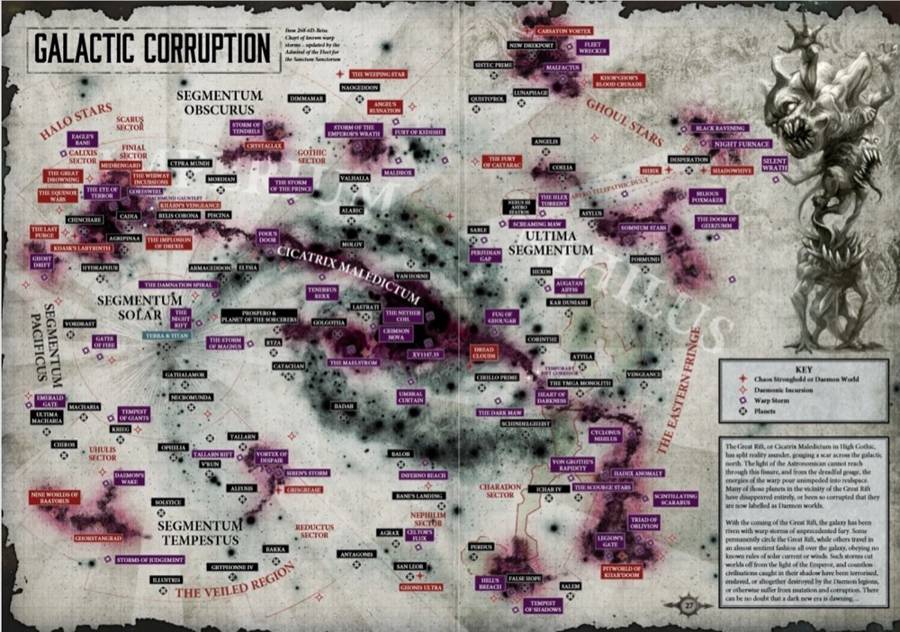
[edit]A Warp storm is a region of the Warp disturbed by an excess of emotion or by the actions of the Powers. The storms may last a few hours or ten thousand years, and they can obscure entire star systems, strand fleets and open the way for daemons. The greatest of them is the Eye of Terror, a permanent rift in the galactic north-west, in which the Powers hold sway and the Traitor Legions dwell. Another, the Maelstrom, is a lesser rift far from it, long used by pirates and renegades. The Ruinstorm, which isolated Terra during the Horus Heresy, was a Warp storm of an unprecedented magnitude, raised by the traitors with the help of the Powers and sustained for years.[6]
The Imperium keeps a chart of known storms, updated by Navigators on the Admiral of the Fleet's authority. The chart for the Era Indomitus has more entries than any previous chart, because the greatest storm of all, the Cicatrix Maledictum, now crosses the galaxy. This rift, also called the Great Rift, opened in 999.M41 after the fall of Cadia, and splits the galaxy into two. Its energies have driven many Warp storms of their own, and the transit of the Rift is the most dangerous voyage in the known galaxy.[5]
The Warp and the Emperor
[edit]The Emperor's relationship to the Warp is the subject of a great deal of speculation and very few firm records. The Imperial Cult teaches that he was the lord of the Warp's light, a god in the making whose psychic power held the Powers at bay. The Ordo Malleus is more careful. Its records indicate that the Emperor had studied the Warp since before the unification of Terra, that he had an unusual power over it and that he spent the Great Crusade trying to find a way to deny the Powers their food. The Webway project, in which he sought to open a human path through the Aeldari's tunnels, was an element of that plan. It was left incomplete after the Heresy, and its final form is sealed.[7]
Today the Emperor's presence in the Warp is the foundation of the Imperium's defence. The Cult holds that his light is a shield, and that the Warp's currents move around Terra as water moves around a rock. It is a fact that the Astronomican has never failed since the Emperor's enthronement, that attempts to open large Warp gates near Terra have always failed and that the Powers have never been able to touch the Throne itself.[4]
Other species and the Warp
[edit]The Imperium is not the only power that must contend with the Warp. The Aeldari are the most affected of the species of the galaxy, since their souls are strongly bound to it and their psychic nature makes them uniquely vulnerable. The Imperial scholarship regards the birth of the youngest Power, Slaanesh, as the direct result of their culture's excess, and the Aeldari's present exile on the craftworlds as the consequence. The Orks generate a mild psychic field that protects them from the Warp's predators and weakens the barrier between worlds, and Ork migrations have been known to cause Warp disturbances in their wake. The T'au Empire knows the Warp only as a hazard to be avoided, and its people are said to be invisible to its inhabitants, a fact that the Ordo Xenos regards with unease. The Necrons, as soulless machines, pay the Warp no heed. The Tyranids are connected to the Warp through their Hive Mind, the shadow of which blots out the Astronomican wherever the swarms advance.[8]
Timeline
[edit]| Date | Event |
|---|---|
| Age of Technology | Mankind uses the Warp for interstellar travel and communication until the storms of the Age of Strife begin.[a] |
| Age of Strife | The Warp storms cut the Human worlds off from one another and from Terra. |
| M30–M31 | The Astronomican is lit above Terra, and the Warp is channelled for the Great Crusade.[b] |
| 001.M31 | The Council of Nikaea forbids the use of sorcery, while the Navigator houses keep their routes through the Warp. |
| 004.M31 | Magnus the Red's sorcerous warning travels through the Warp and breaches the Imperial Palace wards. |
| c. 666.M34 | The first Warp Stars appear after a storm drifts from the Eye of Terror. |
| 999.M41 | After the Fall of Cadia, Warp travel grows more turbulent until the Great Rift opens. |
| Early M42 | The Imperium Nihilus is cut off by the Great Rift, and the Warp storms remain too strong for many routes. |
See also
[edit]

Notes
[edit]References
[edit]- ^ a b c d e f g Wraight, Chris. The Path of Heaven (novel). Black Library, Ch. 3.
- ^ a b c d Codex: Chaos Daemons (8th Edition), pp. 6-9, 26-27. Games Workshop.
- ^ a b c Warhammer Fantasy Chaos Daemons Army Book (8th Edition), pg. 13 (Map of the Realm of Chaos). Games Workshop.
- ^ a b c Codex: Chaos Daemons (6th Edition), pp. 6-20. Games Workshop.
- ^ a b Codex: Chaos Daemons (4th Edition), pp. 6, 8-9, 14-16, 25, 44. Games Workshop.
- ^ Realm of Chaos: Slaves to Darkness (1st Edition), pg. 212. Games Workshop.
- ^ Warhammer 40,000: Rogue Trader (1st Edition), pp. 130-132. Games Workshop.
- ^ Dark Heresy: Enemies Beyond (2nd Edition) (RPG), pg. 136. Games Workshop.
Further reading
[edit]- Liber Daemonica (rev. M38). Ordo Malleus. The principal Inquisitorial study of the Warp and its inhabitants. Restricted.
- Lexicanum Martialis. Officio Militaris. Entries on Warp travel and the Navis Nobilite.
- Records of the Indomitus Crusade (ongoing). Charts of the Great Rift and the warp storms of the Era Indomitus.