
Tzeentch
| Tzeentch The Changer of Ways | |
|---|---|
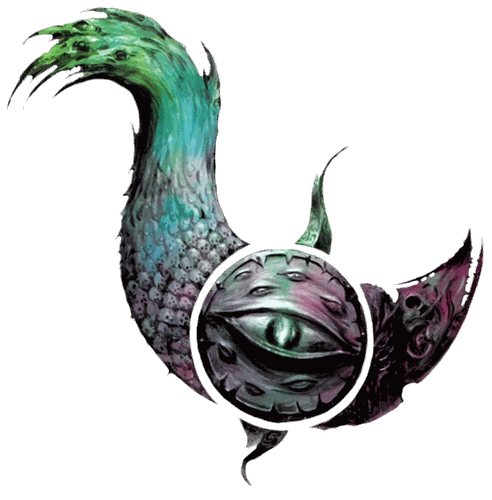 The mark of Tzeentch Artwork © Games Workshop | |
| Titles | The Changer of Ways, the Architect of Fate, the Great Conspirator, the Lord of Change |
| Domain | Change, sorcery, ambition, hope, fate and conspiracy |
| Colours | Blue, with shifting violets, greens and pinks |
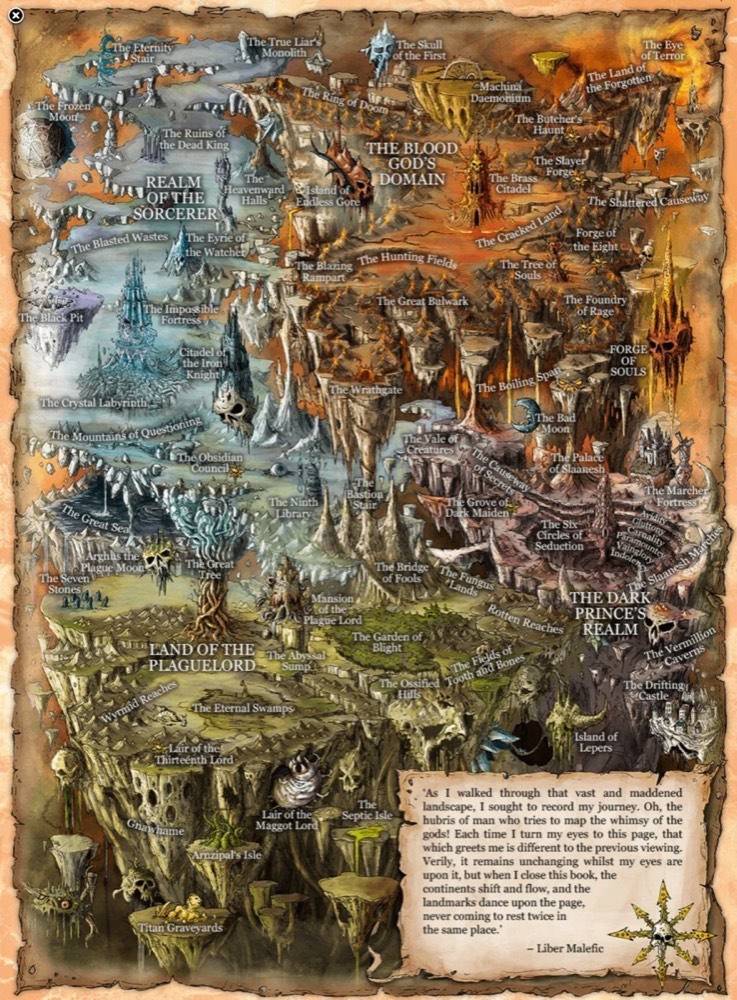
| Realm | The Realm of the Sorcerer, with the Crystal Labyrinth and the Impossible Fortress, in the Realm of Chaos |
| Symbol | The crescent and eye; the raven; the flame |
| Rival | Khorne |
| Servants | |
| Greater daemons | Lords of Change, Kairos Fateweaver |
| Lesser daemons | Pink Horrors, Blue Horrors, Brimstone Horrors, Flamers, Screamers |
| Mortal champions | Ahzek Ahriman; Daemon Primarch Magnus the Red |
| Legion | Thousand Sons |
Tzeentch, called the Changer of Ways, the Architect of Fate and the Great Conspirator, is the Ruinous Power of change, sorcery, hope and scheming. He feeds on the ambition that drives men to plot and to rise, on the hope that sustains them when they fail and on the great power that accompanies the study of the Warp. Of the four named Powers he is the most intelligent in the opinion of Imperial scholars, the most unpredictable and the one most closely associated with the human capacity to imagine a better future. That is the source of his danger. He offers each follower what he most desires, and each gift is a step in a plan that the follower cannot see.[1]
Tzeentch's worshippers include sorcerers, conspirators, ambitious nobles and heretical scholars. His cults are better hidden than those of any other Power. A Tzeentchian cult may spend generations infiltrating a world's government, creating a chain of obligations and secrets, and may never raise a hand until a single act brings the whole structure down. The Inquisition has often found that a cult of Tzeentch that appears to have been destroyed was merely one gambit in a larger scheme, and that its destruction served the Changer's purposes better than its survival.[2]
His mortal legion is the Thousand Sons, the XV Legion of the Great Crusade, whose primarch Magnus the Red became a Daemon Prince of Tzeentch after the burning of Prospero. Tzeentch's daemons, the Pink Horrors, Flamers and Lords of Change, are among the most dangerous in the Warp, not because of their strength but because of their command of sorcery. Imperial doctrine requires that Tzeentchian incursions be met by psychic defence and by the deployment of Sisters of Silence or null-bearing troops.[3]
Nature and domain
[edit]The Changer of Ways
[edit]The aspect of Tzeentch is change, and with it hope, since the two are never far apart. The Ordo Malleus holds that Tzeentch is nourished by every scheme and every revolution, by every mind that believes the world can be improved and by every mind that works to improve it. He is also nourished by the failure of those schemes, and by the disappointment that follows. To Tzeentch's cultists, this is the mystery of their god: that he is served equally by victory and by defeat, and that all things in the galaxy are moves in his game.[1]
Tzeentch's power over sorcery is the chief means by which he draws mortals into his service. Psykers are drawn to him, since he offers them the knowledge their Imperial teachers refuse them. He is described in cult texts as the patron of all who seek to understand the Warp, and many of the forbidden grimoires in the Ordo Malleus's vaults are of Tzeentchian origin. The practice of sorcery is, in the Inquisition's experience, the most reliable path by which a man comes to serve the Changer without knowing it.[1]
It is a rule recorded by the Inquisition that the Changer's promises are always kept and never fulfilled in the way the supplicant expects. A sorcerer who asks for the power to cure a disease is given a cure that spreads a worse one. A noble who asks for a crown receives it and loses everything else. A man who asks for knowledge of his own fate learns it, and finds that learning was the thing that sealed it. Imperial scholars call this the Changer's Courtesy.[2]
The Crystal Labyrinth
[edit]Tzeentch's domain in the Warp is the Realm of the Sorcerer, a place of shifting crystal, towers that fold in on themselves and stairs that lead nowhere. At its centre lies the Crystal Labyrinth, a maze said to be the first and greatest of the Changer's constructions, and the Impossible Fortress, his citadel, whose walls change with each glance. The accounts of the few mortals who have entered the Realm describe it as a vast library with no exit and no beginning, whose books record the fate of every living creature. The Ordo Malleus records no one who returned with a reliable account.[1]
Daemons
[edit]The Horrors
[edit]The common troops of Tzeentch's host are the Pink Horrors, small, grinning daemons that dance and cast spells of fire. A Pink Horror that is struck down splits into two Blue Horrors, each smaller and weaker than its parent, and the Blue Horrors, if killed, dissolve into smaller Brimstone Horrors that burn with a blue flame. The daemons laugh as they die. The Imperial Guard's manual instructs soldiers to retreat from any Horror that seems to be laughing, since the laughter is itself a spell.[3]
Lords of Change and Fateweaver
[edit]The greatest of Tzeentch's daemons are the Lords of Change, tall, winged creatures with the heads of birds, whose robes are woven from the stuff of the Warp. They are the Changer's schemers and lieutenants, each commanding a part of his plans, and each is a more potent sorcerer than any mortal. Among them is Kairos Fateweaver, a two-headed Lord of Change whose right head speaks the future and whose left the past. The Imperium has recorded his appearance in many sources, and the Ordo Malleus regards him as the principal agent of the Changer in the long war. His predictions are always true, and always misleading.[1]
Other servants
[edit]The Flamers are fiery, many-armed creatures that hunt in packs. The Screamers are manta-shaped beasts that glide through the Warp and are known for the shrieking sound they make. The Changer is also served by Chaos Spawn, unfortunate mortals whose bodies have been undone by sorcery and who survive as masses of limbs and eyes. Tzeentch's cultists regard them as blessed, and the Imperial Guard regards them as the most disturbing of the enemy's troops.[4]
Worshippers
[edit]Cults and sorcerers
[edit]Tzeentch's cults appear throughout the Imperium and are found at every level of its society. They are favoured by those who value secrecy and knowledge: scribes of the Administratum, scholars of the Adeptus Mechanicus, adepts of the Navigator Houses and psykers of the Adeptus Astra Telepathica. A typical cult has a hierarchical structure of nested cells, each of which knows only its own task, so that the destruction of any one part does not reveal the whole. Their purposes are often obscure even to their members. A cult may spend generations preparing for a single event, and a member who is asked the reason may say only that it is part of the pattern.[2]
The Inquisition's countermeasure against Tzeentchian cults is slow patience. An Inquisitor who strikes too early may destroy a cell and leave the plot intact, while one who strikes too late may find that the cult has accomplished its goal and moved on. The Ordo Malleus is cautious about drawing conclusions. A cult that appears to follow Tzeentch may be a decoy created by another cult, and a cult that appears to be hostile may be one of the Changer's own.[1]
The Thousand Sons
[edit]The Thousand Sons were the XV Legion, raised from the psykers of Prospero, and their primarch Magnus the Red was the most gifted psyker of all the primarchs. In the Great Crusade the Legion fought with sorcery as well as arms, and its Librarius, led by the Chief Librarian Ahzek Ahriman, was without equal. Magnus had, in his youth, bargained with Tzeentch to halt the mutations of the Flesh Change that threatened his sons, and the Changer's price was one that the primarch did not understand until it was due. At the Council of Nikaea the Emperor ordered the Legion to abandon the practice of sorcery. Magnus obeyed in appearance and continued in secret.[5]
In the Heresy, Magnus tried to warn the Emperor of Horus's fall by a psychic message across the Warp. The message broke through the wards of the Imperial Palace and destroyed the Webway project beneath it. The Emperor commanded the Space Wolves, under Leman Russ, to bring Magnus to justice, and Prospero was destroyed in the attempt. Magnus, dying, was saved by Tzeentch, and the Thousand Sons fled to the Eye of Terror. The Legion's Flesh Change returned at the end of the Heresy, and the survivors would have become Chaos Spawn had Ahriman not cast the spell known as the Rubric. It killed every legionary who lacked the psychic gift and bound the rest in their armour as dust-filled constructs, the Rubricae. The Rubric split the Legion, and Magnus exiled Ahriman, though the Changer protected him.[5]
Ahriman and the Rubricae
[edit]Ahzek Ahriman, the Chief Librarian of the Legion, is the best known of Tzeentch's mortal servants. He is a sorcerer of enormous power who has spent ten thousand years pursuing the Changer's secrets and his own plans. He has appeared in the Imperium's records many times, usually as the author of some cataclysm. The Ordo Malleus records that Ahriman's Rubric was successful in saving some part of the Legion, and a failure in everything else. The Rubricae are silent and obedient, and many of them have been lost to the Warp over the millennia.[3]
History
[edit]Origins
[edit]The Imperium has no firm account of Tzeentch's origin. He is the Power with the strongest connection to intellect, and the Imperium's records of the Age of Strife are full of Tzeentchian cults that arose among the scientists and sorcerers of the time. Aeldari accounts speak of a Power of the same description, and hold that his games were already in play when their civilisation was young.[1]
The Horus Heresy
[edit]Tzeentch played a significant part in the Horus Heresy. His agents were active in the Word Bearers' cult, and the Word Bearers raised the Ruinstorm at Calth that cut Terra off from its armies. Imperial scholars regard the destruction of Prospero as a prime example of the Changer's methods, since the loyalty of the Thousand Sons was destroyed by an event that was itself the result of Magnus's loyal act. The Legion's fall was a gambit within a gambit, and it is the Inquisition's belief that no part of Magnus's story, including his bargain, was accidental.[6]
The long war and the Era Indomitus
[edit]In the ten thousand years after the Heresy, the Changer's schemes touched every part of the galaxy. His agents were behind many of the secret movements of the Black Crusades, and his sorcerers led several of the cults that destabilised the Imperium from within. Magnus has lived since the Heresy in the Tower of the Cyclops on Sortiarius, the Planet of the Sorcerers, and from there has plotted against the Imperium and, in particular, against the Space Wolves. In the early forty-first millennium he moved Sortiarius from the Eye of Terror to the orbit of the ruins of Prospero, powered by the sacrifice of the people of Midgardia.[5]
After the opening of the Great Rift, Tzeentch grew jealous of the gains made by Nurgle in the Scourge Stars, and Magnus launched an invasion of the Stygius Sector. Imperial accounts also record that the Changer's followers have worked among the psykers of the Imperium, offering them refuge on Sortiarius. The Ordo Malleus regards this as a recruiting operation, and the Inquisition's psychic hunters are charged with discovering the means by which the offer is made.[7]
Relations with other Powers
[edit]Tzeentch's principal enemy is Khorne. The Blood God despises sorcery and schemes, and the Changer despises brute violence, and their followers have fought one another since the beginning of recorded history. The Changer has used this to his advantage, and several of the Imperium's victories over Khornate hosts are in the opinion of the Inquisition the result of a Tzeentchian gambit. Nurgle and Tzeentch are also at odds, though the Plague God's slowness gives the Changer time to act. His dealings with Slaanesh are recorded as the least hostile of the four, though no lasting alliance is known.[1]
Imperial response
[edit]The Imperial response to the cults of Tzeentch is a combination of vigilance and psychic discipline. The Adeptus Astra Telepathica screens every psyker, the Black Ships take those with unusual power, and the Inquisition maintains networks of informants. The Space Marine Chapters have their own defences: the Space Wolves, whose history with the Thousand Sons is the longest, treat every sorcerer's stronghold as a target, and the Grey Knights are trained to resist Tzeentch's illusions. The most reliable protection is the faith of the Imperial Cult, which holds that a mind that believes in the Emperor cannot be turned by the Changer's promises.[8]
Timeline
[edit]| Date | Event |
|---|---|
| Age of Strife | The worship of the Architect of Fate grows among sorcerers and scholars of the Age of Strife.[a] |
| 001.M31 | The Council of Nikaea forbids sorcery, and the Thousand Sons keep their psychic studies in secret. |
| 004.M31 | Magnus the Red sends his warning; the Burning of Prospero follows and Tzeentch carries the Thousand Sons into the Eye of Terror. |
| M32 | The First Battle of the Fang: the Thousand Sons attack Fenris under Magnus's visions. The year is not recorded. |
| M36 | The Thousand Sons and Tzeentch's warbands plot in the Warp during the Plague of Unbelief.[b] |
| 998.M41 | Thousand Sons fight through the Webway in the Sanctity Breached. |
| 999.M41 | Tzeentch's sorcerers and warbands fight in the Thirteenth Black Crusade and at Cadia. |
| Early M42 | Ahriman and the Thousand Sons continue their schemes from the Eye of Terror and the Imperium Nihilus.[c] |
See also
[edit]
Notes
[edit]References
[edit]- ^ a b c d e f g h Warhammer 40,000: Core Book (9th Edition), pp. 37-38. Games Workshop. Wraight, Chris. Battle of the Fang (novel). Black Library.
- ^ a b c Codex: Chaos Daemons (8th Edition), pp. 14-17, 47. Games Workshop. Counter, Ben. Grey Knights (novel). Black Library.
- ^ a b c King, William. Space Wolf (novel). Black Library. King, William. Grey Hunter (novel). Black Library.
- ^ Lightner, Lee. Sons of Fenris (novel). Black Library. Lightner, Lee. Wolf's Honour (novel). Black Library.
- ^ a b c McNeill, Graham. A Thousand Sons (novel). Black Library. Abnett, Dan. Prospero Burns (novel). Black Library.
- ^ McNeill, Graham. The Outcast Dead (novel). Black Library. Dembski-Bowden, Aaron. Aurelian (novella). Black Library.
- ^ French, John. Ahriman: Exile (novel). Black Library. Codex: Chaos Daemons (6th Edition), pp. 12-13, 37-45, 61-65, 68-69, 73, 77, 82, 91-92, 95, 97, 99-100, 102. Games Workshop.
- ^ Codex: Chaos Daemons (4th Edition), pp. 11-12, 31, 35, 39, 43, 49, 53, 59, 65, 74, 76, 78-82, 85-86. Games Workshop. Codex: Chaos Space Marines (4th Edition). Games Workshop.
Further reading
[edit]- Liber Daemonica (rev. M38). Ordo Malleus. The chapter on the Changer of Ways and his host. Restricted.
- Liber Primarchus (M32, revised M41). The entry on the XV Legion.