
Inquisitor
| Inquisitor | |
|---|---|
 The Inquisitorial I, borne on the Inquisitorial rosette Artwork © Games Workshop | |
 40,000 Wiki | |
| Notable holder Gregor Eisenhorn Inquisitor of the Ordo Xenos, M41 | |
| Inquisition Ordo Malleus Ordo Hereticus Ordo Xenos | |
| Style | Inquisitor; Inquisitor Lord (Lord Inquisitor) |
| Type | Agent of the Holy Orders of the Emperor's Inquisition |
| Member of | The Inquisition: the Ordo Malleus, Ordo Hereticus, Ordo Xenos and minor ordos |
| Reports to | Answerable to no other authority of the Imperium; senior Inquisitor Lords guide the ordos |
| Appointer | An existing Inquisitor, usually an Inquisitor Lord |
| Term length | For life |
| Formation | c. 014–020.M31, by Malcador the Sigillite[a] |
| First holder | The first Inquisitors recruited by Malcador the Sigillite |
| Deputy | Interrogators and Acolytes |
| Insignia | The Inquisitorial rosette |
An Inquisitor is a clandestine agent and one of the highest-ranking members of the Holy Ordos of the Emperor's Inquisition. Inquisitors serve as the secret police and intelligence agents of the Imperium of Mankind, and their authority is in theory second only to that of the Emperor of Mankind himself. They are charged, by an ancient order of the Emperor, with the security of the Imperium against the taint of Chaos, the daemonic threats of the Warp, internal dissent and the dangers posed by intelligent aliens such as the Orks, the Tyranids, the Aeldari, the Necrons and the T'au.[1][2]
Inquisitors may command any servant of the Imperium, from a planetary militia to a Space Marine Chapter, requisition any resource, try and execute anyone below the rank of High Lord and, in the last resort, condemn a world to Exterminatus. In theory the authority of the Inquisition supersedes all others, including a High Lord or a Chapter Master. In practice Inquisitors belong to a class of high-echelon servants, among them planetary governors, generals, cardinals, Rogue Traders, archmagi and Judges, who wield much the same de facto influence, and relations between these groups are often seething with rivalry. Experienced Inquisitors therefore act with discretion toward the Adeptus Astartes and the Adeptus Mechanicus.[1][2]
The Inquisition is split into three great ordos, the Ordo Xenos, the Ordo Malleus and the Ordo Hereticus, and many smaller, more specialised ordos, the Ordos Minoris. Beneath the Inquisitor, apprentices called Interrogators and the agents of his retinue, the Acolytes and Throne Agents, do much of the work, and the most senior and respected Inquisitors are recognised as Inquisitor Lords, also called Lord Inquisitors or High Inquisitors. An Inquisitor answers to no superior, and is checked only by the judgement of his peers, who may declare one who has fallen into heresy Excommunicate Traitoris and hunt him down.[1][3]
History
[edit]Origins
[edit]Tradition holds that the first Inquisitors were the agents of Malcador the Sigillite during the Horus Heresy (005–014.M31). Malcador recruited warriors from the Space Marine Legions, including loyalists of the traitor Legions, together with members of the Adeptus Custodes, the Sisters of Silence and others, and sent them on secret missions as his Knights-Errant. After the Siege of Terra in 014.M31 their work continued, and the institution that grew from it became the Inquisition. The Grey Knights were founded in the same years from the same circle of agents. The date of formation is not exactly recorded and is estimated at c. 014–020.M31.[4][5][b]
The ordos
[edit]The ordos took their form over the following millennia. The Ordo Malleus, which hunts daemons, has the Grey Knights as its Chamber Militant. The Ordo Hereticus, which hunts heretics, witches and mutants, rose to prominence after the Age of Apostasy in M36 and the Reign of Blood of Goge Vandire, when a corrupt Ecclesiarchy showed the danger of unchecked faith; the Adepta Sororitas became its Chamber Militant. The Ordo Xenos guards against the alien and commands the Deathwatch.[5][6]
The Era Indomitus
[edit]The opening of the Great Rift in 999.M41 and the return of Roboute Guilliman have reshaped the work of Inquisitors. The Rift has cut many conclaves off from one another, and Guilliman, as Lord Commander of the Imperium, has worked with Inquisitors such as Katarinya Greyfax, while many others distrust the return of a primarch to power. Inquisitors remain the Imperium's chief defence against the infiltration of Chaos and the xenos, which the Rift has made harder to resist.[7]
Bearers of the seal
[edit]To be chosen to bear the Inquisitorial Rosette is at once the greatest of honours and the weightiest of burdens. Of the uncounted trillions of humanity only those marked out by the Emperor's grace are judged worthy, and an Inquisitor rises far above the circumstances of his birth. Yet he is far from master of his fate. Many find the station a curse, and some, such as the Oblationists of the Calixis Sector, would sacrifice their eternal souls to become weapons against Chaos. For many, life is a series of terrible revelations. On rising from Interrogator to Inquisitor a man may learn that all he thought he knew was false, and the shock repeats throughout his career; many go mad and must be hunted down by their peers lest they turn Renegade.[1][8]
Temperaments
[edit]Inquisitors are as varied as the worlds that produce them. The militant believes that the enemy must be burned, blasted and scoured, and may order a city destroyed to remove a mutant enclave. The investigator is an arch-detective who surrounds himself with sages and draws on the skills of many organisations. The machinator keeps an intricate web of agents, often unaware of their master, and plays the politics of the Inquisition as much as the war on heresy. The bombast blurs the line between preacher and Inquisitor, dresses like a high priest and denounces on sight. The judicar assumes guilt and travels with a court of clerks, convening a court of assize wherever he arrives. The idealist still hopes that mankind can be redeemed, though bitter experience usually cures him of the hope.[1][3]
Powers
[edit]An Inquisitor's power is limited only by what he can compel others to do. The Inquisitorial rosette gives him the right to command the forces of any Imperial institution, including the Astra Militarum, the Imperial Navy, the Adeptus Arbites and the Space Marine Chapters, though cooperation is not always willing; to investigate, arrest, try and execute any citizen or official, including Planetary Governors; to call on the Chambers Militant of the ordos and on the Officio Assassinorum; and to declare Exterminatus, which only an Inquisitor or a Space Marine officer may unleash.[1][2]
Despite this authority even the Inquisition may be unable to stop a deeply rooted infection of Chaos or a powerful xenos force such as a hive fleet. Inquisitors also draw on an enormous range of wargear and artefacts, because of their dealings with the other adepta and even xenos cultures.[1]
Ranks
[edit]After full Inquisitor rank the Inquisition is a flat organisation, in which the only check on an Inquisitor's authority is another Inquisitor, or several acting in concert as a conclave. Conclaves are usually organised to include the Inquisitors of every ordo in a sector or sub-sector, and within them some titles exist for administration, though they are read by other Inquisitors as marking a first among equals. The egalitarian attitude does not apply to the Acolytes in an Inquisitor's retinue.[1][3]
Inquisitor Lord
[edit]The title of Inquisitor Lord is a recognition and not a promotion. An Inquisitor Lord holds no territory and commands no specific individuals, but he may recognise the appointment of new Inquisitors, convene high conclaves from several sector conclaves and requisition greater resources. Promotion is by invitation only, and a candidate must be nominated by an existing Lord and approved by two others, a rule that proves difficult to apply since few Inquisitors know even one Lord personally. A grandmaster leads the conclave of a sector or sub-sector, and a master oversees each ordo within it, the grandmaster being chosen on his predecessor's death by secret ballot among the three masters. The Inquisitorial Representative speaks for the Inquisition among the High Lords of Terra and is nominated from the Inquisitor Lords of the sectors around Terra; one who has served is thereafter called an Inquisitor Lord Terran.[1]
Interrogator
[edit]An Interrogator is an Inquisitor's apprentice and potential successor. Interrogators often carry a rosette of their own, which lacks the full powers and the access to classified archives that a true Inquisitor's possesses. Above them stands the High Interrogator, who is likely to become an Inquisitor soon. Other titles for apprentices include novitiate, explicator and approbator; the Explicator learns to extract information by physical and mental torture under his mentor. To raise an Acolyte to full rank normally needs the consent of three Inquisitors or a single Inquisitor Lord; in rare cases, such as the death of the master on an operation, an Acolyte inherits the powers at once.[1]
Acolytes and Throne Agents
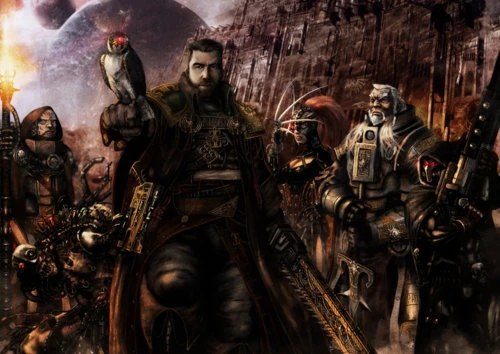
[edit]Few Inquisitors work alone. Their retinues, or cadres, are formed of Acolytes, initiates who may one day become Inquisitors, and Throne Agents, trusted Acolytes who have served for years and who are counted full members of the Inquisition. Acolytes are drawn from every part of the Imperium: priests, astropaths, servitors, tech-priests, Administratum officials, Storm Troopers, Judges, assassins and death cultists. Common ranks, from highest to lowest, run Throne Agent, Trusted Acolyte, Proven Acolyte and Acolyte, with the Prime as commander of a warband. A cadre belongs to the Inquisitor rather than the Inquisition: his enemies are its enemies, and if he is denounced by his fellows, so are all his followers. When an Inquisitor dies, many cadres fall apart.[1][3]
Holdings and recruitment
[edit]The Inquisition as an institution employs few staff. Most work is done by individual Inquisitors with their retinues, and even formal bodies, such as the Ordos Calixis of the Calixis Sector, are controlled by their own members rather than a central authority. An Inquisitor may requisition almost anything, from sidearms to starships, and keeps much of his property secret, even from his allies, lest it become a target for rivals. Most keep safe houses, some maintained for centuries by generations of house-serfs and used only once; some store tainted artefacts away from the eyes of their peers. Some Inquisitors keep private armies drawn from the Astra Militarum, including Tempestus Scions platoons that are never returned.[1][3]
Recruitment is not centralised. Potential Inquisitors are often drawn from the Progena of the Schola Progenium who show promise in intellect or psychic gift, but each Inquisitor chooses for himself, and some do not recruit at all. No physical standard exists; proof of intelligence and loyalty to the Emperor is all that is asked, along with a free mind, strong will and unflinching principles. Acolytes may pass between patrons, which carries the ideals of the Inquisition, and its factional quarrels, across the centuries. The Inquisitorial saying holds: "Knowledge is power; guard it well."[1]
Philosophies
[edit]Inquisitors disagree about how the Imperium is best protected. Puritans hold that the enemy must be destroyed by any means but that its weapons must never be used; Radicals hold that the weapons of the enemy, including daemons, psychic sorcery and alien technology, may be turned against it. Among the Puritans, Monodominants hold that only the Emperor's own creations should be tolerated and Amalathians that order and unity must be defended; the Thorian faction, which sees the saints and the Ecclesiarchy as vessels of the Emperor's power, studies the Living Saints; Radical schools include the Oblationists, who embrace damnation to fight Chaos. Each faction regards some of the others as heretics. A Radical or Puritan who goes too far, by tinkering with Chaos or by corruption, is declared Excommunicate Traitoris by his peers.[1][3][9]
Notable Inquisitors
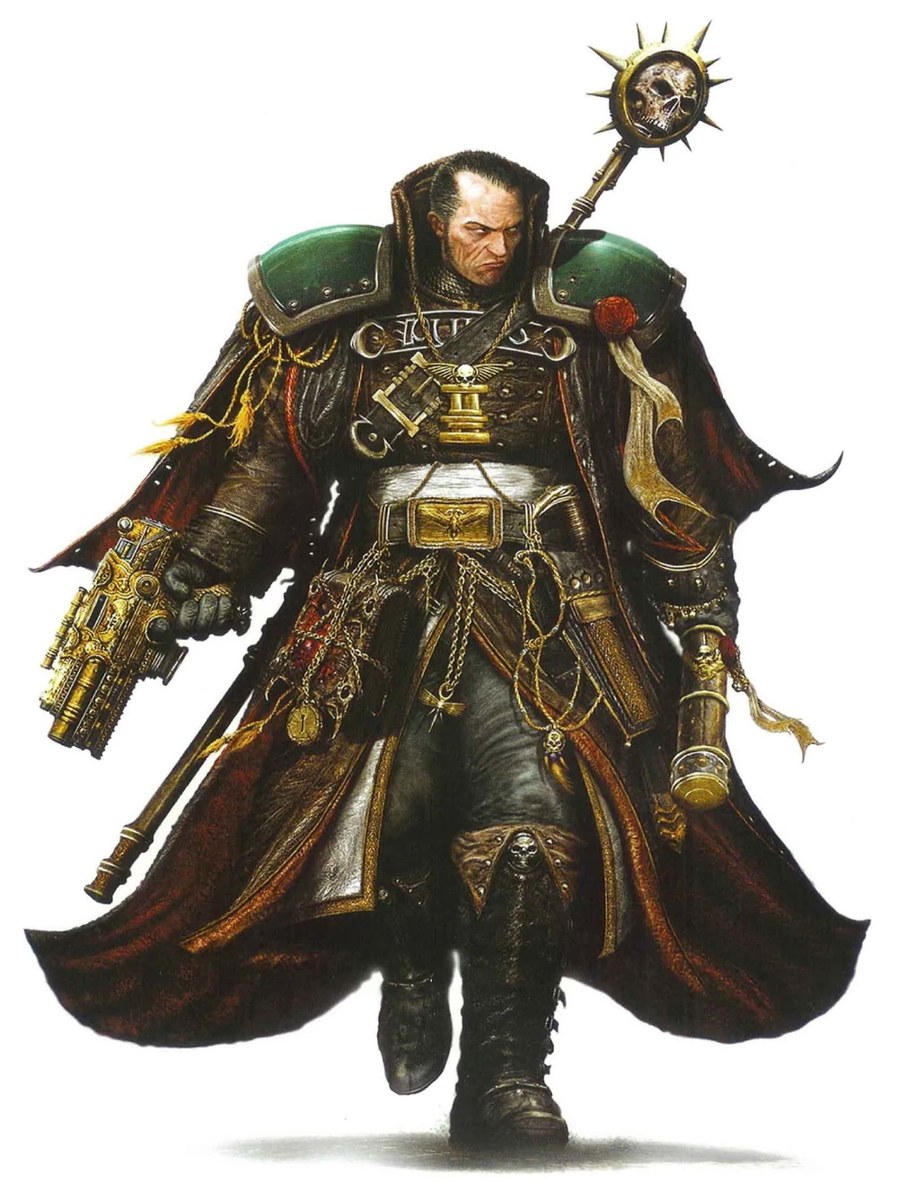
[edit]Imperial records preserve the careers of many Inquisitors, though few are named in the open. Gregor Eisenhorn of the Ordo Xenos, an Amalathian who began as a staunch Puritan and became a Radical, brought down Quixos the Bright and Pontius Glaw with a captured daemonhost, and was finally declared excommunicate. Gideon Ravenor, his former Acolyte and a psyker more powerful than his master, wrote texts that remain famous. Kryptman of the Ordo Xenos, the expert on the Tyranids, ordered the worlds in the path of Hive Fleet Leviathan abandoned or destroyed, and condemned eighty-two newly discovered alien species to eradication.[1]
| Name | Ordo | Period | Known for |
|---|---|---|---|
| Gregor Eisenhorn | Ordo Xenos | M41 | Memoirs of an Inquisitor; Puritan turned Radical; declared excommunicate |
| Gideon Ravenor | Ordo Xenos | M41 | Pupil of Eisenhorn; powerful psyker |
| Kryptman | Ordo Xenos | M41 | Tyranid expert; the Kryptman Census (997.M41); later ordered the worlds in the path of Hive Fleet Leviathan abandoned or destroyed |
| Torquemada Coteaz | Ordo Malleus | M41–M42 | Inquisitor Lord and High Protector of the Formosa Sector |
| Fyodor Karamazov | Ordo Hereticus | M41 | Inquisitor Lord and judge from the Throne of Judgement |
| Jaq Draco | Ordo Malleus | Late M38 to early M39 | Stole the Book of Rhana Dandra; granted an audience with the Emperor |
| Solomon Lok | Ordo Xenos | 850.M41 | Investigated the loss of the Beta Anphelion IV facility |
| Katarinya Greyfax | Ordo Hereticus | 999.M41–M42 | Inquisitor allied with Belisarius Cawl and Roboute Guilliman |
| Xavier Mendoza | Unaligned | Late M31 | Fanatic convinced all Space Marines served Chaos |
Timeline
[edit]| Date | Event |
|---|---|
| c. 014–020.M31 | Malcador the Sigillite's agents become the first Inquisitors (estimated) |
| Late M31 | Inquisitor Mendoza's campaign against the Space Marines |
| M36 | The Age of Apostasy strengthens the Ordo Hereticus |
| 850.M41 | Inquisitor Lok investigates Beta Anphelion IV |
| 997.M41 | Inquisitor Kryptman implements the Kryptman Census to find the entry vector of a new Tyranid invasion |
| 999.M41 | The Great Rift opens; Inquisitor Greyfax works with Belisarius Cawl |
| M42 | Inquisitors of the Era Indomitus divided over the Lord Commander |
See also
[edit]Notes
[edit]- ^ The Inquisition's records place its founding in the last years of the Horus Heresy or shortly after it; no exact year is accepted by the Ordo Originatus.
- ^ The Ordo Originatus accepts no exact founding year; the estimate is drawn from the sequence of events.
References
[edit]- ^ a b c d e f g h i j k l m n o "Inquisitor". Warhammer 40k Wiki (Fandom). Drawing on The Inquisition: An Illustrated Guide to the Secretive Protectors of the Imperium and Dark Heresy: The Inquisitor's Handbook (RPG).
- ^ a b c Codex: Inquisition (6th edition). Games Workshop. pg. 60. Codex: Imperialis (2nd edition). Games Workshop. pg. 39.
- ^ a b c d e f Dark Heresy: The Inquisitor's Handbook (RPG). Games Workshop. pp. 41-51, 54-85, 213.
- ^ Counter, Ben. Dark Adeptus (novel). Black Library.
- ^ a b Codex: Inquisition (6th edition). Games Workshop. pg. 60.
- ^ Codex: Grey Knights (5th edition). Games Workshop. pg. 48. Codex: Witch Hunters (3rd edition). Games Workshop. pp. 16-17.
- ^ War Zone Nachmund: Vigilus Alone (9th edition). Games Workshop. pg. 20.
- ^ Dark Heresy: Core Rulebook (RPG). Games Workshop. pp. 40-94, 276-277.
- ^ Thorpe, Gav. Inquisitor: The Thorians (specialist game background book). Games Workshop. pg. 24.