
Mutant
| Mutant Mutatus | |
|---|---|
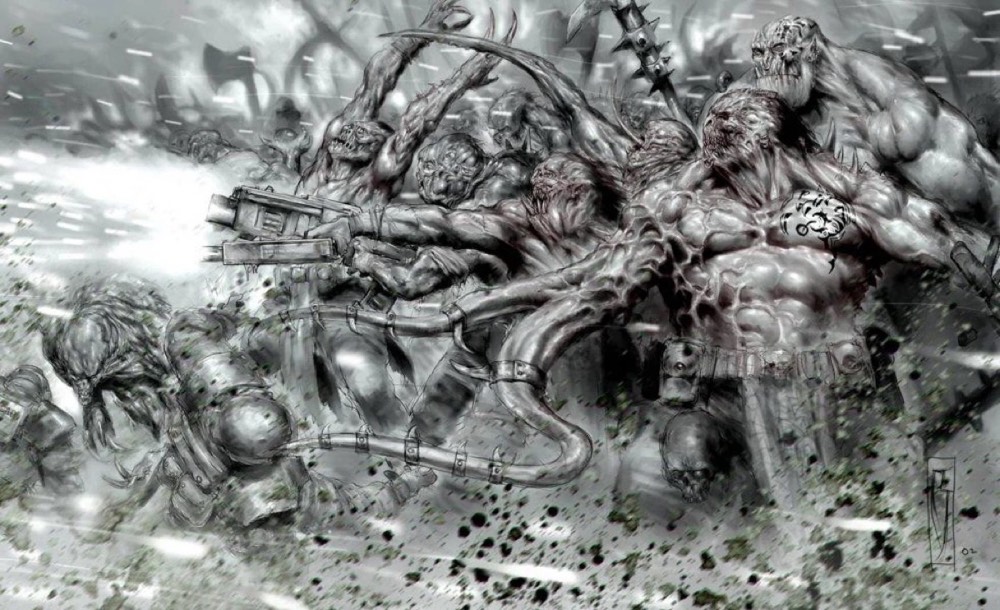 A horde of Chaos mutants in combat Artwork © Games Workshop | |
| Definition | Human deviating from the human genetic pattern |
| Causes | Radiation, extreme planetary environments, inheritance over many generations, Warp and Chaos influence |
| Legal status | Outcasts, often hunted and killed; tolerated only as sanctioned exceptions |
| Assessment | Godolkin Purebreed Guide (Godolkin Index) |
| Exceptions | Abhuman strains; Navigators; sanctioned psykers |
| Policed by | Inquisition; Imperial authorities |
A mutant (in the vulgar Low Gothic, a mutie) is a human being whose body differs from the human genetic pattern. In the Imperium of Mankind the word covers a vast range of conditions, from a minor deformity to a body changed beyond recognition, and it carries a heavy weight of law and religion. Imperial authorities hold the baseline human form to be divinely perfect and treat mutation as a heretical crime against the Emperor of Mankind, because of its link to sympathy for or worship of Chaos. Mutants are shunned by almost everyone and are often hunted down and killed.[1][2]
Mutants are nonetheless numerous. Millions across the Imperium are born deformed by radiation, by the extreme environments their ancestors lived in for generations, or by the touch of Chaos. They become the outcasts and lower classes of Imperial society. On some worlds they live hidden in the undersumps and catacombs beneath great cities or in the radiation-ravaged wastes. Mutant populations have been a frequent source of rebellion and of recruits for Chaos cults.[3][4]
The Imperium tolerates only a few kinds of mutant. These are the stable abhuman strains, such as Ogryns and Ratlings, that serve in the Astra Militarum, the Navigators, who are vital to its commerce and defence and may have been bred deliberately in the Dark Age of Technology, and sanctioned psykers. Psychic ability is itself a form of mutation, governed by its own laws.[1]
Causes
[edit]Imperial records attribute mutation to several causes. Many mutants are born so, because their ancestors were exposed over many generations to mutagens such as radiation or to extreme planetary environments, and radiation can also act on a child before birth. The most feared cause is spiritual: exposure to the psychic energies of Chaos, which can cause rampant mutation. Followers of the Chaos Gods are known to be granted mutations as gifts by their masters, and so physical mutation is taken as a sign of inner corruption.[4][3]
Classification
[edit]The official standard for distinguishing humans from mutants is the Godolkin Purebreed Guide, also known as the Godolkin Index. It scores a subject's deviations from the human phenotype by a system of points: the more severe the mutation, the higher its value. A subject whose total exceeds a set threshold is classed as a mutant. On most worlds a tolerance of up to three points is allowed, but the Administratum may grant exemptions to worlds of strategic value or with highly mutagenic environments. On the industrial world of Kalidar, for example, emergent psykers are put to death only if they deviate by more than fourteen points from the baseline human genome.[1][3][a]
History
[edit]The Age of Strife
[edit]Imperial scholars trace the danger of the warp to the end of the Dark Age of Technology, when uncontrolled human psykers began to appear. The tragedies they caused helped bring on the destruction of the Age of Strife (c. M25–M30), which consumed human space.[5]
The Great Crusade and after
[edit]During the Great Crusade (c. 798.M30–005.M31) mutants such as the Beastmen were accepted and used in the Imperial Army, formed into their own squads or mixed with the regular troops. After the Horus Heresy (005–014.M31) the High Lords of Terra outlawed mutants for the part they had played in the rebellion as favoured servants of the Dark Gods. The link between mutants, heresy and Chaos cults has since hardened the hatred of them.[2][5]
The 41st and 42nd millennia
[edit]The history of many human worlds is full of mutant uprisings, and such conflicts are bitter and merciless. Mutant populations are often vital to economic operations, yet they are also a problem for civil order and a ready source of riots and cult activity. In the Era Indomitus, after the Great Rift opened in 999.M41, mutative warp storms washed over the galaxy. Some of the seeds they carried sprouted at once as mutation outbreaks and plagues. Others lay dormant, and many voidships lost in the warp during the Noctis Aeterna emerged deeply and often unknowingly changed.[6]
Life in the Imperium
[edit]The treatment of mutants depends on the world. On many worlds mutants are quickly abandoned by their parents and must fend for themselves, and it is rare to find a world that tolerates them without discrimination. For every sanctioned mutant that serves the Imperium, a thousand are slain outright and another thousand hide in the shadows. Where they are allowed to exist, they are usually a legally discriminated underclass, forbidden to bear weapons for fear of rebellion, and often exiled to harsh work such as the rad mines of Sepheris Secundus or the chemworks of Solomon in the Calixis Sector. Those not counted fully human have no defence against brutality by those in power.[3][1]
Excluded from society, mutants have repeatedly turned to cults that promise them dignity or vengeance. Chaos cults in particular recruit among them, and the gifts of mutation that the Chaos Gods bestow can make outcasts into worshippers. Such cults are often led by rogue psykers and witches, who can hide more easily among the distortions of a mutant population.[4]
Mutation and Chaos
[edit]Not all mutation is the work of Chaos, but the followers of the Chaos Gods are frequently mutated, and mutation is held to be a sign of Chaos influence. Mutants who serve Khorne are common, since many turn their hatred of Imperial prejudice into battlefield fury, and their mutations, such as razor claws, tripled muscle or acid blood, favour combat. A Chaos warrior who receives too many gifts may degenerate into a mindless spawn.[4][5]
Timeline
[edit]| Date | Event |
|---|---|
| c. M25–M30 | Widespread mutation in the Age of Strife |
| c. 798.M30–005.M31 | Mutants such as Beastmen serve in the Imperial Army during the Great Crusade |
| 005–014.M31 | Mutants fight for the traitors in the Horus Heresy; the High Lords of Terra outlaw them afterwards |
| 999.M41 | The Great Rift opens and mutative warp storms spread across the galaxy |
See also
[edit]
Notes
[edit]- ^ The date of the Godolkin Guide is not recorded. It is the official standard in the 41st millennium.
References
[edit]- ^ a b c d Haley, Guy. Baneblade (novel). Black Library, pg. 263.
- ^ a b Warhammer 40,000: Rulebook (6th Edition), pp. 148, 158, 172-173, 177, 180, 218-219, 232, 404-405. Games Workshop.
- ^ a b c d Warhammer 40,000: Rogue Trader (1st Edition), pp. 52-57. Games Workshop.
- ^ a b c d Kill Team - Rogue Trader (Specialty Game), "A Growing Sickness".
- ^ a b c Black Crusade: The Tome of Blood (RPG), pg. 17.
- ^ Dark Heresy: The Disciples of the Dark Gods (RPG), pg. 57.