
Imperialis Auxilia
| Imperialis Auxilia | |
|---|---|
| Excertus Imperialis; the Imperial Army of the Great Crusade | |
 Emblem of the Imperial Army as carried on the standards of the Great Crusade Artwork © Games Workshop | |
| Active | c. 798.M30 – c. 021.M31 |
| Origin | The regiments of the Unification Wars on Terra (late M29 – c. 712.M30) and the the Saturnyne Ordo |
| Allegiance | The Emperor of Mankind; divided by the Horus Heresy (005–014.M31) |
| Type | Combined ground, air and void army of unaugmented humans |
| Command | Lords Commander Militant and Lords Militant; the Warmaster from 000.M31 |
| Elite divisions | Solar Auxilia; the genos regiments of the Old Hundred; the Lucifer Blacks |
| Size | Billions of soldiers, crew and adepts; 8,000,000 troops at the Ullanor Crusade alone (c. 999.M30) |
| Notable battles | Ullanor Crusade; Battle of Tallarn; Battle of Beta-Garmon; Siege of Terra |
| Successors | Astra Militarum and Imperial Navy (divided c. 021.M31) |
The Imperialis Auxilia, more fully the Excertus Imperialis and in common speech the Imperial Army, was the mortal army of the Imperium of Mankind during the Great Crusade (c. 798.M30 – 005.M31) and the Horus Heresy (005–014.M31). Its soldiers were ordinary men and women, unaugmented or only lightly altered, raised from the conquered worlds of the Imperium. They fought beside the Space Marine Legions, held what the Legions had won, and crewed most of the ships that carried the Crusade between the stars. The term auxiliaries covered all of them, from the elite Solar Auxilia to planetary levies raised for a single campaign.[1]
Unlike the later Astra Militarum, the Imperial Army held ground, air and void forces in a single chain of command. A Lord Militant could command regiments, fighter wings and battleships at once. In the Heresy whole armies followed their commanders into treason, and when the war ended Roboute Guilliman divided the Army in two. Its regiments became the Imperial Guard, and its fleets the Imperial Navy, so that no single officer could again command both.[2][3]
History
[edit]Origins on Terra
[edit]The Army's oldest regiments came out of the Unification Wars, which the Emperor fought on Terra from the late 29th millennium until c. 712.M30. Alongside the Thunder Warriors he raised armies of gene-hardened soldiers called genos, bred to survive the poisoned battlefields of the Age of Strife. When Terra was united, most of these formations were disbanded or purged. A hundred loyal ones were kept. These were the Old Hundred, among them the Geno Five-Two Chiliad, and they became the senior regiments of the new Army.[1]
The Great Crusade
[edit]The Emperor launched the Great Crusade c. 798.M30. The Legions of the Adeptus Astartes were its spearhead, but even several hundred thousand Space Marines could not hold a galaxy. Every world brought to Compliance was required to raise soldiers for the Crusade, and every Expeditionary Fleet carried a mortal army beside its Legion. For most of the Crusade these troops served as garrisons and as a second wave, clearing ground the Legions had broken. Only in its last decades did whole Army corps fight in the battle line with the Astartes.[1][4]
By the Ullanor Crusade (c. 999.M30 – 000.M31) the Army could put eight million soldiers onto a single world. At the Triumph of Ullanor in 000.M31 the Emperor named Horus Warmaster, and the Army's Lords Militant passed under his command. The same year the Emperor withdrew to Terra and left the Crusade to his son.[5]
The Horus Heresy
[edit]The Army's loyalty followed its officers. Many regiments attached to the Traitor Legions turned with them in 005.M31, often because their soldiers had served beside one Legion for decades and knew no other master. Others were purged by the Legions they served, or rose against them.[3]
Mortal armies decided several of the war's largest battles. At the Battle of Tallarn (010–012.M31) loyalist armoured regiments fought the Iron Warriors in the largest tank battle in human history. Army fleets and regiments held the line at the Battle of Beta-Garmon (007–013.M31), and in the Siege of Terra (013–014.M31) millions of Army soldiers, among them the Solar Auxilia and the conscripts of the Palace districts, manned the walls of the Imperial Palace beside the Imperial Fists, the Blood Angels and the White Scars. Admiral Niora Su-Kassen took the damaged fortress-ship Phalanx into hiding at the edge of the Sol System and led the loyalist counter-attack in the war's last hours.[6]
Division
[edit]After the Great Scouring (014–021.M31) the High Lords and the Lord Commander Roboute Guilliman judged that an army that held its own fleets could make itself master of a sector. The Imperial Army was divided c. 021.M31, the same reform that broke the Legions into Chapters at the Second Founding. Its regiments became the Imperial Guard, later the Astra Militarum, and its ships the Imperial Navy. The Guard has kept the Army's regimental traditions, and some of its oldest regiments claim descent from Crusade formations.[2][7]
Solar Auxilia
[edit]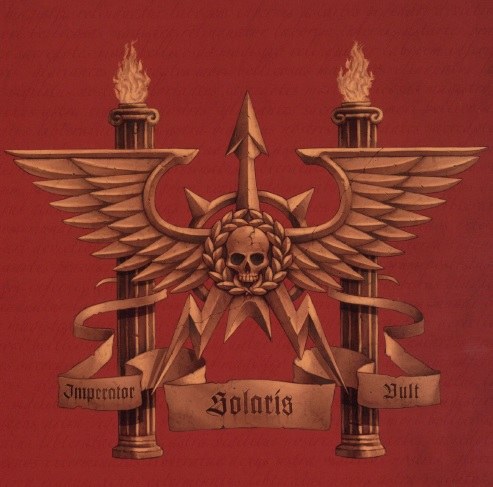
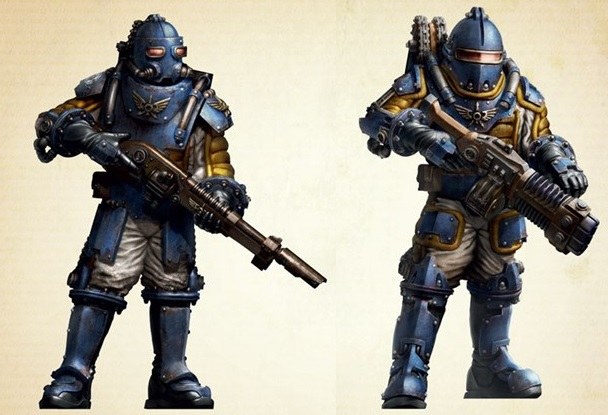
The Solar Auxilia were the elite of the Imperial Army. They were not a single regiment but a pattern of war, a set of doctrines, ranks and equipment that could be copied onto any world able to meet its standard. Their first ten regiments, the "Saturnyne Rams", were the Void Hoplites of the Saturnyne Ordo, the armies of the polities of Saturn, which joined the Imperium of their own accord at the start of the Crusade. Terra and Luna raised more regiments on the same model, and later the pattern spread across the Imperium.[8]
The Auxilia were trained to fight in vacuum and on hostile worlds, in sealed void armour. They garrisoned warships and frontier stations, served with Rogue Traders and held conquered systems after the Legions moved on. Their formations were cohorts that mustered some 120,000 fighters under a Marshal Solar, each split into sub-cohorts of about 1,200 and built from tercios of three sections. Smaller expeditions without a strong Legion presence were often led by a core of Auxilia under a Lord Marshal. Imperial commentators of the time ranked them second only to the Astartes. In the Heresy Solar Auxilia cohorts fought on both sides, and at the Siege of Terra they were among the Palace's most reliable defenders.[8][6]
Organisation
[edit]The Army was organised by world of origin. A world's tithe was raised as regiments, or as cohorts and tercios for the Solar Auxilia, and these were grouped into armies attached to an Expeditionary Fleet. At the top stood the Lords Commander Militant, the Lords Militant and the Lords Marshal, who answered to the Emperor and, from 000.M31, to the Warmaster. The same command held the troop ships, escort squadrons and battleships of the Army fleets, which later passed to the Navy.[1]
The Army also included specialist formations: the Old Hundred; the Lucifer Blacks, an elite regiment of the 670th Expedition; Malcador's Chosen, the guard of Malcador the Sigillite; and ogryn and other abhuman units. Iterators of the Imperial Truth travelled with the regiments to keep their morale and their doctrine sound, a duty later inherited by the Commissars.[1]
Timeline
[edit]| Date | Event |
|---|---|
| Late M29 – c. 712.M30 | Gene-forged regiments fight the Unification Wars; the Old Hundred are kept after Unity |
| c. 798.M30 | The Great Crusade begins; the Saturnyne Ordo forms the first Solar Auxilia |
| c. 999.M30 – 000.M31 | Eight million Army soldiers fight in the Ullanor Crusade |
| 000.M31 | Horus named Warmaster; the Army passes under his command |
| 005.M31 | The Horus Heresy divides the Army |
| 010–012.M31 | Battle of Tallarn |
| 013–014.M31 | Siege of Terra |
| c. 021.M31 | The Army is divided into the Imperial Guard and the Imperial Navy |
See also
[edit]

References
[edit]- ^ a b c d e Abnett, Dan. Horus Rising (novel). Black Library, pp. 93, 262-263. McNeill, Graham. False Gods (novel). Black Library, pp. 71, 193, 130, 322, 326.
- ^ a b McNeill, Graham. Fulgrim (novel). Black Library, pp. 47, 51, 197. Abnett, Dan. Legion (novel). Black Library, pp. 5, 10, 49, 52, 88-89, 93-94, 105, 113, 120, 140, 158-159, 170-171, 177, 185, 192, 197, 199, 203, 208, 255, 265, 290, 301, 314, 318.
- ^ a b Counter, Ben. Battle for the Abyss (novel). Black Library, pg. 64. McNeill, Graham. Mechanicum (novel). Black Library, pp. 309-310, 320.
- ^ Lee, Mike. Fallen Angels (novel). Black Library, pp. 55, 77, 91, 106, 119, 127, 180, 208, 210, 283. McNeill, Graham. A Thousand Sons (novel). Black Library, pp. 46, 89, 93, 99, 106, 115, 117, 174, 191, 201, 216, 218.
- ^ Abnett, Dan. Prospero Burns (novel). Black Library, pp. 31-33, 157, 159-161, 163, 198, 293. Thorpe, Gav. Deliverance Lost (novel). Black Library, pp. 9, 31, 95, 259-260, 412.
- ^ a b Abnett, Dan. Know No Fear (novel). Black Library, pp. 12, 18, 119, 139, 191, 199. Dembski-Bowden, Aaron. Angel Exterminatus (novel). Black Library, pp. 37, 68, 200.
- ^ French, John. Praetorian of Dorn (novel). Black Library, pg. 371. McNeill, Graham. The Chapter's Due (novel). Black Library, pp. 19, 203-204.
- ^ a b Abnett, Dan. First and Only (novel). Black Library. Abnett, Dan. Guns of Tanith (novel). Black Library.