
Imperial saint
| Imperial saint | |
|---|---|
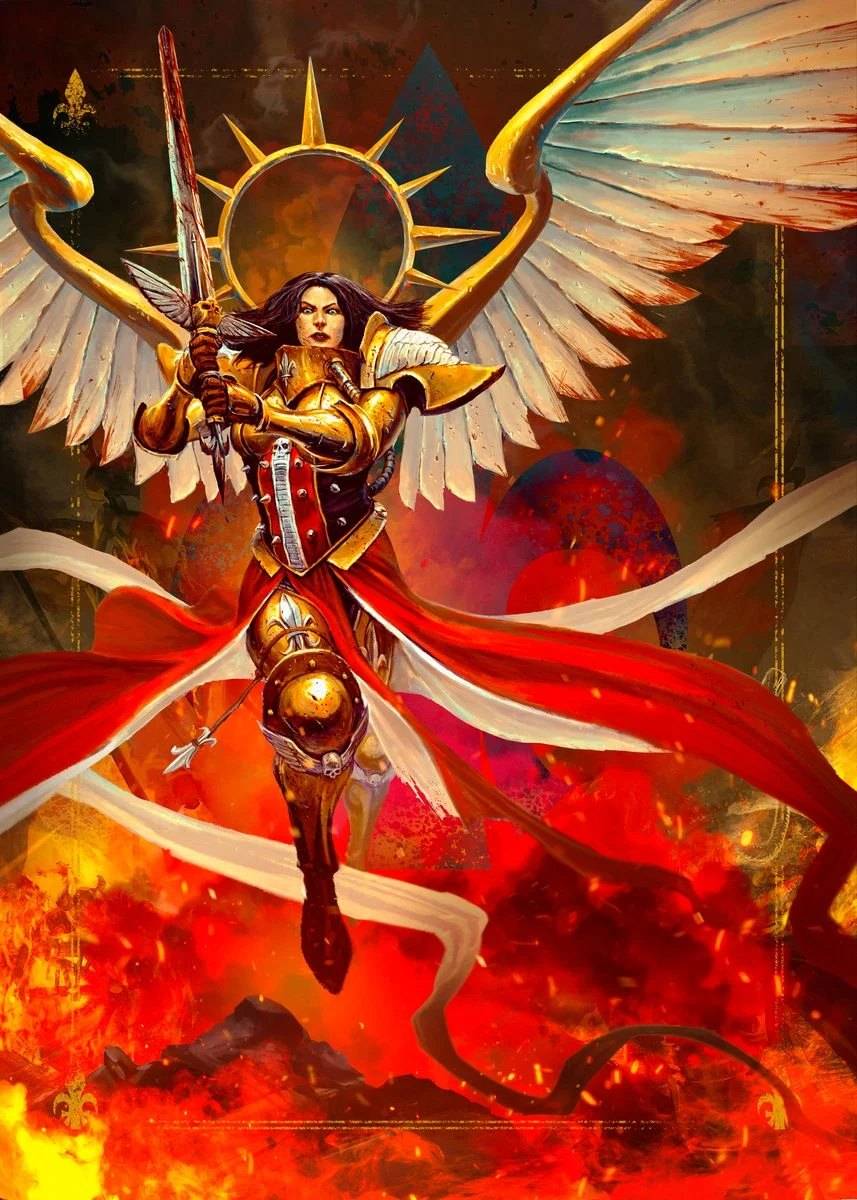 Saint Celestine, the Living Saint, as she has appeared in the Era Indomitus Artwork © Games Workshop | |
| Religion | Imperial Cult |
| Recognised by | Adeptus Ministorum (the Ecclesiarchy), through its synods |
| Process | Beatification and canonisation |
| Number | Millions over the Age of the Imperium; many more unsanctioned |
| Feast | Festival of Saints; individual saints' days |
| Notable | Sebastian Thor; Alicia Dominica; Saint Macharius; Saint Sabbat; Saint Celestine; Dolan Chirosius |
| Watched by | The Inquisition, especially its Thorian faction |
An Imperial saint is one of the men and women who have given their lives for the glory of the Emperor of Mankind and are venerated as holy by the adherents of the Imperial Cult. Saints are made by formal pronouncement of the Adeptus Ministorum, the Ecclesiarchy, and are held to have been raised by the Emperor's grace far above the mass of humanity, so that their words and deeds are counted as the Emperor's own work. Some are revered in a single town; others, like Sebastian Thor, are known wherever Imperial rule extends. They give the faithful a human face for a faith whose object is remote, and an intercessor to whom prayers may be addressed.[1][2]
Saints serve many causes. Most were soldiers, crusaders and liberators of enslaved worlds, preachers and writers of devotional tracts, or ordinary citizens whose faith was tested to death. Because the Imperium is vast, the matters on which a saint may intercede are often narrow: safe passage through the Warp, a good harvest, a warrior's aim, or the temper of a particular mark of lasgun. A truly devout citizen wears the tokens of many saints, and saints' names are given to worlds, warships, streets and children. A warship may bear a saint's name in the hope that it will share the saint's ferocity; there are said to be a hundred and thirteen vessels called the Saint Drusus alone.[1][3]
Most saints are declared after death, sometimes centuries afterwards. A small number, the Living Saints, are held to be spontaneous manifestations of the Emperor's grace, appearing almost always among the Adepta Sororitas and presaging some great endeavour; the best known is Saint Celestine, who has returned repeatedly after her first death and has fought again in the Era Indomitus (from 999.M41).[4][3] The Ecclesiarchy is exacting about who may be called a saint, and the Inquisition watches the cult closely, since saints are a source of influence that the enemies of the Imperium have also sought to use.[1][5]
History
[edit]The Age of the Imperium
[edit]Throughout the ten thousand years of the Age of the Imperium, millions of men and women have been recognised as saints by formal pronouncement of the Ecclesiarchy. Most are known and venerated only within a region or sector, though a few, such as Sebastian Thor, are known across the whole Imperium. The Ecclesiarchy's tradition of martyrdom was extended to the victims of the Age of Apostasy in the 36th millennium: the reforming Ecclesiarch Sebastian Thor, who replaced Goge Vandire, and Alicia Dominica, who beheaded the tyrant and founded the Adepta Sororitas, were both made saints. The Great Confessor Dolan Chirosius was killed by the Apostate Cardinal Bucharis during the Plague of Unbelief, and his death is held to have helped break the cardinal's pocket empire.[4][3][1]
Saints of the later millennia
[edit]The saints of later ages are mostly commanders and missionaries of the great expansions. Saint Sabbat, a shepherd girl of Hagia born about 500.M35, was inspired by a vision of the Emperor to lead the crusade that freed the Sabbat Worlds; it lasted 105 years, until her martyrdom on Harkalon. Macharius, the Lord Solar who added nearly a thousand worlds to the Imperium in the Macharian Crusade (392–399.M41), was later canonised.[6][7] Regional cults grew as well: in the Calixis Sector the general Drusus, who drove the xenos from the sector in the Angevin Crusade, is second only to the Emperor in the devotion of the people, and his shrines on Scintilla and Maccabeus Quintus draw pilgrims in their thousands.[1]
The Era Indomitus
[edit]Saint Celestine, believed slain in a campaign against the Renegade Warmaster of Forrax, has returned at various times to rescue Imperial forces in danger of destruction, and in the Era Indomitus she has appeared among the armies of the Lord Commander of the Imperium.[4][8]
Canonisation
[edit]A candidate is usually first venerated locally, by the people of the world where he or she lived or died. Local clergy may then bring the case before the synod of the sector or Segmentum, with accounts of the candidate's life and of the miracles credited to him or her. If the synod is satisfied it declares the candidate beatified; full canonisation follows, if at all, after solar decades or even centuries, and is slower still when the candidate was disliked in life. It is common for an Ecclesiarch to be declared a saint after death.[1][2]
The Ministorum is meticulous. Even the support of a whole world or system is sometimes not enough, and in the Calixis Sector a score or so of saints are sanctioned as high as the synod of the Segmentum Obscurus, while hundreds of lesser, unsanctioned saints are worshipped on worlds across the sector. Those who promote an unsanctioned cult risk punishment by the Church or, in extreme cases, a charge of heresy from the Holy Ordos of the Inquisition; yet new cults continue to rise from the legends of ordinary men and women.[1]
Martyrs
[edit]The line between saint and martyr is fine, and many who achieve sainthood do so through martyrdom, though martyrs far outnumber saints. The Church holds martyrs up as the ultimate expression of faith. The Calixis Sector holds many: the seventeen Holy Martyrs of Gallowglass, Sisters of Battle who died in a last stand, and the "Lost Pilgrim", who represents all who stray from the pilgrim trails. Others wait for recognition. The Tranch War Saint, a nameless guardsman said to have risen and fought again thirteen times despite mortal wounds, has been put forward repeatedly at the Festival of Saints, and the synod has so far granted him only the title of martyr of exceptional faith.[1]
Veneration
[edit]Saint worship is regarded by the Church as an aspect of worship of the Emperor, on the reasoning that all saints rise to become one with him, so that to revere a saint is to revere the Emperor. Saints are honoured with shrines, relics, feast days and prayers. Their relics, real or claimed, are among the most precious objects in the Imperium and are carried into battle by the Sisters and by regiments of the Astra Militarum; pilgrimages to a saint's tomb draw multitudes, and several shrine worlds exist to serve them. Saints are also patrons of trades, regiments and causes: Annard is patron of penitents, prisoners and slaves, and Ezra, martyred in 670.M40, of those setting forth on a journey.[1][2]
The Festival of Saints is the day on which all saints are honoured together and on which new candidates may be put forward. It matters most to very minor saints with small followings, and the days around it are a trying time for anyone who passes a shrine, since devotees in strange costumes preach the merits of their patron in the streets. Clergy hear long lines of petitioners, each convinced that some dead servant of the Emperor deserves eternal recognition, and must decide which cases merit the Ecclesiarchy's attention.[1]
Living Saints
[edit]A Living Saint is a member of the Adepta Sororitas who is so holy in mind, body and spirit that she manifests something of the Emperor's own power. Such a saint is not beatified after death but arises spontaneously; she is said to glow, and even the faithless fall to their knees in her presence. A manifestation usually comes before some great endeavour in which millions take up arms. It is often brief, for Living Saints are believed to burn brightly and die young, but each is said to leave history changed for the better. The Sister Anais, a Living Saint of the Order of the Sacred Rose in the later M41, defended her Order's bastion on Kaurava I with an aura that rendered every Sister near her invincible.[4][1]
The Thorian faction of the Inquisition, which regards Living Saints as vessels of the Emperor's power in the manner of Sebastian Thor, takes great interest in them. That interest is shared by their enemies, who have sought to capture a Living Saint and dissect her to learn the source of her power.[5] Saint Celestine, a Living Saint of the Order of Our Martyred Lady, was believed slain in a campaign against the Renegade Warmaster of Forrax; she has since returned to rescue Imperial forces that were close to destruction, and in the Era Indomitus has appeared among the armies of the Lord Commander.[4][1]
False saints
[edit]The cult of saints can be turned to ill ends. Saint Basillius, whose judgement after the Ecclesiarchal Purges of 321.M37 found thirty Space Marine Chapters wanting in faith, sent the Judged Chapters on the Abyssal Crusade into the Eye of Terror; when survivors returned in 112.M38, the testimony of Konvak Lann of the Vorpal Swords revealed Basillius, still alive, as an apostle of Chaos. He was executed by the Inquisition, and every shrine to him was destroyed under an edict of obliteration, his bones and thousands of living worshippers being launched into a star. Saint Gerstahl, an Army officer entombed on the shrine world named for him, was prophesied to rise again when the Eye of Darkness opened for the last time; in the Third Black Crusade Abaddon the Despoiler destroyed his remains, and with them the prophecy.[1]
Notable saints
[edit]| Saint | Lived or active | Known for |
|---|---|---|
| Alicia Dominica | M36 | Beheaded Goge Vandire and ended the Reign of Blood; first Canoness of the Order of the Ebon Chalice and founder of the Adepta Sororitas |
| Sebastian Thor | M36 | Reformer who opposed Vandire and became Ecclesiarch; the most widely adored of all saints |
| Katherine | M36 | Shield-bearer and second-in-command to Alicia Dominica; patron of the Order of Our Martyred Lady |
| Arabella | M36 | Companion of Alicia Dominica; patron of the Order of the Sacred Rose |
| Saint Sabbat | From c. 500.M35 | Shepherd girl of Hagia who led the crusade that freed the Sabbat Worlds |
| Basillius | M37–M38 | Proved a heretic after sending thirty Chapters on the Abyssal Crusade |
| Annard | M39 | Judge of the Adeptus Arbites who founded the first penal worlds of the Calixis region; killed near the end of the Angevin Crusade |
| Drusus the Warrior | M39 | Greatest saint of the Calixis Sector; general of the Angevin Crusade |
| Saint Macharius | 392–399.M41 (Crusade) | Lord Solar; conqueror of nearly a thousand worlds |
| Saint Celestine | Active again from 999.M41 | The Living Saint, returned in the Era Indomitus |
Timeline
[edit]| Date | Event |
|---|---|
| c. 500.M35 | Saint Sabbat is born on Hagia; her crusade lasts 105 years |
| M36 | Fall of Vandire; rise of Thor and Alicia Dominica |
| 321.M37 | Ecclesiarchal Purges; Basillius judges thirty Chapters |
| 112.M38 | Survivors of the Abyssal Crusade expose Basillius |
| 670.M40 | Martyrdom of Saint Ezra |
| 392–399.M41 | Macharian Crusade; Macharius later canonised |
| 999.M41 | Opening of the Great Rift; Celestine and other living saints appear |
See also
[edit]
Notes
[edit]References
[edit]- ^ a b c d e f g h i j k l m Dark Heresy: Blood of Martyrs (RPG). Games Workshop. pp. 13-15, 17-21, 23, 25, 27, 42-44.
- ^ a b c Codex: Imperial Guard (2nd edition). Games Workshop. pp. 31-32, 59, 83.
- ^ a b c White Dwarf 289 (US), "The Liber Sororitas". Games Workshop. pp. 78-81.
- ^ a b c d e Codex: Sisters of Battle (2nd edition). Games Workshop. pp. 43-44, 60.
- ^ a b Thorpe, Gav. Inquisitor: The Thorians (specialist game background book). Games Workshop. pp. 7-8.
- ^ The Sabbat Worlds Crusade (background book). Games Workshop.
- ^ White Dwarf 240 (US), "Conqueror of Darkness: Imperial Lord Solar Macharius". Games Workshop. pp. 32-33.
- ^ King, William. Fall of Macharius (novel). Black Library.