
Purity seal
| Purity seal | |
|---|---|
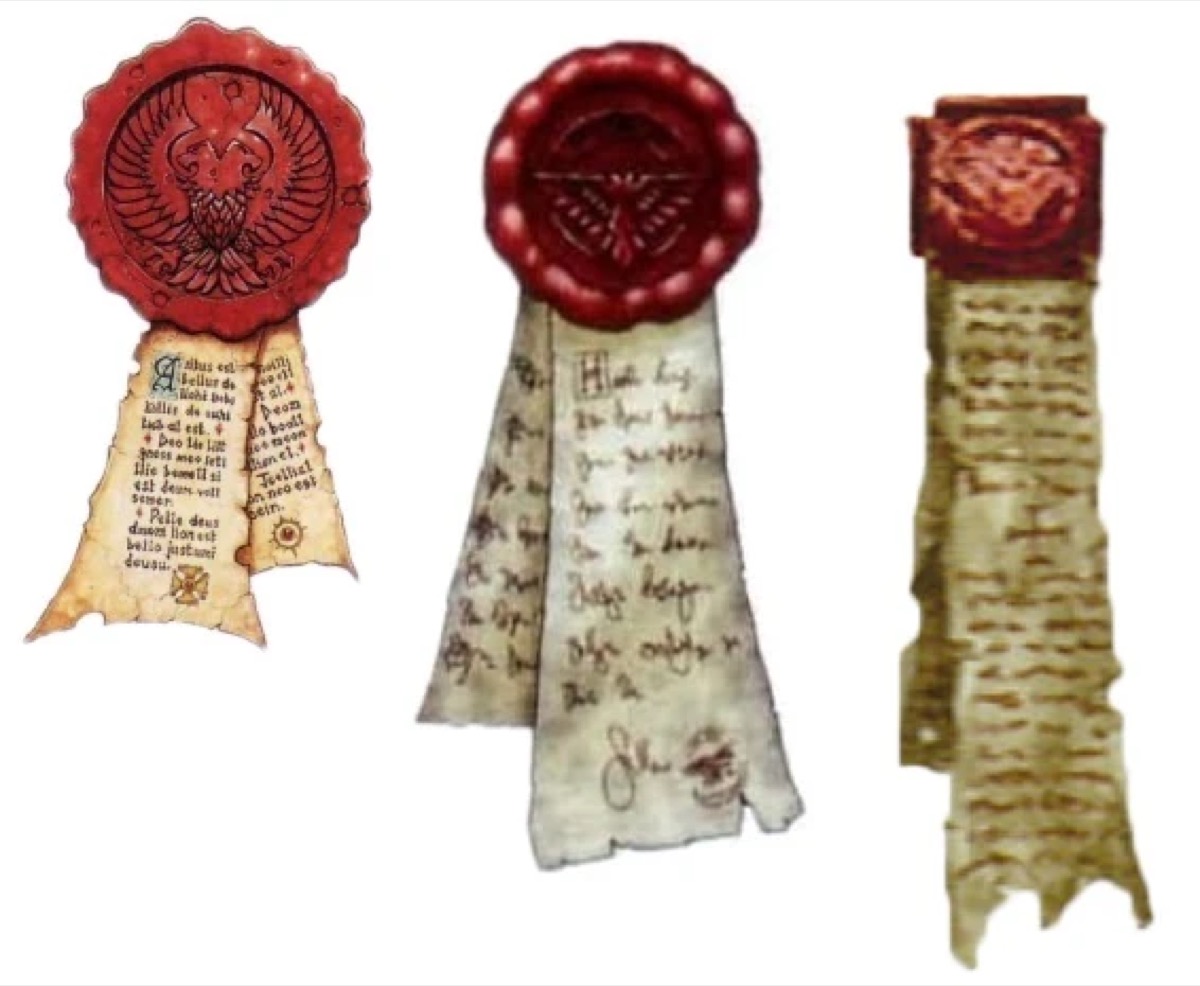 Purity seals of three common patterns, each a wax seal stamped with an Imperial device and hung with written litanies Artwork © Games Workshop | |
| Type | Devotional seal and blessing |
| Material | Wax, parchment or vellum; electrum or other metal for permanent seals |
| Issued by | Chaplains of the Adeptus Astartes; priests of the Adeptus Ministorum; Adepta Sororitas; tech-priests of the Adeptus Mechanicus |
| Worn by | Space Marines, Sisters of Battle, Imperial soldiers, Inquisitors |
| Also fixed to | Weapons, vehicles, warships, Knights, Titans, books and relics |
| In use | By the Horus Heresy (005–014.M31); universal by M41 |
| Related | Aquila; Crux Terminatus; Iron Halo |
A purity seal is a seal of wax, usually red, stamped with a sacred device and hung with strips of parchment on which prayers, litanies or oaths are written. Purity seals are affixed to the armour of the Adeptus Astartes and the Adepta Sororitas, to the weapons and vehicles of the Astra Militarum, to the hulls of warships and war machines, and to holy books, relics and doors throughout the Imperium of Mankind. To the Imperial Cult a seal is a blessing: it marks its bearer or object as purified and protected against corruption, and declares that the rites required for it have been performed.[1][2]
In the Space Marine Chapters, a purity seal is not strictly an honour but a blessing given by the Chapter's Chaplains before battle, recording the oaths a warrior has sworn and the rites performed over him. Some Chapters replace the wax seal with a permanent electrum casting after the battle, so that a veteran's armour may carry the record of many campaigns. Seals are among the most recognisable features of Imperial war-gear, and in the 41st millennium they are found on almost every holy or martial object of the Imperium.[2][3]
History
[edit]Seals of wax and parchment were used in the Great Crusade (c. 798.M30–005.M31) to mark oaths, most famously the oaths of moment sworn by the warriors of the Space Marine Legions before a campaign, which were written on parchment and fixed to their armour. Under the secular Imperial Truth, such seals were records of a promise, not religious objects. During the Horus Heresy (005–014.M31), believers of the Lectitio Divinitatus in the loyal armies began to treat them as charms against the powers of the Warp.[4][5]
After the Heresy, the spread of the Imperial Cult and the emergence of the Ecclesiarchy in the 32nd millennium gave the seals their present meaning. The Liber Ecclesiasticus (M37) lists the forms of the purity seal and the litanies proper to each, and the Adepta Sororitas, whose orders became the Ecclesiarchy's armed force after the Decree Passive of c. 378.M36, adopted them as a standard part of their armour. By the 41st millennium the purity seal had become a universal sign of Imperial devotion.[1][a]
In the Era Indomitus, the warriors of the Primaris Chapters of the Ultima Founding, created by Belisarius Cawl and revealed in 999.M41, were sealed according to the customs of their parent Chapters when they joined them, and the Chaplains of the Indomitus Crusade have been recorded issuing purity seals by the thousand before the great battles of the crusade.[6]
Form
[edit]A purity seal has two parts. The seal itself is a disc of wax, usually red, pressed with a device: most commonly the Aquila, a skull, the letter I of the Inquisition, a Chapter badge or a saint's sign. Below it hang one or more streamers of parchment or vellum, on which a priest or Chaplain has written litanies, verses of scripture, blessings, battle-oaths or a record of the bearer's deeds. Seals are fixed to armour or objects with wax, adhesive or rivets.[2]
Some seals are made to last: a permanent seal is cast in electrum or another metal, with its litanies engraved on metal tabs. The Adeptus Mechanicus uses seals of its own on machines and weapons, inscribed with rites of maintenance and appeasement of the machine spirit.[7]
Use
[edit]Adeptus Astartes
[edit]Before a campaign, a Chapter's Chaplains pass through the ranks chanting litanies and invocations, marking chosen warriors for special blessings. The blessing is written on the streamers and fixed to the warrior's armour with the seal. Practices differ between Chapters. In some, a seal is earned by deed; in others every battle-brother receives one; in the Black Templars and other zealous Chapters, seals cover armour and weapons in great numbers.[2]
Adepta Sororitas and Ecclesiarchy
[edit]The Sisters of Battle wear purity seals as a matter of course, often in large numbers, each bearing a prayer or the name of a martyred sister. Priests of the Adeptus Ministorum attach seals to the weapons and banners of the faithful before battle, and to the doors of churches, reliquaries and the tombs of saints.[1]
Astra Militarum and the Navy
[edit]Regimental priests and Commissars attach seals to tanks, artillery and banners, and individual soldiers buy or are given seals to wear. Warships of the Imperial Navy carry great seals on their hulls and on the doors of their sanctuaries, and the void-shield generators of many ships are sealed against warp intrusion.[8]
The Inquisition
[edit]Inquisitors use seals to mark their property, to close forbidden archives and to seal the prisons of daemons and heretics. A seal of the Ordo Malleus on a door or a book is a warning that what lies behind it must not be opened.[9]
Related honours
[edit]Purity seals are often worn together with other Imperial honours, which Imperial heraldry treats separately:
- Crux Terminatus: the badge of a warrior entitled to wear Terminator armour.
- Iron Halo: a field generator and honour borne by Space Marine officers.
- Imperialis: a winged skull, the badge of loyalist valour since the Heresy (see Aquila).
- Imperial Laurel, Marksman's Honour and Iron Skull: decorations for leadership, marksmanship and long service.
Timeline
[edit]| Date | Event |
|---|---|
| c. 798.M30–005.M31 | Oaths of moment fixed to armour in the Great Crusade |
| 005–020.M31 | Seals worn "against the witch and the daemon" in the Heresy and Scouring |
| c. 378.M36 | Adepta Sororitas established as the Ecclesiarchy's armed orders |
| M37 | Liber Ecclesiasticus lists the forms of the seal |
| 999.M41–present | Mass sealing before the battles of the Indomitus Crusade |
See also
[edit]

Notes
[edit]- ^ The date at which seals took on a religious meaning is estimated from the sequence of events. Records of the Great Scouring (c. 014–020.M31) already describe soldiers wearing them "against the witch and the daemon".
References
[edit]- ^ a b c Watson, Ian. Space Marine (novel). Black Library, pg. 143.
- ^ a b c d Codex: Space Marines (5th Edition), pp. 18-19, 22. Games Workshop.
- ^ Bligh, Alan. The Horus Heresy Book One - Betrayal (Forge World Series). Black Library, pg. 177.
- ^ Warhammer 40,000 Compilation (1st Edition), pg. 30. Games Workshop.
- ^ Imperial Armour Volume Nine - The Badab War - Part One, pp. 71, 79, 91, 99, 107, 116-117.
- ^ Imperial Armour Volume Ten - The Badab War - Part Two, pp. 68, 70, 75, 84-85, 95, 110-112, 133, 139.
- ^ Insignium Astartes, pg. 62.
- ^ White Dwarf 73 (2015), "Forge World - Sigismund, First Captain of the Imperial Fists".
- ^ Watson, Ian. Space Marine (novel). Black Library, pg. 143.