
Sebastian Thor
| Sebastian Thor Ecclesiarch and Imperial saint | |
|---|---|
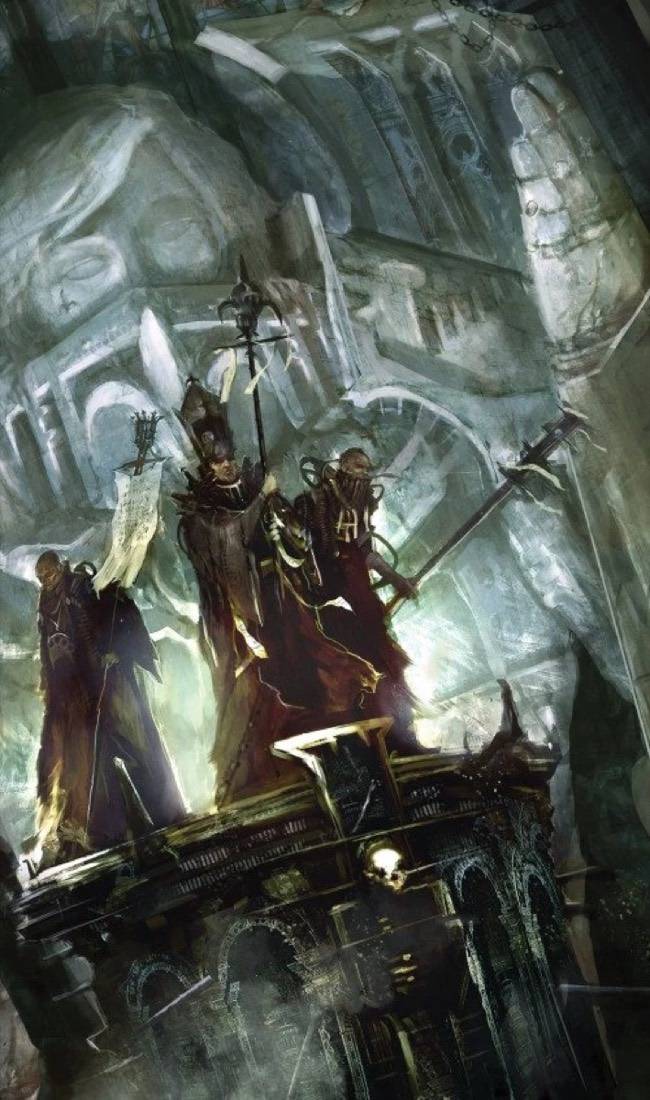 An Ecclesiarchal procession before a colossal monument. No contemporary portrait of Thor is held to be genuine. Artwork © Games Workshop | |
| Title(s) | Ecclesiarch of the Adeptus Ministorum; Saint Sebastian Thor; the Reformer |
| Allegiance | Imperial Cult; the Confederation of Light |
| Life | |
| Born | M36, Dimmamar (year unrecorded) |
| Ecclesiarch | 378.M36 until his death |
| Died | M36, Terra, of old age (year unrecorded); later canonised |
| Predecessor | Goge Vandire (as Ecclesiarch; killed) |
| Successor | Equitus XI |
| Known for | The overthrow of Goge Vandire; the Decree Passive; the founding of the Adepta Sororitas; the reformed Confederation of Light |
Sebastian Thor was an Ecclesiarch of the Adeptus Ministorum in the early 36th millennium and is remembered as the greatest the office has known. A priest from the devastated world of Dimmamar, he preached against the tyranny of Goge Vandire, was joined by the surviving adherents of the banned Confederation of Light, and became the figurehead of the movement that overthrew the High Lord. As Ecclesiarch he dismantled Vandire's regime, issued the Decree Passive, founded the Adepta Sororitas and gave the Imperial Cult the shape it has kept to the present day.[1]
He lived to be 112 and died in office, in his bed on Terra. He was declared a saint almost at once, and a great many of the institutions of the 41st millennium trace their origin to him. His teachings are the basis of the Thorian sects, and the Thorian tradition of the Inquisition takes its name from him.[1][2]
Early life
[edit]Dimmamar, the world of his birth, had been devastated in an earlier age and its people were poor. Nothing is recorded of Thor's family, but it is said that he was a priest from his youth, and that he took no part in the Ecclesiarchy's politics and wanted no power. He preached in the manner of a village priest, plainly, with great passion, and the faithful came from far and wide to hear him.[1]
When he began to speak against the injustice of Vandire's rule, the Frateris Templar and the High Lord's agents moved against him, as they did against others. His supporters protected him. Many of the assassins sent to kill him are said to have been moved by his words, and to have become his guards. When Vandire heard of this he gathered a great army of the Frateris Templar at the Clax system and sent it against Dimmamar. The fleet never arrived. It was torn apart in the Warp by a storm so great that it is still there, four thousand years later: the Storm of the Emperor's Wrath. Astropaths say that the screams of the dead can be heard in it.[3]
Local tradition on Dimmamar adds that he never owned more than one robe, gave away what he was given, and taught that a priest should be known by what he had refused. The Ministorum has neither confirmed nor denied the stories. They are recorded here because they are the form in which his memory is kept by the people he came from.[1]
The Confederation of Light
[edit]The Confederation of Light was an older sect of the Imperial Cult. In the 32nd millennium it had been the rival of the Temple of the Saviour Emperor, which became the established doctrine of the Ministorum, and it had been suppressed after the First War of Faith. Its adherents had kept their faith in secret for more than two thousand years. Where the Temple held that the state church must govern, because only it served the Emperor's will, the Confederation taught that the Emperor had sacrificed Himself for Mankind, and that His servants should follow His example in humility and moral conduct.[1]
Hooded envoys of the Confederation came to Thor at Dimmamar. What passed between them is not known. The result was that Thor and the Confederation became one, and a faith that had been hunted for two millennia became a force again. As the news of the preacher spread, Space Marine Chapter Masters of the Segmentum Solar and the nearer sectors began to speak in favour of the reform movement, which helped bring about the Terran Crusade against Vandire.[1]
Ecclesiarch
[edit]The new regime
[edit]After Vandire was killed, Thor was named Ecclesiarch, and set about the work of dismantling the apparatus of the Reign of Blood. His first acts restored an independent High Lord to each seat in the Senatorum Imperialis. The Ecclesiarchy and the Administratum again became autonomous and competitive. The Confederation's teaching replaced that of the Temple of the Saviour Emperor throughout the Ministorum, and the church turned from a political aim to a spiritual one, in which the individual's morality and salvation counted for more than the institution's power. The Ministorum remained rich and numerous but would not again govern the Imperium.[1]
The Decree Passive
[edit]The High Lords issued the Decree Passive in 378.M36, and Thor, as the Ecclesiarch they had appointed, was responsible for carrying it out. It forbade the Ecclesiarchy "to gather, train, promote, sustain, or in any way command any force of men under arms". Thor disbanded the Frateris Templar and the armies and fleets of every cardinal and priest in the Ministorum. The aim was to prevent the church from ever again being used, as Vandire had used it, as the instrument of one man.[4]
Thor saw that the church could not do without some armed protection. The decree named men, and he used the word. The Daughters of the Emperor, who had served Vandire as the Brides and had killed him, were an order of women, and so the decree did not touch them. He built them into the Adepta Sororitas, whose Orders Militant are the Sisters of Battle. The Sisters are of the Ecclesiarchy but are sworn to the Emperor before the church, and the Inquisition's new Ordo Hereticus, which Thor and the Inquisition created together, made them its Chamber Militant. Where the Ministorum and the Ordo Hereticus come into conflict, the Sisters look to the Inquisition.[4][2]
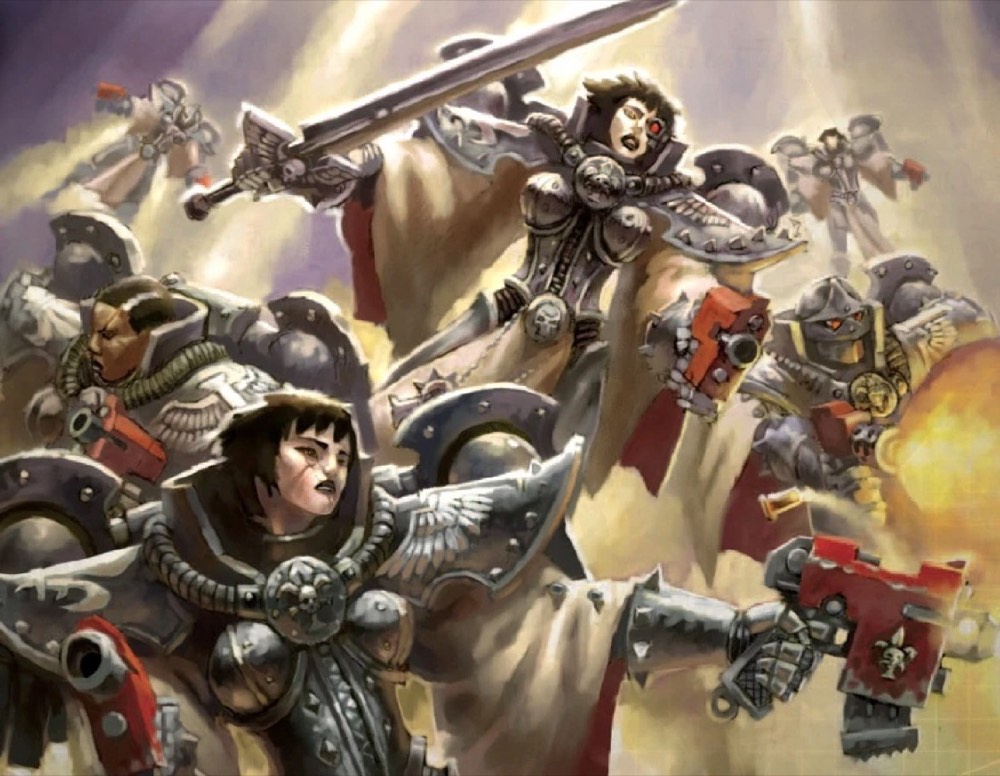
The Decree has been enforced less zealously in later ages. Bands of Frateris Militia gather at the shrines of the Ecclesiarchy, and zealot crusades such as those of the Redemptionists are tolerated under the watch of the Ordo Hereticus. A Departmento Munitorum official can, in an emergency, stamp the Frateris Militia into the Astra Militarum as auxiliaries, so that the Ecclesiarchy can lead its faithful in arms without breaking the Decree.[4]
Doctrine
[edit]Thor wrote little, and what is attributed to him was mostly gathered after his death by his preachers. The core of his teaching, as the Liber Ecclesiasticus records it, is that the Emperor is not served by those who seek power in His name. The Emperor, as the Confederation of Light taught, had given Himself to Mankind and asked nothing in return, and His servants owed Him the same humility. A cardinal who grew rich on the tithes of the poor, a preacher who used the fear of heresy to keep his flock in line and a High Lord who spoke in the Emperor's voice were all, in Thor's view, guilty of the same fault, which was pride.[1]
He was nonetheless no pacifist. The Confederation held that a faith which would not defend itself would not survive, and Thor accepted that the church needed its armed servants. His distinction was between a church that commanded armies and a church that was protected by them. The first had produced Vandire. The second, in the Sisters of Battle, was meant to be a community of the faithful who fought because they were devout and not because they were soldiers of a state.[1]
Relations with the other adepta
[edit]Thor's election owed much to the Chapter Masters and the Mechanicus, who had moved against Vandire, and he kept their goodwill. He gave the Space Marine Chapters that had fought in the Terran Crusade the right to hold shrines in their own cathedrals, a privilege their successors still claim. He was less trusted by the Administratum, which had expected that the end of Vandire would mean a return to its own supremacy, and found instead that Thor had restored an equal Ecclesiarch to the Senatorum Imperialis. He was, in the end, an ally of the Inquisition. The Ordo Hereticus, formed in his time, has throughout its history counted him among its patrons.[2]
Death and canonisation
[edit]Aged 112, Thor returned to Terra for the last time. He died six solar months later, in office, of old age. The whole Imperium mourned him, and the Holy Synod, which had a reputation for caution on such matters, declared him a saint in the same year. His successor, Equitus XI, completed his work by organising the Sisterhood into convents under abbesses and appointing Sister Palmiro of the Order of the Holy Word as the first Abbess Sanctorum, the head of the Sisterhood, an office whose holder has sat on the Senatorum Imperialis in some centuries since.[1]
Legacy
[edit]Thor is held to be the model Ecclesiarch, and his reforms have shaped the Imperial Cult ever since. The Adepta Sororitas, the Ordo Hereticus, the Decree Passive and the principle that the state church shall not govern are all ascribed to him. The Thorian sects, which are found throughout the Imperium, hold to his teaching that an act of faith is moral before it is political. Many of the Imperium's churches are dedicated to him, and the Imperial calendar keeps the day of his death.[1]
The Imperium's later Ecclesiarchs have not always kept faith with his example. The Ecclesiarch Umberto II of the 39th millennium was the first since Vandire to reassert the Ministorum's authority over the Imperium, and in the 41st millennium the Ecclesiarchy's wealth and numbers again give it great weight in the Senatorum Imperialis. The Decree Passive has not been repealed.[1]
Timeline
[edit]| Date | Event |
|---|---|
| Before 378.M36 | Thor begins to preach against the injustice of Goge Vandire's rule; the Frateris Templar are sent against him, but many of their assassins become his guards |
| Before 378.M36 | Hooded envoys of the Confederation of Light come to Thor on Dimmamar, and Thor and the Confederation become one |
| Before 378.M36 | Goge Vandire sends the Frateris Templar against Dimmamar; their fleet is destroyed in the Clax system |
| Before 378.M36 | Space Marine Chapter Masters of the Segmentum Solar speak in favour of the reform movement, helping to bring about the Terran Crusade against Vandire |
| 378.M36 | Vandire is killed, and the High Lords of Terra issue the Decree Passive; Thor becomes Ecclesiarch |
| 378.M36 | The High Lords restore an independent High Lord to each seat in the Senatorum Imperialis |
| 378.M36 | Thor dismantles the Reign of Blood, disbands the Frateris Templar and founds the Adepta Sororitas from the Daughters of the Emperor |
| M36 | Thor dies in office on Terra, aged 112, and is declared a saint in the same year |
| M36 | Thor's successor, Equitus XI, organises the Sisterhood into convents, and the first Abbess Sanctorum is appointed |
See also
[edit]
Notes
[edit]References
[edit]- ^ a b c d e f g h i j k l Keefe, Matt. Outlander (novel). Black Library, pp. 12, 34, 163-164, 207. McNeill, Graham. The Outcast Dead (novel). Black Library.
- ^ a b c McNeill, Graham. Mechanicum (novel). Black Library. Counter, Ben. Daenyathos (novella). Black Library.
- ^ The Redeemer (Graphic Novel) written by Pat Mills and Debbie Gallagher and illustrated by Wayne Reynolds. Warhammer 40,000 Rulebook (6th Edition), pp. 158-159. Games Workshop.
- ^ a b c Codex: Black Templars (4th Edition), pg. 19. Games Workshop. Sisters of Battle (5th Edition). Games Workshop.
Further reading
[edit]- Liber Ecclesiasticus (M37). Adeptus Ministorum.
- Text and Commentary of the Decree Passive (378.M36, revised M37). Senatorum Imperialis Archive, Terra.