
Imperial Dating System
| Imperial Dating System Terran Standard Calendar | |
|---|---|
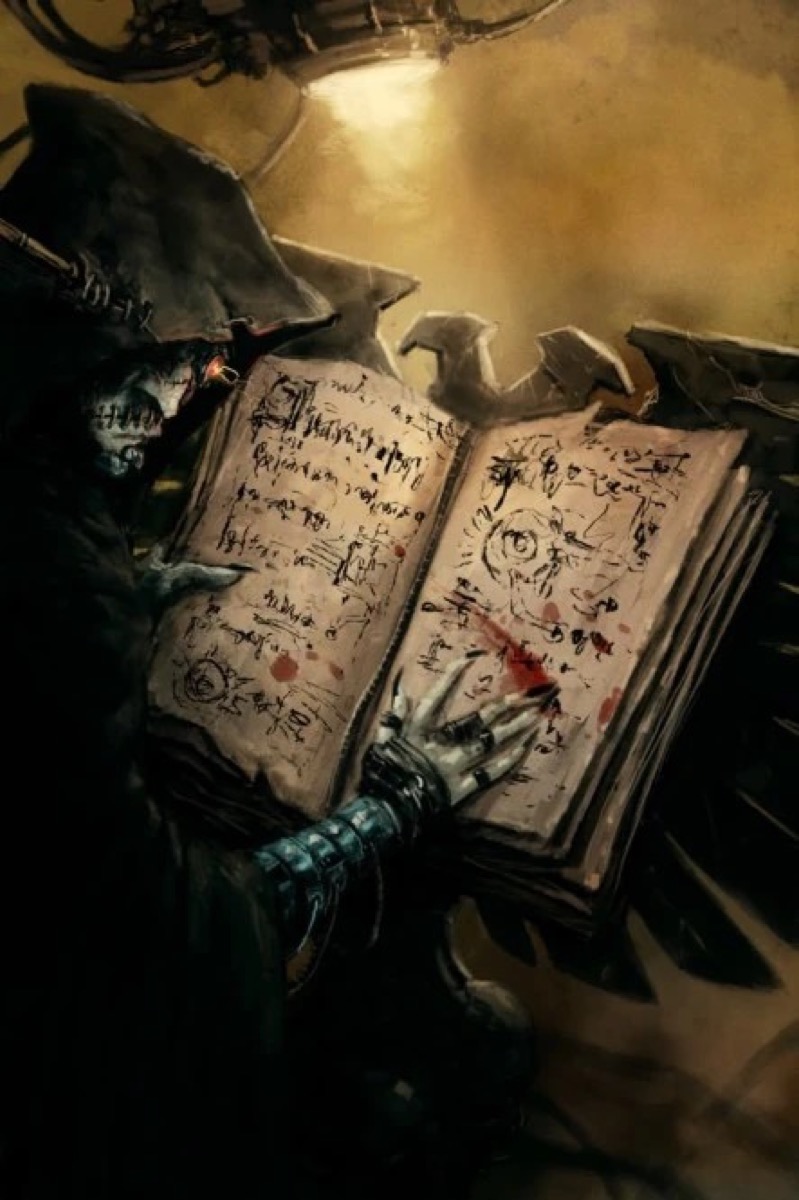 A historitor of the Logos Historica Verita reconciles dated entries in a chronicle Artwork © Games Workshop | |
| Type | Solar (Terran year), decimal fractions |
| Epoch | Ancient Terran era; origin of the count lost |
| Format | Check number · year fraction · year · millennium e.g. 0 345 997.M41 |
| Year fraction | 1/1000 of a year, about 8 hours 45 minutes |
| Introduced | c. 798.M30 (Great Crusade) |
| Maintained by | Administratum; Ordo Chronos of the Inquisition |
| Successors | Local Rift calendars (e.g. the Vigilus Template), from 999.M41 |
| Current year | Early 42nd millennium by the Terran reckoning[a] |
The Imperial Dating System, also called the Imperial calendar or the Terran Standard Calendar, is the official system by which the Imperium of Mankind records dates. A full Imperial date has four parts: a check number that states how reliable the date is, a year fraction that divides the year into a thousand parts, the year within the millennium, and the millennium itself. In the date 0 345 997.M41, for example, the check number is 0, the year fraction 345, the year 997 and the millennium the 41st.[1][2]
The system was set down by the Administratum in the early years of the Great Crusade (c. 798.M30) to keep order among the records of a galaxy in which Warp travel distorts the passage of time and in which messages may take years to arrive. It counts years in the ancient Terran era whose origin, and the event that began it, is no longer known with certainty. Most citizens never use the full form, and most worlds keep their own local calendars alongside it; the full form is used by the Adeptus Terra, the military and the Inquisition.[1]
The opening of the Great Rift in 999.M41 threw the system into crisis. Temporal distortion across the galaxy left worlds and fleets years apart from Terra and from each other, and an inquiry ordered by Roboute Guilliman found that the Imperium's main calendars no longer agreed on what millennium it was. The resulting dispute, the Chronostrife, was settled by a decree of the High Lords of Terra that allows each region to keep a local calendar anchored on the arrival of the Rift.[3][4]
Structure
[edit]Check number
[edit]The first digit of a full date is the check number. It does not measure time; it records how the date was obtained and how far it can be trusted. Its classes are:[1][2]
| Check | Name | Meaning |
|---|---|---|
| 0 | Terran | The event took place on Terra |
| 1 | Sol | The event took place elsewhere in the Sol System, for example on Mars or Titan |
| 2 | Direct | The recorder was in direct astropathic contact with Terra or the Sol System |
| 3 | Indirect | The recorder was in contact with a check 2 source |
| 4 | Corroborated | The recorder was in contact with a check 3 source |
| 5 | Sub-corroborated | The recorder was in contact with a check 4 source |
| 6 | Non-referenced, 1 year | No contact at the time, but within one year of a dated check 0–5 record |
| 7 | Non-referenced, 10 years | Within ten years of a dated check 0–5 record |
| 8 | Non-referenced, over 10 years | More than ten years from the nearest dated check 0–5 record |
| 9 | Approximated | Taken from a non-Imperial source or a local calendar, or reconstructed |
Year fraction
[edit]For administrative purposes each Terran year is divided into 1,000 equal parts, numbered 001 to 000, in place of months and weeks. One part lasts about 8 hours and 45 minutes. The year fraction is used by the Administratum, the Navy and the Inquisition to order events within a year; ordinary citizens and most planetary governments do not use it.[1]
Year and millennium
[edit]The year runs from 001 to 000 within each millennium; there is no year zero, and a new millennium begins with its year 001. The millennium is written with an M and its number. When the fraction and check are unknown or not needed, the year and millennium alone are written (999.M41), and when even the year is uncertain, the millennium alone (M36) or a qualifier ("c. 650.M35", "mid-M38") is used. Terran records also use a short form with a slash, 456/M41, for a year reckoned on Terra itself.[1][4]
History
[edit]Origins
[edit]The count of years is older than the Imperium. Imperial scholars believe that it continues the civil calendar of Terra in the Age of Technology, and that its starting point was an event of religious significance in ancient Terran history; the records that named it were lost in the Age of Strife (c. M25–M30). The Emperor of Mankind retained the count when he unified Terra in the Unification Wars (c. M30).[4]
The Great Crusade
[edit]The check number and the year fraction were introduced by the young Administratum at the start of the Great Crusade in about 798.M30, to reconcile the reports of expeditionary fleets whose ship-time had drifted in the Warp. The Remembrancer Order dated its works by it, and the oldest surviving fully dated documents are crusade fleet logs of the late 30th millennium.[5][2]
Drift and rival reckonings
[edit]Over ten thousand years, the calendar was corrupted by copying errors, local corrections, the destruction of archives and deliberate revision. The Nova Terra Interregnum (early M35 to 975.M35) left two administrations keeping two sets of records; the Age of Apostasy (early M36 to c. 400.M36) produced Ecclesiarchal reckonings that counted from events in the life of the Church; and isolated regions maintained their own corrections for centuries. Imperial historians have long noted that dates given in different archives for the same event can differ by years or decades, and the Timeline of Imperial history follows the Administratum's reconciled chronology wherever sources conflict.[4][6]
The Chronostrife
[edit]After his return in 999.M41, Roboute Guilliman ordered a full accounting of the Imperium's history and founded the Logos Historica Verita to carry it out. In the course of that work he learnt of a long dispute within the Ordo Chronos of the Inquisition over the true date, known as the Chronostrife. By the end of the first phase of the Indomitus Crusade, about 012.M42, Guilliman had found at least five orthodox variants of the Imperial calendar in use, which placed the present anywhere from the early 41st millennium to a full millennium later, without counting heretical reckonings.[4][3]
Guilliman concluded that no single calendar could be applied across a galaxy in which the Great Rift had disturbed time itself. After conference with his historitors and the Ordo Chronos, he put a decree before the High Lords of Terra that abandoned the requirement of a single universal reckoning. Each region of the Imperium was to keep its own chronology, anchored on the moment the Great Rift was first observed there. Terran records continue to use the old count, by which the present is the early 42nd millennium, and this encyclopedia follows them.[3][b]
Rift calendars and the Vigilus Template
[edit]The best-documented of the new local calendars is the Vigilus Template, used on Vigilus and its neighbours at the mouth of the Nachmund Gauntlet during the War of Beasts. Its dates have four parts: the number of years before or after the Rift opened over the system, the number of eight-hour "chronosegments" within that year, the word previo (before) or post (after), and the initials of the system and the Rift, VCM for Vigilus Cicatrix Maledictum. An event three days before the Rift's arrival is thus written 0.9 previo VCM.M41, or simply "0.9–".[7]
The fleets of the Indomitus Crusade use a related practice, the Tempus Indomitus, in which each fleet keeps time by its flagship's chronometer and its battlegroups correct their logs to it.[3]
Timeline
[edit]| Date | Event |
|---|---|
| Before M25 | Terran civil count of years in use |
| c. M30 | The Emperor retains the count during the Unification Wars |
| c. 798.M30 | Check number and year fraction introduced by the Administratum |
| Early M35–975.M35 | Nova Terra Interregnum; parallel record-keeping |
| Early M36–c. 400.M36 | Age of Apostasy; Ecclesiarchal reckonings |
| 999.M41 | Great Rift opens; temporal distortion across the galaxy |
| c. 999.M41 | Logos Historica Verita founded |
| c. 012.M42 | Guilliman identifies five orthodox calendars; decree on local chronologies |
See also
[edit]
Notes
[edit]- ^ See The Chronostrife. Rival Imperial reckonings place the present anywhere from the early 41st millennium to a millennium later.
- ^ The date of the decree is not recorded. It followed the end of the crusade's first phase, c. 012.M42; the date is estimated from the sequence of events.
References
[edit]- ^ a b c d e Haley, Guy. Dark Imperium (novel). Black Library, Ch. 9 "Imperator Gloriana," pp. 96-97.
- ^ a b c Imperium Nihilus - Vigilus Defiant (8th Edition), pp. 10, 20. Games Workshop.
- ^ a b c d Warhammer 40,000: Rulebook (5th Edition), pg. 127. Games Workshop.
- ^ a b c d e Haley, Guy. Dark Imperium (novel). Black Library, Ch. 9 "Imperator Gloriana," pp. 96-97.
- ^ Imperium Nihilus - Vigilus Defiant (8th Edition), pp. 10, 20. Games Workshop.
- ^ Warhammer 40,000: Rulebook (5th Edition), pg. 127. Games Workshop.
- ^ Haley, Guy. Dark Imperium (novel). Black Library, Ch. 9 "Imperator Gloriana," pp. 96-97.