
Imperial Truth
| Imperial Truth | |
|---|---|
| State doctrine of the Imperium of Mankind, 30th millennium | |
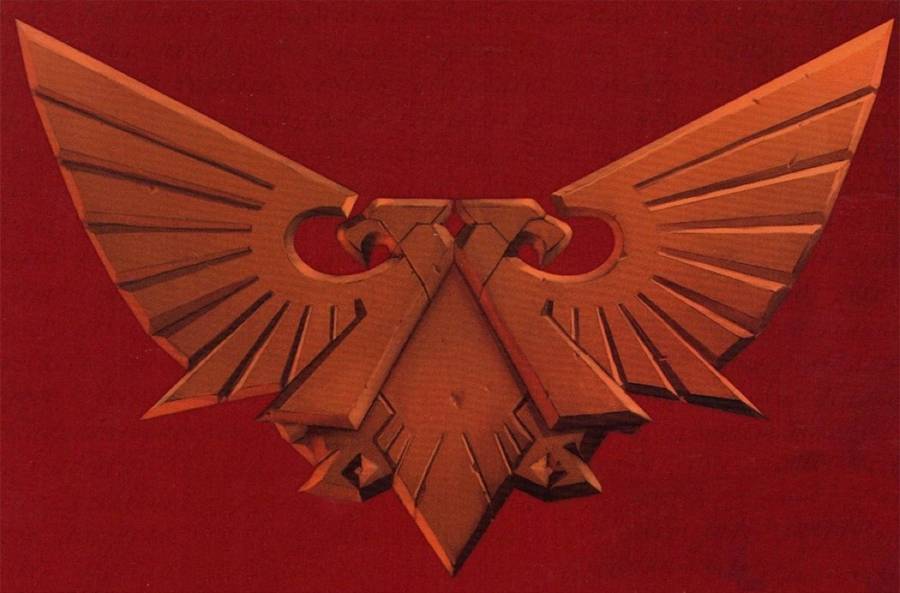 The early Aquila, worn on the banners of the Great Crusade Artwork © Games Workshop | |
| Type | Secular, rationalist, materialist doctrine |
| Founder | Emperor of Mankind |
| Promulgated | Terra, during the Unification Wars; the Imperium, from 798.M30 |
| Preached by | Iterators; the Legions and the Army; the Chaplains (from 001.M31) |
| Exempt | The Mechanicum of Mars, by the Treaty of Olympus |
| Chief rival | The Lectitio Divinitatus |
| Abandoned | During and after the Horus Heresy, 005–014.M31 |
| Succeeded by | The Imperial Cult |
The Imperial Truth was the official doctrine of the Imperium in the Great Crusade, a rationalist and materialist account of the universe that denied the existence of gods and of the supernatural and held that fear and ignorance, rather than daemons, had caused the suffering of the Age of Strife. It was devised by the Emperor of Mankind on Terra during the Unification Wars, carried to the stars by the Great Crusade, and enforced by a corps of orators called Iterators, by the Imperial Army and the Space Marine Legions, and by the Emperor's own authority. It rested on two claims. The first was that the universe is knowable, so that what looks like the supernatural is the natural not yet understood. The second was that Mankind, being the species best placed to rule the galaxy, had a duty to do so.[1][2]
The Truth worked as a political instrument and, for two centuries, as a moral one. It broke up the old sectarian loyalties that had divided Terra and many of the rediscovered colonies, gave the Imperium's servants a common language and made it possible for a citizen of merit to rise regardless of the faith of his birth. It also had a flaw, which the Heresy exposed. The Emperor's own subjects were told that the Warp and its creatures were not what they were, and the lie, or what later scholars have called the Great Lie, left Mankind unprepared for the revolt that followed. The Truth did not survive the Heresy. In the following millennium it was replaced by the worship of the Emperor, and by the forty-first millennium to profess it was heresy.[3][4]
Doctrine
[edit]Tenets
[edit]The Imperial Truth was neither a creed nor a philosophy in the old sense. It was a set of public positions, which the Iterators expanded into lectures and the Army into drill. The core tenets were as follows.[4]
- The universe is rational. It runs on laws that reason can discover. What is not yet understood is a task for science, not a mystery for worship.
- There are no gods. Religion is a relic of fear, and in particular of the Age of Strife, when it had been used by tyrants and cults. The Emperor himself was a man, though the most gifted the species had produced.
- The supernatural is natural. Other dimensions, alien species and psychic mutants were not denied, but described as phenomena that could be understood. Those who called them sorcery, or attributed them to gods, simply had an incomplete view of the facts.
- Mankind has a destiny. The human form was held to be the best fitted to rule the galaxy. The Aeldari and other ancient species had tried to hold empires and failed, and it was Mankind's turn.
- Unity is survival. A scattered humanity could not survive a hostile universe. Local cults, nations and customs that divided people were obstacles to be overcome, not traditions to be respected.
- No thinking machines. The one fixed prohibition of the Truth on the side of science was the ban on artificial intelligence, a lesson from the Dark Age of Technology.
The Emperor is recorded as holding that Mankind could not advance while any temple stood over a priest's shoulder, and the saying that every church must fall was attributed to him in the Iterators' manuals.[1]
Practice
[edit]In practice the doctrine was less rigid than its slogans. The Imperium of the Great Crusade kept the forms and language of authority that it had inherited from older ages, and its ceremonies, oaths and symbols wore the clothes of the religion they replaced. The Oaths of Moment, the ranks of the Legions and the emblems of the Aquila owed much to the habits of faith. Scholars of the Ecclesiarchy have since observed that the Emperor could hardly have undone the religious instincts of a species in two centuries. It is possible that he knew, and that the Truth was meant to be the means of weaning his subjects from faith by the use of its own methods. It was an inherent contradiction of the Imperial project, and it was never reconciled.[4]
History
[edit]Terra
[edit]The Imperial Truth was first applied on Terra. During the Unification Wars, from the late 29th millennium to 712.M30, the Emperor suppressed the old religions of the planet. The Imperial Cult's own chronicle records that he personally witnessed the destruction of the last church on Terran soil, having first engaged its keeper, a holy man called Uriah Olathaire, in a debate of ideas and doctrine, and prevailed. The work of replacing the faiths was entrusted to the Iterators, a corps trained on Terra, and by the end of the Unification the planet had no organised religion that the Emperor's government acknowledged.[1]
The crusade
[edit]The Truth went out with the fleets. A world discovered by an Expeditionary Fleet was invited to acknowledge the Emperor, accept the Truth and pay tithe. A world that complied was left much of its own government and had to close its temples and send its priests to the Iterators' lectures. A world that refused was warned, and then assaulted. The Imperial Army taught the Truth to its recruits, the Legions embodied it, and in the later years of the crusade the Remembrancers who accompanied each fleet were expected to record its victories in the Truth's idiom, as the triumph of reason over the dark.[2]
The costs were high. Ancient communities descended from Old Terra, which had carried their religions across the stars, were destroyed because of them. Tens of thousands of cities were burned and cultures put to the sword. The Imperial Truth also coexisted with a cruel logic about artificial minds. When the fleets met human worlds that had developed thinking machines, the populations were exterminated as a danger to the whole body politic, and the Imperium made no distinction between a world that had used such minds well and one that had been ruled by them.[5]
Enforcement
[edit]The Iterators
[edit]The Iterators were a corps of orators and rhetoricians of the highest order, attached to every Expeditionary Fleet to teach the Truth. They were not priests, and they did not claim to be, but they combined the persuasive skills of the old preachers with the rhetoric of the new reason. In each fleet they lectured the troops and the people of the compliant worlds, answered objections and cultivated local intellectuals who could carry the message after the fleet moved on. The best of them, such as Kyril Sindermann of the 63rd Expedition, were respected for their learning and their wit. Others were less scrupulous and used the Truth to silence rivals.[2]
The Legions and the Chaplains
[edit]The Space Marine Legions held to the Truth with the particular firmness of those who were close to the Emperor. It was part of their identity, and the Legions that had the most contact with Terra were the most firmly committed to it. At the Council of Nikaea in 001.M31 each Legion was ordered to appoint Chaplains, on the model of the Word Bearers, to keep its warriors faithful to the Truth and to the Emperor's commands. A Chaplain's task was the morale and the dedication of his brothers, and not worship. The Truth was to be preached, not believed as a creed.[6]
The exempt
[edit]The Mechanicum was exempt. Under the Treaty of Olympus the Cult Mechanicus of Mars retained its religion, which treated the Emperor as the Omnissiah, the incarnate machine god. The arrangement was an obvious contradiction of the Truth, and the Emperor accepted it because the Mechanicum was necessary to the crusade. The Mechanicum, for its part, learned to speak of its faith in terms that the Iterators could tolerate.[7]
Challenge
[edit]The Lectitio Divinitatus
[edit]The first serious challenge came from within the Legions. The primarch Lorgar had been raised on Colchis, a world of priests and temples, and had led a holy war there against the Old Faith in the name of a new belief, the Covenant, which saw the Emperor as an incarnate god. When the Emperor came to Colchis to claim him in 857.M30, Lorgar wrote the Lectitio Divinitatus, a text proclaiming the Emperor the single god worthy of the worship of Mankind. It spread through the fleets, finding more support among the civilians and the auxiliaries than among the Army's officers or the Legions, who were closer to the Emperor and believed in the Truth more strongly. Cults of the Emperor sprang up on worlds the Word Bearers had converted, and the Word Bearers converted every world they pacified.[4][8]
Monarchia
[edit]The slow pace of the Word Bearers' conquests was eventually noticed. In 964.M30 the Emperor sent the Ultramarines to Khur, where the Word Bearers had built the city of Monarchia, and ordered them to raze it. He then appeared before the assembled Legion and made it kneel, Lorgar among them, and told its warriors that he was not a god and would not be worshipped. Lorgar's humiliation is held in the sealed Chronicles of the Heresy to have turned him from the Emperor toward the powers whose existence the Truth denied. The Word Bearers hid their change of heart, and the Legion worked for four decades under a mask of loyalty, until Isstvan III in 005.M31. The Truth, in the end, was brought down not by a rival doctrine but by the powers it did not recognise.[3]
The warning of Nikaea
[edit]The Truth also suffered from the Council of Nikaea. By ruling that psychic sorcery was a sin against it, the Emperor placed himself in the awkward position of defining a supernatural category that his doctrine claimed did not exist. The judgment on Magnus is evidence that the Emperor knew the gap between what he taught and what he understood. The Thousand Sons, which had taken the Truth's promise of knowledge seriously and gone to the limit of it, were its first casualty.[6]
The Great Lie
[edit]Exposure
[edit]The Horus Heresy exposed the central contradiction of the Truth. The Warp had a living sentience, and the entities that dwelt there, which fed on mortal souls, were supernatural in any sense that matters. The Emperor knew this and did not say so. His sons were told some of it, and Magnus more than the rest, but most of the Imperium's people were not, and when Horus turned his Legions to Chaos the people of the Imperium were left to learn the facts from the daemons.[3]
The question of how much the Emperor told Horus has never been settled. Jaghatai Khan reflected after the Heresy that the knowledge that the Emperor had hidden his purpose from his favoured son lay at the root of Horus's fall: Horus suspected that he was not the favourite, since Magnus knew more of the Warp and Corax more of the darkness within Mankind. The Sons of Horus' surviving officers, among them Garviel Loken, have said that it was merely the discovery that the Emperor was fallible, as all sons discover of their fathers. Horus is dead, and the Imperial record is silent.[3]
The necessity of the lie
[edit]Whether the Emperor was wrong to preserve the Truth is debated by the learned. Some argue that he saw the danger and made a calculated decision. The Warp was a danger to be denied rather than explained, because a people who believed in its powers would worship them. Others believe that he feared the consequences of Mankind's knowledge of the soul and the afterlife, and others, that the Great Crusade existed to obtain the materials of some other work, and that the Truth was a means to that end, never expected to survive the test it met. The Inquisition has declined to adjudicate.[4]
The costs of the policy are recorded more clearly. Many billions of lives were lost in the purges that sustained it. Ignorance was promoted along with enlightenment. When the Heresy came, the faith the Imperium had suppressed proved to be a real defence against the powers it faced, and a people that had been deprived of it were more vulnerable than they would otherwise have been.[4]
Decline
[edit]During the Heresy the Truth ceased to hold. The belief in the Emperor's divinity grew among the defenders of Terra. After the Great Scouring (014–c. 021.M31), without the Emperor's presence to renew it, the hold of the Truth on the Imperium's people failed. The loyalist Legions and the Mechanicum, the Administratum and the Army had every reason to keep order, and a faith that treated the Emperor as a protector served them better than a doctrine that denied him. The Lectitio Divinitatus became the basis of a state religion. In the early 32nd millennium the High Lords recognised the Imperial Cult, and the Adeptus Ministorum was formally established.[4]
By the 41st millennium the Truth had passed through contempt to the status of a heresy. The Ecclesiarchy and the Inquisition treat the denial of the Emperor's divinity as an offence, and the few scholars who study the Truth do so in the archives of the Logos Historica Verita, under seal.[4]
Timeline
[edit]| Date | Event |
|---|---|
| Late M29 – 712.M30 | The Emperor suppresses the faiths of Terra in the Unification Wars; the last church falls after his debate with Uriah Olathaire.[a] |
| 739.M30 | The Treaty of Olympus exempts the Cult Mechanicus of Mars. |
| 798.M30 | The Great Crusade carries the Truth to the stars with the Iterators. |
| 857.M30 | Lorgar found on Colchis; he writes the Lectitio Divinitatus. |
| 964.M30 | Razing of Monarchia on Khur; the Word Bearers made to kneel. |
| 000.M31 | The Remembrancer Order chartered to record the crusade in the Truth's idiom. |
| 001.M31 | The Council of Nikaea bans sorcery and creates the Chaplains to preach the Truth. |
| 005–014.M31 | The Horus Heresy exposes the powers of the Warp; worship of the Emperor spreads among Terra's defenders. |
| 014–c. 021.M31 | The Great Scouring; the Truth loses its hold. |
| After 014.M31 | The Temple of the Saviour Emperor becomes the leading sect of Emperor-worship. |
| Early M32 | The Imperial Cult becomes the state religion; the Adeptus Ministorum is established. |
See also
[edit]

Notes
[edit]- ^ Date estimated from the sequence of events.
References
[edit]- ^ a b c Abnett, Dan. Horus Rising (novel). Black Library.
- ^ a b c Counter, Ben. Galaxy in Flames (novel). Black Library.
- ^ a b c d Dembski-Bowden, Aaron. The First Heretic (novel). Black Library.
- ^ a b c d e f g h Bligh, Alan. The Horus Heresy Book Two - Massacre (Forge World Series). Black Library, pg. 139.
- ^ Wylie, Neil et al.. The Horus Heresy Book Eight - Malevolence (Forge World Series). Black Library, pp. 9-11, 24-25, 27-31, 231.
- ^ a b Abnett, Dan. Horus Rising (novel). Black Library.
- ^ Counter, Ben. Galaxy in Flames (novel). Black Library.
- ^ Dembski-Bowden, Aaron. The First Heretic (novel). Black Library.