
Omnissiah
| Omnissiah Avatar of the Machine God | |
|---|---|
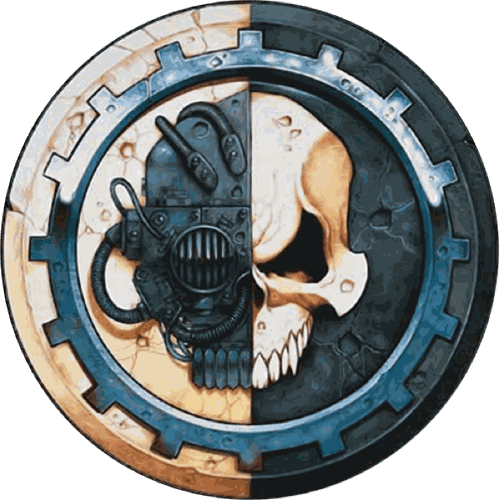 The Icon Mechanicus, half skull and half machine, symbol of the Machine God Artwork © Games Workshop | |
| Faith | Cult Mechanicus |
| Other names | Machine God, Deus Mechanicus (the deity); the Omnissiah (its avatar) |
| The Trinity | The Machine God; the Omnissiah; the Motive Force |
| Domain | Knowledge, machinery and motion |
| Identified with | The Emperor of Mankind, by the Treaty of Olympus (orthodox) |
| Centre of worship | Mars and the forge worlds |
| Priesthood | The tech-priests of the Adeptus Mechanicus |
| Sacred goal | The Quest for Knowledge |
The Omnissiah is, in the faith of the Cult Mechanicus, the physical avatar of the Machine God or Deus Mechanicus, the deity who embodies and bestows all knowledge and all technology. The Machine God is held to be an immanent, omniscient and omnipotent deity that governs all machinery and all knowledge in the universe. Its avatar, the Omnissiah, is believed to be friendly to mankind as its chosen people and to be the source of all human technological and scientific knowledge. Orthodox doctrine identifies the Omnissiah with the Emperor of Mankind.[1][2]
The Mechanicus's willing conflation of the Omnissiah with the Emperor keeps the peace between the Cult Mechanicus and the Imperial Cult, which holds that the Emperor is the only god of mankind, and so it keeps the Imperium functioning. The Treaty of Olympus (739.M30) joined Mars to the Emperor's Imperium. The compromise satisfies neither faith completely. Many members of the Mechanicus doubt that the Omnissiah and the Emperor are the same being, and similar beliefs led to the Schism of Mars and the formation of the Dark Mechanicum in the Horus Heresy (005–014.M31).[1][3]
The worship of the Machine God is the faith of the Adeptus Mechanicus and the countless tech-priests, Skitarii and servitors of the forge worlds. Its rituals govern the use and repair of every machine in the Imperium.[2]
Doctrine
[edit]The Trinity
[edit]The Cult Mechanicus holds knowledge to be the manifestation of the divine in the universe, and therefore treats anything that contains knowledge, from a data-crystal to a battle tank, as sacred. Its theology recognises three divine principles:[1]
The Machine God
The Machine God is the immanent, omniscient and omnipotent deity who governs all machinery and knowledge in the universe. Knowledge is held to be the manifestation of divinity.[4]
The Omnissiah
The Omnissiah is the Machine God's avatar in the physical universe, who reveals its will to mankind and grants human beings their knowledge. Orthodox believers of the Cult Mechanicus identify the avatar with the Emperor of Mankind, though many within the Mechanicus doubt it, and many heretical cults hold that the Omnissiah has not yet revealed himself. Similar beliefs led to the Schism of Mars.[4][5]
The Motive Force
The Motive Force is the universal spiritual power by which all life and motion, mechanical or organic, continues to exist. It is most fully expressed in the machine spirits that the Cult believes to inhabit every machine.[4][5]
Machine spirits
[edit]The Cult teaches that every machine is inhabited by a spirit, an expression of the Motive Force. The spirit must be appeased before a machine is used or repaired, lest the machine fail because its spirit feels disrespected.[1]
The Quest for Knowledge
[edit]The ultimate aim of the Cult is to understand the Machine God fully. This communal and personal search for enlightenment is the Quest for Knowledge. The Cult believes that all knowledge already exists in the universe, and that it is mainly a matter of time before it is gathered together to complete the Quest. The Cult is therefore disinclined to perform most basic research and development. Some original research continues on Mars and the other forge worlds, enough to keep Imperial technology advancing steadily, if extremely slowly.[1][5]
The Universal Laws
[edit]The faith is defined by sixteen precepts called the Sixteen Universal Laws, divided into two sets of eight, the Mysteries and the Warnings. The Mysteries include that life is directed motion, that the spirit is the spark of life, that understanding is the true path to comprehension, and that the Omnissiah knows all and comprehends all. The Warnings include that the alien mechanism is a perversion of the true path, that a soul can be bestowed only by the Omnissiah, that soulless sentience is the enemy of all, that the knowledge of the Ancients stands beyond question, and that to break with ritual is to break with faith.[5]
History
[edit]The Treaty of Olympus
[edit]The Imperium of Mankind and the Mechanicum of Mars agreed the Treaty of Olympus in 739.M30. It granted the Mechanicum political autonomy and an exception from the Imperial Truth so that the Cult Mechanicus could keep its faith in the Machine God, and in return the Mechanicum supplied the Great Crusade with weapons, starships and technicians. Many magi acknowledged the Emperor as the Omnissiah.[5][1]
Not every tech-priest accepted the identification. Some held that the Omnissiah had not yet revealed himself. In the Horus Heresy a large faction of the Martian Mechanicum led by the Fabricator General Kelbor-Hal came to believe that the Emperor was a false idol, and sided with Horus, bringing on the Schism of Mars (005–006.M31), a civil war that devastated the Red Planet. The loyalists were led by Zagreus Kane, and the denial of the Emperor's divinity became the defining heresy of the Dark Mechanicum.[5]
The Dragon of Mars
[edit]A forbidden tradition, held by the heretical Cult of the Dragon, teaches that the Machine God may in truth be the C'tan shard known as the Void Dragon, an ancient alien being of immense power, imprisoned in a Necron-built stasis tomb beneath the Noctis Labyrinthus of Mars. In this account the Emperor, unable to kill the being, imprisoned it before he emerged to found the Imperium, so that its passive power would cause the Adeptus Mechanicus to rise, whose support he needed for the Great Crusade. The legend has gained credit since the awakening of the Necron dynasties: a small Necron force is said to have reached Mars and destroyed some of the mine complexes of the Labyrinthus before the Skitarii and Titans destroyed it. The Mechanicus then enforced a perdita zone around the Labyrinthus, which an entire Skitarii Legion still holds.[5]
Practice
[edit]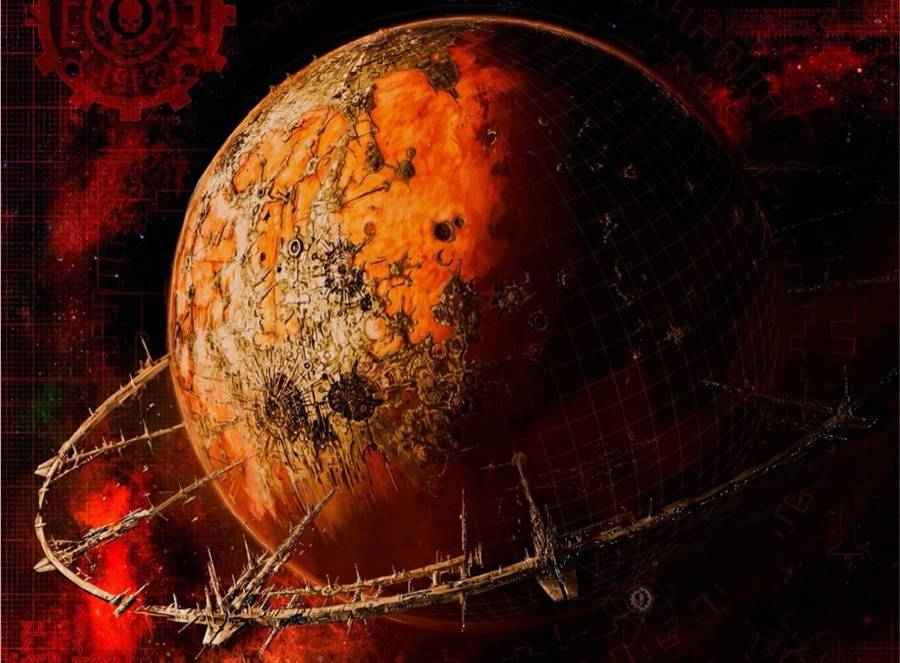
Worship of the Machine God is led by the priesthood of the Adeptus Mechanicus, headed by the Fabricator General of Mars. The Cult teaches that flesh is fallible but ritual honours the machine spirit, and its tech-priests replace their flesh with machinery. Its faithful include not only the priesthood but also the servitor workforce and the warriors of the Skitarii and the Titan Legions.[1][5]
The Cult distinguishes sharply between permitted and forbidden technology. Alien machines are anathema. Innovation without precedent is called tech-heresy.[1]
Relations with the Imperial Cult
[edit]The Ecclesiarchy holds that the Emperor is the one god of mankind, and so treats the Machine God as an aspect of him. The Cult Mechanicus holds that the Emperor is the avatar of the Machine God. This compromise satisfies neither believers of the Cult Mechanicus nor the Imperial Cult, but it keeps the peace between the two faiths and the wider Imperium functioning.[2][6]
The Archmagos Dominus Belisarius Cawl, who has lived since the Horus Heresy and whose work produced the Primaris Space Marines, holds that the Emperor is the Omnissiah, the orthodox position, but disagrees with much other Mechanicus dogma, believing that the true Quest for Knowledge is to pursue technological innovation. He asked several times that the Lord Commander Roboute Guilliman install him as Fabricator General of Mars. Guilliman refused: the Imperium does not exert such control over Mars under the ancient Treaty of Mars, and the other tech-priests would never accept a Fabricator General he appointed.[7][5]
Timeline
[edit]| Date | Event |
|---|---|
| 739.M30 | The Treaty of Olympus joins Mars to the Imperium; many magi acknowledge the Emperor as the Omnissiah. |
| 005.M31 | Fabricator-General Kelbor-Hal sides with Horus and the Schism of Mars begins. |
| 006.M31 | The open war of the Schism of Mars ends. |
| 999.M41 | Belisarius Cawl reveals the Primaris project. |
See also
[edit]
Notes
[edit]References
[edit]- ^ a b c d e f g h Codex: Adeptus Mechanicus (8th Edition), pp. 44-45, 80. Games Workshop.
- ^ a b c McNeill, Graham. Mechanicum (novel). Black Library.
- ^ Codex: Adeptus Mechanicus - Cult Mechanicus (7th Edition) (Digital Edition), "Fulgurite Electro-Priests," "Corpuscarii Electro-Priests". Games Workshop.
- ^ a b c Codex: Adeptus Mechanicus (8th edition). Games Workshop. pp. 10, 44-45.
- ^ a b c d e f g h i "Machine God". Warhammer 40k Wiki (Fandom).
- ^ Codex: Adeptus Mechanicus (8th Edition), pp. 44-45, 80. Games Workshop.
- ^ Warhammer 40,000: Rulebook (4th Edition), pp. 120-122. Games Workshop.