
Heresy
| Heresy | |
|---|---|
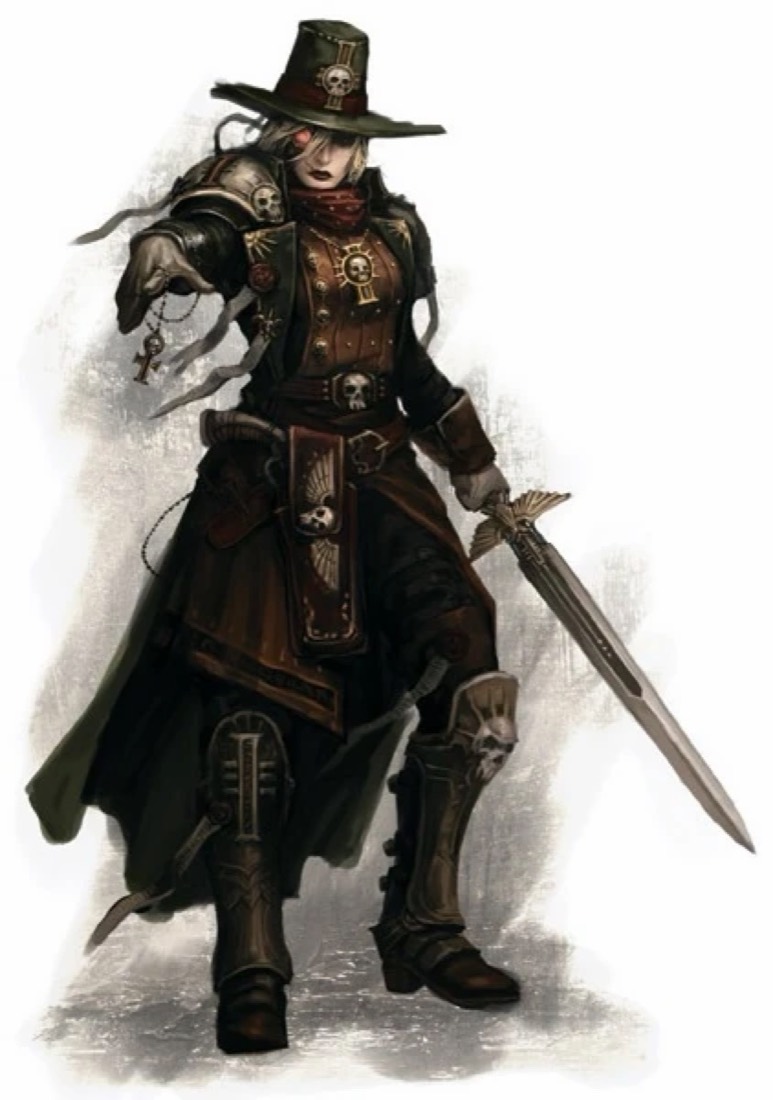 An Inquisitor of the Ordo Hereticus, the body most charged with the pursuit of heretics Artwork © Games Workshop | |
| Type | Crime against the Imperial Cult and the Imperium of Mankind |
| Defined by | The beliefs of the Imperial Cult and the laws of the Imperium; what counts is decided by the high officers of the Ecclesiarchy |
| Pursued by | Ecclesiarchy, Inquisition (Ordo Hereticus) |
| Penalties | Imprisonment, service in a Penal Legion, excommunication, execution, arco-flagellation; Excommunicate Traitoris; Exterminatus |
| Related terms | Heretic, Traitor, Renegade, Chaos cult |
Heresy is, in Imperial law and doctrine, any opinion, act or teaching that contradicts the beliefs, theology and commandments of the Imperial Cult of the God-Emperor, or the laws of the Imperium of Mankind. A person who commits heresy is a Heretic.[1][2]
Because the Imperial Cult is the state religion, the Emperor is not only the secular ruler of the Imperium but the one true god of mankind, and to take up arms against him or his faithful agents is more than treason: it is heresy. All enemies of the Imperium may thus be called heretics. In practice the Adeptus Ministorum seldom marks as heretics those who merely rebel against Imperial rule or kill a Guardsman. Such people are mundane rebels or criminals, dealt with by more conventional forces, though their deeds may hide the taint of true heresy, that of the Renegade or Traitor.[1][2]
The word is also used for the great civil war of the 31st millennium, the Horus Heresy, in which the Warmaster Horus turned against the Emperor.[3]
Definition
[edit]Heresy is more often the worship of the Ruinous Powers of Chaos, or aid given to the forces of Chaos in their attempts to subvert the Imperium, than the expression of an unusual religious opinion. The worship of any god other than the Emperor is forbidden. Those who overtly turn from the Imperial Creed are punished by death, as are those who deny the spiritual authority of the Ministorum. Many variant belief systems have been declared heretical by the Ministorum or the High Lords of Terra over the ages.[1][2]
What does and does not count as heresy is generally decided by the high officers of the Ecclesiarchy. Large divisions of the Ministorum exist to monitor and study the sects that flourish across the Imperium and to judge whether they remain within the orthodoxy of the Imperial Cult.[2]
The accusation of heresy is also a political weapon. A reasoned debate between cardinals can end the moment one hints at accusing the other, and a diocese slow in raising its tithes can be brought into line by the mere suggestion. An accusation is a blunt tool that can turn upon its wielder, since the accused may have unknown allies or patrons, and war between rival factions sometimes follows.[1]
Acts of heresy are sorted into legal grades (first, second, third and so on) according to the severity of the act. The faithful and the faithless are not always easy to tell apart. Among the thousands of Imperial cults and saints, seemingly faithful practices can mask heretical deeds, and the Ministorum, a church that spans tens of thousands of light years, cannot watch its own ranks closely.[1][2]
Tolerated faiths
[edit]The Ecclesiarchy tolerates several variant faiths that it disagrees with fundamentally. The Chapter cults of the Adeptus Astartes are among them. Every Space Marine Chapter is faithful to the Emperor and to its own ancestral primarch, but does not usually revere the Emperor as a god, and this has often been a source of tension with the Ministorum. On the whole the Ministorum and the Astartes keep cordial relations, since the Space Marines are the genetic descendants of the Emperor through the blood of the primarchs.[1][2]
The Cult Mechanicus is another deviant faith with which the Ecclesiarchy is often at odds. The tech-priests of the Adeptus Mechanicus worship the Machine God, commonly held to be a manifestation of the Emperor as the Omnissiah, although many in the Ecclesiarchy find this hard to accept. The Ecclesiarchy tolerates the Cult Mechanicus under the ancient Treaty of Mars, as the Emperor himself had to accept its deviation from the atheistic Imperial Truth in the Great Crusade: without the tech-priests the Imperium would grind to a halt.[1][2]
Examples of heresy
[edit]- The worship of gods other than the Emperor, especially the Chaos Gods. The Machine God of the Mechanicus and the varied views of the Chapters on the Emperor's divinity are not counted.
- The practice of witchcraft or sorcery, or any other use of unsanctioned psychic powers. Psykers and mutants often bear the suspicion of heresy, sometimes unfairly, but they are too much part of Imperial society to be purged wholesale.
- Treason or rebellion against the rightful rule of the Imperium and its Emperor.
- The usurpation of power within the adepta from the rightful agents of the Emperor, of which the Horus Heresy and the Reign of Blood are the most infamous examples.
- The use of alien technology, or of any technology not approved by the Adeptus Mechanicus. The Mechanicus is entitled to confiscate all alien technology and rediscovered archeotech for study.
- The use of Warp-based weapons and entities, such as daemon weapons, daemonhosts and the summoning of daemons.
The Ecclesiarchy is especially interested in those who not only reject the Emperor but embrace something else in his place. Servants of xenos and Warp entities are regarded as true heretics, and their discovery and eradication is a chief aim of the Ministorum throughout the Imperium.[1][2]
Dealing with heresy
[edit]The Inquisition teaches that the identification and eradication of heresy has three stages: suspicion, investigation and purging. Acolytes are taught that nothing and no one is beyond suspicion, which can make them paranoid, a virtue the Inquisition encourages, and that the Emperor's will guides their instincts to his enemies. In investigation, gathering evidence is secondary to finding the guilty, and stealth matters most, since the hint of acolytes nosing about sends cultists underground. The Inquisition therefore advocates striking as soon as possible, even on circumstantial evidence, holding that any number of innocent deaths is acceptable if a true heretic is destroyed.[4]
Once a heresy has been unmasked, it must be purged. Heretical cults, like weeds, can seem destroyed only to spring up again, and the teaching of the Ecclesiarchy and the Inquisition is that the Emperor rewards thoroughness. Where a heresy has consumed an entire hive city or continent, individuals cannot be singled out, and the Imperium shows no mercy and offers no quarter, to the point of destroying cities or whole worlds by war, atomic fire or virus bomb.[4]
The Ordo Hereticus was founded in the Inquisition after the Age of Apostasy to police the enemies of the Emperor within the Imperium's own structures, and is known as the Witch Hunters.[5]
Heretical cults
[edit]Heresy is contagious, and when it spreads a cult is often formed. In other cases a charismatic leader gathers followers, or deviants join for mutual support and protection. Cults exist chiefly for secrecy and for power, and most conceal themselves behind a more benign front or remain wholly hidden. They tend to favour a particular setting: a cult fomenting rebellion among mutant labourers keeps to the shatters and barrens, while a conspiracy of daemon-worship among the nobility keeps to the salons and estates of the elite. Cults take three common forms. Charismatic cults are built around a single leader, often a witch or sorcerer. Mystery cults and secret societies are built around secrets held by an inner circle, and the largest of these in the Imperium is arguably the Cult Mechanicus itself. Cellular cults are broken into small cells, none of which knows the others, so that a captured member can betray only his own cell. The Inquisition itself, ironically, organises its field agents in cells.[1][2]
Punishment
[edit]Punishments for heresy range from imprisonment, assignment to an Astra Militarum Penal Legion, excommunication from the rites and protection of the Ecclesiarchy, and execution, to arco-flagellation, among others.[1][2]
Excommunicate Traitoris
[edit]Excommunicate Traitoris is a High Gothic bureaucratic designation, the highest form of Imperial reproach, for a citizen, world or organisation guilty of extreme heresy, including mutation, rebellion and corruption by Chaos. The accused is banished from the Imperium on pain of death. When the High Lords of Terra or an Inquisitor of the Holy Ordos pronounce it, the accused is struck from the annals of Imperial history: names are deleted from the scrolls of honour in the Hall of Heroes in the Imperial Palace and wiped from the Librarium Terra by the Deletion Teams of the Historical Revision Unit. If the accused is a Space Marine or a whole Chapter, its gene-seed stores held by the Mechanicus are destroyed, and slain heretics are incinerated so that their blood will no longer taint mankind. An accused who confesses and repents is granted a quick and clean death. More often the accused flee towards the great Warp rifts, such as the Eye of Terror and the Maelstrom, and are hunted for the rest of their days or executed on sight.[1][2]
Edict of Obliteration
[edit]An Edict of Obliteration, also called a Damnatio Memoriae, is a frequent part of major political or religious change in the Imperium. It erases an individual from Imperial history, by destroying images of the member of the elite after death or overthrow, so that every trace of one who damaged humanity is removed as if he had never existed.[1]
Exterminatus
[edit]The order of Exterminatus is the last resort of the Imperium, the complete eradication of all life on a planet. It may be given only by the highest ranks: a Chapter Master, a Lord High Admiral of the Imperial Navy, a Lord Commander of the Astra Militarum or an Inquisitor. It is issued only when a threat is judged to be an extinction-level event beyond redemption, and has been used against planet-wide heresy, uncontrollable mutation or disease, the opening of Warp rifts and entrenched xenos.[1][2]
Notable heresies
[edit]The Horus Heresy
[edit]The largest heresy in the history of the Imperium began in 005.M31 at Isstvan III, and ended in 014.M31 when the Emperor killed Horus in the Siege of Terra. The Traitor Legions were declared Excommunicate Traitoris and driven into the Eye of Terror in the Great Scouring.[3]
Goge Vandire and the Reign of Blood
[edit]In the early 36th millennium the High Lord of Terra Goge Vandire, who held the offices of Master of the Administratum and Ecclesiarch at once, ruled the Imperium according to his own wishes instead of the Emperor's will, in the tyranny called the Reign of Blood. He held power for almost a standard century, until the Terran Crusade of 378.M36 overthrew him, and he was slain by his own bodyguard, the Daughters of the Emperor. Sebastian Thor replaced him as Ecclesiarch, and the end of the Reign brought a reform of the Ecclesiarchy, the creation of the Ordo Hereticus and of the Adepta Sororitas.[5]
The Moirae Schism
[edit]The Moirae Schism was a religious schism and civil war of the Adeptus Mechanicus in the 35th millennium, spread from the rebel forge world of Moirae. It led to the excommunication of several Iron Hands clan companies, which founded the Sons of Medusa. It took over two Terran millennia of warfare before the Moirate doctrines were considered fully purged from the servants of the Machine God.[6]
The Plague of Unbelief
[edit]The Plague of Unbelief was a great rebellion led by the Apostate Cardinal Bucharis of Gathalamor. It is counted by historitors as part of the Age of Apostasy, although it occurred several solar decades after Goge Vandire's death and Thor's elevation to Ecclesiarch.[7]
The Macharian Heresy
[edit]After the death of the Lord Solar Macharius in 400.M41, the generals of his seven army groups repudiated their oaths and the conquered territories fell into civil war. The High Lords called in Space Marine Chapters, over a hundred of them in all, to suppress what became known as the Macharian Heresy, a campaign that lasted until about 470.M41 and in which the Minotaurs were among the spearhead.[8]
Cypher
[edit]Cypher, one of the Fallen Angels, is hunted by the Dark Angels as a heretic. In 999.M41, during the Terran Crusade, he freed the resurrected Roboute Guilliman from a Blackstone Fortress in the Maelstrom, in return for a promise that he would be brought before the Emperor.[9]
Timeline
[edit]| Date | Event |
|---|---|
| 005.M31 | Horus begins the Horus Heresy at Isstvan III. |
| 014.M31 | Horus is slain at the Siege of Terra; the Traitor Legions are declared Excommunicate Traitoris. |
| M35 | The Moirae Schism splits the Adeptus Mechanicus. |
| Early M36 | The Age of Apostasy; Goge Vandire rules as Master of the Administratum and Ecclesiarch in the Reign of Blood. |
| 378.M36 | The Terran Crusade overthrows Vandire; Sebastian Thor becomes Ecclesiarch. |
| After the Age of Apostasy | The Ordo Hereticus is founded in the Inquisition. |
| 400–c. 470.M41 | The Macharian Heresy, after the death of Macharius. |
| 999.M41 | Cypher frees Roboute Guilliman from the Maelstrom. |
See also
[edit]
References
[edit]- ^ a b c d e f g h i j k l m Dark Heresy: Blood of Martyrs (roleplaying game). Fantasy Flight Games. pp. 21-22.
- ^ a b c d e f g h i j k l Dark Heresy: Disciples of the Dark Gods (roleplaying game). Fantasy Flight Games. pp. 22-25.
- ^ a b "Horus Heresy". Warhammer 40k Wiki (Fandom).
- ^ a b Dark Heresy: The Inquisitor's Handbook (roleplaying game). Fantasy Flight Games. pp. 204-205.
- ^ a b "Age of Apostasy"; "Goge Vandire". Warhammer 40k Wiki (Fandom).
- ^ "Moirae Schism". Warhammer 40k Wiki (Fandom).
- ^ "Plague of Unbelief". Warhammer 40k Wiki (Fandom).
- ^ "Macharian Heresy". Warhammer 40k Wiki (Fandom).
- ^ "Cypher". Warhammer 40k Wiki (Fandom).