
Ordo Hereticus
| Ordo Hereticus | |
|---|---|
| Ordo Majoris of the Inquisition | |
 The Inquisitorial I, the symbol of the Holy Ordos Artwork © Games Workshop | |
| Organisation | |
| Known as | The "Witch Hunters" |
| Parent body | Holy Ordos of the Emperor's Inquisition |
| Chamber Militant | Sisters of Battle (the Orders Militant) |
| Remit | Heresy, mutation, unsanctioned psykers, treason and corruption within the Imperium of Mankind |
| Founded | After the Age of Apostasy, M36 (no year is recorded) |
| Founded in response to | The Reign of Blood of Goge Vandire |
| Watches over | The Ecclesiarchy, the Adeptus Arbites, the Adeptus Astartes, the Adepta Sororitas, the other Ordos |
| Instruments | Black Ships, Acolytes, Frateris Militia, Astra Militarum regiments |
| Sibling Ordos | |
| Ordo Malleus, Ordo Xenos | |
The Ordo Hereticus, known across the Imperium as the Witch Hunters, is one of the three Ordos Majoris of the Inquisition. Its charge is to protect Mankind from itself. Its agents combat the internal threats to the Imperium of Mankind: treason, mutation, heresy, apostasy among the clergy of the Ecclesiarchy, and the unsanctioned psykers who are called "witches" in the common speech of most worlds. Mutants, rebels and heretics fall within its remit as well, and it has never hesitated to act against the other Adepta. A Renegade cardinal of the Adeptus Ministorum or a corrupt Tech-priest is as likely to meet a Witch Hunter as any cultist.[1][2]
The Ordo is the youngest of the three Ordos. The Ordo Malleus and the Ordo Xenos trace their origin to the order that the Emperor of Mankind gave to Malcador the Sigillite at the opening of the Horus Heresy in 005.M31. The Ordo Hereticus was set up only after the Age of Apostasy in the 36th millennium, when the anarchy of the Reign of Blood and the heresies that grew from it, above all the Plague of Unbelief, had shaken the Imperium's government as nothing had since the Heresy. Its founding purpose was to check the power of the Ecclesiarchy, so that another prelate like Goge Vandire could never again hold the machinery of state.[3][1]
Witch Hunters are counted the darkest and most unforgiving of the Inquisition, because their prey is Humanity. Like all Inquisitors they hold ultimate authority over every organisation of the Adeptus Terra and may demand help from any source of authority in the Imperium. Their Chamber Militant is the Adepta Sororitas, the Sisters of Battle, and they may also call on the Ecclesiarchy's Frateris Militia or requisition regiments of the Astra Militarum. The arrival of one of them on a world is met with fear and awe, since only the Inquisitor knows on whom the gaze will fall.[1][4]
History
[edit]Origins
[edit]The Ordo Hereticus exists because of the Reign of Blood. In the 36th millennium the High Lord Goge Vandire, Master of the Administratum, seized the office of Ecclesiarch of the Adeptus Ministorum as well, and so held the two greatest bureaucracies of the Imperium at once. He thereby threatened the rule of the Emperor and of the Senatorum Imperialis, which governs in the Emperor's name. His tyranny ended around 378.M36, when the reformer Sebastian Thor led an army against Terra and Vandire was killed by his own guard.[3][1][a]
The Inquisition had to answer how a single churchman had come so close to supplanting the Throne. It had always watched the organs of state, the Ecclesiarchy among them, but the Ecclesiarchy now held an extraordinary place in the daily life of the Imperium's people. Nothing moves the men and women of the Imperium like faith in the Emperor, and the Inquisition feared a repetition by other corrupt men, or the perversion of honest faith into a new Chaos Cult that could drive a planetary rebellion. The Ordo Hereticus was shaped as the permanent watchman over that danger.[2][3]
From myth to open shadow
[edit]For its first standard millennia the Ordo was a rumour even to other Inquisitors, so fanatically was its secrecy guarded. After the Apostasy the leaders of the Holy Ordos judged that it would serve better as a shadow that frightened than as a myth too easily ignored, and it became openly feared. It grew with the Ecclesiarchy it was meant to watch, for nothing arouses an Inquisitor's suspicion faster than a holy man who claims to speak with the Emperor's voice.[3][1]
The Sisters of Battle
[edit]Under the reforms that followed the Apostasy the ecclesiarch Sebastian Thor issued the Decree Passive, which forbade the Ecclesiarchy to keep "men under arms". Later ecclesiarchs found a loophole in the wording and refounded the Daughters of the Emperor as warrior-nuns, merged into the Adepta Sororitas. Soon afterwards the reformed Sisterhood and the Ordo Hereticus made an agreement of mutual aid at the Convocation of Nephilim. Its terms are still shrouded in mystery, and some Inquisitors suspect that only the canonesses of the Sororitas and a few Inquisitor Lords understand what the two bodies are working toward.[1][2]
Remit
[edit]Watching the Ecclesiarchy
[edit]The Ordo's original task remains its first. Its Inquisitors monitor the Wars of Faith declared by the Ecclesiarchy, to see that they stay within the aims set by the Ecclesiarch and the High Lords of Terra. They test that the doctrine preached by the priests of the Imperial Cult remains true to the orthodoxy of the Ministorum, and they check the wealth and the stellar territory claimed by bishops and cardinals, so that the princes of the church never again gather temporal power on the scale of the Reign of Blood. Many Witch Hunters pose as servants of the Ecclesiarchy, feigning obedience to a cardinal until they have proof of his guilt. It is said that a rare priest has no fault that an Inquisitor of the Ordo cannot find.[3][1]
The Ordo's gaze also falls on the Adeptus Arbites, the Space Marines, the Sisters of Battle and its fellow Inquisitors. Only the Emperor is beyond its suspicion. Simply to oppose a Witch Hunter is to risk being declared a heretic and condemned as Extremis Diabolus.[3]
Heresies of faith and thought
[edit]In the Ordo's working definition, heresy is to adhere to, promulgate or act on a theological or political doctrine contrary to the orthodoxy of the Ministorum or to the Lex Imperialis, which is itself held to be of divine origin. In practice the crime covers everything from the denial of the Emperor's divinity and rebellion against the Adeptus Terra to blasphemy and irreligious practice. Imperial confessors use the word more loosely still, for any sin of thought that the Imperium's moral guardians dislike, and the zeal with which a given world treats heresy varies enormously, since the Imperium holds countless cultures and doctrines that do not fit well together.[5][6]
Corruption of the body and the witch
[edit]The Ordo regards the mutant and the psyker as threats to the nature of Humanity itself. The mutant, corrupted in flesh, is held to be a possible sign of the taint of Chaos, and to be a mutant under the Lex Imperialis is to be removed from Humanity. Many so-called mutants are really abhumans, deformed by generations of industrial pollution or alien biospheres and blameless of any Warp taint, yet they are still often the victims of zealots. More measured factions of the Ordo do draw the distinction, preferring not to waste effort on a few chem-dregs when real corruption hides behind a wealthy facade. Others of a Puritan mind would destroy all of them, to be safe. That course meets stiff resistance on worlds whose economies depend on an abhuman underclass, and on the whole the pragmatist's policy of control and repression prevails, until Warp taint or rebellion appears and the Holy Ordos loose the Emperor's hounds, and whole worlds are heaped with pyres.[3][6]
The witch is held to be more dangerous than any other traitor or heretic. An unsanctioned psyker is a door by which the Warp may reach the unsuspecting, and every untrained one is a possible planetary catastrophe, capable by accident or design of starting fires, spreading nightmares, enslaving others as living puppets or killing by a stray thought. Hunting them is the central task of many Witch Hunters, and the Black Ships carry the captured to Terra. The Ordo has no objection to psykers who have been properly sanctioned, and a surprising number of its Inquisitors are psykers themselves.[3][1]
Sins of the past
[edit]Rarer crimes also concern the Ordo: the veneration of false gods and the pursuit of forbidden lore that recall the sins of Humanity's ancient past. Some are so proscribed that to know of them is cause for summary execution. The worship of "progress" and the pursuit of technologies banned since the Emperor walked among his people are treated with the contempt reserved for mutant cults. In these matters the Ordo has clashed with the Adeptus Mechanicus and with the Ordo Xenos, which dispute both its involvement and its methods.[3]
Methods and organisation
[edit]Witch Hunters
[edit]Witch Hunters are by repute figures of strong will. Some wear psychic hoods against hostile witchery. Others trust in litanies of protection and hatred. A Hereticus Inquisitor may specialise in the identification of mutants and command cells of Acolytes that range from hive-hardened flamer squads, trained to purge whole infected districts, to assassination cells that remove and replace political figures who have succumbed to the Dark Gods. Such an Inquisitor is usually less concerned with the mutants than with the cause of an outbreak, which may herald a rise in Chaos or xenos cult activity. An investigation may thus end with the removal of a head of state, the cleansing of a polluted region, or a war.[3][6]
When an individual poses a severe threat, such as a psyker of unprecedented power, a mutant with terrible abilities or a planetary governor unwilling to carry out a necessary pogrom, the Ordo excommunicates the offender from the human species and hunts him down, calling on the Sisters of Battle, other Adepta or another Ordo. It will send the Astra Militarum against the Imperium's own people if needed, holding it better to end a thousand innocent lives than to let corruption reach millions. The Ordo thinks in sectors and star systems, not in planets or individuals, and its masters regard the billions of the Imperium as a flock in which every soul may be a psyker, a mutant or a rebel.[3]
The art of investigation
[edit]Because the heretic, the witch and the traitor lurk unseen among the masses, the Ordo's work is detection before it is destruction. Its records sort the clues an investigator follows into three kinds. Physical clues are the remnants of dark rituals, markings and pendants of allegiance, and blasphemous works of craft, from weapons that use xenos technology to paintings laced with fine heretical iconography. Mutation is also a physical sign, though cultists sometimes mark their allegiance on their own flesh with scars, brands or electoos, which can be a trap for an Acolyte infiltrating a cult.[3]
Informational clues are less reliable. They include heresies of thought, found by covert monitoring or, for those who employ psykers, by telepathy; heresy of tolerance, the failure to act on knowledge of a heresy; and the accusation of a neighbour, which the Adeptus Terra and many governments encourage by reminding citizens to report heresy. Correlational clues are patterns that link the others: a series of murders that proves to be the work of a cult of the Blood God, dark patterns such as a lingering smell or nightmares at regular intervals, ciphers and secret signs such as a feather of a certain colour, and heresy by association. The strictest Witch Hunters hold that friends and family of a heretic should simply be purged with him, since innocence proves nothing.[3]
Chamber Militant
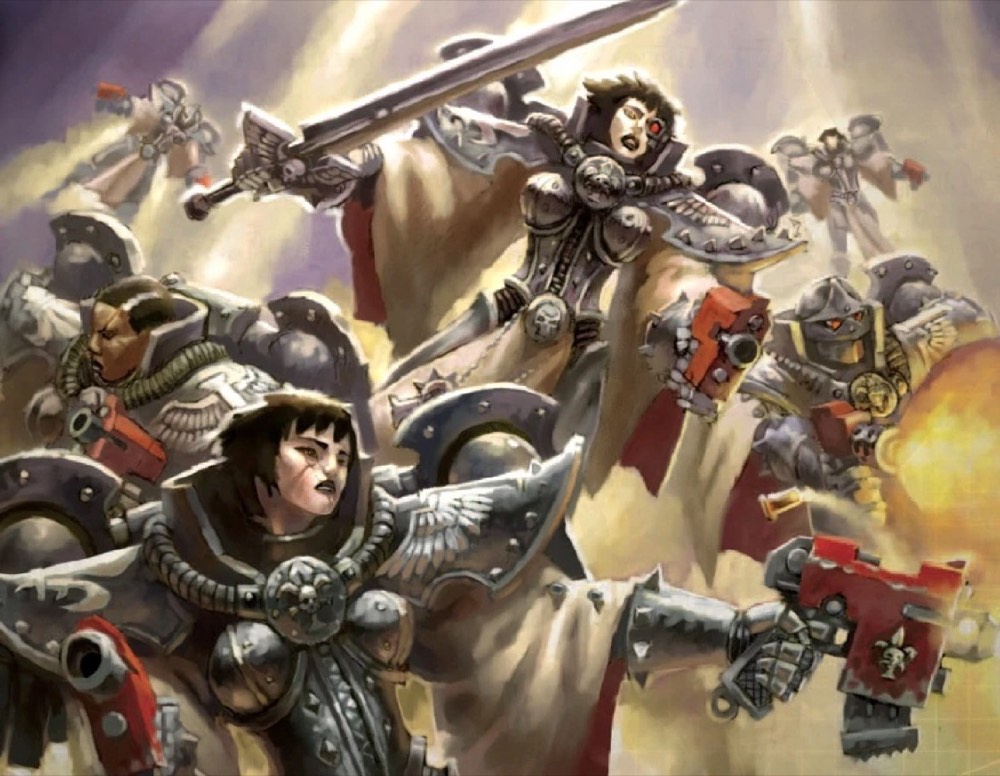
[edit]The Ordo's Chamber Militant is the Adepta Sororitas, also called the Sisters of Battle or the Daughters of the Emperor. The Orders Militant form the military arm of the Ecclesiarchy and answer when an Inquisitor of the Ordo needs a more forceful resolution. The two bodies differ in temper. Hereticus Inquisitors tend to be analytical, methodical and suspicious, while the Sisters are zealous and unquestioning of the Imperial Creed, yet both are committed to rooting out threats from within. Through the Sisterhood the Ordo has a standing armed force that is, in theory, owned by the very church it watches.[1][2]
Notable members
[edit]The Ordo's most famous Inquisitors are known by repute more than by record, and many of its cases are sealed. Fyodor Karamazov, an Inquisitor Lord, gained his name on Salem Procor when he executed a popular servant of the Ministorum. The Ecclesiarchy and the Thorian Inquisitors cried out, but the preacher proved to be a true heretic, and Karamazov's reputation was redeemed, though his relations with the church and his peers never mended. He rides into battle on the war-machine called the Throne of Judgement.[1][3]
In the Calixis Sector the Witch Finder Rykehuss descends on a city, sets up a Court of Ordeals and puts the accused to the flame, holding that fear itself suppresses witches. Some call him a hero and others a butcher, and both are right. The same sector holds Vownus Kaede, a swordsman and psyker of Puritan leanings who spirits promising young psykers away from the pogroms of Rykehuss, and Astrid Skane, a former Arbitrator of Scintilla, who hunts corruption among the nobility and the Adepta. Both belong to the Tyrantine Cabal, which watches the Tyrant Star.[6][7]
Others are known from the Imperium's wider wars. Inquisitor Ligea, who studied texts and ancient writing and served beside the Grey Knights on the trail of Ghargatuloth, fell to the taint of the daemon prince she hunted and was captured by her own Inquisition. In her ravings she let slip the true name of Ghargatuloth, which gave the Grey Knights the means to destroy it once in every thousand years. Inquisitor Adrastia was sent to the Aurelia sub-sector in the late 41st millennium with Lord General Castor of the Cadian Shock Troops to investigate charges against Azariah Kyras, Chapter Master of the Blood Ravens, while an Exterminatus fleet approached. Inquisitor Agmar, working with the Adeptus Arbites on Ichar IV, helped to break a Genestealer cult and then, through his astropaths, to detect the approach of Hive Fleet Kraken.[4][1][3]
Not every Witch Hunter is a zealot. Hettesh Kane, a sanctioned psyker and former teacher of the Scholastica Psykana, came to believe that psykers of moral conviction could achieve great things, and trained those he caught instead of killing them. Victoria Aldrich, trained by the cunning Inquisitor Yusuph Trevar, tempers an Acolyte's verve with her master's planning. Havelock Blackheel of Maccabeus Quintus has waged a one-man war on psykers for a standard century in the Koronus Expanse.[3][6]
Timeline
[edit]Dates are the best Imperial estimates. Where the records give no year the entry is marked as estimated.
| Date | Event |
|---|---|
| 005.M31 | The Emperor orders Malcador the Sigillite to found the forerunners of the Ordo Malleus and Ordo Xenos, at the outset of the Horus Heresy. The Ordo Hereticus does not yet exist. |
| Early M32 | The Temple of the Saviour Emperor is recognised as the state religion and becomes the Adeptus Ministorum; some centuries later the Ecclesiarch takes a seat among the High Lords of Terra. |
| M36 (estimated) | Goge Vandire becomes Ecclesiarch as well as Master of the Administratum and begins the Reign of Blood. |
| M36 (estimated) | The Plague of Unbelief and other heresies spread in the anarchy of the Apostasy. |
| c. 378.M36 (estimated) | Vandire is killed by his own bodyguard after Sebastian Thor invades Terra. |
| After c. 378.M36 (estimated) | The Ordo Hereticus is founded; the Decree Passive forbids the Ecclesiarchy to keep armies. |
| After c. 378.M36 (estimated) | The Convocation of Nephilim joins the reformed Sisterhood and the Ordo in common purpose. |
| After the Apostasy | The Ordo ceases to be a rumour and becomes an open and intimidating presence. |
| M41 | Inquisitors of the Ordo work in the Calixis Sector and Koronus Expanse; the Tyrantine Cabal watches the Tyrant Star. |
| 999.M41 | The Great Rift opens and apocalyptic cults multiply across the Imperium. |
See also
[edit]
Notes
[edit]- ^ The Imperial record of the Apostasy gives no single year for each event. The date of Vandire's death is the estimate used in the article on the High Lords of Terra.
References
[edit]- ^ a b c d e f g h i j k Codex: Inquisition (6th edition). Games Workshop. pp. 12-13, 22, 39, 50, 83, 101, 107, 130-131, 136, 154, 167.
- ^ a b c d Codex: Witch Hunters (3rd edition). Games Workshop.
- ^ a b c d e f g h i j k l m n o p Dark Heresy: Enemies Within (2nd edition, roleplaying game). Games Workshop. pp. 138-140.
- ^ a b Counter, Ben. Grey Knights (novel). Black Library.
- ^ Dark Heresy: Disciples of the Dark Gods (roleplaying game). Games Workshop. pp. 21-22.
- ^ a b c d e Dark Heresy: Core Rulebook (roleplaying game). Games Workshop. pp. 220, 226, 257, 268-269, 318-322.
- ^ Dark Heresy: The Radical's Handbook (roleplaying game). Games Workshop. p. 233.