
Ghargatuloth
| Ghargatuloth | |
|---|---|
| Greater Daemon of Tzeentch | |
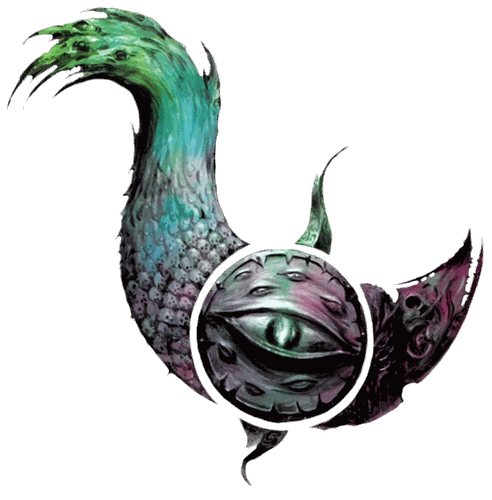 The mark of Tzeentch Artwork © Games Workshop | |
| Known titles | |
| Titles | Prince of a Thousand Faces; Forger of Hells; Whisperer in the Darkness; God of the Last Hunt; Seventy-Seventh Masque |
| Allegiance | Tzeentch (Chaos) |
| Origin | The Warp; first seen in the material realm in the Age of Strife |
| First banishment | On Khorion IX, by Grand Master Mandulis of the Grey Knights (date disputed, see text) |
| Reborn | Volcanis Ultor, c. 999.M41 |
| Second banishment | c. 999.M41, by Justicar Alaric |
| Agents | Missionary Crucien; Inquisitor Gholic Ren-Sar Valinov; Kelkannis Evisser |
| Known for | The Trail of Saint Evisser; theft of the Sword of Mandulis |
Ghargatuloth is a Greater Daemon of Tzeentch. The Inquisition records him as the Prince of a Thousand Faces, the Forger of Hells, the Whisperer in the Darkness, the God of the Last Hunt and the Seventy-Seventh Masque. His substance is knowledge, and every secret learned and every life taken makes him stronger.[1]
Ghargatuloth has been banished from the material realm twice. The first time cost the lives of three Grand Masters of the Grey Knights and three hundred of their brethren. On the second occasion, on the eve of the Thirteenth Black Crusade, he was driven out by Justicar Alaric using his True Name. The Emperor's Tarot suggests that he will not return for another thousand standard years.[1]
History
[edit]Age of Strife
[edit]Ghargatuloth took physical form for the first time by possessing minds of unusual psychic strength. He emerged in the Age of Strife and, according to the Inquisition, spent most of that era under many mortal guises: warlord, hero, pirate-king and bloodthirsty queen. He learned much, but he was defeated as often as he won. He concluded that Mankind was too weak to endure and came to despise it.[1]
The rise of the Emperor and the Great Crusade changed his mind. When the Imperium survived the Horus Heresy and the loss of its founder, Ghargatuloth resolved to ensure that it would fall, as every human empire before it had.[1]
Thalassocres
[edit]Ghargatuloth can exist in the Warp and in the material realm at once, so his essence answered Tzeentch when the Changer of Ways summoned his greatest servants to the world of Thalassocres, a world of constant change. Imperial records place this conclave in the 38th millennium, although the order of events in his career is disputed.[1][a] Tzeentch tore the planet to a fiery core and drifting continents. He then spoke to the Greater Daemons gathered there. Several of the weakest were destroyed by what they heard. Ghargatuloth absorbed the whole of it, and when the communion ended he had "a thousand new faces".[1]
Khorion IX
[edit]Ghargatuloth had already claimed the empty world of Khorion IX in the Halo Zone of the Segmentum Obscurus. After Thalassocres his host body released a psychic scream that killed every living thing on the planet and told nearby systems that he existed. The Ordo Malleus spent a standard century tracing him. When it arrived, Khorion IX held a forest made of crucified cultists, fused with their torture racks by the Warp.[1]
The Grey Knights struck with two strike cruisers, the Valour Saturnum and the Vengeful, under Inquisitor Lord Lakonios. Over 250 Grey Knights followed three Grand Masters, Mandulis, Ganelon and Malquiant. They dropped by pod, because the Warp was too unstable for teleportation. Ganelon's company of a hundred was cut off and held a doomed ring in the middle of the Daemon host. Malquiant led about seventy against the horde. Mandulis and Terminator Squad Martel reached the barrow where Ghargatuloth stood, past a guard of a dozen Lords of Change. The details are unknown, but Mandulis's sacrifice banished the Daemon.[1]
The Grey Knights and the Ordo Malleus commemorated the victory for three thousand standard years. Only later did they learn that it had been part of his design.[1]
The Trail of Saint Evisser
[edit]Ghargatuloth had meanwhile corrupted the Trail of Saint Evisser, a chain of worlds on the western edge of the Segmentum Solar. The origin of the taint was the Feudal world of Sophano Secundus, where an agent of his called Missionary Crucien had posed as a preacher of the Imperial Cult for ten thousand years, changing identity every few decades. Crucien placed a follower, the clerk Kelkannis Evisser, on the Agri-world Solshen XIX. Evisser survived an Ork invasion unharmed and became a popular unofficial saint. On the worlds he visited he calmed plagues and revolts, and hidden cults of Tzeentch took root behind him. When he died, the Ecclesiarchy buried him on the hive world of Volcanis Ultor, hoping that he would be forgotten.[1]
Rebirth and second banishment
[edit]Before the Thirteenth Black Crusade Ghargatuloth corrupted Inquisitor Gholic Ren-Sar Valinov of the Ordo Malleus. Valinov stole an edition of the Codicium Aeternum and made the Grey Knights believe that only the Sword of Mandulis could destroy Ghargatuloth's body. In fact the sacrifice the Daemon needed had to be slain by the weapon that first banished him. On Volcanis Ultor, c. 999.M41, local forces were turned against the Grey Knights of Justicar Alaric, and the blood spilt fed the ritual. The Sword struck down the risen corpse of Evisser, and Ghargatuloth burst out as a column of flesh bearing thousands of faces.[1][b]
The Inquisitrice Brei Ligea, an infocyte, had learned his True Name. Alaric spoke it while the Daemon was weak, and the Imperial bombardment destroyed his body. Ghargatuloth was driven back into the Warp, and the name was entered in the second tome of the Codicium Aeternum. Valinov was absorbed by him as a further identity.[1]
Timeline
[edit]| Date | Event |
|---|---|
| Age of Strife | Ghargatuloth first walks among mortals |
| M38 (disputed) | Conclave of Thalassocres |
| Date disputed | Battle of Khorion IX; first banishment |
| c. 999.M41 | Rebirth on Volcanis Ultor and second banishment by Alaric |
See also
[edit]


Notes
[edit]- ^ The sources give the Thalassocres conclave as roughly the 38th millennium, "two thousand standard years" before the events on the Trail of Saint Evisser, and the first banishment as ten thousand standard years before the Thirteenth Black Crusade. These figures cannot be reconciled, so no exact dates are given here.
- ^ The date is placed on the eve of the Thirteenth Black Crusade by the sources; c. 999.M41 is inferred.