
Feudal world
| Feudal world | |
|---|---|
| Class of Imperial world | |
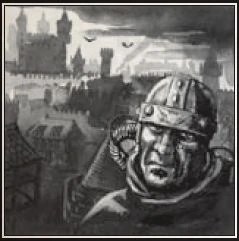 A walled city of a feudal world, from an early Administratum survey plate Artwork © Games Workshop | |
| Classification | Feudal world, one of the Administratum's classes of settled world[a] |
| Technology | Late Iron Age to early gunpowder; no powered flight, automatic weapons or powered vehicles |
| Population | Typically 10,000,000 to 500,000,000 |
| Economy | Farming and animal husbandry; largely self-sufficient |
| Tithe | Low tithes of crops or minerals; manpower for the Astra Militarum is the chief tribute |
| Government | Kings, princes or great lords, who owe fealty to the Planetary Governor |
| Governor's seat | Commonly a space station in orbit, to avoid altering the culture below |
| Related classes | Feral world; Knight world; Death world; Civilised world |
| Examples | Attila, Nocturne, Caliban (destroyed at the end of the Horus Heresy), Chogoris (semi-feudal), Alaric Prime, Sovereign (formerly) |
A feudal world is a planet of the Imperium of Mankind into which the Imperium has not seen fit to introduce most advanced technology. Its people have reached or fallen back to a late Iron Age civilisation, moderately advanced but still pre-industrial, and they have usually progressed as far as the discovery or rediscovery of rudimentary gunpowder weapons. The only common exception is in medicine, since simple antiseptic and other medical measures are often allowed so that the labour of the world is not wasted by every plague. Culturally and technologically, the people resemble the Terran societies of the European late Middle Ages or Renaissance in the Age of Progress.[1][2]
The population of a feudal world is bound together in a web of obligations and allegiances. Everyone owes loyalty to those above, from the lowliest peasant to the elite warrior to the local ruler, and the ruler in turn bows before the world's assigned Planetary Governor. Each ruler has duties toward those below him, such as protection from external threats and land to work. This structure lends stability to a hard life, and the worlds that live by it are often said to be the most politically harmonious in the Imperium, because their peoples know their place.[1][3]
The Imperium usually leaves such worlds alone. A feudal world pays low tithes, and its governor lives apart from the people, so that the culture below is not disturbed. Its greatest value to the Imperium is its manpower, since it is a strong source of recruits for the Astra Militarum and of candidates for the Chapters of the Adeptus Astartes. Feudal worlds have produced some of the most famous cavalry of the Imperium, and several primarchs were raised on them.[1][4]
Characteristics
[edit]Technology and population
[edit]A feudal world is held down by two features. The first and most pronounced is a level of technology far below that of the more advanced Imperial societies. On many feudal worlds gunpowder weapons are the limit of invention, and ranks of crude black-powder firearms and mounted warriors on the charge may be the greatest weapons on the battlefield. Simple machines such as pulleys and windmills are known, but propelled flight, automatic weapons and powered vehicles are rare or absent. Beasts and human muscle till the fields, raise the walls and carry goods and people.[1][2]
The second feature is the way the people live. Their lives are ordered by networks of duty and allegiance that run through tribe and class and last for generations, and the members of a feudal society are born, raised and buried in their fixed stations. A typical feudal world holds between ten million and five hundred million people, many of them farmers. Because the populations are low enough to feed themselves from farming and herding, feudal worlds are generally self-sufficient, unlike many other planets of the Imperium.[1]
These limits do not make the people incapable. Feudal worlders raise complex aqueducts and gigantic statues, and their healers and animal trainers may develop alchemical potions, herbal remedies, poisons and methods of training beasts that surpass those of more advanced societies. With limited access to Imperial technology, they rely on manual labour and simple materials, but they still follow the principles of Imperial design in their building.[1][3]
Difference from related worlds
[edit]A feudal world differs from a Feral world in having a settled society. On a feral world, the people are nomadic hunters or members of early agricultural societies at the level of the Stone Age, Bronze Age or early Iron Age, who live in tribes, number only 100,000 to 5,000,000, and pay the lowest tithe grade. A feudal world has organised kingdoms or nation-states, linked by webs of vassal obligation.[5][4]
It differs from a Civilised world in lacking industry. A special form of feudal society is the Knight world, whose dynasties of nobles pilot the Imperial Knights, giant war machines. All Knight worlds are feudal, divided into fiefdoms, and the Knight houses owe their rank to their service in the suits. They keep a feudal order and, because the thrones of their machines imprint upon their minds, most are conservative and mistrust psykers.[6]
Relations with the Imperium
[edit]Governance and tithe
[edit]The governor of a feudal world lives apart from the people. Generally he or she makes a home on a space station in orbit, to avoid altering the cultural balance of the planet, and descends to the surface only to deal with heresy, rebellion or rampant mutation. Most feudal worlds owe only minor agricultural or mineral tithes, and their main offering is raw manpower, which the Departmento Munitorum collects as regiments for the Astra Militarum. The Imperium places little direct political or economic demand upon them.[1][7]
Culture shock and recruitment
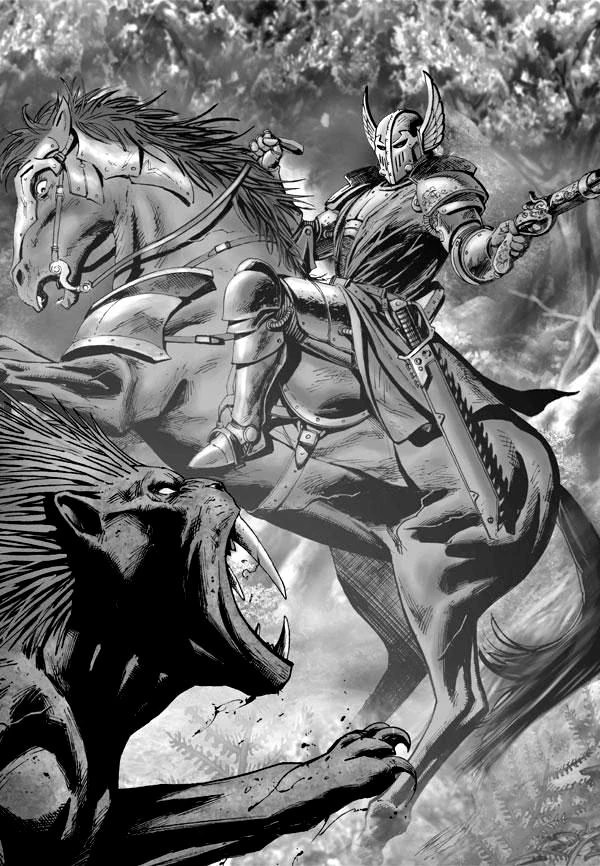
[edit]When the Imperium makes contact, a feudal world often suffers culture shock. Once this has passed, and the threats that Mankind faces have been put in forms that the natives understand, they become strong sources of recruits. Mounted warriors, riding steeds that range from near-Terran horses to reptilian lizards and huge flightless birds, are among the most famous shock troops of the Imperium. Feudal worlders honour personal combat and loyalty, and a society that already runs on vassalage fits easily into an Imperium that works on the same principle on a galactic scale.[1][8]
Service in the Imperial institutions
[edit]Feudal worlders may also serve in the civil arms of the Imperium. Since their culture has no advanced technology, they depend on memory and mental order, and make strong placements within the Administratum. Many take up the Imperial Creed and join the Ecclesiarchy or the Adepta Sororitas. Witches are still captured on feudal worlds, despite unauthorised pogroms and burnings, and those taken to the Black Ships may go on to serve the Emperor directly.[1][7]
Space Marine Chapters
[edit]Many Space Marine Chapters draw their recruits from feudal worlds, which together with feral and death worlds provide some of the best natural warriors. A Chapter that uses a feudal world as its base may keep its distance from the populace, as it would on a feral world, or it may establish itself as distant overlord, high king or secret warrior order. Where the Chapter planet is a feudal possession of the Chapter, the Chapter Master is often the traditional feudal ruler and so also holds the rank of planetary governor and Imperial Commander.[4][9]
History
[edit]The Age of Technology and the Age of Strife
[edit]Many feudal worlds were colonised by Mankind in the Age of Technology and fell back in the Age of Strife, when Warp storms cut the colonies off from Terra and from each other. Caliban is the best-known example. Imperial records say that, cut off by the Warp storms, its people devolved into a semi-feudal state ruled by a small warrior elite, and the planet was a death world as well as a feudal one.[10][3]
Rediscovery
[edit]The Great Crusade (from 798.M30) rediscovered these worlds one at a time. The fleets found each world in the condition that the Age of Strife had left it. Some, such as Chogoris, which the Emperor and the Luna Wolves reached in 865.M30, had already been united under a strong ruler, and others were divided among rival kingdoms. The tech-priests of Mars settled among the feudal empires they found, founded many forge worlds there, and made contact with the knightly houses.[11][6]
The Age of the Imperium
[edit]Under the Imperium of the following ten thousand years, a feudal world was normally left as it was found. Its tithes were small, the Imperium did not interfere much in its politics or economy, and its governor kept away from the people so as not to disturb the order of their lives. Many feudal worlds remained in the same state across several millennia.[1][3]
The Era Indomitus
[edit]Sovereign in the Jericho Reach shows how a feudal world can fall. It was a rich agri-world that kept itself well fed and held a conservative feudal government in the long isolation of the Age of Shadow, but the return of the Imperium in the Achilus Crusade brought the world to ruin, by the Stigmartus Chaos Cult first and then by the Inquisition. It has become a dead world held by heretek Dark Mechanicum and awakening Necrons.[12]
Notable feudal worlds
[edit]Attila
[edit]Attila is a feudal world of the Segmentum Ultima that holds a late Iron Age civilisation and has almost no advanced Imperial technology. It is slightly smaller than Terra, and its single continent is ringed by steppe and savannah around a desert, so that most of its people live as nomads, herding the shaggy ovigors on which they live. Its one city, Khanasan, is the seat of its government and is where the Imperial and Ecclesiarchy missions are barely tolerated. Attila is the homeworld of the Rough Riders of Attila, the mounted regiments of the Astra Militarum.[13]
Nocturne
[edit]The Administratum classes Nocturne, the homeworld of the Salamanders, as both a feudal world and a death world. Its feudal peoples regard the Salamanders as akin to living gods.[14]
Chogoris
[edit]Chogoris is a semi-feudal world, and was so in the 41st millennium. When the primarch Jaghatai Khan grew up there, the dominant empire was an organised feudal aristocracy that had conquered most of the planet with disciplined pre-industrial armies. The Khan overthrew it and united the steppe tribes, and the Emperor and the Luna Wolves arrived in 865.M30 to find a world that had united under him.[11]
Other worlds
[edit]The Administratum records a number of other feudal worlds, some known only by name, and the table below sets down what is recorded of them.[1]
| World | Segmentum and sector | Notes |
|---|---|---|
| Adderoth | Segmentum Obscurus, Askellon Sector | Sub-sector and population unrecorded |
| Attila | Segmentum Ultima | Homeworld of the Rough Riders of Attila |
| Caliban | Segmentum Obscurus | Death world and feudal world; destroyed at the end of the Horus Heresy |
| Chbal | Unrecorded | Population unrecorded |
| Danarch | Segmentum Ultima, Ultima Sector | In the Talasa System of Ultramar |
| Endrite | Segmentum Obscurus, Calixis Sector | Population unrecorded |
| Mancora | Segmentum Ultima | Population unrecorded |
| Nocturne | Segmentum Ultima | Homeworld of the Salamanders; population recorded at 15,000,000 |
| Sacris | Segmentum Obscurus, Calixis Sector | In the Drusus Marches |
| Slud | Unrecorded | Population unrecorded |
| Solstice | Segmentum Tempestus | Population unrecorded |
| Sophano Secundus | Unrecorded | Population unrecorded |
| Sovereign | Segmentum Ultima, Jericho Reach | Formerly an agri-world; now a dead world |
| Tranquility-II | Ultima Segmentum, Maelstrom Zone | Population unrecorded |
| Triandr | Unrecorded | Population unrecorded |
| Vhospis | Unrecorded | Population unrecorded |
| Yamnan | Unrecorded | Population unrecorded |
| Zillman's Domain | Segmentum Obscurus, Calixis Sector | Population unrecorded |
Timeline
[edit]| Date | Event |
|---|---|
| Age of Technology | Many future feudal worlds are colonised by Mankind.[3] |
| Age of Strife | Warp storms cut colonies off from Terra; feudal orders replace many colonial governments and Caliban becomes a semi-feudal death world.[10][b] |
| 798.M30 | The Great Crusade begins to rediscover the feudal worlds.[6] |
| 865.M30 | The Emperor and the Luna Wolves reach Chogoris, a feudal world united by the primarch Jaghatai Khan.[11] |
| c. 014.M31 | The feudal and death world of Caliban is destroyed at the end of the Horus Heresy.[10][c] |
| Age of the Imperium | The Administratum classes feudal worlds as low-tithe worlds and leaves their cultures alone; Space Marine Chapters and the Astra Militarum recruit from them.[1] |
| from 777.M41 | The Achilus Crusade returns Imperial power to the Jericho Reach; Sovereign, a former feudal agri-world, is ruined.[12] |
See also
[edit]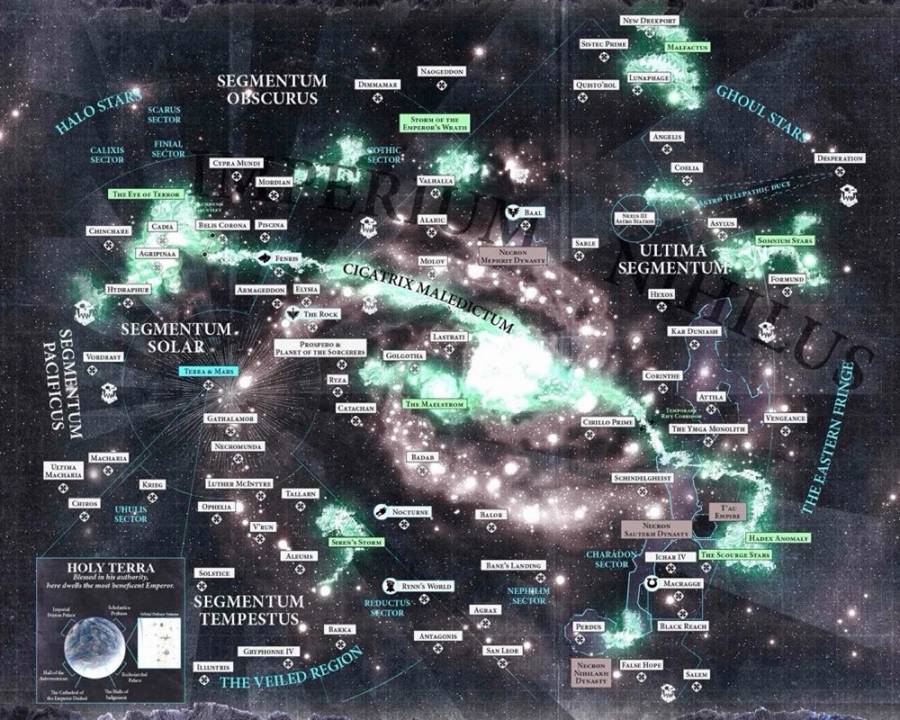

Notes
[edit]References
[edit]- ^ a b c d e f g h i j k l Dark Heresy: Core Rulebook (roleplaying game). Fantasy Flight Games. pp. 250, 326.
- ^ a b Warhammer 40,000: Rogue Trader (roleplaying game). Fantasy Flight Games.
- ^ a b c d e Dark Heresy: Enemies Within (2nd edition, roleplaying game). Fantasy Flight Games. pp. 26-27.
- ^ a b c Codex Adeptus Astartes: Space Marines (8th edition). Games Workshop. p. 25. Deathwatch: Core Rulebook (roleplaying game). Fantasy Flight Games. pp. 50-51.
- ^ "Planets". Warhammer 40k Wiki (Fandom). Dark Heresy: Core Rulebook (roleplaying game). Fantasy Flight Games. pp. 249-250.
- ^ a b c "Knight World". Warhammer 40k Wiki (Fandom).
- ^ a b Dark Heresy: Enemies Within (2nd edition, roleplaying game). Fantasy Flight Games. pp. 26-27. Deathwatch: Core Rulebook (roleplaying game). Fantasy Flight Games. pp. 50-51.
- ^ Imperial Armour Volume Ten: The Badab War, Part Two. Forge World. pp. 67-68. Warhammer 40,000: Rulebook (5th edition). Games Workshop.
- ^ Deathwatch: Core Rulebook (roleplaying game). Fantasy Flight Games. pp. 50-51.
- ^ a b c "Caliban". Warhammer 40k Wiki (Fandom).
- ^ a b c "Chogoris". Warhammer 40k Wiki (Fandom).
- ^ a b "Sovereign". Warhammer 40k Wiki (Fandom).
- ^ Codex: Imperial Guard (2nd edition). Games Workshop. pp. 17, 40-41, 90. Only War: Hammer of the Emperor (roleplaying game). Fantasy Flight Games. pp. 12-16.
- ^ "Nocturne". Warhammer 40k Wiki (Fandom).