
Cardinal world
| Cardinal world | |
|---|---|
| Class of Imperial world; a ruled sub-class of the Shrine world | |
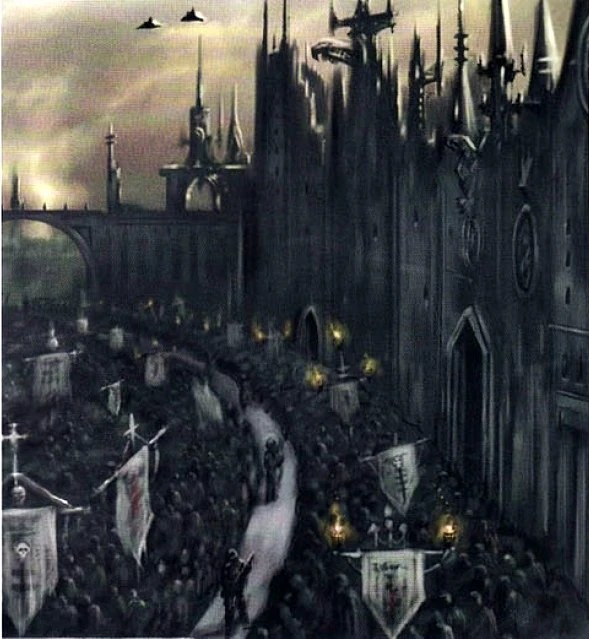 Pilgrims in procession beneath the cathedrals of a cardinal world Artwork © Games Workshop | |
| Administratum class | Cardinal world; every cardinal world is also a Shrine world[a] |
| Ruler | A Cardinal of the Adeptus Ministorum, as planetary governor |
| Faith | The Imperial Cult, the worship of the Emperor of Mankind |
| Tithe | Paid to the Ecclesiarchy rather than the Administratum; see Imperial tithe |
| Population | Millions to 100 billion (Benediction), swollen by pilgrims |
| Garrison | Adepta Sororitas, Frateris Militia, Planetary Defence Forces |
| Greatest example | Ophelia VII, second in holiness only to Terra |
| Examples | Ophelia VII, Benediction, Gathalamor, Dimmamar, Savaven, Espandor, Phaistos Osiris, Bekrin |
A cardinal world is a planet of the Imperium of Mankind ruled directly by the Ecclesiarchy, and wholly given over to the worship of the Emperor of Mankind according to the doctrine of the Imperial Cult. Imperial sanctuaries, cathedrals and temples may cover whole continents, and the great mass of the population serves the Church as clergy, servants, builders or pilgrims. The planetary governor of such a world is always a Cardinal of the Adeptus Ministorum, who often heads the Ecclesiarchy's hierarchy over a whole sector.[1][2]
The Administratum treats the class as a kind of Shrine world, and every cardinal world is also one. It is a shrine world of exceptional weight: an important centre of Ecclesiarchal power and the goal of countless pilgrims of the Imperial Cult, and also the base from which many Orders of the Adepta Sororitas are raised and sent into the wars of the Church. The most important example is Ophelia VII, whose spiritual significance to the Imperial Cult is second only to that of Terra itself.[1][3]
The history of the cardinal worlds is the history of the quarrel between the Church and the secular state. They were the centres of the Age of Apostasy in the 36th millennium, when Goge Vandire ruled in terror and the preacher Sebastian Thor, who came from the cardinal world of Dimmamar, led the movement that overthrew him. Since the opening of the Great Rift in 999.M41 they have been targets of the forces of Chaos because of their holiness, and the war for Benediction in the early Era Indomitus is the most recent of the great sieges of the Ecclesiarchy's worlds.[1][3]
Government
[edit]A cardinal world is a theocracy. The cardinal governs both the world and the Church upon it, appoints the officials of its administration and commands its defences, and the law of the faith and the law of the state are one. Offences against the Imperial Cult are treated as offences against the world. Most cardinals are charged with a diocese, which may be as small as one hive city or as large as a star system, and the arch-cardinals who lead the Church over a sector sit at the head of its Sector Synod from the cardinal worlds. A cardinal world is therefore as much a seat of government as the capital of a sector.[1][4]
The tithe of a cardinal world is paid to the Ecclesiarchy, not to the Administratum, and the Church draws further tithes from the worlds of the cardinal's diocese. This has made some cardinals very rich. It has also been the source of conflict between the Ministorum and the Administratum, and it explains why the reforms that followed the Age of Apostasy, the Decree Passive of Sebastian Thor and the rules that followed it, limited the powers of the Church to raise men under arms.[1][3]
Society
[edit]Life on a cardinal world is organised round worship. The day is divided by services and the year by festivals and fasts, and pilgrims arrive by the shipload to see holy relics and the tombs of saints. The population may be made up of millions of clergy and lay servants, and a great part of its manufacture goes to devotional objects and the upkeep of the sanctuaries. Preachers are trained on cardinal worlds before being sent out to others, and the Schola Progenium often keeps houses there. The numbers of pilgrims make some of these worlds very populous: Benediction held some hundred billion people before the war, and Savaven, in the Gothic Sector, some fourteen billion.[2][1]

Defence
[edit]A cardinal world has a Planetary Defence Force like any other, but the Church adds armies of its own. Convents and preceptories of the Adepta Sororitas are kept on many cardinal worlds, and the greatest are guarded by whole Orders. In emergencies the preachers raise the Frateris Militia from the faithful. The Sisters came into being as a result of the Age of Apostasy, when the Ecclesiarchy's armies were disbanded and the Ministorum was forbidden to keep men under arms. Their populations, made fervent by constant worship, fight to the last for their shrines, and for the traitor Legions the desecration of a cardinal world is a blow to the faith of the whole Imperium.[1][5]
Relations with the other Adepta
[edit]The cardinal worlds sit awkwardly in the structure of the Imperium. They are held by the Church, but they stand inside the sectors of the Imperium and depend on the Imperial Navy and the Astra Militarum for their defence against anything larger than a local uprising. The Adeptus Arbites keep a presence on most of them, as do the agents of the Inquisition, particularly the Ordo Hereticus, whose Chamber Militant is the Adepta Sororitas. The Administratum records their tithes and their populations and has often tried to enlarge its share, and the Planetary Defence Forces of the world are raised and commanded by the cardinal, not by an officer sent by the sector. The tension between these authorities has been a cause of reform since the Age of Apostasy, and the Ecclesiarchy's own rules, laid down after the Decree Passive, now govern what a cardinal may do with arms.[1][5]
History
[edit]Origins
[edit]Worlds of faith existed from the early years of the Imperial Cult, which grew on Terra in the decades after the Horus Heresy. Ophelia VII is the oldest, brought into the Imperium by the Emperor in the Great Crusade. In the 34th millennium the Ecclesiarch Benedin IV moved the whole Church there, and for a time Ophelia VII rather than Terra was the capital of the Imperial Cult. The class of the cardinal world as it is known in the 41st millennium took shape in the centuries after that, as the Church's holdings were counted among the possessions of the Imperium.[1][b]
The Age of Apostasy
[edit]In the early 36th millennium the High Lord Goge Vandire, who had taken the office of Ecclesiarch as well as that of Master of the Administratum, ruled the Imperium in the Reign of Blood and used the armies of the Church, the Frateris Templar, to burn whole populations. The preacher Sebastian Thor, born on Dimmamar, spoke against him, and Vandire's own bodyguard killed him. Thor was raised to Ecclesiarch, issued the Decree Passive, which disbanded the Church's armies and forbade the Ministorum to keep men under arms, and founded the Adepta Sororitas. He died on Terra and was declared a saint almost at once.[3][5]
From about 300.M36 the cardinal world of Gathalamor gave rise to the last act of the age, the Plague of Unbelief. The Apostate Cardinal Bucharis denied the teaching of the Church and gathered a vast empire in the west, hidden from Terra by Warp storms. His armies were destroyed at Fenris, the Space Wolves' world, and on Chiros, where a whole people of hunters defeated them, and the torture of the Confessor Dolan Chirosius brought the empire into revolt. Bucharis was torn apart by a mob as he tried to flee Gathalamor.[3][5]
The Era Indomitus
[edit]The opening of the Great Rift in 999.M41 fell hardest on the worlds that the Imperial Cult held most dear. Ophelia VII, in the Segmentum Tempestus, was overrun by daemons and was freed by the Indomitus Crusade. In the early 42nd millennium the Dark Apostle Kor Phaeron led a Chaos armada against the Talledus System, whose capital is the cardinal world of Benediction, in a war that the Ecclesiarchy has called a war for the souls of the population, and the Adepta Sororitas, the Astra Militarum and several Space Marine Chapters held it in a war that lasted for years.[3][1]
Notable cardinal worlds
[edit]| World | Location | Notes |
|---|---|---|
| Ophelia VII | Segmentum Tempestus | Oldest cardinal world; seat of the Synod from the 34th millennium; the Sisters' Convent Sanctorum |
| Benediction | Talledus System, Veritus Sub-sector | Population about 100 billion; besieged in the Talledus War |
| Gathalamor | Segmentum Solar | Diocese of the Apostate Cardinal Bucharis, c. 300.M36 |
| Dimmamar | Segmentum Obscurus | Birthplace of Sebastian Thor |
| Savaven | Gothic Sector, Segmentum Obscurus | Quinrox Sound sub-sector; about 14 billion people |
| Espandor | Segmentum Ultima | A system of Ultramar, listed in the registers also as a civilised world |
| Bekrin | Jericho Reach, Segmentum Ultima | Cardinal world of the Reach, a frontier of the Church |
| Phaistos Osiris | Osiris Sector, Segmentum Ultima | Cardinal world of the Osiris System |
| Chiros | Segmentum Pacificus | Where the armies of Bucharis were defeated by a whole population of hunters |
Timeline
[edit]| Date | Event |
|---|---|
| Late M30 | Ophelia VII is brought into the Imperium in the Great Crusade[c] |
| M31 | The cult of the Emperor spreads from Terra in the years after the Horus Heresy[d] |
| M34 | The Ecclesiarch Benedin IV moves the Church to Ophelia VII[e] |
| Early M36 | The Reign of Blood of Goge Vandire begins the Age of Apostasy |
| c. 300.M36 | The Plague of Unbelief on Gathalamor |
| 999.M41 | The Great Rift opens; cardinal worlds are assaulted by daemons |
| Early M42 | The Talledus War: Kor Phaeron assaults Benediction |
See also
[edit]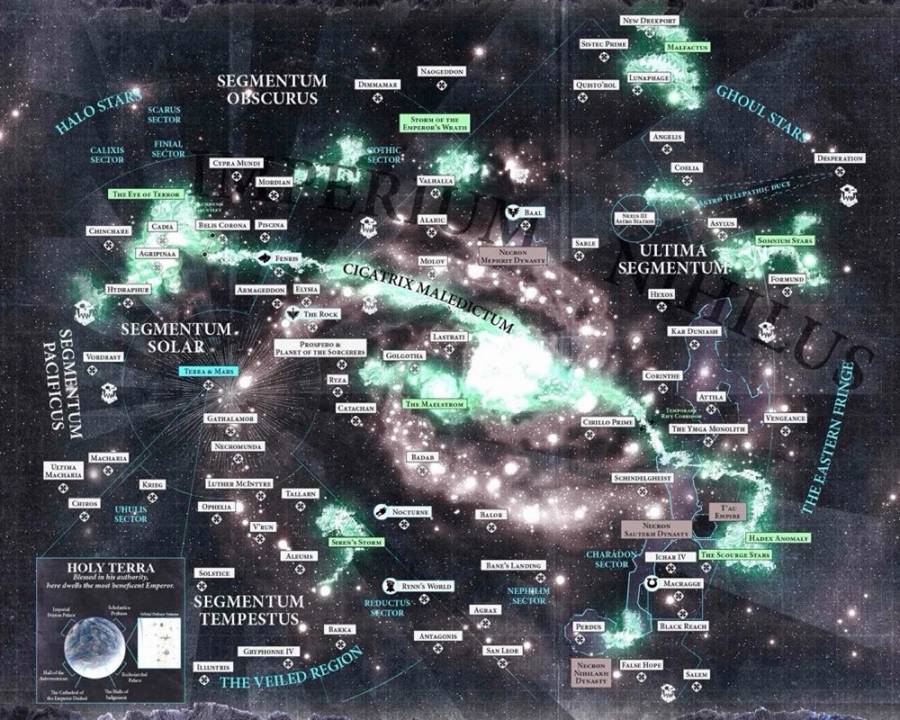

Notes
[edit]References
[edit]- ^ a b c d e f g h i j Codex: Sisters of Battle (2nd edition). Games Workshop. pp. 8, 10, 16, 24-25, 39-42, 60, 64.
- ^ a b Dark Heresy: Blood of Martyrs (roleplaying game). Fantasy Flight Games. pp. 9, 14-16, 23, 35, 39. Dark Heresy: Core Rulebook (roleplaying game). pg. 250.
- ^ a b c d e f Psychic Awakening: Faith & Fury (8th edition). Games Workshop. pp. 6-9, 14-17.
- ^ Warhammer 40,000: Rogue Trader (1st edition). Games Workshop. Warhammer 40,000 Rulebook (3rd edition). Games Workshop. pg. 114.
- ^ a b c d Codex: Witch Hunters (3rd edition). Games Workshop. pg. 45. Codex Imperialis (2nd edition). Games Workshop. pg. 39.