
Civilised world
| Civilised world | |
|---|---|
| Class of Imperial world, also called a developing world | |
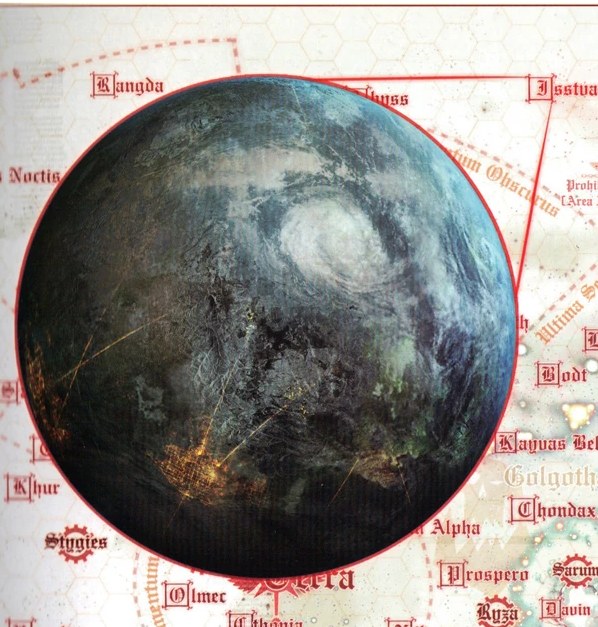 Survey chart of a settled world, from the registry of the Departmento Cartographicae Artwork © Games Workshop | |
| Administratum class | Civilised world[a] |
| Population | 15 million to 10 billion |
| Tithe | Moderately high; paid in goods and levies of the Astra Militarum under the Imperial tithe |
| Ruler | A planetary governor over local states, power blocs or tribes |
| Defence | A Planetary Defence Force; Adeptus Arbites for the law |
| Sub-types | Pleasure worlds, Mining worlds and some Shrine worlds |
| Comparable to | Terra in the early third millennium, before the Age of Technology |
| Examples | Luna, Espandor, Gudrun, Rynn's World, Tallarn, Cyrene |
A civilised world, also called a developing world, is a class of planet of the Imperium of Mankind whose development has been left to run its own course over the millennia, without a purpose laid on it by the Imperium. Such a world feeds itself, keeps manufactories and trade of its own and exports what it can spare. It is not a hive world, a forge world or an agri-world, and the registry of the Administratum files under this heading the great and varied remainder, which makes it one of the most numerous classes in the Imperium.[1][2]
The Administratum's guidelines define a civilised world by its population, which runs from fifteen million to ten billion, and by its tithe, which is moderately high. A civilised world may have large cities, but none has reached the density or self-sufficiency of a true hive city. Its land is divided between states, power blocs or tribal territories that differ widely in technology and wealth, and the richest regions commonly lie around the places where Mankind first settled the planet. Many such worlds resemble Terra as it was in the early third millennium, before the Age of Technology.[3][4]
Other classes shade into this one. Pleasure worlds, Mining worlds and some Shrine worlds are counted as kinds of civilised world, and a civilised world may change its class as it grows, falls or is conquered. No two are alike in the way they realise their divisions, and the Imperium has no single image of them, as it has of a hive spire or a forge. In the Era Indomitus they are the worlds most often cut off by the Great Rift, and the ones the Indomitus Crusade has had to reassess one by one.[5][1]
Characteristics
[edit]Land and peoples
[edit]A civilised world is rarely uniform. Its surface is divided into regions whose peoples have drifted apart in culture and power, and in the Imperial registers these appear as countries, states, power blocs or tribal homelands, according to the governments that prevail on the world. Where the land is poor in resources, the people are poor in arms, wealth and influence too. Some planets keep a great divide because of ancient tribal taboos, religious notions or plain habit, and a visitor may pass from a city of power plants and orbital elevators to a province where the plough is still drawn by beasts.[4][3]
The cities are the centres of the world. They may be large and sprawling, with districts of industry, administration and commerce, and they may match the size of the lesser hives, but they are bound to the farmland and the smaller towns around them. The planet's economy therefore rests on its own food and manufacture, not on imports from the Imperial Navy's long supply lines, and this is one reason the Imperium values these worlds as dependable payers of tithe.[2]
Technology
[edit]The level of technology on a civilised world follows its history. Worlds colonised in the Age of Technology and spared the worst of the Age of Strife keep power grids, voidships and the machines of the Imperium of the 41st millennium, tended with the help of the Adeptus Mechanicus. Others that fell back in isolation have rebuilt only part of what was lost. Most civilised worlds therefore hold, side by side, regions of Imperial standard and regions of the pre-industrial or early industrial kind.[3]
Government and tithe
[edit]A civilised world is ruled by a planetary governor, formally an Imperial Commander, who may be the head of an old dynasty confirmed by the Imperium or an officer sent by the sector. The governor answers to the sector and ultimately to the Administratum and the High Lords of Terra, and the people of the planet are bound by the Imperial law, which the Adeptus Arbites enforce. Within these limits the governor may leave the local states to run their own affairs, and the Imperium seldom inquires into the quarrels of a world that pays.[3][1]
The tithe is the measure of the class. Civilised worlds pay it at a moderately high grade, partly in goods and partly in the regiments they raise for the Astra Militarum from their Planetary Defence Forces. A world whose tithe falls short can be reassessed, and a governor who fails or rebels can expect to be replaced. A civilised world that is lost to heresy, xenos invasion or Exterminatus is removed from the register; Cyrene, in the Korianis Sector, was one such world, ended by the order of Exterminatus.[3][6]
Space Marines and civilised worlds
[edit]A civilised world is generally a poor recruiting ground for the Adeptus Astartes. In a society where an infant is almost certain to live to adulthood, without being killed by a beast or enslaved by a rival tribe, the instinct for survival is weak, and the Chapters prefer Death worlds, Feral worlds and Feudal worlds. Only the exceptional few that keep a rigid military tradition, sometimes enforced by a ruling soldier caste, are of interest to them.[1][7]
The clearest example is Ultramar, the realm of the Ultramarines, where every family hopes that a son will be taken by the Chapter and trains him to the utmost from the time he can walk. The Crimson Fists hold their fortress-monastery on the civilised world of Rynn's World, while recruiting from other planets of the region. Where a Chapter makes its home on such a world it commonly keeps apart from the people, though some Chapters and their servants are woven into the tradition and duties of the whole society.[1][8]
History
[edit]Settlement and the Age of Strife
[edit]Most civilised worlds were first settled in the Age of Technology, c. M15–M25, when the colony ships of Old Earth spread across the galaxy, and many hold their oldest cities from that time.[b] The long isolation of the Age of Strife, c. M25–M30, broke most of them into rival states or sent them back to older customs. Those that kept their industry did so at the cost of wars, and the divisions that survive in their territories often date from that time.[3][2]
The Great Crusade
[edit]The Great Crusade, begun in 798.M30, found a great many such worlds and brought them into Compliance. The Expeditionary Fleets of the Space Marine Legions and the Imperial Army left most of the worlds they won much of their own government, so long as they accepted the Imperial Truth and paid tithe. The Administratum's adepts needed a way to sort what they found, and the class of the civilised world, the great middle between the hives and the primitives, was the result. It is the heading under which most compliant worlds of the Crusade were afterwards recorded.[9][3]
The Horus Heresy
[edit]Many civilised worlds were drawn into the Horus Heresy (005–014.M31), and their defence forces sometimes had to choose a side. The greatest single catastrophe to fall on a world of this class in the Heresy was the Battle of Tallarn (010–012.M31), where the Iron Warriors of Perturabo destroyed the biosphere of the muster world of Tallarn and the survivors fought the largest tank battle in human history on its poisoned plains. The Tallarn Desert Raiders of the Astra Militarum are its inheritors.[10]
The 41st millennium
[edit]In the late 41st millennium the civilised worlds were the first to feel the pressure of the Black Crusades and the raids of xenos, and some of the oldest of them were lost. The Thirteenth Black Crusade and the opening of the Great Rift in 999.M41 cut many off from Terra at once. In the Era Indomitus the civilised worlds of Ultramar, among them Espandor, were attacked by the daemons of Nurgle in the Plague Wars, and the world governors of the Imperium Nihilus now depend on the Indomitus Crusade to learn whether the registry still counts them.[5][11]
Notable civilised worlds
[edit]| World | Segmentum | Notes |
|---|---|---|
| Adumbria | Segmentum Ultima | In the Damocles Gulf |
| Amistel Majoris | Segmentum Obscurus | Amistel Sector |
| Cyrene | Unrecorded | Korianis Sector, Aurelia sub-sector; destroyed by Exterminatus |
| Espandor | Segmentum Ultima | In Ultramar; attacked by the Death Guard in the Plague Wars |
| Gudrun | Segmentum Obscurus | Scarus Sector, Helican Sub-sector |
| Jouran | Unrecorded | Jouran System |
| Korsk II | Unrecorded | |
| Kronus | Segmentum Ultima | Lithesh Sector |
| Luxor | Segmentum Obscurus | Gothic Sector, Bhein Morr sub-sector |
| Luna | Segmentum Solar | Moon of Terra; Sol System |
| Periremunda, Perlia | Segmentum Ultima | Each in its own system |
| Quadravidia | Segmentum Ultima | In the Damocles Gulf |
| Rhanda | Segmentum Solar | |
| Sixty-Three-Nineteen | Unrecorded | |
| Tallarn | Segmentum Tempestus | Muster world, destroyed in 010–012.M31; see Battle of Tallarn |
| Rynn's World | Segmentum Ultima | Chapter homeworld of the Crimson Fists |
Timeline
[edit]| Date | Event |
|---|---|
| c. M15–M25 | Most civilised worlds are settled in the Age of Technology[c] |
| c. M25–M30 | Isolation in the Age of Strife splits many worlds into rival states[d] |
| 798.M30 | The Great Crusade begins to bring civilised worlds into Compliance |
| 005–014.M31 | The Horus Heresy divides the defence forces of many such worlds |
| 010–012.M31 | Tallarn is destroyed by the Iron Warriors in the Battle of Tallarn |
| M32–M36 | Worlds rebuild their forces under Astra Militarum levies[e] |
| M38–M41 | The Black Crusades and xenos raids take some civilised worlds[f] |
| 999.M41 | The Great Rift opens and cuts many worlds off from Terra |
| Early M42 | The Plague Wars fall on Espandor and the worlds of Ultramar; the Indomitus Crusade reassesses the isolated worlds |
See also
[edit]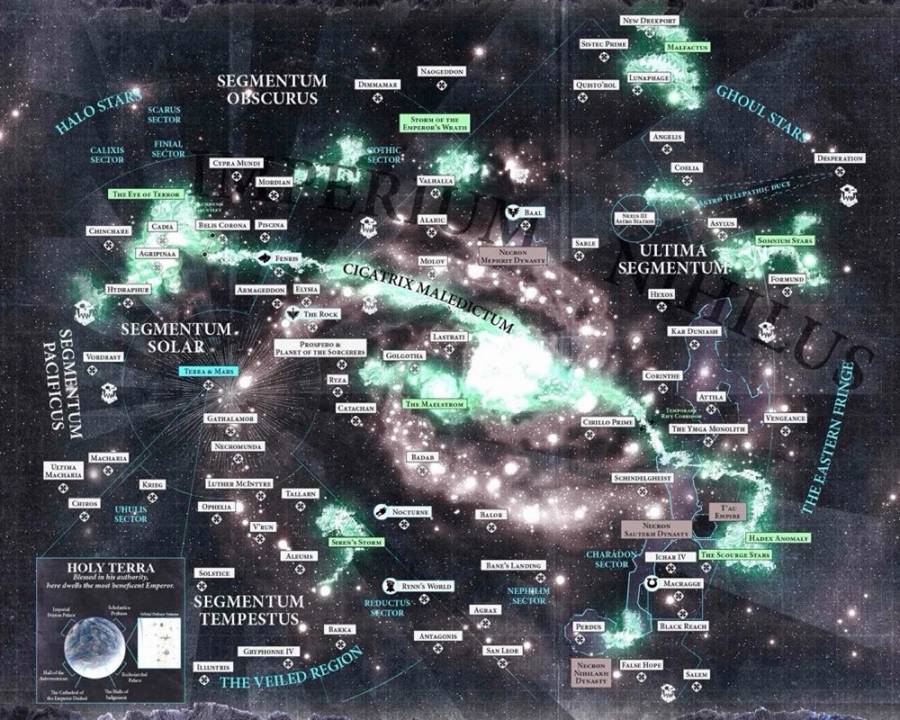

Notes
[edit]References
[edit]- ^ a b c d e Codex: Space Marines (5th edition). Games Workshop. pg. 31. Codex: Ultramarines. Games Workshop. pg. 15.
- ^ a b c Priestley, Rick. "Space Fleet - Galactic Civilisation". White Dwarf 140 (UK). Games Workshop. pg. 46.
- ^ a b c d e f g Warhammer 40,000 Rulebook (3rd edition). Games Workshop. pg. 114.
- ^ a b Dark Heresy: Core Rulebook (roleplaying game). Fantasy Flight Games. pg. 250.
- ^ a b The 13th Black Crusade (background book). Games Workshop. pg. 23.
- ^ Rogue Trader: Core Rulebook (roleplaying game). Fantasy Flight Games. pg. 305.
- ^ McNeill, Graham, Kevin Hopgood and Tony Parker. Defenders of Ultramar (graphic novel). Black Library.
- ^ Parker, Steve. Rynn's World (novel). Black Library.
- ^ Abnett, Dan (2006). Horus Rising (novel). Black Library.
- ^ Codex: Astra Militarum (8th edition). Games Workshop. pg. 25. Soulban, Lucien. Desert Raiders (novel). Black Library.
- ^ Haley, Guy. Dark Imperium (novel). Black Library.