
Imperial tithe
| Imperial tithe Terra's Due | |
|---|---|
 Emblem of the Administratum, which assesses and collects the tithe Artwork © Games Workshop | |
| Type | Levy in kind, manpower and psykers |
| Imposed by | Adeptus Terra, in the name of the Emperor of Mankind |
| Assessed by | Administratum; Departmento Munitorum (military tithe) |
| Collected by | Administratum and Departmento Munitorum officials; Black Ships of the Adeptus Astra Telepathica (psykers) |
| Owed by | Every Planetary Governor |
| Grades | Exactis, Decuma, Solutio (each Extremis to Tertius); Aptus Non |
| Penalty for default | Execution of the governor and a swift change of regime; withdrawal of Imperial protection |
The Imperial tithe, also called the Great Tithe, Terra's Due or simply the tithe, is the levy that every world of the Imperium of Mankind owes to the Imperium in return for its protection. It is assessed by the Administratum according to each world's ability to pay, expressed as its tithe grade and may be paid in any resource the world produces: food, ore, manufactured goods, warships, soldiers and, by Imperial law, every psyker born on the world. It keeps the government, the armies and the economy of the Imperium functioning, and by it the Astra Militarum is filled and the Astronomican is fed.[1][2]
The responsibility for paying the tithe rests on the world's Planetary Governor, also called the Imperial Commander. As long as the tithe is met and the world remains loyal, a governor may rule as he or she pleases. Failure is punished severely: even the slightest breach of protocol often brings the execution of the governor and a swift and thorough change of regime, and Imperial records admit that rulers are sometimes replaced for minor accounting errors. The Munitorum's cheapest answer to a rebellious world is simply to cut it loose from the Emperor's protection.[1][3]
On many worlds the day of collection has become a sacred festival, the Emperor's Gift, when millions of tonnes of ore, metal or foodstuff are borne skyward and the world's newly raised regiments depart for the stars.[4]
The Emperor's Gift
[edit]Every world owes loyalty and tithe to the Emperor, whether it is gathered once in a solar cycle or once in a hundred standard years, and it is the first duty He demands of His subjects. On the day of the Emperor's Gift the citizens look up and give thanks as the tithe leaves the world, and they spend the day in feasting, refusing little to the soldiers who are leaving for ever. It is a time of fierce pride in the home world, and an off-worlder who slanders it may well be set upon. Some scholars suspect that it was the Administratum and not the Ecclesiarchy that sanctioned the holiday, since it lets a world be stripped of its wealth and feel well about it.[4]
Tithe grades
[edit]Every world is assigned a grade, which fixes the size of its tithe. The make-up of the payment, what proportion is owed in grain, metal, men or ships, is set separately by the Administratum office responsible for the world's sector and sub-sector. The grades, from the heaviest to the lightest, are:[2]
| Grade class | Grades (heaviest first) |
|---|---|
| Exactis | Exactis Extremis, Exactis Particular, Exactis Median, Exactis Prima, Exactis Secundus, Exactis Tertius |
| Decuma | Decuma Extremis, Decuma Particular, Decuma Prima, Decuma Secundus, Decuma Tertius |
| Solutio | Solutio Extremis, Solutio Particular, Solutio Prima, Solutio Secundus, Solutio Tertius |
| Aptus Non | Aptus Non, also written Adeptus Non: no tithe is required of worlds already serving the Imperium, such as Chapter homeworlds and forge worlds, or of worlds left lifeless by Exterminatus |
Forge worlds are graded Aptus Non because their resources go to making manufactured goods and vehicles for the Imperium, and Chapter homeworlds because their resources maintain the Adeptus Astartes they supply. A large hive world such as Necromunda is expected to give a far larger tithe than a pre-industrial feudal world.[2]
Components
[edit]Material tithe
[edit]Most of the tithe is paid in goods. An agri world's tithe is usually stated as a proportion of its harvest; a hive world's as a quota of manufactures; a mining world's as tonnage of ore. A tithe may be any resource native to the world: food, weapons, minerals, manufactured goods, soldiers or psykers. Many branches of the Administratum assess the rates, measure the collections and watch for fluctuations.[2]
Military tithe
[edit]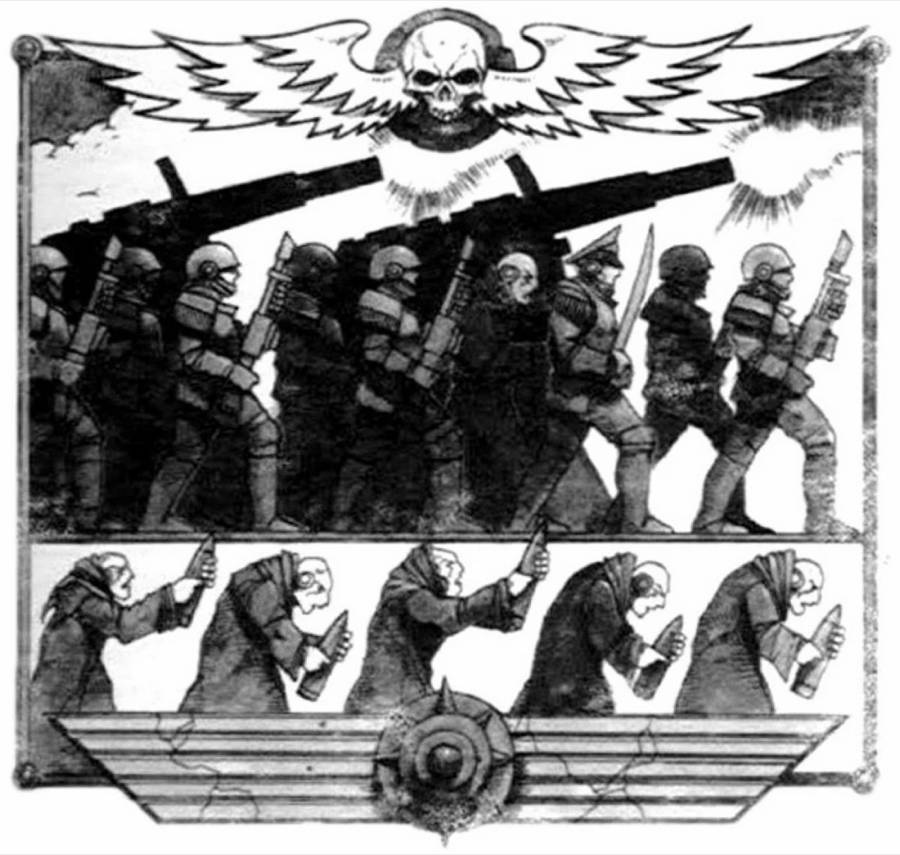
Every world able to do so must raise regiments for the Astra Militarum. By the long-standing rule recorded by the Munitorum, a world gives up one tenth of its military forces at each founding. Governors are liable to death for supplying too few soldiers, or soldiers who are poorly equipped, badly trained or of doubtful genetic purity, and for that reason most send their best troops. Worlds choose their soldiers by many methods: caste, lottery, volunteers, conscription or custom. The manufacturing world of Vostroya gives up every firstborn son, and on some worlds competition to be chosen is fierce enough to cost lives and, rarely, to cause local wars, such as the Bardellan Wars of Proving. In times of crisis the Munitorum may demand far more than the normal levy, emptying cities or continents.[3][5]
Psychic tithe
[edit]Imperial law forbids any world to harbour unsanctioned psykers. Each governor must find them, by whatever means, and hand them over when the Black Ships arrive, escorted by the Sisters of Silence. Those collected are taken to Terra, where they are tested: some are trained as sanctioned psykers and the rest are offered up as sacrifices to the Emperor to power the Astronomican.[6]
Enforcement
[edit]The tithe is tracked by many adepta, yet discrepancies may take years to surface, given the distances of interstellar travel and the weight of bureaucracy. When they do, the Imperium acts with brutal finality. The Imperium is at war for the survival of the human race, and the selfishness of the few is not tolerated. As long as the tithe is met and the enemies of the Imperium are rejected, a governor may rule as he or she sees fit, and may call on the Adeptus Terra for aid in time of need. In times of great peril the Munitorum may demand forces far above the normal tithe, and no governor may refuse, knowing that his own world may be the next to need protection.[1][3]
See also
[edit]
References
[edit]- ^ a b c Codex: Astra Militarum (6th Edition), pg. 14. Games Workshop.
- ^ a b c d Warhammer 40,000: Rulebook (6th Edition), pg. 148. Games Workshop.
- ^ a b c Warhammer 40,000: Rulebook (3rd Edition), pp. 114–115. Games Workshop.
- ^ a b Codex: Astra Militarum (6th Edition), pg. 14. Games Workshop.
- ^ Warhammer 40,000: Rulebook (6th Edition), pg. 148. Games Workshop.
- ^ Warhammer 40,000: Rulebook (3rd Edition), pp. 114–115. Games Workshop.