
Planetary classification
| Planetary classification | |
|---|---|
| Administratum registry of Imperial worlds | |
 Seal of the Administratum, which keeps the registry of worlds Artwork © Games Workshop | |
| Kept by | Administratum, Adeptus Terra |
| Origin | The Great Crusade, when the colony worlds of Mankind were brought back under one rule |
| Classes in use | Some forty standard types of world |
| Tithe scale | Seventeen tithe grades, from Exactis Extremis to Aptus Non |
| Worlds registered | c. 1,000,000 (before 999.M41) |
| Applies to | Every world of the Imperium of Mankind, including the Imperium Nihilus |
| Related | Imperial Tithe, Departmento Munitorum, Planetary governor, Exterminatus |
Planetary classification, also called world classification or Imperial planet classification, is the system by which the Administratum of the Adeptus Terra sorts the worlds of the Imperium of Mankind into types according to their population, economy, environment and purpose. Each registered world is given a class, such as hive world, agri-world or forge world, and a tithe grade that sets how much it must pay towards the Imperium in goods, soldiers and psykers. Together the two entries decide what the Imperium expects of a world, how closely it is governed and how much aid it may hope for in time of war.[1][2]
Most of the worlds of the Imperium were settled by Mankind many centuries before the Great Crusade of the 30th and 31st millennia reunited them under the Emperor of Mankind, and thousands more have been settled in the ten thousand years since. Whole departments of the Administratum are given over to cataloguing them, a task that is never finished, since the borders of the Imperium are in constant change. In the Era Indomitus the opening of the Great Rift in 999.M41 has cut many worlds off from Terra, and the true state of the registry is not known.[1][2]
Classification is administrative rather than scientific. A world may hold more than one class, for example a Death world that is also a Feral world, or a Space Marine Chapter homeworld that is also a Fortress world. Some worlds fall into a new class when their condition changes, as when a world is destroyed by Exterminatus or a successful Tyranid invasion and becomes a Dead world.[1]
History
[edit]The Adeptus Terra holds that the whole human race and the whole galaxy are under the Emperor's rule, though the Imperium's true reach is far smaller. The registry that the Administratum keeps is accordingly a record of what the Imperium holds, in a state of eternal flux as worlds are discovered, conquered or colonised and old ones are lost to xenos invasion, rebellion, Exterminatus, daemonic incursion or the warp itself.[1][2]
Under the arrangement known as the Treaty of Mars, the worlds of the Adeptus Mechanicus have always stood apart from the rest. They are recorded as forge worlds, and are largely autonomous from the rest of the Imperium.[2]
Method
[edit]The Administratum classifies the planets of the galaxy for the purposes of raising tithes of raw materials, manufactured goods and regiments of the Astra Militarum. The make-up of a world's tithe payments is decided by the section of the Administratum that governs that world's sector and sub-sector.[2][3]
The Imperium moves slowly to correct its records. Tidings from a distant world may take centuries to reach Terra, and discrepancies in a world's tithe can take a long time to be noticed and acted on.[3]
Forge worlds, which are ruled directly by the Adeptus Mechanicus, and Space Marine homeworlds are recorded by class but pay no tithe, and are given the grade Aptus Non.[3]
Tithe grades
[edit]The Imperial tithe, also called Terra's Due, is the levy each world owes the Imperium. It may be paid in food, ore, manufactured goods, soldiers for the Astra Militarum, ratings for the Imperial Navy, or psykers for the Black Ships of the Adeptus Astra Telepathica. Its size is set by the world's tithe grade. In addition, each world able to do so must give a tenth of its total military force to the Astra Militarum.[3]
There are sixteen grades in three bands, Exactis, Decuma and Solutio, each divided into degrees, and a seventeenth grade for worlds that pay no tithe:[3]
| Band | Grades | Typical worlds |
|---|---|---|
| Exactis | Exactis Extremis, Exactis Particular, Exactis Median, Exactis Prima, Exactis Secundus, Exactis Tertius | Rich and populous worlds: hive worlds, major agri-worlds, mining worlds |
| Decuma | Decuma Extremis, Decuma Particular, Decuma Prima, Decuma Secundus, Decuma Tertius | Ordinary civilised worlds and lesser agri-worlds |
| Solutio | Solutio Extremis, Solutio Particular, Solutio Prima, Solutio Secundus, Solutio Tertius | Poor, primitive or frontier worlds: feudal worlds, feral worlds, frontier worlds |
| Aptus Non (also Adeptus Non) | Worlds exempt from tithe: forge worlds, Space Marine homeworlds, worlds already giving a vital service, and worlds rendered useless by war or Exterminatus | |
Failure to pay the tithe is punished severely. Even a slight breach of protocol often brings the execution of the planetary governor and a swift change of regime. In times of great peril the Departmento Munitorum may call on governors to raise forces far above the normal tithe, which can leave entire cities or continents almost emptied.[3]
Classes
[edit]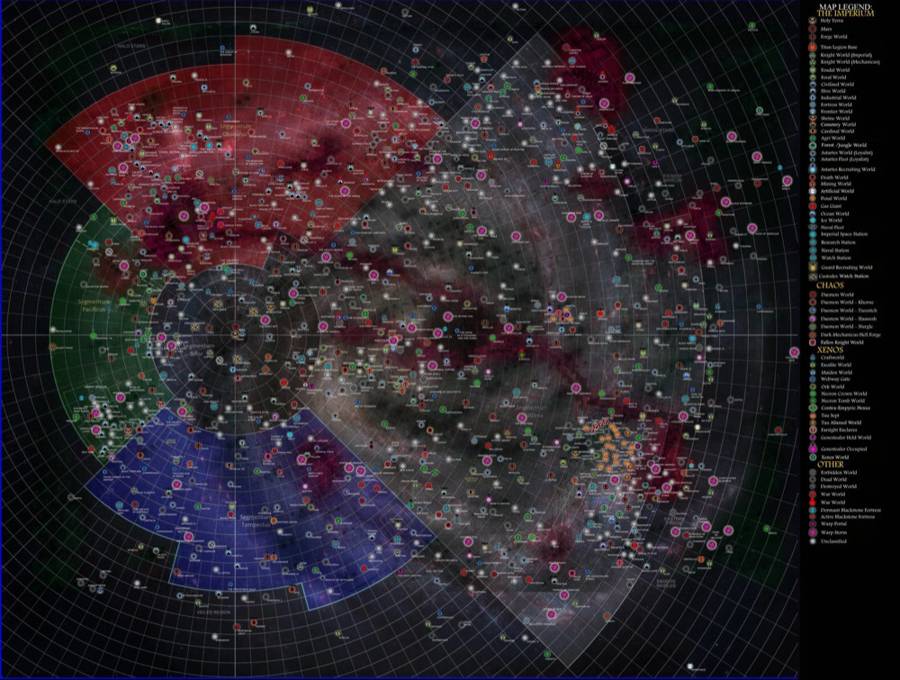
The table lists the principal types of world, with what is recorded of the tithe each pays. Grades are set world by world, and for most types no fixed grade is recorded.[1]
| Class | Description | Tithe | Example worlds |
|---|---|---|---|
| Hive world | Worlds dominated by vast city-spires housing billions or tens of billions; the Imperium's main sources of soldiers and manufactured goods | Large; many regiments and much manufactured material | Necromunda, Armageddon, Scintilla, Verghast |
| Forge world | Industrial worlds ruled by the Adeptus Mechanicus; graded by production, not by tithe | Aptus Non | Mars, Ryza, Metalica, Stygies VIII, Agripinaa |
| Agri-world | Worlds given over to farming to feed hive and forge worlds and the armies of the Imperium | A share of the world's food output | Iocanthus, Dreah, Orbel Quill, Siculi |
| Mining world | Worlds or moons exploited for ore, minerals and fuel, often with small, harshly governed populations | Raw materials | Betalis III, Landunder |
| Civilised world | Developed worlds with mixed economies and populations from millions to billions; the most common class | Not fixed | Gudrun, Volistad |
| Feudal world | Worlds kept at a pre-industrial level of technology under hereditary lords | Low | Fervious, Sisk |
| Feral world | Worlds whose people live as hunters, herders or tribes; prized as recruiting grounds by the Adeptus Astartes | Solutio Tertius | Dusk, Fedrid, Volonx |
| Death world | Worlds lethal to unprepared humans through climate, wildlife, radiation or disease | Not fixed | Catachan, Cretacia, Karrik |
| Frontier world | Recently settled or remote worlds on the edges of Imperial space | Not fixed | Orask, Gladius Prime |
| Fortress world | Worlds fortified to guard strategic routes; their populations serve as garrison | Not fixed | Cadia (lost 999.M41), Jago |
| Knight world | Feudal worlds whose noble houses pilot Imperial Knights | Not fixed | Alaric Prime, Adrastapol |
| Shrine world | Worlds sacred to the Imperial Cult, destinations of pilgrimage | Not fixed | Hagia, Herodor, Drusus |
| Cardinal world | Shrine worlds ruled directly by the Ecclesiarchy; the governor is always a cardinal of the Adeptus Ministorum | Not fixed | Ophelia VII |
| Paradise world | Temperate, lightly populated worlds kept as retreats for the nobility and high officials | Not fixed | Reth, Forraliss |
| Research station | Worlds held by an Adeptus for study, often of xenos or of the warp | Not fixed | Sealed |
| Penal colony | Worlds used to confine criminals, who labour or are raised as penal legions | Not fixed | Various |
| Chapter homeworld | Worlds governed by a Space Marine Chapter as a feudal possession and serving as the base of its fortress-monastery | Aptus Non | Macragge, Baal, Fenris |
| Quarantined world | Worlds closed by Imperial or Inquisitorial edict, usually because of plague, mutation or forbidden knowledge | Not fixed | Sealed |
| Dead world | Worlds that no longer support life, often after Exterminatus | Aptus Non | Isstvan III, Belis Corona |
| Daemon world | Worlds overrun by the warp and ruled by Daemon princes; not part of the Imperium | Not fixed | Planet of the Sorcerers |
| Tomb world | Worlds containing Necron tomb complexes | Not fixed | Klybo, Lorn V |
| Xenos world | Worlds held or inhabited by alien species | Not fixed | Worlds of the T'au Empire |
Classification and government
[edit]A world's class shapes the way it is governed. Most worlds are ruled by a planetary governor, also called an Imperial Commander, who has wide freedom to rule as he or she sees fit provided the tithe is met and the world remains loyal. Some classes are governed differently. Forge worlds are ruled by the Adeptus Mechanicus, and the planetary governor of a cardinal world is always a cardinal of the Adeptus Ministorum. The master of a Space Marine Chapter is often also the traditional ruler of its homeworld, and holds the rank of planetary governor.[2][3]
The governor of a feudal or feral world commonly lives apart from the natives, in a single city of outsiders or on a station in orbit, and takes little part in their lives unless heresy, rebellion or mutation appears. A world that cannot be saved may be destroyed by Exterminatus, and is then recorded as a Dead world.[2]
Timeline
[edit]| Date | Event |
|---|---|
| 30th and 31st millennia | The Great Crusade reunites the colony worlds of Mankind under the Emperor of Mankind; the Treaty of Mars leaves the forge worlds largely autonomous |
| 999.M41 | The Great Rift opens and cuts many worlds off from Terra |
| From 999.M41 | Indomitus Crusade fleets recover worlds in the Imperium Nihilus |
See also
[edit]

References
[edit]- ^ a b c d e Warhammer 40,000: Rulebook (6th edition). Games Workshop. p. 153. Warhammer: 40,000 Rogue Trader (1st edition). Games Workshop. p. 134.
- ^ a b c d e f g Dark Heresy: Core Rulebook (roleplaying game). Fantasy Flight Games. pp. 249-250. Imperial Armour Volume One: Imperial Guard and Imperial Navy. Forge World. pp. 10-12.
- ^ a b c d e f g Codex: Astra Militarum (6th edition). Games Workshop. p. 14. Warhammer 40,000: Rulebook (6th edition). Games Workshop. p. 148.