
Adeptus Astartes
| Adeptus Astartes Angels of Death | |
|---|---|
| Space Marines of the Imperium of Mankind | |
 Emblem of the Adeptus Astartes Artwork © Games Workshop | |
| Type | Transhuman warrior order; the Imperium's elite shock troops |
| Creator | The Emperor of Mankind |
| Founded | Late M30 (Space Marine Legions, the First Founding); reorganised c. 021.M31 (Second Founding) |
| Allegiance | Imperium of Mankind; subject to the Codex Astartes and the Adeptus Terra |
| Strength | About a thousand Chapters of roughly a thousand warriors each[a] |
| Gene-seed | Derived from the nine loyal primarchs; Primaris stock refined by Belisarius Cawl |
| Nickname | Angels of Death; the Emperor's Space Marines |
| Organisation | |
| Basic unit | Space Marine Chapter, of ten companies |
| Specialists | Apothecaries, Chaplains, Librarians, Techmarines |
| Governing text | Codex Astartes |
| Notable Chapters | |
| Ultramarines, Dark Angels, Blood Angels, Space Wolves, Imperial Fists, White Scars, Iron Hands, Salamanders, Raven Guard, Black Templars | |
| Conflicts | |
| Great Crusade, Horus Heresy, Great Scouring, Black Crusades, Indomitus Crusade | |
The Adeptus Astartes, known throughout the Imperium of Mankind as the Space Marines, the Astartes or the Angels of Death, are the Imperium's foremost body of transhuman warriors. Each is a human recruit who has been remade by a long course of surgery, gene-seed implantation and psycho-indoctrination into a being larger, stronger, faster and far longer lived than any ordinary man, clad in sealed ceramite armour and armed with weapons that few other soldiers can carry. They are organised into self-governing brotherhoods called Chapters, each of about a thousand warriors, and they are among the most honoured and most feared institutions of Mankind.[1]
The Adeptus Astartes descend from the Space Marine Legions created by the Emperor of Mankind for the Great Crusade, each Legion bred from the preserved flesh of one of his twenty primarchs. Nine Legions followed Horus into rebellion during the Horus Heresy; the nine that remained loyal were broken into Chapters by the Codex Astartes of Roboute Guilliman in the Second Founding, so that no single commander should ever again hold such power. Later Foundings have raised many hundreds of further Chapters from the same stock.[1][2]
At the close of the 41st millennium the Adeptus Astartes entered their greatest transformation since the Second Founding. The Archmagos Dominus Belisarius Cawl revealed the Primaris Space Marines, a stronger breed created in secret over ten thousand years, and Guilliman, returned to life as Lord Commander of the Imperium, raised the Ultima Founding from them while reinforcing the older, or Firstborn, Chapters. By the Era Indomitus the Chapters fight as a mixed force of Firstborn and Primaris brothers, and the Firstborn Marines who undergo the surgery to become Primaris are said to have "crossed the Rubicon".[3][4]
Names and terms
[edit]Astartes is a High Gothic word of uncertain origin, used in Imperial law for the Emperor's warrior-sons; the full style Adeptus Astartes places them among the Adepta of the Imperium, though they answer to no Adeptus Terra authority in the field. Popular speech prefers "Space Marines", a term from the early Great Crusade that survives in every dialect of Low Gothic. Folk tradition across the Imperium calls them the "Angels of Death", and the superstitious of many worlds believe them to be saints or spirits rather than men.[5]
The warriors of the Great Crusade are called Legiones Astartes and their ranks "Legionaries". The term "Firstborn" denotes the Marines created before the Ultima Founding; "Primaris" denotes those made with Cawl's improved organs, and "Greyshields" is the name given to Primaris warriors who fought in the Indomitus Crusade without a Chapter. The Emperor's earlier, flawed gene-warriors, the Thunder Warriors, are not counted among the Adeptus Astartes.[4]
History
[edit]Origins
[edit]Imperial records of the first Space Marines are partial, and the surviving accounts disagree on details. All agree that during the Unification Wars the Emperor created the Thunder Warriors, a first generation of gene-engineered soldiers, and that the Thunder Warriors proved unstable, short-lived and prone to rage. When the wars ended the Emperor ordered them put down, and in their place he began the work that would become the Legions.[6] The earliest Legion, the First, was formed on Terra from warriors who had fought beside him from the start, and it was followed by others as the Emperor perfected his methods and as his lost sons, the primarchs, were found among the stars.[7]
The Emperor's genetic science is not understood today. The Adeptus Mechanicus holds fragmentary notes and the Administratum holds the surviving gene-seed stocks, but the techniques of the original creation, and in particular the means by which the primarchs were made, were never recorded in a form any later scholar could use. Several of the implants used by later Chapters are copies of copies, and Mechanicus genetors have noted for centuries that the oldest vault stocks perform better than any seed made since.[5]
Great Crusade and Horus Heresy
[edit]Twenty Legions took the field in the Great Crusade from c. 798.M30, each commanded by a primarch and numbered in tens of thousands. The Legions conquered and compelled, and they exterminated xenos empires judged a danger to Mankind. The war was widely believed won when the Emperor returned to Terra after Ullanor and named Horus Warmaster, but in 005.M31 Horus rebelled, and the Legions divided.[8]
The Legions that followed Horus were the Sons of Horus, Word Bearers, World Eaters, Death Guard, Emperor's Children, Iron Warriors, Night Lords, Alpha Legion and Thousand Sons. The loyalist Legions were the Dark Angels, White Scars, Space Wolves, Imperial Fists, Blood Angels, Iron Hands, Ultramarines, Salamanders and Raven Guard. Two further Legions, the Second and the Eleventh, were struck from every record, and no Imperial source names them with certainty.[6]
The war ended at the Siege of Terra in 014.M31, at the cost of much of the Legions' strength. Loyal Legions had been wrecked at Isstvan V and in the long campaigns afterwards, and the Imperial Fists, Blood Angels and Space Wolves bled heavily on Terra itself.[9]
Second Founding
[edit]In the Great Scouring the loyalist Legions drove the Traitors into the Eye of Terror. Guilliman, who had been given the task of reorganising the military of the Imperium, then wrote the Codex Astartes. Its central ruling was that no Legion should again exceed a thousand warriors under a single commander. The surviving Legions were divided into Chapters in the Second Founding, which began in 021.M31.[2] Some primarchs accepted the change gracefully. Others, among them the Space Wolves' and the Dark Angels' leaders, kept parts of their old order, and a handful of Chapters never adopted the Codex fully.[1]
Later Foundings
[edit]The Chapters have been added to in successive Foundings. The total number is disputed, but at least twenty-six Foundings have followed the First. Most were intended to refill the Adeptus Astartes after periods of heavy loss, and each drew on the vault stocks held on Terra and Mars. Some Foundings, such as the Cursed Founding of 991.M35, produced Chapters with seriously flawed gene-seed, and the Imperium treats the Chapters of those Foundings with caution.[10]
| Founding | Date | Notes |
|---|---|---|
| First | M30 | The twenty Legions of the Great Crusade |
| Second | From 021.M31 | The Legions divided into Chapters under the Codex Astartes |
| Third | M31 | Called for by Rogal Dorn after the Great Scouring; over a hundred writs of succession issued |
| Fourth | Mid-M32 | After the War of the Beast; the largest Founding since the First |
| Tenth | Mid-M35 | During the Nova Terra Interregnum; records are scant |
| Thirteenth | Early M36 | The "Dark Founding"; its gene-seed was never tithed to Terra |
| Twenty-first | 991.M35 | The "Cursed Founding"; flawed gene-seed from Mechanicus genetors |
| Twenty-third | Late M37–early M38 | The "Sentinel Founding"; made good the losses of the Age of Apostasy |
| Twenty-fifth | Late M40 | The "Bastion Founding"; the Emperor's Spears, the Fire Angels and the Star Scorpions |
| Twenty-sixth | 738.M41 | The Storm Giants and the Mentors |
| Ultima | From c. 999.M41 | Primaris Chapters raised by Roboute Guilliman and Belisarius Cawl |
Creation of a Space Marine
[edit]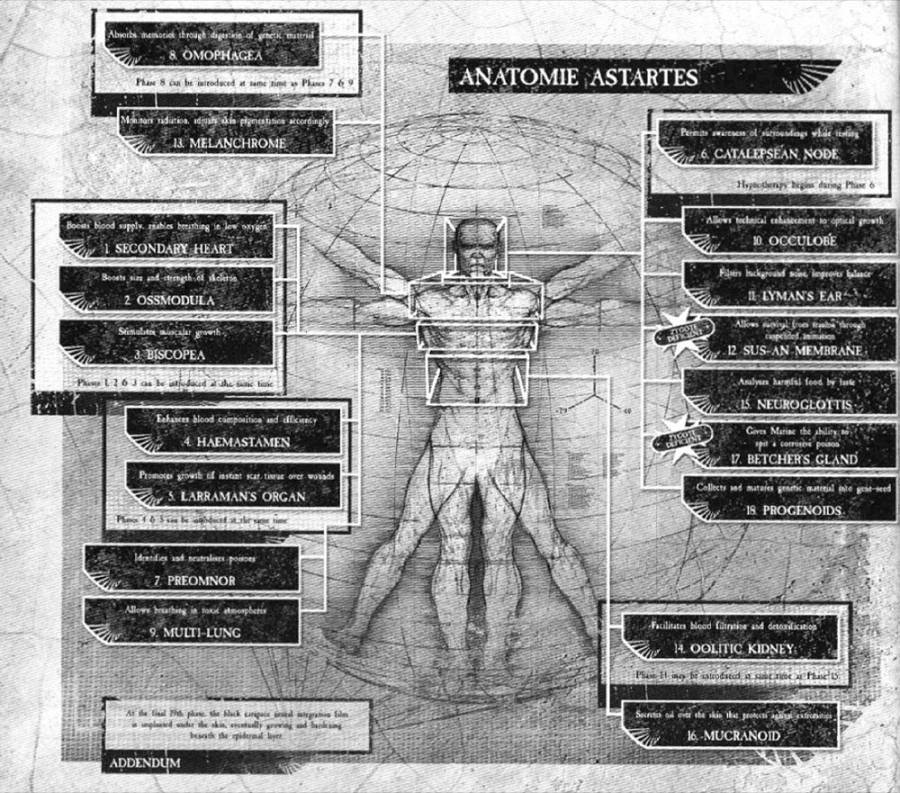
Recruitment
[edit]Recruits are drawn from the worlds from which a Chapter takes its blood, and every Chapter has its own custom of choosing them. Several recruit from a single homeworld, among them the Ultramarines of Macragge, the Blood Angels of Baal and the Space Wolves of Fenris. Others, such as the Dark Angels, take warriors from many worlds, and some take their candidates from Imperial schola progenium or from penal worlds. Most look for the same qualities: physical strength, intelligence, resistance to pain and an unusual degree of loyalty.[1] Candidates are usually aged between ten and fourteen when first selected, though the practice varies. A candidate is called an Aspirant until he completes his trials and is chosen to become a Neophyte.[5]
The trials differ widely. On feral worlds they are tests of survival, hunts, ritual combat and endurance; among the noble houses of Macragge, a record of service and education is combined with trial by combat. A Chapter will usually take only a handful of recruits each year from each recruiting world, and a majority of Aspirants are rejected or die. The Chapter's Apothecaries then assess those chosen for their psychic aptitude, their reflexes and their resistance to the strain of the implants. A candidate who proves unable to survive the surgery may be returned to his people or retained as a Chapter serf.[1]
Implantation
[edit]The making of a Marine takes years. A Neophyte receives a series of implants, nineteen in the Firstborn pattern, in a fixed order, by Apothecaries working with Chapter Techmarines and the Librarius. Each organ must be accepted by the body before the next is introduced, and the surgery is accompanied by hypnotherapy and doctrinal instruction. The process often kills the Neophyte or leaves him unfit, and survivors are said to go through a process of mental reinforcement that makes them reliably obedient to their Chapter. The final organ, the Black Carapace, is implanted at the end of service among the Scouts, and the Neophyte becomes a Battle-Brother only when it has fully taken.[11]
| Phase | Implant | Function | Typical age at implantation |
|---|---|---|---|
| 1 | Secondary Heart | Boosts blood supply; allows breathing in thin atmospheres | 10–14 |
| 2 | Ossmodula | Increases the size and strength of the skeleton | 10–12 |
| 3 | Biscopea | Stimulates muscular growth | 10–12 |
| 4 | Haemastamen | Improves the composition and efficiency of the blood | 12–14 |
| 5 | Larraman's Organ | Grows instant scar tissue over wounds | 12–13 |
| 6 | Catalepsean Node | Lets the Marine remain aware while resting; hypnotherapy begins | 14–17 |
| 7 | Preomnor | Identifies and neutralises poisons | 14–16 |
| 8 | Omophagea | Absorbs memories through digestion of genetic material | 14–16 |
| 9 | Multi-lung | Allows breathing in toxic atmospheres | 14–16 |
| 10 | Occulobe | Enhances vision, including in poor light | 14–16 |
| 11 | Lyman's Ear | Filters noise and improves balance | 14–16 |
| 12 | Sus-an Membrane | Allows suspended animation to survive severe trauma | 14–16 |
| 13 | Melanchrome | Monitors radiation and darkens the skin in response | 15–16 |
| 14 | Oolitic Kidney | Filters and detoxifies the blood | 15–16 |
| 15 | Neuroglottis | Lets the Marine analyse food and some substances by taste | 15–16 |
| 16 | Mucranoid | Secretes an oil over the skin that protects against extremes | 16–18 |
| 17 | Betcher's Gland | Lets the Marine spit a corrosive poison | 16–18 |
| 18 | Progenoids | Collect and mature genetic material into new gene-seed | 16–18 |
| 19 | Black Carapace | A neural interface woven under the skin to link the Marine to his armour | 16–18 |
The table gives the standard sequence recorded in the Apothecarion archives. Several implants are known to fail to grow in some Chapters, and the Imperium calls the condition "zygote deficiency". The Imperial Fists have lost the Sus-an Membrane and the Betcher's Gland, and the Blood Angels and Space Wolves each carry a defect passed on through the Progenoids.[11][5]
Gene-seed
[edit]The gene-seed is a Marine's inheritance. The Progenoid glands in the chest cavity produce the cells from which the Chapter makes new Marines, and the Chapter's Apothecaries must recover them from the fallen. A Chapter that loses its gene-seed stock, whether to destruction or theft, has lost its future. A Marine's death is therefore not the end of his service: the Progenoids of the fallen are harvested and, if sound, implanted into the next generation. Chapters that are unable to recover their dead for long periods can be reduced to a handful of warriors, and every Chapter's gene-seed is also tithed in part to the vaults of Terra.[1]
The gene-seed carries its primarch's strengths and defects. The Blood Angels' inheritance includes the Red Thirst and the Black Rage, the Space Wolves bear the Canis Helix, and most other Legions carry some lesser variation. A Chapter's "genetic stability", the degree to which its seed is free of mutation, is a matter of record in the Administratum and one of the matters an Inquisitor will examine closely.[5]
Physiology and mind
[edit]A Firstborn Marine stands well over two metres in height and is correspondingly broad. His bones are denser than a man's, his muscle is more than twice as strong, he can breathe in a wide range of atmospheres and survive wounds that would kill many men. He heals with a speed that seems unnatural to observers, needs little sleep and can live for centuries. His body also responds to hypnotherapy and is trained for years to use his armour and his wargear as a single weapon.[1]
The mind of a Marine is formed with equal care. Hypno-doctrination instils the beliefs and the discipline of the Chapter, and a Marine's faith, in the Emperor, in the Chapter and in the brotherhood of his squad, is intended to be absolute. Marines are generally celibate and are expected to hold no ties outside their Chapter. Most share an outlook that ordinary Imperials find alien: they are courageous, aloof and, in many cases, genuinely unable to understand the fears of the unaugmented.[1] The same indoctrination makes them effective soldiers but leaves them vulnerable to certain types of corruption, and Inquisitors of the Ordo Astartes are tasked with monitoring those Chapters whose loyalty is in doubt.[10]
Organisation and ranks
[edit]A Chapter is a sovereign body. It owns its fortress, its fleet, its recruits and its gene-seed, and it answers to the High Lords of Terra only through the Codex Astartes and the tithe of gene-seed. The standard Codex Chapter, described in full in the article on Space Marine Chapters, has ten companies of one hundred warriors, led by a Chapter Master. Non-Codex Chapters, among them the Space Wolves, Dark Angels, Blood Angels and Black Templars, are organised in their own way.[2]
| Rank | Role |
|---|---|
| Aspirant | A candidate undergoing trials; not yet a Space Marine |
| Neophyte | A recruit in training who is receiving his implants |
| Scout Marine | A Neophyte serving in the Tenth Company before receiving the Black Carapace |
| Battle-Brother | A full Marine, serving in one of the Battle, Reserve or Veteran companies |
| Sergeant / Veteran Sergeant | Leader of a squad of ten |
| Lieutenant | Second to a captain; two per company |
| Captain | Commander of a company |
| Chapter Master | Supreme commander of a Chapter, advised by the Chapter's officers |
Four groups of specialists serve beside the Battle-Brothers. Apothecaries tend the wounded and recover the gene-seed of the dead. Chaplains maintain the Chapter's faith and discipline and lead it in war. Librarians are the Chapter's psykers, trained to fight the powers of the Warp with their minds and often to serve as scribes of its lore. Techmarines maintain the Chapter's armour and vehicles, and are initiates of the Cult Mechanicus as well as the Chapter. A warrior who is mortally wounded may be interred in the sarcophagus of a Dreadnought, and so serve on for centuries more.[1]
Wargear
[edit]Armour
[edit]A Marine fights in power armour, a sealed suit of ceramite plates over a layer of bodyglove, powered by a backpack reactor and driven by fibre bundles that magnify his strength. The suit is linked directly to the Marine's nervous system by the Black Carapace. It carries the Marine's helmet, with auto-senses, vox, targeting and vital-sign monitors, and it protects him from vacuum, heat and many hostile atmospheres for a period. Its pauldrons, helm and knee guards bear the heraldry of his Chapter and company, and its colours serve as the Chapter's identity.[1]
Successive patterns of power armour, called Marks, were produced as the technology improved. The earliest, the Mark I Thunder, was worn in the Unification Wars; later patterns include the Mark II Crusade, the Mark III Iron, the Mark IV Maximus, the Mark V Heresy, the Mark VI Corvus and the Mark VII Aquila. A good deal of the older equipment is still used by Chapters that cannot replace it. The Primaris pattern is the Mark X Tacticus, a design that Cawl drew from the best of the old patterns, and its heavier variant is the Gravis armour.[3] Marines facing the heaviest fighting wear Terminator armour, a tactical dreadnought suit once reserved for the First Company, and the Primaris Terminator is the Tartaros pattern. Scouts wear a light armour called a carapace.[1]
Weapons
[edit]The signature weapon of the Adeptus Astartes is the bolter, a rocket-propelled mass-reactive shell weapon. Its Primaris successor is the bolt rifle of the Cawl pattern. Standard Space Marine wargear also includes the bolt pistol, the combat knife, frag and krak grenades, the chainsword, the power sword and the power fist. Support weapons include the heavy bolter, the lascannon, the missile launcher, the plasma gun and the meltagun. Librarians carry force weapons, and Chaplains the crozius arcanum. A broad range of specialist weapons has been produced for the Primaris, among them the plasma incinerator, the heavy bolt rifle and the gravis weaponry carried by the Aggressors and Eradicators.[3]
Vehicles and ships
[edit]Chapter armouries field the Rhino armoured carrier, the Razorback, the Predator and Land Raider battle tanks, the Whirlwind, the Vindicator, the Land Speeder and the Thunderhawk gunship, together with assault bikes and drop pods. The Primaris-era range includes the Repulsor and Impulsor transports, the Gladiator tank family and the Redemptor and Brutalis Dreadnoughts. A Chapter's fleet is made up of battle barges and strike cruisers, supported by smaller escorts. Several Chapters, among them the Imperial Fists and the Black Templars, operate a fleet that is itself their home.[1][3]
Primaris Space Marines
[edit]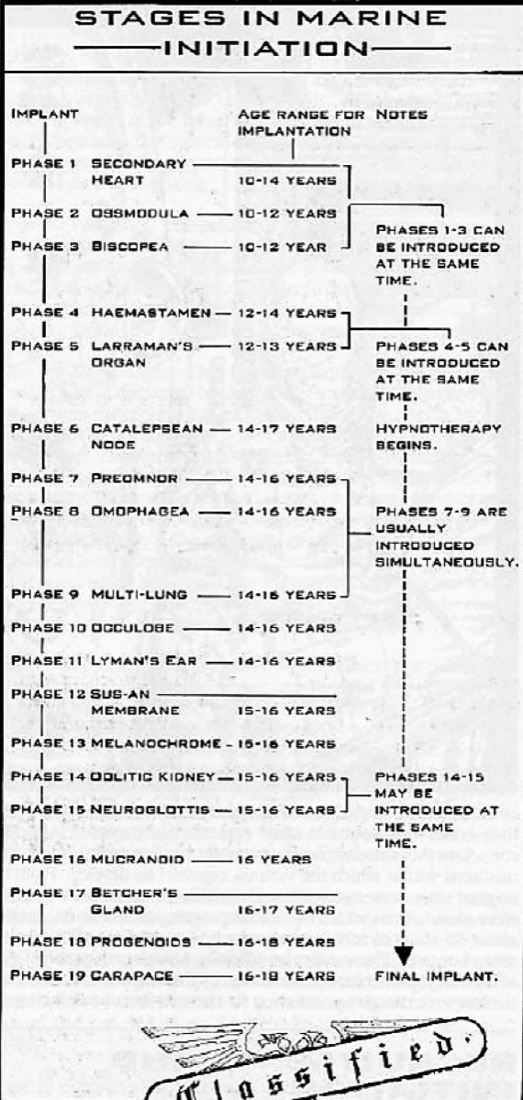
Origin
[edit]The newest Imperial record, based on the notes of Belisarius Cawl, gives the following account. In the early 31st millennium, soon after the Second Founding, Roboute Guilliman, unsatisfied with the Space Marines' resilience after the Heresy, ordered the Adeptus Mechanicus to study the creation of a new generation of warriors who could stand against the Traitors if the Imperium were ever to be broken again. The task passed to Cawl, who spent ten thousand years refining the gene-seed of the loyal Legions, drawing on stocks of unknown origin and on the preserved fragments of the original genetic work. The product was the Primaris Space Marine.[3]
An earlier, and still widely repeated, Imperial account held that Cawl's work was a Mechanicus experiment conducted without the Emperor's blessing; the Ecclesiarchy and a number of Chapters regarded it as heresy. The newer record says instead that Guilliman himself commissioned it, and the Adeptus Custodes, speaking in the Emperor's name, have declared the Primaris to be a gift of the Master of Mankind. The Imperial authorities have not published the Custodes' reasoning.[4]
Organs and physique
[edit]A Primaris Marine carries the nineteen implants of a Firstborn and three more. The Sinew Coils are durametallic cables woven through the muscle that magnify strength and give an additional layer of defence. The Magnificat is a thumbnail-sized lobe in the cortex that stimulates growth and heightens the working of the other implants. The Belisarian Furnace is a dormant organ linked to both hearts that, in a crisis, floods the body with a mixture of stimulants and healing agents. The Magnificat is only half of an organ the Emperor made for the primarchs; Cawl could find no plans for the second half, and it is not known whether they were lost or erased.[3]
The result is a Marine noticeably taller and broader than his Firstborn brother, with faster reflexes and a greater capacity to survive. Primaris armour and weapons were developed alongside the warrior: the Mark X Tacticus armour, the Cawl-pattern bolt rifle, and a range of new squad types: Intercessors, Hellblasters, Aggressors, Eradicators, Reivers, Inceptors, Eliminators, Bladeguard and others.[3]
The Ultima Founding and the Indomitus Crusade
[edit]The first host of Primaris Marines was woken from stasis aboard Cawl's ark mechanicus, the Zar-Quaesitor, at the start of the Indomitus Crusade in 999.M41. Each had been indoctrinated for a single role, and each was ready to fight at once. Some were formed into entirely new Chapters, the Ultima Founding, and others were assigned to existing Chapters. The remainder served as Greyshields with the Unnumbered Sons until the crusade's fleets reached the home or the fleet of the Chapter whose colours they would wear. Examples of Ultima Chapters recorded so far include the Rift Stalkers and the Silver Templars, and many have been given the abandoned fortress-monasteries of lost Chapters, often on the borders of the Great Rift.[4]
Not every Chapter welcomed the newcomers. Several Chapter Masters regarded the Primaris with suspicion, and a few declared them an offence to the Emperor's work. A shield host of the Adeptus Custodes, the Emissaries Imperatus, accompanied the crusade and told the doubters that the Primaris had the Emperor's sanction. Most Chapters complied, and the Imperial Fists, Dark Angels and Blood Angels have each since inducted Primaris recruits from their own worlds.[4]
Integration with the Firstborn
[edit]By the Era Indomitus the Firstborn and Primaris Marines fight in the same companies. Many Chapters have changed their organisation to put Primaris squads in the line, and the Firstborn who wish to do so may undergo the Rubicon Primaris, a surgery to implant the three extra organs. The procedure kills a significant proportion of those who attempt it. Marneus Calgar of the Ultramarines was among the first to cross it, in order to show that the Primaris were an inheritance and not a threat, and Chapters whose losses were heavy have performed the surgery on warriors who would otherwise have died.[3][4]
The older Marines' tactical formations, such as Tactical Squads and Devastators, remain in the Chapters, which also continue to recruit Firstborn warriors in the traditional way. The accepted Imperial account, drawn from the Records of the Indomitus Crusade, is that the two breeds are intended to serve together, and an earlier prediction that the Firstborn would be retired has not come true. Chapters differ in their pace: the Space Wolves and Dark Angels have been slow to change their rituals, while the Ultramarines and Imperial Fists reorganised quickly.[4]
Beliefs and culture
[edit]Almost all Space Marines revere the Emperor, though the nature of their devotion varies. Some Chapters, such as the Black Templars, treat him as a god; the Ultramarines are generally more restrained, and are in the Codex Astartes tradition of regarding the Imperial Cult as an institution of the unaugmented. Every Chapter keeps its own rites, relics and honours, and its own calendar of days of remembrance, and many Chapters keep warrior lodges, scrimshaw, honour markings and oaths that have no equivalent among other Chapters. The Chapter is a family: the Chapter's serfs, who work the fortress and the fleet, are born into its service and are its only contact with ordinary humanity.[1]
The Adeptus Astartes are also, by long tradition, a force of last resort. The Codex requires that a Chapter's duties be to defend Mankind and the Imperium, and in practice the Chapters are asked to take on missions that the Astra Militarum cannot. The Inquisition has the right to call on them, as does the Lord Commander, and each Chapter lends warriors to the Deathwatch, an Inquisitorial force that guards the Imperium from xenos threats. Many Chapters also maintain their own rivalries and feuds, of which the oldest and best known are those between the Dark Angels and Space Wolves, and between the Imperial Fists and the Iron Warriors.[10]
Non-Codex and Renegade Chapters
[edit]Several Chapters do not follow the Codex Astartes: the Space Wolves and the Dark Angels retain their older structures; the Blood Angels use a modified order of battle; the Black Templars, who split from the Imperial Fists under High Marshal Sigismund at the Second Founding, are a crusading fleet of far more than a thousand warriors. The Codex permits such divergence, though it is regarded with suspicion by the Administratum. The Imperium's greatest concern is with Chapters that cease to answer to Imperial authority, or that turn to the Ruinous Powers. A Chapter declared Excommunicate Traitoris loses its recognition and may be hunted by the Inquisition and by other Chapters. Renegade Chapters of Heretic Astartes exist in great number, as do the descendants of the Traitor Legions who fled into the Eye of Terror.[10]
Timeline
[edit]| Date | Event |
|---|---|
| End of the Unification Wars[b] | The Thunder Warriors are put down, and the Emperor begins the work that becomes the Space Marine Legions. |
| c. 798.M30 | The Great Crusade begins, with twenty Legions under their primarchs. |
| 000.M31 | The Triumph of Ullanor; Horus is named Warmaster. |
| 005.M31 | Horus rebels at Isstvan III and the Legions divide. The Drop Site Massacre follows on Isstvan V. |
| 014.M31 | The Siege of Terra ends the Horus Heresy. Loyal Legions have been broken at Isstvan and on Terra. |
| c. 021.M31 | Roboute Guilliman completes the Codex Astartes. |
| 021.M31 | The Second Founding begins, dividing the surviving Legions into Chapters. |
| 544–546.M32 | The War of the Beast; the Fourth Founding follows in the years after it. |
| c. 550.M32[c] | The Fourth Founding, the largest since the First. |
| 991.M35 | The Cursed Founding produces Chapters with flawed gene-seed from Mechanicus genetors. |
| M36 | During the Age of Apostasy Goge Vandire declares the Adeptus Astartes traitors; four Chapters, among them the Imperial Fists and the Black Templars, join the Terran Crusade against him. |
| 738.M41 | The Twenty-sixth Founding raises the Storm Giants and the Mentors. |
| 999.M41 | The Indomitus Crusade begins, and the first Primaris Marines are woken from stasis aboard the Zar-Quaesitor. |
See also
[edit]
Notes
[edit]- ^ The Administratum has never produced a reliable count. A figure of a thousand Chapters is traditional, but Chapters are lost, destroyed or founded faster than the rolls are corrected, and several are known only by rumour.
- ^ Estimated; no record gives an exact year.
- ^ Estimated; no record gives an exact year.
References
[edit]- ^ a b c d e f g h i j k l m Codex: Space Marines (9th Edition), pp. 4-87, 108-111. Games Workshop. Haley, Guy. Dark Imperium (novel). Black Library, Chs. 6, 7, 12, 13, 15, 18, 20.
- ^ a b c Codex Adeptus Astartes - Space Marines (8th Edition), pp. 10-11, 14, 16-17, 18-19, 62, 130-187. Games Workshop. Codex: Adeptus Custodes (8th Edition), pg. 9. Games Workshop.
- ^ a b c d e f g h Codex: Space Marines (8th Edition) (Revised Codex), pp. 6-21, 184-185. Games Workshop. Haley, Guy. Avenging Son (novel). Black Library.
- ^ a b c d e f g Warhammer 40,000: Rulebook (8th Edition), pp. 40-41, 61-63. Games Workshop. Codex: Space Marines (7th Edition) (Digital Edition), "The Forging of Heroes," "Chapter Organisation," "Codex Astartes", "The Chronicle of Heroes", "Forces of the Space Marines". Games Workshop.
- ^ a b c d e Death from the Skies (7th Edition), pp. 8-11. Games Workshop. Codex: Chaos Space Marines (6th Edition), pp. 5-13. Games Workshop.
- ^ a b Codex: Space Marines (6th Edition), pp. 3-18, 76-127. Games Workshop. Warhammer 40,000: Rulebook (6th Edition), pg. 234. Games Workshop.
- ^ Codex: Blood Angels (5th Edition), pp. 12-13, 48-53. Games Workshop. Codex: Space Marines (5th Edition), pp. 23, 51-95, 84-94. Games Workshop.
- ^ Codex: Space Wolves (5th Edition), pg. 56. Games Workshop. Codex: Black Templars (4th Edition), pp. 8, 30-41. Games Workshop.
- ^ Codex: Dark Angels (4th Edition), pg. 46. Games Workshop. Priestley, Rick et al.. Codex Imperialis (2nd Edition). Black Library, pg. 16.
- ^ a b c d Codex: Space Marines (4th Edition), pp. 4, 10-11. Games Workshop. Codex: Space Marines (3rd Edition), pg. 48. Games Workshop.
- ^ a b c Warhammer 40,000 Compendium (1st Edition), "Chapter Approved: The Origins of the Legiones Astartes," by Rick Priestley, pp. 6-10. Games Workshop. Priestley, Rick. Codex Ultramarines (2nd Edition). Black Library.
Further reading
[edit]- Guilliman, Roboute (c. 021.M31). Codex Astartes. Macragge. The foundational text of the Second Founding.
- Cawl, Belisarius (c. 999.M41). Notes on the Ultima Founding. Mars. The Primaris programme from the Mechanicus perspective.
- Records of the Indomitus Crusade (ongoing). Office of the Lord Commander. The integration of the Primaris into the Chapters.