
Fulgrim
| Fulgrim | |
|---|---|
| Primarch of the III Legion | |
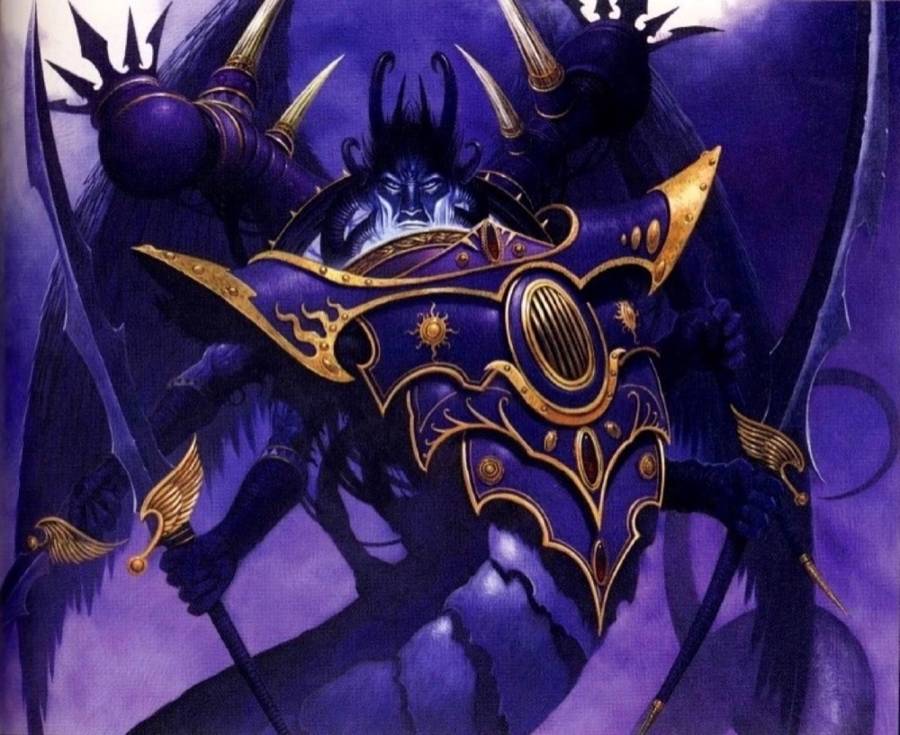
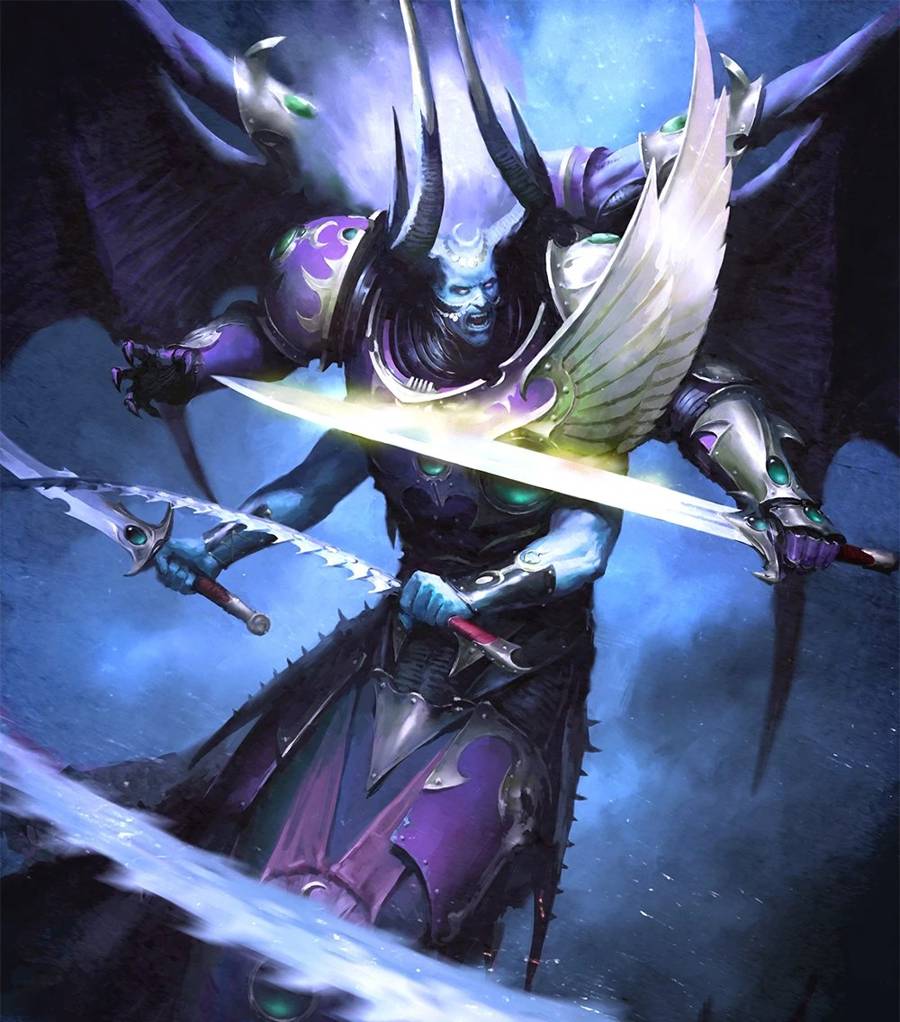 The Daemon Primarch of Slaanesh, from sealed Ordo Malleus files Artwork © Games Workshop | |
| Primarch of the Emperor's Children | |
| Tenure | 830.M30 – present |
| Predecessor | Position established |
| Successor | Incumbent |
| Daemon Primarch of Slaanesh | |
| Tenure | Since the Horus Heresy |
| Predecessor | Position established |
| Successor | Incumbent |
| Also known as | The Phoenician; the Illuminator |
| Allegiance | Emperor of Mankind until 005.M31; thereafter Horus and Chaos (Slaanesh) |
| Legion |  III, the Emperor's Children |
| Homeworld | Chemos (city of Callax) |
| Created | Beneath the Himalazian mountains, Terra, c. 792.M30 |
| Discovered | 830.M30 |
| Status | Alive as a Daemon Prince; held to dwell on the Daemon World of Callax, and reported active since the opening of the Great Rift |
| Relatives |
|
| Wargear | Gilded Panoply; Fireblade; Forgebreaker; Blade of the Laer; Kinebrach Anathame |
| Known for | Perfectionism; the Isstvan III Atrocity; slaying Ferrus Manus; wounding Roboute Guilliman at Thessala |
Fulgrim, called the Phoenician and the Illuminator, was the Primarch of the III Legion of the Space Marine Legions, the Emperor's Children. A ruler of the mining world of Chemos before the Emperor found him in 830.M30, he made the pursuit of perfection his Legion's founding creed, and was admired across the Imperium as a duellist, a sculptor and the most refined of the primarchs. He was a Traitor in the Horus Heresy. At the war's turning point he killed his friend Ferrus Manus on Isstvan V, and he afterwards became a Daemon Prince of Slaanesh, the Chaos God of excess.[1][2]
After the Heresy he withdrew from the affairs of his Legion for long ages, to a Daemon World he named Callax. In 121.M31, at the Battle of Thessala, he fought Roboute Guilliman aboard his flagship and wounded him so badly that the Ultramarine primarch was placed in stasis, where he remained until the Era Indomitus. Since the opening of the Great Rift, he has reappeared among his gene-sons, who march toward Terra under the claim that he is the true heir of the Emperor.[3][4]
Early life
[edit]Chemos
[edit]The gestation capsule of the infant Fulgrim was cast across the galaxy by the Chaos powers and landed on Chemos, a bleak mining world warmed by a small binary star and wrapped in a nebula of dust, so that it lived in perpetual twilight. Chemos had been settled in the Dark Age of Technology and cut off by warp storms in the Age of Strife. Its mines were running out, and the planet could not feed itself. Its people lived in a handful of fortress-factories and worked every hour. Art and leisure had been sacrificed to survival.[1]
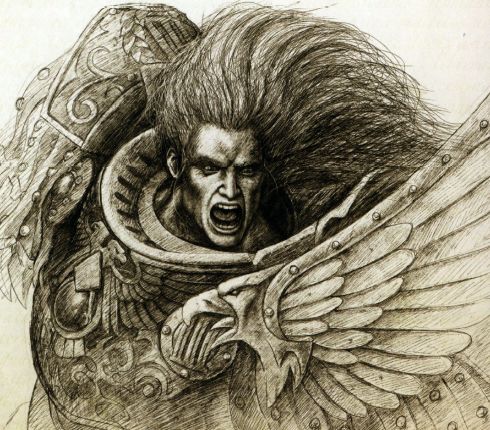
The child was found by scouts of the Caretakers, the police force of the fortress-factory of Callax. Orphans were normally put to death to save resources, but the scouts were so struck by the infant's beauty that they begged the ruling Executives to spare him. One of them raised him as his own. Fulgrim, named for an ancient deity of the Chemosians, worked as a labourer at half the age others were put to work. He understood the ramshackle mining machinery intuitively and improved it. By fifteen he was one of the Executives who governed Callax.[1]
He sent engineers to restore the old mining outposts, and Chemos produced a surplus for the first time in decades, allowing the planet to buy food from passing traders. As the recognised leader of the world he encouraged a revival of Chemosian art and culture, which he regarded as essential to human life.[1]
The Emperor
[edit]In 830.M30 a flight of battered Stormbirds bearing the Imperial Aquila came out of the twilit sky of Chemos. Fulgrim ordered the Caretakers to receive the strangers and met them in Callax. When the Emperor stepped out from among his Astartes, Fulgrim knelt and offered his sword. The Emperor told him of Terra and the Great Crusade, and of a Humanity that could take its place in the galaxy. Fulgrim swore to serve for ever. He was given the III Legion, which became the Emperor's Children, and it took the Palatine Aquila, the Emperor's own personal sigil, as its mark.[1]
Great Crusade
[edit]The Illuminator
[edit]Fulgrim was unusual among the primarchs in believing that the competent conduct of war was not enough. The Crusade, he held, was fought to create a civilisation that would pursue the finer things in life: music, literature, drama and art. He regarded himself as an artist and was a skilled sculptor who made statues of the Legion's first captains. Yet he felt that nothing he made was perfect, and the pursuit of perfection became the principle that governed the Legion. The Emperor's Children were exemplary in all things, drilled to perfection in peace and war, and later intolerant of failure in themselves.[1][2]
Because his Legion was small, it was first placed under the command of Horus and fought beside the Luna Wolves on the Eastern Fringe, and Horus and Fulgrim grew close. When the Legion had regrown, Fulgrim was given the 28th Expeditionary Fleet. His flagship, the battle barge Pride of the Emperor, was among the most refined vessels of the Imperial fleet. The Legion made its fortress-monastery in the old fortress-factory of Callax on Chemos. His friendship with Ferrus Manus began beneath Mount Narodnya on Terra, where the two forged weapons for one another. Fulgrim made the hammer Forgebreaker, and Ferrus Manus made the sword Fireblade. The 28th Expedition worked alongside the Iron Hands against the Diasporex, a nomad fleet of humans and xenos, and Ferrus Manus came to Fulgrim's aid in the Firebird when it was badly damaged in the battle.[1][5]
Laeran
[edit]The first step in his fall came on Laeran, the third world that the 28th Expedition brought to compliance. The Laer were a serpentine species that had remodelled themselves through genetic engineering into many castes. They lived on hundreds of floating islands of coral around a central nexus, and their technology rivalled the Imperium's. The Laer rejected compliance and attacked, and the Emperor's Children exterminated them. What the Legion did not know was that the Laer had been corrupted by Slaanesh, and that the great structure at the heart of their islands was a temple to the Prince of Pleasure.[6]
In the temple Fulgrim took up a single-edged sword of silver that held a fragment of a daemon. From that day, Imperial records suggest, he was no longer wholly himself. The Remembrancers who followed the 28th Expedition went to the temple and were changed by it. The composer Bequa Kynska of Terra was driven to write a symphony, the Maraviglia, to capture what she had heard there, and played it before the Legion. The Legion slid by degrees into the pursuit of sensation. The change in Fulgrim himself showed on Tarsus, where he took offence at a warning from the Aeldari Farseer Eldrad Ulthran that Horus was corrupted, and opened fire on the Aeldari. His Phoenix Guard were all killed in the fight and a new one was raised.[6][7]
Horus Heresy
[edit]Isstvan III and the Anvilarium
[edit]When the rebellion began, the Emperor's Children joined Horus at Isstvan III in 005.M31, taking part in the atrocity there, in which the Warmaster's Legions, together with the Death Guard and World Eaters, destroyed the loyalists among their own ranks and bombarded the world with a virus bomb. Among the dead were the loyal members of Fulgrim's own Legion, who fought under Captains Saul Tarvitz and Solomon Demeter. The Ancient Rylanor survived, entombed in a Dreadnought sarcophagus, for ages afterwards.[2]
Fulgrim stayed away from the main force. At Horus's request he went to the Iron Hands' 52nd Expeditionary Fleet at Callinedes IV, to try to bring his friend Ferrus Manus over to the Warmaster. Horus had already given Fulgrim the Kinebrach Anathame as a mark of trust. The meeting in the Anvilarium aboard the Fist of Iron ended in violence. Fulgrim spared Ferrus, took Forgebreaker as a token of their friendship and left Fireblade behind. His Phoenix Guard then killed the Morlock Terminators outside, and the Emperor's Children ships fired on the Iron Hands fleet.[5]
Isstvan V
[edit]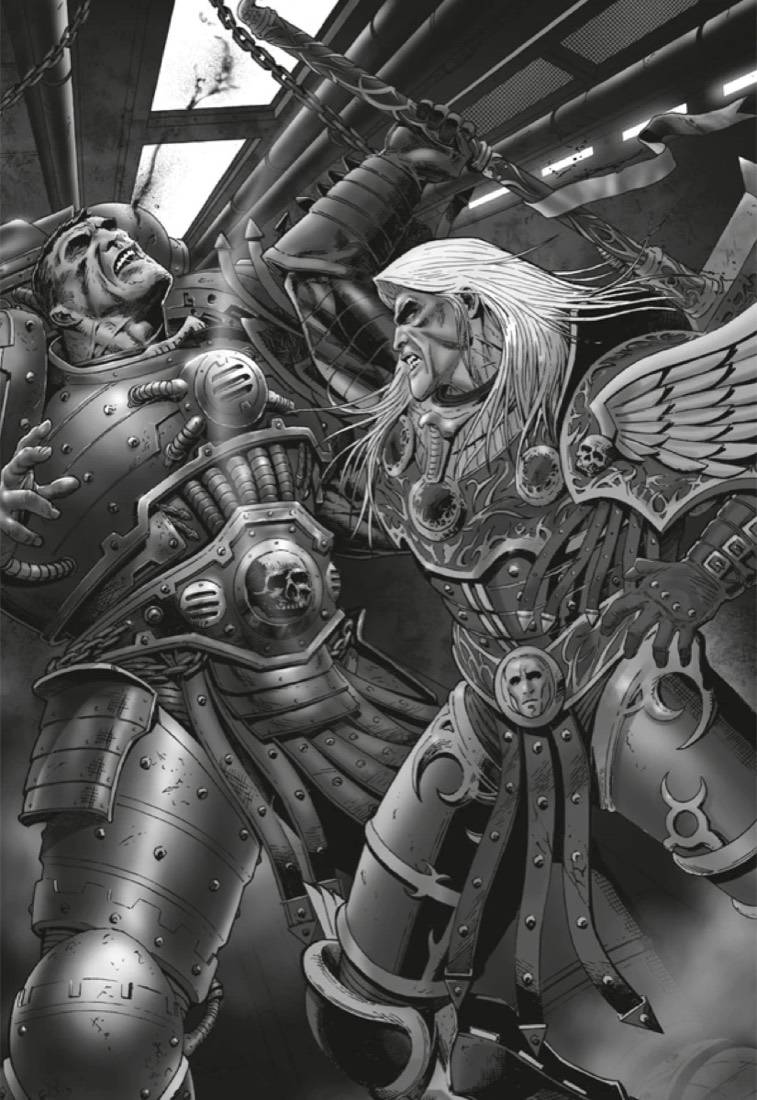
On Isstvan V in 006.M31, Fulgrim taunted the Iron Hands primarch for his rashness, then revealed the second wave of the Traitors, which fell on the loyalists. The two primarchs fought. Fulgrim was badly hurt and, drawing the possessed blade he had taken from the Laer temple, he found the strength of the Warp pouring into him. He beat Ferrus Manus down. According to the surviving accounts he hesitated, realising for an instant what he had become, and then the daemon in the blade took control and he struck off his friend's head.[5][8]
Four days afterwards Horus convened his primarch commanders in the Vengeful Spirit. Eight attended: Fulgrim, Perturabo, Angron and Lorgar in person, with Konrad Curze, Mortarion and Alpharius present as projections, and Magnus in a shining image. Fulgrim, whose body the Slaaneshi daemon from the Laer blade had seized after the death of Ferrus Manus, wielded the Anathame. The Laer blade, now bereft of its spirit, passed to Captain Lucius of the 13th Company, who became one of the Legion's most dreaded duellists. The Legion's own accounts say that Fulgrim afterwards cast the daemon out and imprisoned it in a painting aboard the Pride of the Emperor.[9][10]
Angel Exterminatus
[edit]The Warmaster ordered the Emperor's Children to Mars. Fulgrim, already difficult to command, disobeyed and attacked the Mechanicum mining world of Prismatica V instead. He then arranged a meeting with Perturabo, who had by then humbled the Imperial Fists at Hydra Cordatus. Fulgrim spoke of something "wondrous". Perturabo, who had counted Fulgrim's adherence to perfection as the nearest thing to friendship he had among his brothers, agreed to go. The Phoenician led the joint fleet into the Eye of Terror to Iydris, one of the lost Crone Worlds, and to its citadel of Amon ny-shak Kaelis, which guarded the Sepulchre of Isha's Doom and the prison-tomb of the "Angel Exterminatus".[10]
In the citadel Fulgrim sought apotheosis. Perturabo, who had come prepared to turn the rite against him, was thrown aside. Fulgrim floated above the central shaft, his armour shimmering, his eyes black voids, and took the power of the Dark Prince. Perturabo destroyed his mortal body with Forgebreaker, and from the light that burst out Fulgrim was reborn a Daemon Prince, a four-armed serpentine being with wings, like the Laer that he and his Legion had destroyed. The Emperor's Children, and their primarch, were Slaanesh's.[10]
Earlier Imperial summaries placed his apotheosis after the end of the Heresy. The account in the Chronicles, which is now accepted, places it before the Siege of Terra.[11]
Siege of Terra
[edit]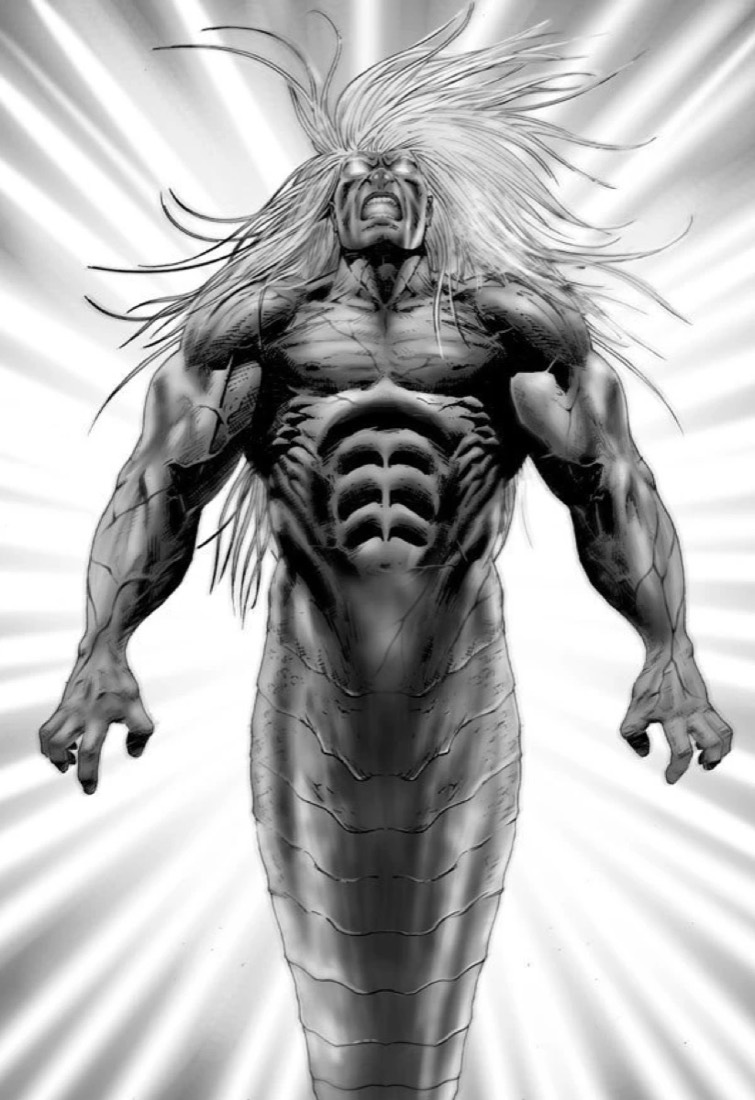
At the Siege of Terra in 014.M31, the Emperor's Children were of little use as a disciplined force. Fulgrim spent the early stages goading Angron and begging Horus to let him loose. The Legion preferred to take prisoners for its own pleasure and, on Terra, turned on the helpless population beyond the Palace. The Sons of Horus' First Captain, Ezekyle Abaddon, persuaded Lord Commander Eidolon to bring Fulgrim into an assault on the Saturnine Gate, while Abaddon led another force through a secret passage under the Ultimate Wall.[12]
Fulgrim entered the combat in his old mortal form. He slaughtered a great number of Imperial Fists and then met their First Captain, Sigismund, whom he overcame. He was then confronted by Rogal Dorn. The two duelled. Dorn ignored the daemon's taunts, matched every attack, and eventually ran him through. Fulgrim laughed and declared that he could not be killed. When he learned that Abaddon's attack had failed, he resumed his serpent form and left the field, after ordering the Phoenix Guard under Eidolon to attempt to kill Dorn. The attempt failed.[12]
After the Heresy
[edit]Thessala
[edit]After Horus fell, the Emperor's Children fled into the Eye of Terror. Fulgrim was last seen in realspace during the Great Scouring, when in 121.M31 he fought Roboute Guilliman aboard the Pride of the Emperor at the Battle of Thessala. Fulgrim, using the sight that the Warp had given him, saw the scar left on the Ultramarine primarch's neck by the blade of the Word Bearer Kor Phaeron at Calth, the one weak point in his body. He opened Guilliman's throat with a poisoned blade. The Ultramarines took their primarch back to Macragge and put him in stasis in the Temple of Correction. This was the wound that kept him from the Imperium for ten thousand years.[3]
Callax and the Legion Wars
[edit]The Emperor's Children left a trail of ruined worlds as they fled into the Eye. When their slaves were exhausted they raided the other Traitor Legions for new ones, and were crushed in the Legion Wars. The Legion broke into small, competing warbands. Fulgrim, bored by the poor pleasures of his Legion, shut himself away on a Slaaneshi daemon world in the Warp, which he named Callax after the city of his youth. He was absent from realspace for millennia.[13]
He has appeared at times. During the 13th Black Crusade, a giant, serpent-bodied daemon was seen destroying Astra Militarum regiments at Extremis Six, after the Emperor's Children and the Riotous Host Titan Legion levelled its cities with sonic weapons on the orders of Lucius the Eternal, and Imperial analysts believe it was Fulgrim. He is said to have sensed the moment, in the Ultramar campaign of the same crusade, when Guilliman was healed of the wound that he had inflicted.[13]
Era Indomitus
[edit]Since the Great Rift opened, the Emperor's Children have been more active than ever. Their warbands commit atrocities so vile that the veil between worlds thins, and Slaanesh's daemons manifest. Fulgrim ended his long exile on Callax. He believes that his father's vision of a united Humanity was flawed, but that in his own hands it would have been magnificent, and that it was not he but Horus whom the Emperor chose to leave in command after Ullanor. He gathered his gene-sons to march on Terra and take his place as the Emperor's true heir. As a test of their worth he ordered the conquest of Crucible, an industrial world whose authorities had burned a Chaos cult of Slaanesh at the stake for worshipping him. A Black Templars detachment, led by the Emperor's Champion Johannes Brengar, defended it with a regiment of Cadians.[14]
Inquisitorial reports record an account that the clone-master Fabius Bile succeeded in growing a copy of Fulgrim, a pure one, uncorrupted by Slaanesh and remorseful for his actions. The Ordo Malleus regards the report as unconfirmed.[15]
Character and abilities
[edit]Before his corruption, Fulgrim was the most cultured of the primarchs, and the vainest. He believed that Humanity was the perfection of intelligent life and that the Emperor was the most perfect human. He took pride in the Legion's looks and discipline and could not abide imperfection. The loss of the Legion's gene-seed before the Crusade left him secretly insecure, and later Fabius Bile used that weakness to win leave to alter the Legion's flesh. He was a fine duellist, fast and exact, and in every account the most graceful swordsman of the primarchs.[1][2]
As a Daemon Prince he is more powerful and less stable. His four arms end in claws or gauntlets, his form changes with his moods, and he commands the gifts of Slaanesh. He cannot be killed in the ordinary sense. Dorn's sword, which ran him through, did not end him.[13]
Wargear
[edit]As a mortal he wore the Gilded Panoply, an artificer suit in purple and gold, built to let him use his speed and agility. His early blade was Fireblade, a power sword that produced intense heat, made by Ferrus Manus; he later took the possessed Blade of the Laer, a single-edged silver sword. He also carried the hammer Forgebreaker, made by himself for Ferrus Manus and taken back on the Fist of Iron, and the Kinebrach Anathame, given by Horus. Forgebreaker was passed on to Perturabo. As a Daemon Prince his arms and armour change with his whims. Some of his weapons are manifestations of will, others are trophies. Among them, observers note Fireblade, which alone seems unmarred by the Warp; some of his sons hold it to be only a weapon shaped from his own will.[1][13]
Timeline
[edit]| Date | Event |
|---|---|
| c. 792.M30 | The infant primarch is scattered from Terra and falls on Chemos, where he is raised in the fortress-factory of Callax. |
| 830.M30 | The Emperor lands on Chemos. Fulgrim takes command of the III Legion, then all but destroyed by a gene-seed failure, and names it the Emperor's Children. |
| After 830.M30 | Forges the hammer Forgebreaker beneath Mount Narodnya with Ferrus Manus, who makes the sword Fireblade. |
| Before 005.M31 | The 28th Expedition brings Laeran to compliance; Fulgrim takes up the daemon-haunted Blade of the Laer. |
| Before 005.M31 | Meets the farseer Eldrad Ulthran on Tarsus, who warns him of the Warmaster's treachery; he attacks the Aeldari. |
| 005.M31 | Joins Horus at the Isstvan III atrocity; fails to turn Ferrus Manus in the Anvilarium at Callinedes IV. |
| 006.M31 | Beheads Ferrus Manus during the Drop Site Massacre on Isstvan V. |
| After 006.M31 | With Perturabo enters the Eye of Terror and on the Crone World of Iydris ascends as a Daemon Prince of Slaanesh. |
| 014.M31 | Fights Rogal Dorn at the Siege of Terra and is run through; flees with his Legion into the Eye after the death of Horus. |
| After 014.M31 | Withdraws to the daemon world he names Callax; the Emperor's Children break apart in the Legion Wars and at Skalathrax. |
| 121.M31 | At the Battle of Thessala wounds Roboute Guilliman with a poisoned blade, sending him into stasis. |
| c. 999.M41 | Seen at Extremis Six during the Thirteenth Black Crusade, according to Imperial analysts. |
| After 999.M41 | Ends his exile on Callax and reappears among the Emperor's Children after the opening of the Great Rift; attacks Crucible. |
See also
[edit]

References
[edit]- ^ a b c d e f g h i Codex: Emperor's Children (10th Edition), pg. 18. Games Workshop. McNeill, Graham. Fulgrim (novel). Black Library, Chs. 1-2, 5-6, 10, 14-17, 19, 21-22, 24-25.
- ^ a b c d McNeill, Graham. Angel Exterminatus (novel). Black Library, Theogonies-III, Chs. 5-7, 16, 18, 21-24, 25-27. Wraight, Chris. The Path of Heaven (novel). Black Library.
- ^ a b French, John. Slaves of Darkness (novel). Black Library, Chs. 15-19. French, John. The Solar War (novel). Black Library, Ch. 19.
- ^ Haley, Guy. The Lost and the Damned (novel). Black Library, Chs. 4-5. Abnett, Dan. Saturnine (novel). Black Library, Part 3, Chs. 3-4.
- ^ a b c Reynolds, Josh. Fulgrim: The Palatine Phoenix (novella). Black Library, Chs. 3, 5. Reid, Jude. Fulgrim: The Perfect Son (novel). Black Library, Ch. 25.
- ^ a b Reynolds, Josh. Fabius Bile: Clonelord (novel). Black Library, pp. 117, 129, 143, 246, 272-273, Ch. 9. Codex Supplement: Iron Hands (8th Edition), pg. 14. Games Workshop.
- ^ McNeill, Graham. False Gods (novel). Black Library. Counter, Ben. Galaxy in Flames (novel). Black Library.
- ^ McNeill, Graham. A Thousand Sons (novel). Black Library. Dembski-Bowden, Aaron. The First Heretic (novel). Black Library.
- ^ Abnett, Dan. Prospero Burns (novel). Black Library. McNeill, Graham. The Vengeful Spirit (novel). Black Library.
- ^ a b c French, John. Mortis (novel). Black Library, Limited Edition Artwork. Black Legion - A Codex: Chaos Space Marines Supplement (6th Edition), pg. 50. Games Workshop.
- ^ Gathering Storm: Fracture of Biel-Tan (7th Edition), "War in the Labyrinth", +++Opticon Solo+++. Games Workshop. Gathering Storm: Rise of the Primarch (7th Edition), Part 1. Games Workshop.
- ^ a b Codex: Chaos (2nd Edition), pp. 15-16. Games Workshop. The Primarchs (Anthology) edited by Christian Dunn, "The Reflection Crack'd" by Graham McNeill, Chs. 9, 11, 13-14.
- ^ a b c d Sons of the Emperor (Anthology), "The Ancient Awaits" by Graham McNeill, pp. 133-149. White Dwarf (December 2019), "Worlds of Warhammer" by Phil Kelly, pg. 11.
- ^ Dembski-Bowden, Aaron. Death and Defiance (Anthology). Black Library, Guy Haley, Nick Kyme, Andy Smillie and James Swallow, "Imperfect" by Nick Kyme. Index Astartes I, "Children of the Emperor - The Emperor's Children Space Marine Legion".
- ^ The Horus Heresy Book One: Betrayal (Imperial Armour), pp. 29, 102-109, 114, 116-119, 257-258. The Horus Heresy Legiones Astartes: Isstvan Campaign Legions, pg. 28.