
Dreadnought
| Dreadnought | |
|---|---|
| Cybernetic combat walker of the Adeptus Astartes | |
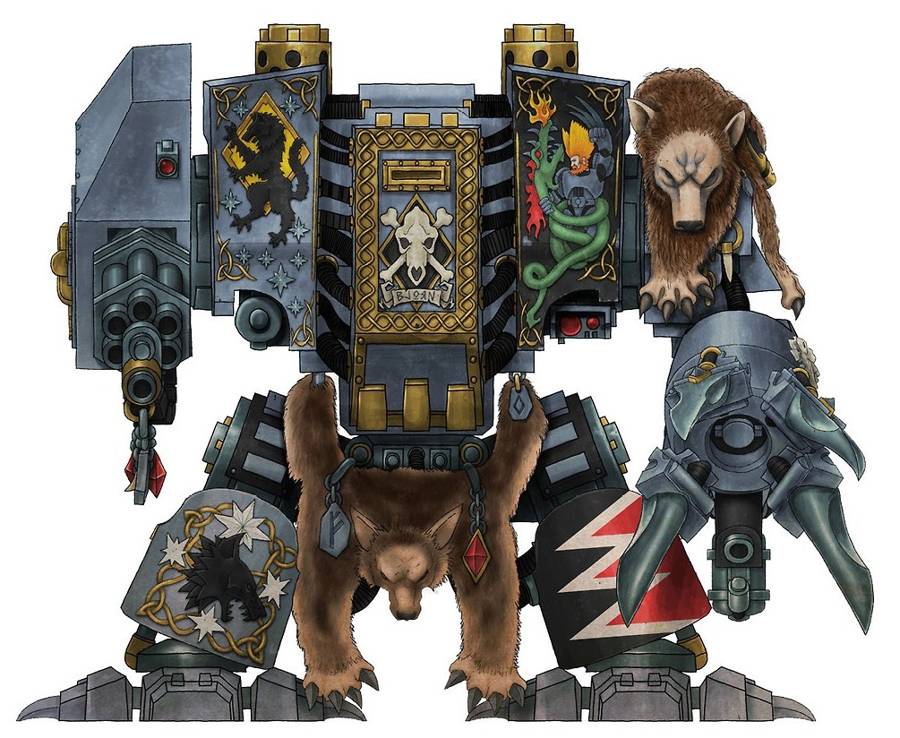 Bjorn the Fell-Handed of the Space Wolves, the oldest Dreadnought in the service of the Imperium Artwork © Games Workshop | |
| Type | Armoured walker and cybernetic life-support sarcophagus |
| Size | Intermediate between a Space Marine and a battle tank |
| Users | Chapters of the Adeptus Astartes; the Legions in the Horus Heresy; the Legio Custodes (Telemon pattern) |
| Role | Heavy infantry support for a Space Marine company |
| Crew | One Space Marine, interred within the machine for life |
| Common patterns | Castraferrum (Marks IV and V), Contemptor, Deredeo, Leviathan, Redemptor |
| Maintained by | Techmarines of each Chapter |
| Origins | Dark Age of Technology; refined by the Legions in the Great Crusade (from 798.M30) |
A Dreadnought is a cybernetic combat walker of intermediate size, used by the Chapters of the Adeptus Astartes as heavy infantry support for their companies. The most common form fielded in the 41st millennium is the Castraferrum pattern. A Dreadnought is not a robot and not a suit of armour. It is a life-support sarcophagus, set in the chest of an armoured walker, in which a Space Marine too badly wounded to fight in power armour is kept alive and given a new, mechanical body.[1][2]
The warrior within is linked to the machine by neural interfaces and controls it as though it were his own body, but he cannot leave it. He is interred for as long as the machine endures, and a Dreadnought may serve for centuries or millennia. Between wars the machine sleeps in a shrine of its Chapter's fortress-monastery, tended by the Techmarines with oils and litanies. The oldest, called Venerable Dreadnoughts, are treated as living relics and as advisers in the council of their Chapter.[1][3]
The art of building new chassis is largely lost to the Imperium, so each Chapter's Dreadnoughts are inherited, repaired and prized. The patterns used in the Great Crusade, among them the Contemptor and the Leviathan, are rarer still, while the Primaris Chapters of the Era Indomitus field a new and more powerful family, the Redemptor and its variants. The Traitor Legions and the renegades of the Chaos Space Marines have their own Dreadnoughts, driven mad by their confinement and known as Helbrutes.[1][4][5]
Description
[edit]A Dreadnought stands taller and broader than an infantryman and is armoured like a tank. A typical machine carries one heavy ranged weapon on one arm and a Dreadnought close combat weapon on the other, usually a power fist or power claw with a storm bolter or heavy flamer mounted beneath it. Imperial scholars stress that the power fist of a Dreadnought shares only a name with the weapon of an infantryman: it is unrestricted by weight and strong enough to tear apart even a Chapter Master in his armour.[1][4]
The warrior within survives as a shrivelled organic core, kept alive by the sarcophagus and feeding on its systems. His senses reach the world through sensors and neural links, and many pilots are said to feel the walker as their own limbs. The link is absolute and cannot be undone, so that when the walker is destroyed, the warrior dies with it. For this reason the interment of a hero in a Dreadnought is both an honour and a sentence, and Chapters speak of it as being allowed to "sleep" until the next war.[1]
Dreadnoughts are carried into battle by Drop Pod, Thunderhawk or on foot beside the infantry. In the narrow corridors of boarding actions and in the close fighting of hive cities, the low profile of the Castraferrum pattern lets it pass where taller Dreadnoughts could not. In open fighting its main use is to draw fire and to hold a line.[4]
History
[edit]Origins in the Dark Age of Technology
[edit]The roots of the Dreadnought lie far back in the Dark Age of Technology, when the human worlds built heavy walkers for war and for labour. In the Age of Strife these machines survived in idiosyncratic forms on Mars, among the warlords of Terra and on isolated colony worlds. The older "proto-Dreadnoughts" could be piloted by ordinary humans, which the later patterns could not.[1][4]
The Great Crusade and the Horus Heresy
[edit]When the Emperor of Mankind raised the Legions for the Great Crusade (from 798.M30), the technology of the walker was joined to the physiology of the Space Marine. The Legions fielded the large Contemptor pattern, the Furibundus and the Lucifer, and later the Deredeo, a heavy support frame. Imperial records name the Contemptor as a core of the earliest Legion armies raised on Terra. A few Leviathan siege Dreadnoughts were built in secret on Terra in the last years of the Crusade, and the Adeptus Custodes fielded a handful of the enormous Telemon pattern.[6][4]
In the Horus Heresy (005–014.M31) Dreadnoughts fought on both sides. The Dreadnought Huron-Fal of the Death Guard refused to follow his Primarch and was destroyed in the Isstvan III atrocity in 005.M31. The Iron Hands lost most of their Dreadnoughts in the Drop Site Massacre on Isstvan V in 006.M31 and were never able to replace them. Ancient Marcellus of the Ultramarines stood against the Traitors at the Battle of Calth in 007.M31 and was last recorded fighting the daemonic host summoned there. The Contemptor pattern suffered the heaviest losses of all, and the knowledge to build it was lost in the confusion that followed, together with the secrets of its atomantic shielding and of its graviton weapons, which perished in the Schism of Mars.[6][4]
The long decline
[edit]After the Heresy, the Codex Astartes was promulgated and the Legions were divided into Chapters (c. 020–030.M31). The Dreadnoughts of the Legions were divided with them. By the 41st millennium the art of building them had passed into ritual, and the Mechanicum could repair a chassis but not create one. Chapters kept their machines by cannibalising wrecks and by stockpiling ancient parts, and many of those still standing are the same hulls that fought in the Heresy, retenanted many times.[1][4]
The Era Indomitus
[edit]The appearance of the Primaris Space Marines brought a new family of Dreadnoughts. The Redemptor pattern was made to give mortally wounded Primaris warriors the same second life, and it is taller, broader and more heavily armed than the older machines. Its variants, the Brutalis and the Ballistus, serve in the Primaris Chapters and the Ultramarines forces of the Indomitus Crusade (from 999.M41). Imperial scholars record that the Redemptor demands more of its pilot than any older pattern and that many have already worn out their sarcophagi.[2][7]
Patterns
[edit]Castraferrum pattern
[edit]The Castraferrum, produced by the forges of Mars in the Marks IV and V, is the pattern found in nearly every Chapter. It is lower than the Contemptor and its armour is gathered more to the front. Instead of the Atomantic arc reactors and helical targeting arrays of the older machines, it uses an adaptable thermic reactor and systems found in other Astartes war machines, which is why it can still be maintained. In the Heresy many Mark IV machines went over to the Traitors, and the Imperium now finds that most Chaos Dreadnoughts are Mark IVs. Some Imperial scholars suspect a flaw in the machine spirit of the Mark IV, and loyal Chapters protect the Mark IVs they keep with purity seals and anti-daemonic wards.[4][1]
Variants
[edit]Chapters fit the Castraferrum to many roles. The Ironclad has heavy frontal plating and a seismic hammer for fighting in the open or against fortifications. The Siege Dreadnought carries an inferno cannon or flamestorm cannon and an assault drill, and is used to break fortresses. A Hellfire or fire support Dreadnought swaps its close combat arm for a missile launcher, while the Mortis, favoured by the Dark Angels and their successors, carries two ranged weapons. Assault Dreadnoughts with two close combat arms are favoured by Chapters that fight from Drop Pods.[4][8]
Several Chapters keep their own forms. The Blood Angels and their successors use the Furioso, with blood-themed fists and talons, and they inter Librarians in Librarian Dreadnoughts. A Blood Angels Dreadnought may also fall to the Black Rage and join the Death Company. The Grey Knights use the Doomglaive Dreadnought, warded by the Aegis against the Warp and able to link its field to the wards of nearby brothers, and the Deathwatch inters heroes of the Ordo Xenos who remain in the Long Watch for centuries. The Space Wolves have their own armed and ornamented machines, fitted with weapons such as the Helfrost cannon.[9][10][11][12]
Older and newer patterns
[edit]The Contemptor was a larger and more powerful machine than the Castraferrum, with atomantic shielding that could overload with an explosion if the walker was damaged. The Deredeo of the Great Crusade carried anvilus autocannon batteries and an Aiolos missile launcher. The Leviathan, built in secret on Terra, carried a larger reactor, and the Telemon was the heavy walker of the Custodes, bearing at least one plate worked by the Emperor's own hand. A relic of these patterns, found in a Chapter armoury, is brought out only in the direst need.[4]
Venerable Dreadnoughts
[edit]A Dreadnought that has served for many centuries is called a Venerable Dreadnought, or an Ancient. Venerable machines are harder to destroy than younger ones but they carry older and more volatile weapons, and a great share of a Chapter's Master of the Forge is spent keeping them running. The Ancient grows harder to wake as the centuries pass, and the chassis grows more prone to failure. No Chapter would grant the Emperor's Peace to its Ancients, because only they remember at first hand what is written in the mouldering tomes of the librarium.[13][1]
The greatest of them is Bjorn the Fell-Handed of the Space Wolves, who served in the retinue of Leman Russ and was the first Great Wolf when he was still whole of body. He fought in the Great Crusade and the Heresy and is well over ten thousand years old. He is woken once in each century, at the great feast, when the whole Chapter gathers in silence to hear him speak of the Primarch.[13][14]
Chaos Dreadnoughts
[edit]The Traitor Legions and renegade warbands also inter their wounded. A Chaos Space Marine regards the fate as a living death, and the confinement, together with the power of Chaos, drives the pilot mad over the centuries. Such machines are known as Ferrum Infernus Dreadnoughts or, when the Warp has twisted metal and flesh together, as Helbrutes. They are chained when not in battle and are used as insane engines of destruction, regarded with caution by their own warbands. Abaddon the Despoiler called for the Defiler to take their place as a more reliable engine, according to Imperial records. The Emperor's Children use Sonic Dreadnoughts, which broadcast howling dirges as they advance.[5][4]
Notable Dreadnoughts
[edit]Imperial records name many Dreadnoughts. Ancient Aeneas, a Grand Master of the Grey Knights who led the Chapter for fifty-five years in the 37th millennium, was mortally wounded in a fight against Ahriman and interred in an Aegis Dreadnought. Brother Agnathio of the Ultramarines was interred in 141.M36 after the fall of Chundrabad. Astramael of the Blood Angels led all forty-one of the Chapter's Dreadnoughts in the defence of Baal in the Battle of Iron, which ended the Ork invasion of 789.M41. Bray'arth Ashmantle of the Salamanders occupies the chassis called the Iron Dragon, which the Chapter believes was built by Vulkan himself. Daenyathos, the philosopher of the Soul Drinkers, was corrupted by Chaos and was destroyed in the late 41st millennium by the Chapter's last Chief Librarian.[4][9]
Timeline
[edit]| Date | Event |
|---|---|
| c. M15–M25 | Walkers and proto-Dreadnoughts built in the Dark Age of Technology[a] |
| c. 798.M30 | The Legions are raised and begin to field Dreadnoughts in the Great Crusade |
| 005.M31 | Huron-Fal of the Death Guard is destroyed at Isstvan III |
| 006.M31 | Drop Site Massacre at Isstvan V: the Iron Hands lose most of their Dreadnoughts |
| 007.M31 | Battle of Calth: Ancient Marcellus of the Ultramarines is lost |
| c. 020–030.M31 | The Codex Astartes divides the Legions into Chapters and shares out their Dreadnoughts |
| 141.M36 | Brother Agnathio of the Ultramarines is interred after the fall of Chundrabad |
| 789.M41 | Astramael and the Blood Angels Dreadnoughts defend Baal in the Battle of Iron |
| From 999.M41 | Redemptor Dreadnoughts enter service with the Primaris Chapters in the Indomitus Crusade |
See also
[edit]For the order that builds and keeps the machines, see Adeptus Mechanicus and Techmarine. For the armour from which the warrior is taken, see Power armour. For the infantry the Dreadnoughts support, see Adeptus Astartes and Space Marine Chapter. The Traitor kind is treated under Helbrute and Chaos Space Marines.

Notes
[edit]- ^ Date estimated from the age of the surviving patterns.
References
[edit]- ^ a b c d e f g h i Index Astartes: "Warriors of Old, Space Marine Dreadnoughts". White Dwarf 255 (UK). Games Workshop. pp. 12-18.
- ^ a b Codex: Space Marines (9th edition). Games Workshop. pp. 37, 163.
- ^ Codex Adeptus Astartes: Space Marines (8th edition). Games Workshop. pp. 82-83, 163.
- ^ a b c d e f g h i j k l Imperial Armour Volume Two, Second Edition: War Machines of the Adeptus Astartes. Forge World. pp. 164-181.
- ^ a b Codex: Chaos Space Marines (6th edition). Games Workshop. pp. 56, 87, 97.
- ^ a b Bligh, Alan. The Horus Heresy Book Two: Massacre (Forge World series). Forge World. pp. 33, 37, 78-79, 96-97.
- ^ Haley, Guy (2017). Dark Imperium (novel). Black Library. ch. 21.
- ^ Codex Adeptus Astartes: Dark Angels (8th edition). Games Workshop. pp. 52, 101.
- ^ a b Codex: Blood Angels (5th edition). Games Workshop. pp. 14, 29, 74, 85, 89, 94.
- ^ Codex Adeptus Astartes: Grey Knights (8th edition). Games Workshop. pp. 47, 80.
- ^ Deathwatch: Rites of Battle (roleplaying game). Fantasy Flight Games. pp. 110-113, 235-236.
- ^ Codex: Space Wolves (5th edition). Games Workshop. pp. 48-49, 83, 87.
- ^ a b Codex: Space Wolves (5th edition). Games Workshop. pp. 48-49.
- ^ Codex: Space Wolves (3rd edition). Games Workshop. pp. 7, 18, 24.