
Space Marine Legions
| Space Marine Legions Legiones Astartes | |
|---|---|
 Emblem of the Adeptus Astartes, borne by the Legions Artwork © Games Workshop | |
| Active | c. 700.M30[a] to 021.M31 (the Legions as such); succeeded by the Chapters from the Second Founding of 021.M31 |
| Allegiance | Emperor of Mankind; after 005.M31 divided between the Loyalist Legions and the Traitor Legions |
| Type | Genetically enhanced heavy infantry, with armour, fleet and auxiliary arms |
| Number of Legions | Twenty: eighteen known to history, two expunged from the record |
| Commanders | The twenty primarchs, answering to the Emperor; later to the Warmaster |
| Size | From a few thousand to over a hundred thousand warriors each at the height of the Crusade[b] |
| Notable campaigns | The Great Crusade; the Ullanor Crusade; the Horus Heresy; the Siege of Terra; the Great Scouring |
| Successors | The Space Marine Chapters of the Adeptus Astartes; the Chaos Legions and warbands of the Traitors |
The Space Marine Legions, or Legiones Astartes, were the twenty armies of genetically engineered warriors that the Emperor of Mankind raised for the Great Crusade. Each Legion was created from the gene-seed of a primarch, one of twenty superhuman beings made by the Emperor, and each was commanded by that primarch once he had been found. Their warriors, the Space Marines or Astartes, were the Imperium's strongest military arm during its foundation. Together they conquered and reclaimed thousands of worlds in the course of two centuries.[1]
The Legions were not an institution of long standing. They were raised in the First Founding of about 700.M30, late in the 30th millennium,[a] in succession to the Emperor's earlier experiments, the Thunder Warriors, and were reunited with their primarchs only as these were found.[c] The primarchs were scattered through the Warp as infants in about 792.M30 and were recovered over nearly two centuries, from 801.M30 to 981.M30. In consequence, the Legions varied greatly in character, size, recruitment and doctrine, and each developed a distinct identity.[1]
The Legions' history ended in civil war. In 005.M31 the Warmaster Horus rebelled against the Emperor, and eight other Legions, nine in all, followed him. Nine Legions remained loyal, and two were removed from the record before the Heresy. The Legions that survived the Siege of Terra were reformed by Roboute Guilliman's Codex Astartes into the smaller Chapters of the modern Imperium, an act called the Second Founding. The Traitor Legions withdrew to the Eye of Terror and other havens, where they continue the war.[2][3]
Origins
[edit]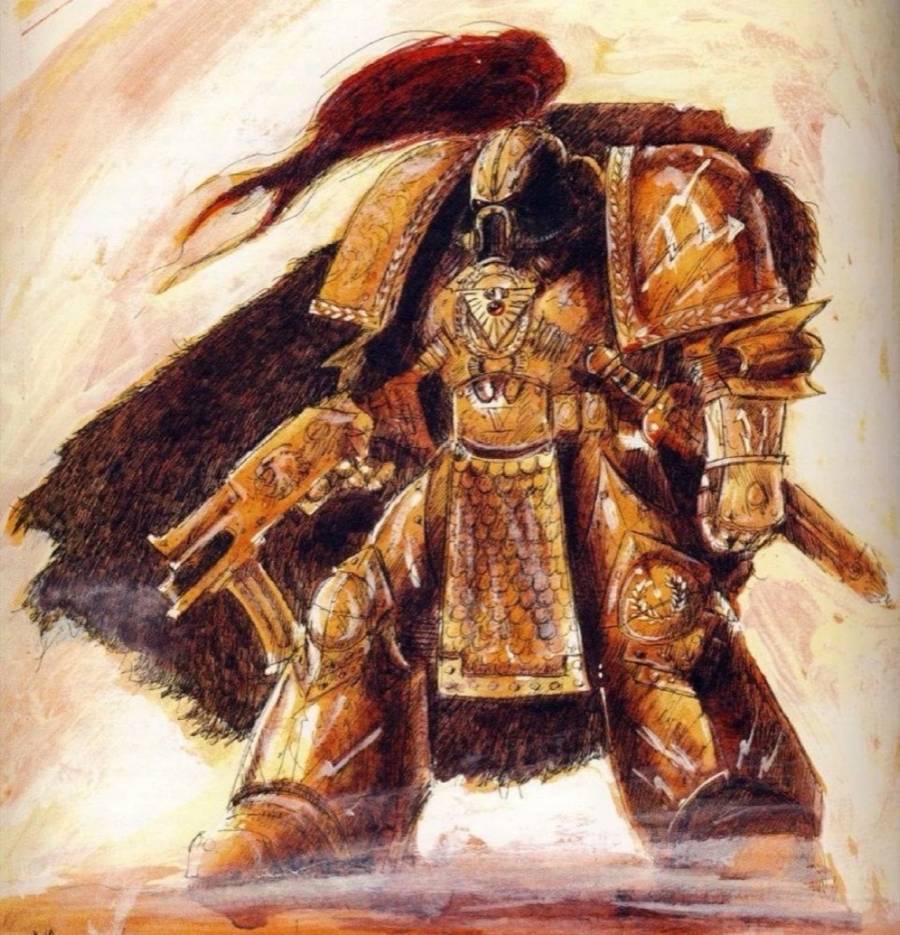
The Thunder Warriors
[edit]The Legions had a predecessor. During the Unification Wars on Terra, the Emperor created a first generation of enhanced soldiers, the Thunder Warriors, to break the warlords of the Age of Strife. They were bred rapidly, trained for war and given armour of a heavy, gilt pattern that bore the thunderbolt emblem from which their name derived. They were effective, and also, in the view of the Emperor and his advisers, flawed. Their physiology was unstable, their lives short, and their temperament, once the wars ended, unsuited to the peace the Emperor intended. The Unification Wars were declared won in 712.M30. Imperial records on the end of the Thunder Warriors are sparse and in part sealed. It is held that most had died by the beginning of the Great Crusade, that a number were killed by the Emperor's order after unrest, and that a few served in the earliest campaigns of the Crusade before they too were gone. Their armour was the pattern from which the first armour of the Legions descended.[1]
The Primarch Project
[edit]The Emperor's greatest project, carried out in his laboratories beneath the Himalazian mountains of Terra, was the creation of the twenty primarchs. Each was an enhanced human being of immense physical and intellectual capacity, created from the Emperor's own genetic template, and intended to lead the Emperor's armies as generals and administrators. Imperial records are not unanimous as to whether the project was intended to produce soldiers, rulers or something else. It is agreed that the Emperor did not complete the project as he had planned. Shortly after the primarchs were created, in about 792.M30,[a] they were taken from their gestation capsules and scattered through the Warp, an event the Mechanicus attributes to the Chaos powers, and which the Emperor never explained to his court. Each fell to a different world.[1][2]
The Emperor had already prepared a means of raising armies from the primarchs' flesh. From the genetic material of each of them, the Emperor's Apothecaries and the geneticists of the Adeptus Mechanicus developed gene-seed, the organs and implants that transform a young human into a Space Marine. Each Legion thereby inherited its primarch's gift and flaw. The Thousand Sons' unstable seed and the Blood Angels' latent weakness, both later to become the subjects of much concern, were written into the Legions from the beginning.[1]
Raising the Legions
[edit]The first twenty Legions were recruited mostly from Terra and from the hardest worlds then within reach of the Emperor's armies, and were organised by the Emperor's own commanders in the years before the Great Crusade. The Legions went to war without their primarchs and were led by their Legion Masters, senior officers who commanded until the primarch was found. This was the case for a number of years, and for some Legions, such as the War Hounds, as long as two centuries: the XII Legion fought from about 700.M30 until Angron was found in 899.M30. The Legions' original names were those they bore in these years, and several, notably the Luna Wolves, the Dusk Raiders, the War Hounds and the Imperial Heralds, would change when their primarchs took command.[1]
The recovery of each primarch was an event in the history of his Legion. Some, like the Lion on Caliban or Horus on Cthonia, had grown up as respected leaders, and the Legions took them at once. Others had to be won. Angron, who had been enslaved on Nuceria, killed several of his War Hounds before he accepted his command. Whatever the circumstances, the Legion after its primarch's arrival was reshaped in his image, in custom, in colour, in name and in the world from which it recruited.[2]
Organisation
[edit]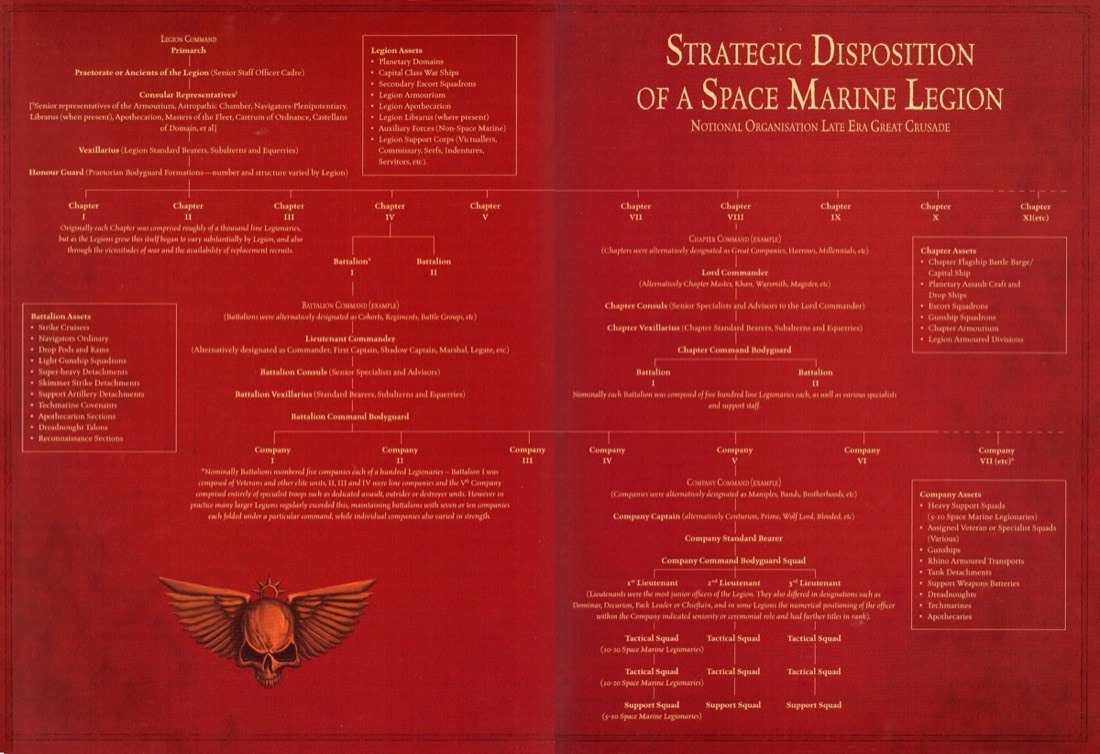
The Legions did not use a single organisation. The Imperial staff's notional pattern, which the Legions followed only roughly, gave the Legion a command, a number of Chapters (also called Great Companies, Harrows or Millennials), each divided into Battalions and Companies, with squads at the base. The Legion's primarch stood at its head, and beneath him were the senior officers of the Legion's staff: the Praetor or Ancient, the Consular representatives of the Mechanicum, the Navigators, the Apothecaries and others, the Vexillarius, who bore the Legion's standards, and an honour guard. Each Legion was also assigned a large non-Astartes component, including the vessels of a fleet, the Auxilia, and the serfs and indentured workers who maintained the Legion.[1]
Command structure
[edit]- Legion command: the primarch, his Praetor and the Legion's senior officers, with a bodyguard whose size and character varied. The Emperor's Children's Phoenix Guard, the Death Guard's Deathshroud, the Blood Angels' Sanguinary Guard and the Legion Praetorians of the Imperial Fists are examples.
- Chapter: a division of around a thousand legionaries at first, but in practice varying, under a Lord Commander, Khan, Warsmith, Magister or other officer, according to Legion. Its assets included a flagship, assault craft and escorts, armoured divisions, an Armoury and a force of Apothecaries and Techmarines.
- Battalion: nominally five hundred legionaries, plus specialists and staff, under a Lieutenant Commander, First Captain, Marshal or Legate. Most Battalions had five companies, of which the first was a veteran company and the last specialised in assault, outrider or destroyer duties.
- Company: nominally a hundred legionaries, under a Captain, a Centurion, a Wolf Lord or a Prime. A company consisted of a command squad and tactical squads of ten to twenty, with a support squad and attached specialist squads.
- Squad: ten to twenty legionaries under a sergeant.
Larger Legions often exceeded the notional pattern, maintaining Battalions of seven or ten companies. Terms differed greatly. The Space Wolves' packs and Great Companies, the White Scars' keshig and the Iron Hands' clans are examples of the cultural overlay each Legion put on the common pattern.[1]
Formations and specialists
[edit]The Legion's core was the tactical legionary in power armour, armed with a bolter and a close-combat weapon. Specialist formations were drawn from experienced warriors. The most important were the Terminators, heavily armoured legionaries in the powered suits known by names that varied from Legion to Legion, who were used as shock troops and as the primarch's personal guard. Others included reconnaissance and infiltration units, assault squads with jump packs, siege and breaching formations, armoured and dreadnought divisions, and the heavy support squads armed with missile launchers and heavy bolters. Several Legions developed units peculiar to themselves, such as the Alpha Legion's Lernaean Terminators and the Blood Angels' Sanguinary Guard.[1]
The Legion's non-combat orders were essential. Its Apothecaries cared for its wounded and preserved its gene-seed. Its Techmarines, trained on Mars, maintained its vehicles and weapons. Until the Council of Nikaea in 001.M31 each Legion also had a Librarius of psychic warriors, which the Emperor's edict then disbanded. In the same period the Legions' Chaplains, a form invented by Lorgar's Word Bearers, became widespread in the other Legions.[1]
Armour and wargear
[edit]The Legions' power armour passed through several patterns as the Crusade went on. The first, descended from the Thunder Warriors' plate, was replaced in the early Crusade by the Mark II, called Crusade armour, which was a simpler and more easily manufactured suit. It was followed by the Mark III, the heavy "Iron" pattern for assault on fortified positions, the Mark IV, known as Maximus, the standard suit of the later Crusade, and, in the Heresy, the Mark V and the Mark VI, the latter of which was designed for reconnaissance. Each Legion's armour was coloured and decorated in the manner of its primarch and its world.[1]
Culture and recruitment
[edit]Each Legion took shape from the world of its primarch. The Space Wolves recruited from the tribes of Fenris, the Ultramarines from the cities of Macragge and the hundreds of worlds of Ultramar, the White Scars from the steppe tribes of Chogoris, and the Night Lords from the criminals of Nostramo. The Legions also differed in how they treated their recruits and in what they valued: the Iron Hands prized the rejection of weakness, the Salamanders protected the people of the worlds they conquered, and the Word Bearers conquered more slowly than their rivals because they stayed to convert. In the Great Crusade the Legions were as much rivals as comrades, and their rivalries, in the long run, contributed to the divisions of the Heresy.[1][4]
The twenty Legions
[edit]The table lists the twenty Legions in numerical order. The names in the second column are those the Legion bore before its primarch took command, where these are known, and the third column gives later names. Homeworlds are those of the primarchs.[1]
| No. | Original name | Later names | Primarch | Homeworld | Allegiance | Fate |
|---|---|---|---|---|---|---|
| I |  Dark Angels | The Unforgiven; Fallen (those who defected) | Lion El'Jonson | Caliban | Loyalist | Caliban was destroyed during the Heresy. The Legion survives as the Dark Angels and their successors, the First Legion in name. |
| II | [expunged] | [expunged] | [expunged] | [expunged] | Unknown | Removed from every record before the Heresy. Sealed by edict. |
| III |  Emperor's Children | The Third Legion; Noise Marines (a cult of the Legion) | Fulgrim | Chemos | Traitor | Fell to Slaanesh. Fled to the Eye of Terror and survives in warbands. |
| IV |  Iron Warriors | The Iron Warriors | Perturabo | Olympia | Traitor | Fortified the Eye of Terror and the fortress-world of Medrengard; survives in fortified warbands. |
| V |  White Scars | The Khan's Legion | Jaghatai Khan | Chogoris | Loyalist | Fought at the Siege of Terra. Reformed into the White Scars Chapter and its successors. |
| VI |  Space Wolves | Vlka Fenryka (Fenrisian) | Leman Russ | Fenris | Loyalist | Did not divide under the Codex. Survives as the Space Wolves, still of Legion size. |
| VII |  Imperial Fists | The Praetorian Legion | Rogal Dorn | Terra | Loyalist | Defended the Imperial Palace. Reformed into the Imperial Fists Chapter and successors, among them the Black Templars. |
| VIII |  Night Lords | The Night Lords | Konrad Curze | Nostramo | Traitor | Nostramo was destroyed. Konrad Curze was killed by an Imperial assassin at the close of the Heresy. The Legion survives in warbands. |
| IX |  Blood Angels | The Host of Baal | Sanguinius | Baal | Loyalist | Sanguinius was killed at the Siege of Terra. Reformed into the Blood Angels Chapter and successors. |
| X |  Iron Hands | The Iron Hands | Ferrus Manus | Medusa | Loyalist | Ferrus Manus was killed at Isstvan V. The survivors were reformed as the Iron Hands Chapter and successors. |
| XI | [expunged] | [expunged] | [expunged] | [expunged] | Unknown | Removed from every record before the Heresy. Sealed by edict. |
| XII |  War Hounds | World Eaters | Angron | Nuceria | Traitor | Fell to Khorne. Split into independent warbands after the massacre at Skalathrax. |
| XIII |  Ultramarines | The Ultramarines | Roboute Guilliman | Macragge | Loyalist | Reformed by Guilliman into the Ultramarines Chapter and successors. Guilliman was restored to life in 999.M41. |
| XIV |  Dusk Raiders | Death Guard | Mortarion | Barbarus | Traitor | Fell to Nurgle. Survives as a unified Legion in the Eye of Terror. |
| XV |  Thousand Sons | The Thousand Sons | Magnus the Red | Prospero | Traitor | Prospero was destroyed. Fell to Tzeentch. Survives in sorcerous cults led by the Rubricae. |
| XVI |  Luna Wolves | Sons of Horus; the Black Legion (part) | Horus | Cthonia | Traitor | Horus was destroyed in 014.M31. The Legion was absorbed in part by the Black Legion under Abaddon. |
| XVII |  Imperial Heralds | Word Bearers | Lorgar | Colchis | Traitor | The first Legion to turn to Chaos. Survives as a unified Legion under a Dark Council. |
| XVIII |  Salamanders | The Salamanders | Vulkan | Nocturne | Loyalist | Vulkan, a Perpetual, survived Isstvan V and later vanished after hiding nine artefacts for his sons; the Chapter awaits his return. Reformed as the Salamanders Chapter and successors. |
| XIX |  Raven Guard | The Raven Guard | Corvus Corax | Deliverance | Loyalist | Reduced at Isstvan V. Reformed as the Raven Guard Chapter and successors. Corax is held to have been transformed by the Warp. |
| XX |  Alpha Legion | The Hydra | Alpharius Omegon | Unrecorded | Traitor (public) | Dispersed into autonomous warbands; has been declared destroyed more than once. |
The Loyalist and Traitor Legions
[edit]Of the eighteen Legions known to history, nine remained loyal to the Emperor at the outbreak of the Heresy: the Dark Angels, the White Scars, the Space Wolves, the Imperial Fists, the Blood Angels, the Iron Hands, the Ultramarines, the Salamanders and the Raven Guard. Nine took the Warmaster's side: the Emperor's Children, the Iron Warriors, the Night Lords, the World Eaters, the Death Guard, the Thousand Sons, the Sons of Horus, the Word Bearers and the Alpha Legion. The line was not clear in every Legion. Substantial loyalist elements, many of them Terran-born, were found in the Traitor Legions, and the Imperium's records of the first days of the Heresy are full of the stories of those who were killed for refusing to follow their primarchs, or who escaped. The Death Guard, the World Eaters and the Sons of Horus lost many to purges at Isstvan III. In the loyalist Legions, too, individuals and small groups went over to the Traitors.[2][5]
The lost Legions
[edit]The II Legion and the XI Legion are missing from every Imperial record of the Great Crusade. The Imperial Palace's Investiary, a hall of statues commemorating the primarchs, is said to have held twenty plinths, and two of them have stood empty. The statues were destroyed, and the names of the primarchs and their Legions were expunged, in an act of the Emperor and his regent, and it is a crime to enquire into them. They are called the Lost Legions or the Lost Primarchs, and the two plinths are the only record that they existed. The only statement that may be made without breaching Inquisitorial seals is that they were removed from history before the Heresy began, that the circumstances were such that the Emperor judged the Imperium would be better without even the memory, and that the gene-seed they bore was not used again. Speculation among scholars as to what happened, and why, is considerable and is discouraged.[2][6]
The Horus Heresy
[edit]Isstvan and the Heresy
[edit]The Legions were at the centre of the Horus Heresy. The Warmaster's first move, in 005.M31, was the virus bombing of Isstvan III, in which loyalist elements of four Legions were destroyed. At the Drop Site Massacre on Isstvan V in 006.M31 the Traitor Legions destroyed most of three loyal Legions, the Iron Hands, the Salamanders and the Raven Guard, and killed Ferrus Manus. The war that followed lasted until 014.M31 and was fought between Legions across the galaxy. Its great battles included the Battle of Calth (007.M31), in which the Word Bearers attempted to destroy the Ultramarines, the Fall of Prospero (004.M31), the Battle of Beta-Garmon (010–013.M31) and the Siege of Terra (014.M31).[2]
At the Siege of Terra in 014.M31 the Legions of the Traitors, supported by Titan Legions and the Dark Mechanicum, besieged the Imperial Palace for fifty-five days. The loyalist defenders were the Imperial Fists, the Blood Angels and the White Scars, and the Space Wolves arrived after the siege had begun. The Ultramarines, held back by the Ruinstorm, could not reach the Sol System in time. The siege ended when Horus was killed by the Emperor aboard the Vengeful Spirit.[7]
The Great Scouring and the Second Founding
[edit]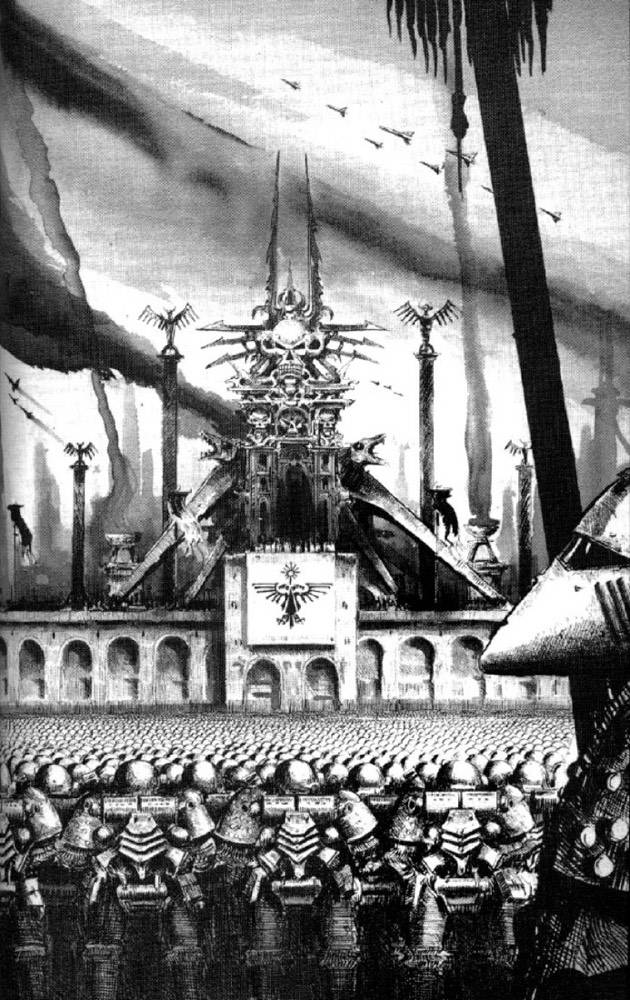
After the Siege the loyalist Legions pursued the Traitors in the Great Scouring. The Legions, however, were few and their losses heavy. The Emperor was interred on the Golden Throne, and the Imperium's regents resolved that no single commander should again hold so great a force. Roboute Guilliman wrote the Codex Astartes, which provided that the Legions should be broken into Chapters of about a thousand warriors, that no Chapter should be more than one thousand strong, and that each Chapter should answer to its own Master. The Codex also fixed the organisation, doctrine and armament of the Chapters. The Second Founding, begun about 021.M31, divided the loyalist Legions into new Chapters. The Imperial Fists, the Blood Angels, the Ultramarines, the Salamanders, the Raven Guard, the Iron Hands and the White Scars each provided successor Chapters. Two did not accept the Codex in the same way. The Space Wolves held to the older pattern and are still counted as a Legion-sized force, while the Dark Angels, which had their own reasons, kept their structure in part.[3]
Legion Wars after the Heresy
[edit]The Heresy did not end the conflict between the Legions. Imperial historians use the term Legion Wars loosely for the wars between the Chapters descended from the loyalist Legions and the Traitor Legions in the millennia that followed. The Traitors, who withdrew to the Eye of Terror, the Maelstrom and the Warp-rifts, kept their Legion identities more fully than the loyalists, and it is from their havens that the Black Crusades have been launched.[8]
- The first Black Crusade was launched by Abaddon in 781.M31. The Thirteenth, under Abaddon the Despoiler in 999.M41, destroyed Cadia.
- In M38 the World Eaters under Angron overran seventy sectors in the Dominion of Fire. In 444.M41 Angron led the First War of Armageddon.
- The Thousand Sons, led by Magnus, laid siege to Fenris around 999.M41. The Death Guard under Mortarion attacked Ultramar in the Plague Wars.
- The Alpha Legion's activities, by their nature, are difficult to establish, and are known mainly as an indirect cause of uprisings.
The Imperium's own earlier tradition holds that the Alpha Legion's primarch was killed in the Great Scouring, at Eskrador, by Roboute Guilliman. More recent records say that Alpharius died at the Battle of Pluto in 010.M31, in the opening of the war for the Sol System, and that his twin took his name. The matter is described more fully in the article on Alpharius Omegon.[6]
In the Era Indomitus, with the opening of the Great Rift, several Traitor primarchs have returned to the material universe: Mortarion in the Plague Wars, Magnus at Luna and in the Stygius Sector, and Angron in the Arks of Omen campaign. Lorgar is reported to have been seen. Guilliman has resurrected the Imperium's military authority with the Indomitus Crusade and the introduction of the Primaris Space Marines, founded by the Archmagos Belisarius Cawl.[6]
Legacy
[edit]The Legions are remembered in the Imperium as both the instrument of the Great Crusade and the cause of its greatest calamity. The modern Space Marine Chapters regard the Legion that they derive from as their ancestor, and in the Imperial Cult the primarchs are venerated, with the exception of the Traitors, as saints. The Traitor Legions are treated in Imperial law as ones that have forfeited their name. The Adeptus Astartes does not erase the memory of the Legions' conquests. It has taught, since the Second Founding, that the strength of the Legions was their weakness, and that the Emperor's armies were most dangerous when most united under a single hand.[3]
Timeline
[edit]| Date | Event |
|---|---|
| c. 700.M30 | The twenty Legions are raised on Terra in the First Founding, led by Legion Masters.[a] |
| 703.M30 | First Pacification of Luna by the XVI Legion, which takes the name Luna Wolves. |
| 712.M30 | End of the Unification Wars; the Thunder Warriors are retired. |
| 739.M30 | The Treaty of Olympus binds the Mechanicum of Mars to the Legions' supply. |
| c. 792.M30 | The primarchs are created and scattered through the Warp.[a] |
| 798.M30 | The Great Crusade begins. |
| 801.M30 | Horus found on Cthonia (XVI). |
| 819.M30 | Leman Russ found on Fenris (VI). |
| 819–824.M30 | The primarch of the II Legion found; date redacted, records expunged. |
| 824.M30 | Ferrus Manus found on Medusa (X). |
| 830.M30 | Fulgrim found on Chemos (III). |
| 832.M30 | Vulkan found on Nocturne (XVIII). |
| 835.M30 | Rogal Dorn found on Inwit (VII). |
| 837.M30 | Roboute Guilliman found on Macragge (XIII). |
| 840.M30 | Magnus the Red found on Prospero (XV). |
| 843.M30 | Sanguinius found on Baal (IX). |
| 846.M30 | Lion El'Jonson found on Caliban (I). |
| 849.M30 | Perturabo found on Olympia (IV). |
| Unrecorded | Mortarion found on Barbarus (XIV). |
| 857.M30 | Lorgar found on Colchis (XVII). |
| 865.M30 | Jaghatai Khan found on Chogoris (V). |
| 896.M30 | Konrad Curze found on Nostramo (VIII). |
| 899.M30 | Angron found on Nuceria (XII); the War Hounds become the World Eaters. |
| 922.M30 | Corvus Corax found on Deliverance (XIX). |
| Unrecorded | The primarch of the XI Legion found; records expunged. |
| 981.M30 | Alpharius takes command of the XX Legion. |
| 000.M31 | The Ullanor Crusade; Horus is named Warmaster. |
| 001.M31 | The Council of Nikaea disbands the Librarius of every Legion. |
| 005.M31 | Isstvan III: nine Legions declare for Horus. |
| 006.M31 | The Drop Site Massacre; Ferrus Manus is slain. |
| 014.M31 | The Siege of Terra; Sanguinius and Horus are slain. |
| 021.M31 | The Second Founding divides the loyal Legions into Chapters under the Codex Astartes. |
See also
[edit]- Primarch
- Adeptus Astartes
- Space Marine Chapter
- Great Crusade
- Horus Heresy
- Codex Astartes
- Second Founding

Notes
[edit]- ^ a b c d e Date estimated from the sequence of events.
- ^ Legion sizes varied greatly. The Thousand Sons were among the smallest after the failure of their gene-seed. The Ultramarines, the Word Bearers and several others are recorded in the six figures. Totals for the whole of the Legiones Astartes in the late Great Crusade are not recorded in any surviving archive and differ between sources.
- ^ The Legions were raised from gene-seed taken from the primarchs before their birth, so the First Founding of about 700.M30 precedes the scattering of the capsules in about 792.M30 and the Great Crusade of 798.M30. Imperial chronicles agree that the Legions were raised in the late Unification Wars; the date 700.M30 is the usual reckoning, and no record gives the exact year.
References
[edit]- ^ a b c d e f g h i j k l m Scanlon, Michael. Descent of Angels (novel). Black Library, pp. 235, 303. Thorpe, Gav. Deliverance Lost (novel). Black Library, pg. 14.
- ^ a b c d e f Counter, Ben. The Bleeding Chalice (novel). Black Library. Abnett, Dan. Horus Rising (novel). Black Library.
- ^ a b c Dembski-Bowden, Aaron. The First Heretic (novel). Black Library. Abnett, Dan. Know No Fear (novel). Black Library.
- ^ McNeill, Graham. Angel Exterminatus (novel). Black Library. Counter, Ben. Soul Drinker (novel). Black Library.
- ^ McNeill, Graham. Warriors of Ultramar (novel). Black Library. Abnett, Dan. The Unremembered Empire (novel). Black Library.
- ^ a b c Codex: Blood Angels (7th Edition), pp. 6, 9-12, 34, 62, 175. Games Workshop. Codex: Dark Angels (7th Edition), pp. 6, 8, 40, 43-44, 61, 66, 85, 109. Games Workshop.
- ^ Codex: Space Marines (7th Edition), pp. 7, 13, 68. Games Workshop. Codex: Space Wolves (7th Edition), pp. 6-7, 9-11, 60. Games Workshop.
- ^ Vulkan Lives (novel) (Digital Edition) by , pg. 119. Games Workshop. Codex: Dark Angels (6th Edition), pp. 6, 9-12, 14, 16, 18-19, 21. Games Workshop.