
Mortarion
| Mortarion | |
|---|---|
| The Death Lord, the Pale King, the Reaper of Barbarus | |
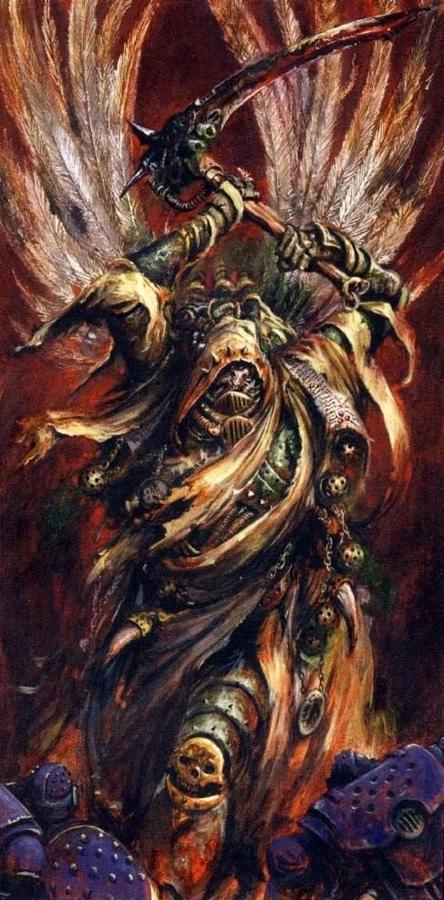 Mortarion in his daemonic form, from a Mechanicum pict-capture Artwork © Games Workshop | |
| Primarch of the Death Guard | |
| Tenure | Great Crusade – present |
| Predecessor | Position established |
| Successor | Incumbent |
| Daemon Primarch of Nurgle | |
| Also styled | Prince of Decay |
| Seat | The Plague Planet, in the Eye of Terror |
| Also known as | The Death Lord; the Pale King; Prince of Decay |
| Allegiance | Imperium of Mankind (until 005.M31); Chaos (Nurgle) |
| Legion |  XIV, the Dusk Raiders, renamed the Death Guard |
| Homeworld | Barbarus |
| Created | Terra, c. 792.M30, in the gene-laboratories of the Emperor of Mankind |
| Discovered | Barbarus, during the Great Crusade (year unrecorded) |
| Status | Alive as a Daemon Prince of Nurgle; held to rule the Plague Planet in the Eye of Terror and to command the Death Guard |
| Gene-father | The Emperor of Mankind |
| Foster father | Necare, High Overlord of Barbarus |
| Brothers | The other primarchs; closest to Horus and Konrad Curze |
| Lieutenants | Calas Typhon, First Captain; Nathaniel Garro (loyalist) |
| Wargear | The scythe Silence, the sidearm The Lantern, the Barbaran plate, phosphex bombs |
| Known for | The liberation of Barbarus; the testimony at the Council of Nikaea; the betrayal of the loyalists of the Legion at Isstvan III; the Plague Wars in Ultramar |
Mortarion, known as the Death Lord, the Pale King and the Reaper of Barbarus, was the primarch of the XIV Legion of the Space Marine Legions, the Death Guard. He was raised among the necromancer-lords of the poisoned world of Barbarus, where he overthrew his adoptive father's rivals, led the human settlers of the valleys against their masters and then, when the Emperor arrived, was denied the vengeance he had wanted most. Imperial scholars hold that the slight, and the resentment he carried from it, was the weakness through which the Chaos power Nurgle eventually claimed him.[1]
During the Great Crusade Mortarion and the Death Guard were known for relentless, unglamorous campaigns of attrition, and Mortarion grew close to Horus, whose campaigns his own Legion often supported. A lifelong enemy of sorcery, he spoke more effectively than any of his brothers against Magnus the Red at the Council of Nikaea. Yet in 005.M31, resentful of the Emperor and persuaded by Horus that the Emperor himself was a sorcerer, he joined the Warmaster's rebellion. His Legion fought at Isstvan III and the Drop Site Massacre, was trapped in the Warp on the way to Terra, and emerged transformed by Nurgle.[2]
Since the Heresy he has ruled from the Plague Planet in the Eye of Terror, and in the Era Indomitus returned to the material universe to lead the Plague Wars in Ultramar, where he met his brother Roboute Guilliman in battle at Iax.[3]
Early life on Barbarus
[edit]Foundling of the Overlords
[edit]Mortarion's capsule came to rest on Barbarus, a world covered by a poisonous fog whose human settlers had been trapped there since the Age of Strife. The planet's rulers were the Overlords, necromancers who held power by means of warp-derived sorcery and who kept the human population in the valleys as livestock, harvesting their dead to raise as servants and their living to be twisted into monsters. The infant was found among the dead on a battlefield, screaming where any normal child would have died of the air. The most powerful of the Overlords, Necare, took the child in as an heir and named him Mortarion, "child of death" in the local tongue.[1]
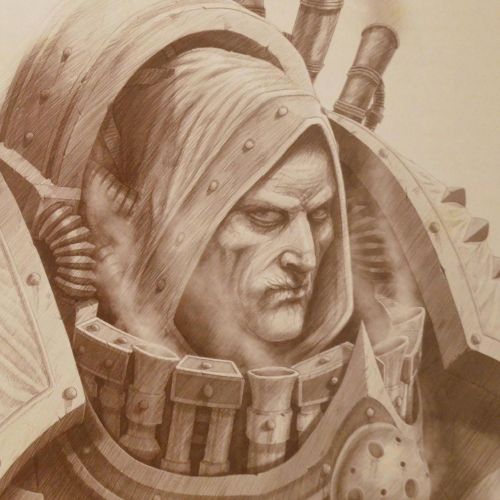
The boy was raised in a tower at the edge of what even his body could endure of the fog, while Necare himself withdrew to the highest peak of the world. He was taught battle doctrine, the arts of the artificer, strategy and sorcery, and showed an appetite for knowledge. But he also began to ask what became of the people in the valleys, and the questions were not welcome.[4]
Deliverance of Barbarus
[edit]Mortarion eventually broke out of Necare's fortress, killing the guards at its gate, and went down to the valleys. He found that the people there were of the same kind as himself. They were slow to trust him, but when one village was attacked by creatures enthralled to another overlord, he killed the beasts with a harvesting scythe and followed the overlord himself into the fog. He then trained the villagers in war. Representatives of other settlements came to learn from him, and the valleys were turned into a chain of strongholds.[4]
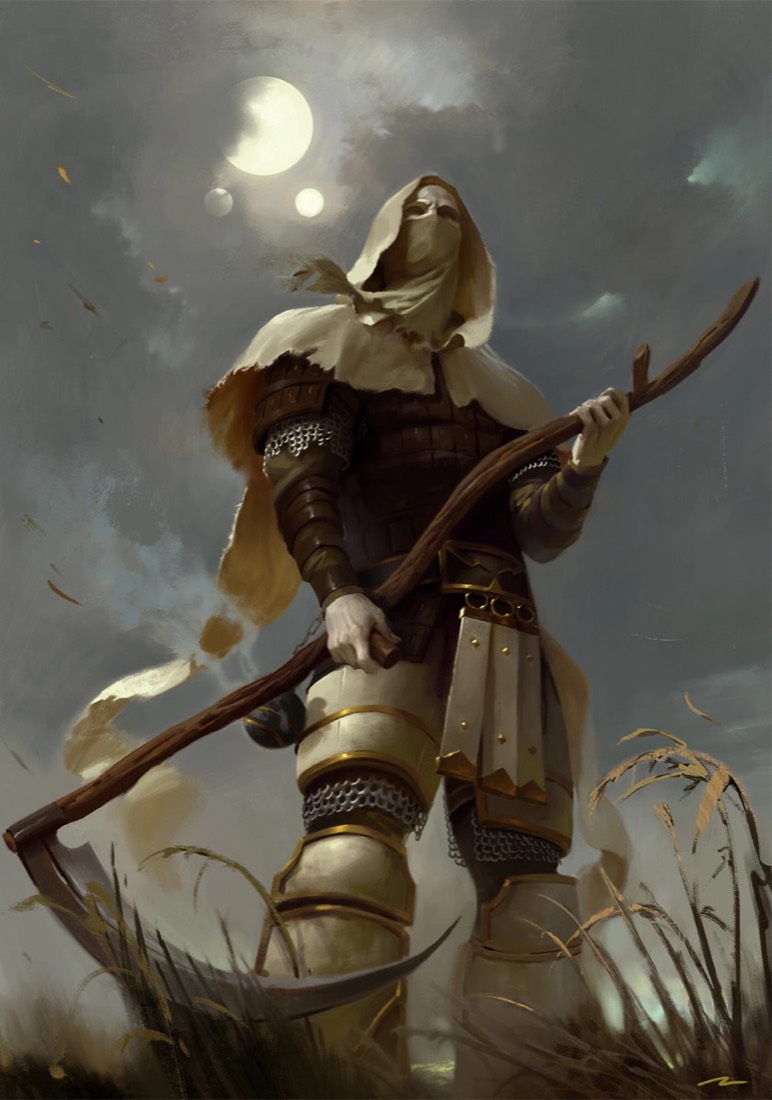
He selected the strongest and most resilient fighters to form small companies, and enlisted smiths and artificers to make suits of armour in which men could walk in the fog. The armour was refined with every fight, and the companies that wore it became known, in time, as the Death Guard. They pushed higher and higher up the mountains. When only the peak of his foster father remained, Mortarion prepared to assault it.[4]
The coming of the Emperor
[edit]One of his officers, Calas Typhon, advised against attacking before the armour was ready, and Mortarion deferred. On his return to the village he found its people talking about a stranger who had come to offer them salvation. The stranger, who was the Emperor, proposed a wager: if Mortarion could defeat Necare, the Emperor would leave; if he could not, Mortarion and Barbarus would swear fealty to the Imperium.[1]
Mortarion went alone to Necare's fortress. The air around it was so toxic that parts of his armour began to rot, and he collapsed at the gate. As Necare came to kill him, Mortarion heard a voice in his head that was not his own, offering to teach him how to overcome death. It was Nurgle, who had already marked him. Before Necare could strike, the Emperor killed the Overlord with a single sword thrust. Mortarion honoured his oath and swore to his father. But the Emperor had taken from him the one thing he had set out to do, and he held a grudge for the rest of his existence.[1][2]
The Great Crusade
[edit]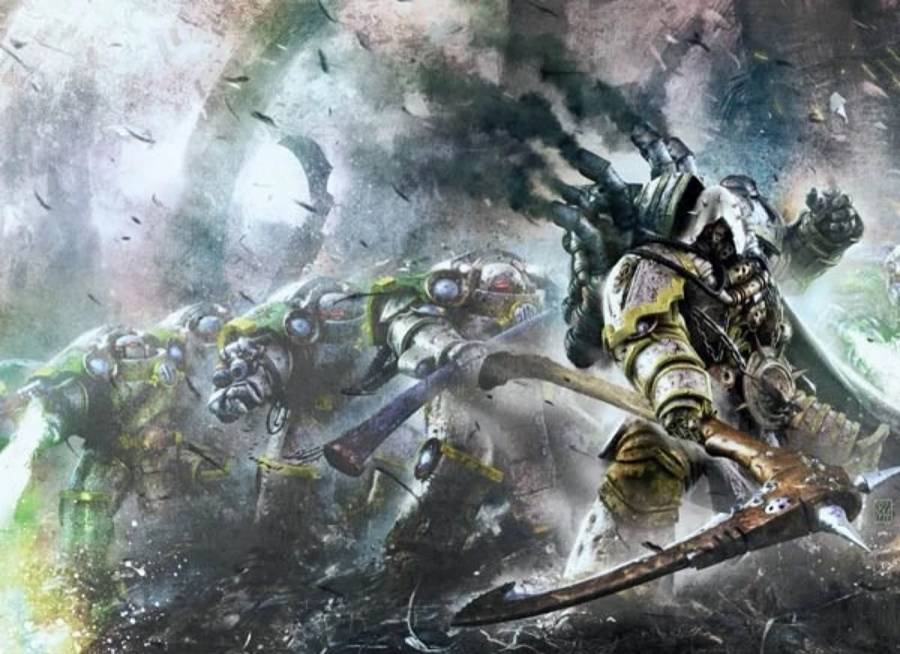
The Death Guard
[edit]On finding him, the Emperor gave Mortarion command of the XIV Legion, the Dusk Raiders. Mortarion met them in a black robe, scythe in hand, like the figure of a reaper from old Terran folklore, and told them that they were his unbroken blades and would be known as the Death Guard. The Legion adopted his name, his iconography and his creed. A Terran-born Legion before, it came to draw nearly all its recruits from Barbarus, whose hardy population proved well suited to the gene-seed and whose resistance to disease and toxin the seed amplified. The Terran minority, who kept to the Legion's older traditions, increasingly felt like outsiders.[1]
Over the following decades the Legion's armour lost its ornament. Its unpainted grey-white ceramite was marked only with green markings that recalled the corrosion-proof mud which Mortarion's first warriors had coated their iron plates with. The Legion's Librarius was disbanded, owing to the primarch's hatred of the sorcery that had enslaved his homeworld. The Death Guard were unmatched in the Great Crusade's longest and bloodiest campaigns. Their doctrine was based on endurance: they drew out the enemy, absorbed the punishment and wore him down until a fresher Legion could finish him, a combination that Horus employed repeatedly with the Sons of Horus in the role of the second force.[5]
Mortarion and his brothers
[edit]Mortarion was a pale, gaunt figure who wore a breathing mask and cowl, and many of his brothers found him disquieting. He was close to few of them. The two he trusted were Horus, whose appreciation of the Death Guard he valued, and Konrad Curze, the primarch of the Night Lords, with whom he shared an experience of a violent and brutal world. Guilliman, in particular, feared that Mortarion was more loyal to Horus than to the Emperor. The Emperor replied that loyalty to Horus was loyalty to himself.[1]
The Council of Nikaea
[edit]Mortarion was among those who testified at the Council of Nikaea in 001.M31, which ruled on the use of psychic powers in the Imperium. Where other speakers who opposed the Thousand Sons mostly declaimed against Magnus, Mortarion's evidence was short and impersonal. Having seen what sorcery had done to Barbarus, he warned that no servant of the Emperor should use it. His statement carried great weight with the Emperor, and added to the passion with which Magnus defended himself. The council resulted in the Edicts of Nikaea, which forbade the use of sorcery and disbanded the Librarius divisions of the Legions. Mortarion was gratified.[1]
The Horus Heresy
[edit]Allegiance
[edit]Horus knew well what lay in his brother's heart. He told Mortarion that the Emperor had dealt with the powers of the Warp to create the primarchs, and that he was no different in kind from Necare. For a man who believed that he had been cheated of his proof of worth by the Emperor on Barbarus, this proved decisive. Calas Typhon, First Captain of the Legion, was himself a secret follower of the Ruinous Powers, and encouraged the Legion's turn. Mortarion's declared aim was a purified human race, rid of the corruption of the Warp. The irony of joining a rebellion that was itself the creature of Chaos was not lost on him later.[2]
Isstvan III and Isstvan V
[edit]About a third of the Legion, among them the Terran-born survivors of the old Dusk Raiders, such as Battle-Captain Nathaniel Garro of the Seventh Great Company, were judged unlikely to follow their primarch. At Isstvan III he sent them to the planet's surface in the full knowledge that Horus had arranged for them to be killed. The Death Guard who were left fought on at the Drop Site Massacre at Isstvan V.[2][6]
Prospero and the daemon
[edit]After the destruction of the Thousand Sons' homeworld, Mortarion appeared before the primarch Jaghatai Khan among the ruins of Tizca on Prospero, and attempted to persuade him to join the Traitors. He argued that the war would end with the Emperor deposed and the strong free to act as they pleased, but the Khan refused, saying that neither of them was an empire-builder and that they were outriders by nature. The two fought. When their fleets in orbit began fighting without their orders, Mortarion broke off and teleported away. The encounter is remembered as the Second Battle of Prospero.[2]
Mortarion then devastated the Prosperine worlds. In 007.M31 he came to the library-world of Terathalion and destroyed it from orbit with his whole Legion. He then seized a woman from the surface, who was in truth possessed by a daemon, and questioned the creature to learn why his brothers Lorgar and Fulgrim served the powers of the Warp. The daemon told him that one of those powers had claimed him. In his anger Mortarion killed it with his bare hands, and in doing so used a psychic strength he had always denied. As it died the daemon saluted him as the Master of the Plague. He concluded, after thought, that it was better to master the Warp than to be its slave.[2]
The Warp and the Plague God
[edit]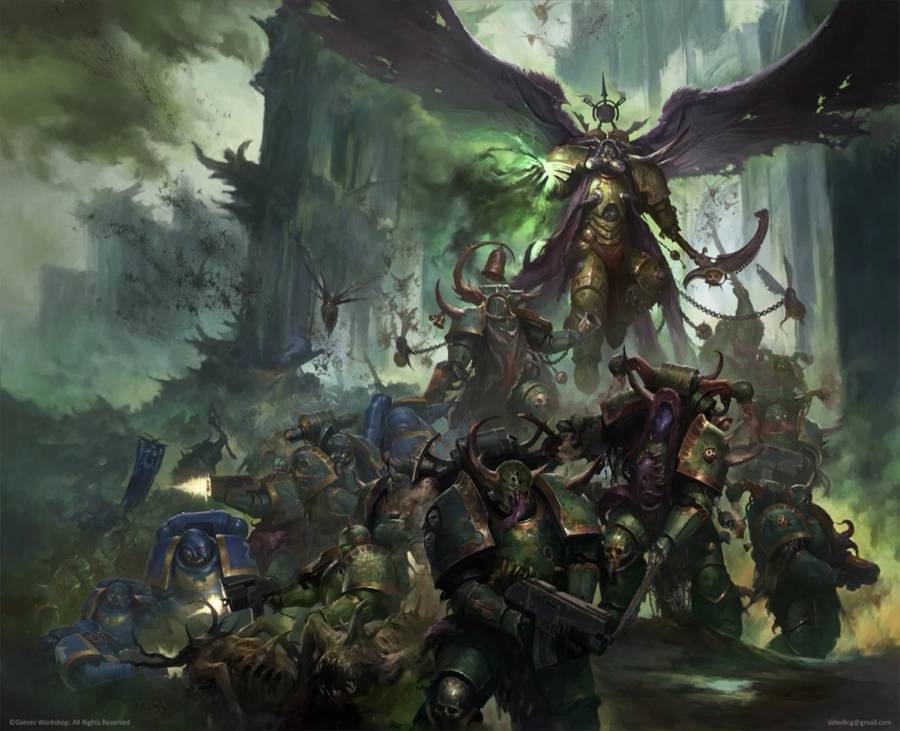
On the way to Terra, in about 013.M31,[a] the Legion's fleet entered the Warp without Navigators, whom Calas Typhon had had killed, claiming that they were loyal to the Emperor. Typhon's psychic power was supposed to guide them. It delivered them instead into the realm of Nurgle. The fleet was becalmed, and a plague that no Death Guard could resist, the Destroyer Plague, spread through the ships and the Legion. The Death Guard, whose pride lay in their endurance, were transformed into bloated, diseased creatures that could not die. Mortarion suffered more than any, in a repetition of the mountain on Barbarus with no Emperor to save him. At the end of his endurance, he gave himself and his Legion to Nurgle in return for an end to the pain. Nurgle accepted, and Mortarion became a Daemon Prince.[2]
The fleet, emerging at last in the Sol System, joined the siege after it had begun. The Death Guard are recorded in the accounts of the siege as the last Legion to leave Terra, retreating in good order while loyalist forces dashed themselves against them. Mortarion led his Legion to the Eye of Terror and claimed a daemon world there, which he reshaped to resemble Barbarus, with himself in Necare's place as its lord.[7]
After the Heresy
[edit]The Plague Planet and the Long War
[edit]For ten thousand years Mortarion sat in a fortress on the mountain of the Plague Planet, in the manner of the foster father he had hated. The Death Guard sallied through the Cadian Gate and spread the diseases of Nurgle through the galaxy. Calas Typhon, now called Typhus the Traveller, went his own way. In 901.M41, in the Battle of Kornovin, Mortarion killed the Supreme Grand Master of the Grey Knights, Geronitan, and was in turn struck down by Geronitan's successor Kaldor Draigo, who carved the dead man's name on his heart. Mortarion survived, but was unable to return to the material universe for many years.[8]
The Plague Wars
[edit]The opening of the Great Rift in 999.M41 and the return of Roboute Guilliman angered Mortarion intensely, and his anger is recorded to have seeded seven plagues across Imperial worlds. He did not move against Guilliman at once. Nurgle's strength had grown in the southern reaches of the Ultima Segmentum, where three systems, the Scourge Stars, fell to the Plague God, and from this base Mortarion led the Death Guard and the daemonic Plague Legions against Ultramar. His plan, as the Ultramarines reconstructed it, was a seven-part campaign that began with the War of Flies, the assault on the Three Planets, the siege of the hive world Ardium and the Creeping Doom offensive against Espandor and Drohl.[3]
Guilliman, back from the first phase of the Indomitus Crusade, stabilised the fronts with a counter-offensive called the Spear of Espandor, and defeated a greater daemon at the Gates of Parmenio. At Iax, a garden world that had been turned into a hospital for the sick, Mortarion and Guilliman met in person. The two fought each other to a standstill, and the forces of Chaos then withdrew under the cover of a virus bombardment that added to the suffering of the world. The war marked the first time in ten millennia that Mortarion had appeared in the material universe in strength.[3]
Character and abilities
[edit]In his own mind Mortarion was a liberator and a judge. He believed that humanity should be free of the powers that preyed on it, and held that any means were justified by that end. He was grim and austere, rarely spoke above a whisper, and was practical in his ways, and his preference for plain, unadorned armour and weapons set him apart from his more vain brothers. He regarded witchcraft as a cancer and could not forgive himself for having been, in the end, a master of it.[1]
As a living primarch he possessed prodigious resilience, with a resistance to poisons and disease that was greater than that of any other, and an unwavering will that took him through terrain that killed other Space Marines. As a Daemon Prince he commands the diseases of Nurgle and is accompanied by a retinue of plague-bearing daemons. His bodyguard, the Deathshroud, were silent warriors in Terminator armour who carried the great scythes called Manreapers.[8]
Wargear
[edit]- The Barbaran plate: his own design, based on ancient power armour and adapted to the air of his homeworld. His armour is unadorned except for an iron crown, in contrast to the gold worn by other primarchs. Even after his transformation it has changed little, though it has taken on a fleshy and infected look.
- Silence: a two-handed scythe, the blade of which is as long as a man is tall. Rumours hold that it was once the weapon of Necare. Over ten thousand years it has become a daemon weapon.
- The Lantern: a drum-barrelled energy pistol, once the weapon of the leader of a cult of dragon-worshippers on the industrial world of Shenlong. It passed to Mortarion after the Emperor destroyed the cult.
- Phosphex bombs: compact devices of his own design carried at his belt in the shape of censers.
Legacy
[edit]The Death Guard remain a unified Legion, unlike most of the Traitors, and their organisation under Mortarion has made them one of the more effective Chaos forces in the Long War. Within the Imperium the name of Mortarion has become a byword for disease and betrayal. The Adeptus Ministorum teaches that his fall is a warning that bitterness, unchecked, will find the hand that offers it relief. On Barbarus the descendants of the human settlers who followed him are said to live under a tyranny little different from the one he ended.[8]
Timeline
[edit]| Date | Event |
|---|---|
| c. 792.M30 | The infant primarch is scattered from Terra and falls on Barbarus, where the Overlord Necare raises him. |
| Before the Emperor's arrival | Breaks out of Necare's fortress and leads the people of the valleys against the Overlords, with Calas Typhon among his officers. |
| Unrecorded (Great Crusade) | The Emperor saves him at the gate of Necare's fortress. Mortarion takes command of the XIV Legion, the Dusk Raiders, and renames it the Death Guard. |
| After his discovery | The conquest of Galaspar, the first independent campaign of the Death Guard under Mortarion. |
| 000.M31 | Present at the Triumph of Ullanor as a close ally of Horus. |
| 001.M31 | Testifies against the use of psychic power at the Council of Nikaea. |
| 005.M31 | Joins Horus at the Isstvan III atrocity; Nathaniel Garro escapes with the loyalists in the Eisenstein. |
| 006.M31 | Fights in the Traitor second wave at the Drop Site Massacre on Isstvan V. |
| After the Burning of Prospero | Fights Jaghatai Khan in the ruins of Tizca on Prospero. |
| 007.M31 | Destroys the library-world of Terathalion. |
| 009.M31 | The Death Guard join the Sons of Horus in the Battle of Molech. |
| c. 013.M31[a] | Becalmed in the Warp on the way to Terra, the Legion is struck by the Destroyer plague and Mortarion gives himself to Nurgle. |
| 014.M31 | Joins the Siege of Terra after it has begun; the Death Guard are the last Legion to leave Terra. |
| After 014.M31 | Rules the Plague Planet in the Eye of Terror. |
| Era Indomitus (c. 012.M42) | The Plague Wars in Ultramar against Roboute Guilliman. |
See also
[edit]
Notes
[edit]References
[edit]- ^ a b c d e f g h Wraight, Chris. Scars (Collector's Edition Novel). Black Library. Codex Adeptus Astartes - Space Marines (8th Edition), pp. 24, 29. Games Workshop.
- ^ a b c d e f g Codex Heretic Astartes - Death Guard (8th Edition), pp. 6-9, 18-19, 26-27. Games Workshop. Warhammer 40,000: Rulebook (8th Edition), pp. 53, 99, 154, 158-159. Games Workshop.
- ^ a b c Counter, Ben. Galaxy in Flames (novel). Black Library. Swallow, James. The Flight of the Eisenstein (novel). Black Library.
- ^ a b c McNeill, Graham. Fulgrim (novel). Black Library. McNeill, Graham. A Thousand Sons (novel). Black Library.
- ^ Dembski-Bowden, Aaron. The First Heretic (novel). Black Library. Abnett, Dan. Prospero Burns (novel). Black Library.
- ^ Swallow, James. The Buried Dagger (novel). Black Library, Intervals I-VIII, Coda. Haley, Guy. The Lost and the Damned (novel). Black Library, Limited Edition Artwork.
- ^ Goulding, Laurie. Mortarion's Heart (Audio Book). Black Library. Gathering Storm - Part Three - Rise of the Primarch (7th Edition), "Dark Revelations," pg. 38. Games Workshop.
- ^ a b c Codex: Chaos Space Marines (6th Edition), pp. 9-10, 23. Games Workshop. Warhammer 40,000: Rulebook (6th Edition), pp. 183, 228. Games Workshop.