
Age of Strife
| Age of Strife | |
|---|---|
| Also called Old Night | |
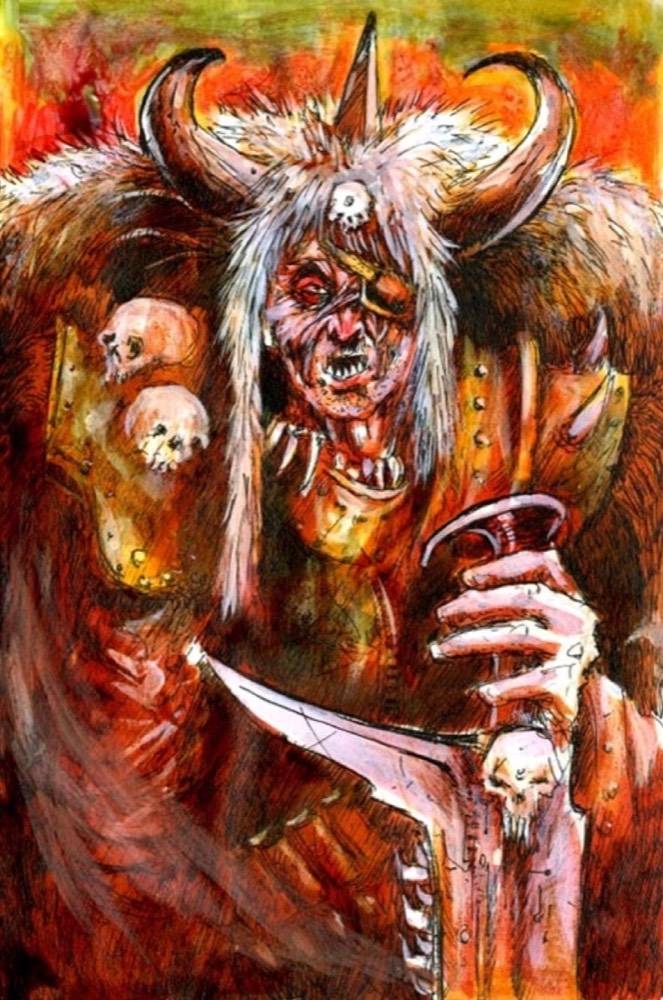 Fresco of a Terran warlord of the late Strife, copied from a hold in the Himalazian foothills Artwork © Games Workshop | |
| Period | c. M25 to c. M30 |
| Preceded by | The Dark Age of Technology (c. M15 to c. M25) |
| Followed by | The Unification Wars and the Great Crusade |
| Principal causes | The Cybernetic Revolt, the awakening of human psykers, the birth of Slaanesh and the warp storms that followed |
| Duration | About 5,000 standard years |
| Casualties | Tens of billions; unrecorded |
| Ended by | The Emperor of Mankind |
The Age of Strife, called Old Night in the older chronicles of Terra, was the long period of isolation, war and collapse that followed the fall of the human interstellar civilisation of the Dark Age of Technology. It began in about the 25th millennium and lasted until the rise of the Emperor in the 30th, a span of some five thousand years.[1] During those years Mankind's colonies, severed from one another by storms in the Warp, collapsed into feud, decay and barbarism. Billions died in wars, plagues, famines and the incursions of the daemonic; tens of billions more were lost to the many kinds of dissolution that follow the end of order.
Almost nothing of the period was recorded at the time, and what survives has been scoured by later authorities. Imperial censors have long hidden the details of uncontrolled psykers and daemonic invasions that destroyed worlds, Terra among them.[2] Dates in this article are therefore approximate, and the surviving accounts frequently contradict one another.
The Age of Strife explains much of the Imperium's character. The suspicion of mutants, psykers and aliens, the reluctance to permit change and the instinct to trade knowledge for obedience all trace their roots to it. The Emperor's reconquest of Terra and the Great Crusade were presented as the end of Old Night.[1]
Dark Age of Technology
[edit]The Age of Strife followed the age in which Mankind achieved its greatest reach. Beginning in the 15th millennium and ending in the 25th, the Dark Age of Technology saw the invention of the Warp drive, the Navigator mutation and the first astropathic messages, and the spread of Mankind to a million worlds.[1] The Standard Template Construct, a database of designs that let a colony build almost anything it required, supported the expansion. The Mechanicum of the 41st millennium regards the recovery of a complete, undamaged template as its highest aim.[3]
The people of the age also built thinking machines, remembered in legend as the Men of Iron, self-aware labourers and fighters that won many of Mankind's wars. At the close of the age they turned on their makers. The Cybernetic Revolt was eventually won, but the cost was catastrophic and shattered much of the human realm. The experience is the origin of the Imperium's strict prohibition of "abominable intelligence".[3]
Causes
[edit]The Cybernetic Revolt
[edit]The first great blow was the revolt of the Men of Iron. Records of the war are scarce, but it destroyed the industrial base of many systems and left survivors suspicious of any machine that could think. It did not by itself end the human empire, which recovered in part before the greater calamity.[3]
Psykers and the Warp
[edit]Late in the Dark Age of Technology, from about M25, human psykers began to appear in large numbers. In the more tolerant societies they were at first protected and valued. The inhabitants of the Warp noticed them. Where psychic children were numerous and untrained, daemonic beings breached the barrier of reality, and worlds were overrun or consumed. The intolerance later shown towards psykers, harsh as it was, owes its logic to those events.[2]
The Fall of the Aeldari and the warp storms
[edit]The third cause lay with another species. The ancient Aeldari empire had grown decadent, and the spiritual corruption of its people produced in the Warp the stirring of a new power, Slaanesh. As the new god gathered strength the Warp was convulsed by storms that closed the routes between the stars.[2] Only at the opening of the 30th millennium,[a] when Slaanesh was born, did the Aeldari civilisation fall in the event they call the Fall, and its birth cry opened the Eye of Terror. In the long centuries before, navigation became impossible and astropathic communication failed, and the Human colonies were cut off from each other, from the central worlds, and from Terra.
Course of the Age
[edit]Isolation
[edit]Cut off from one another, the worlds went their own ways. Some were seized by warlords, some by cults, some by their own surviving machines. Others fell to famine, to mutation, or to the invasion of the Warp. Alien powers saw their chance to take revenge for the conquests of the Dark Age or to plunder undefended colonies, and hundreds of human systems were sacked. Those that endured were largely thrown back to feudal or barbaric states, with a few islands of preserved technology.[2]
Several human realms rose and fell in the storm-bound centuries, among them the Interex, which survived until the Great Crusade, and the Saturnyne Dominion, whose masters were overthrown by their own subjects in time for the fleets to find them.[4]
Terra and the Sol System
[edit]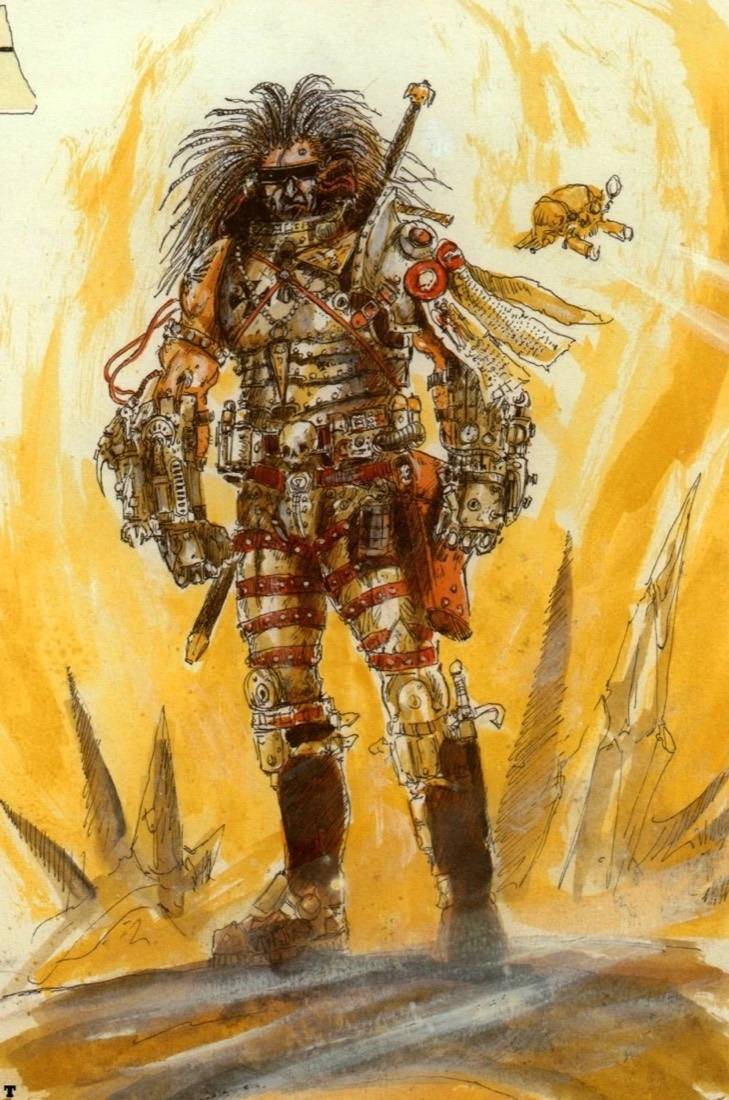
The cradle of Mankind suffered as badly as any colony. Terra had been the centre of a human empire, but in the Age of Strife its unified government dissolved into dozens of warring states and tribes. Warfare raged across its surface for some two and a half thousand years, from the middle of the 27th millennium.[5] The warlords who ruled the planet are known as the techno-barbarians: they inherited scraps of the machines of the old age and used them, without understanding, to feed their wars. They fought with chemical, biological and thermonuclear weapons, turning much of the planet into a wasteland of fortified holds and drifting nomad hordes.[5] A succession of prophets, butcher-kings and cyber-augmented tyrants ruled the survivors, and names such as the Unspeakable King and the Seven Neverborn survived as terror stories.
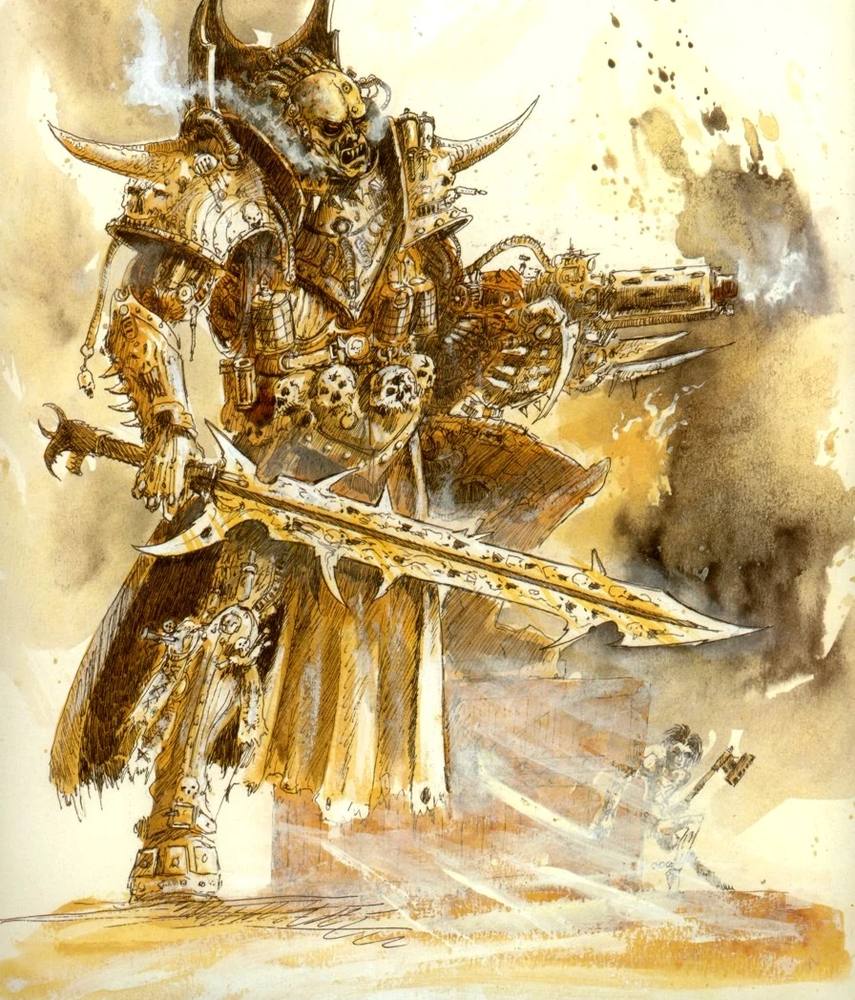
The rest of the Sol System fared no better. Control of the system passed back and forth between Terra, Mars and Luna, and the settled worlds were often at war with one another. On Mars the Mechanicum, which would one day join the Imperium, held to its machine-cult and its forges; its priests deliberately kept their secrets from the surface.[3]
The Emperor
[edit]The Imperial Cult teaches that the Emperor had watched Mankind since before the age of its first cities. Whatever the truth, the sources agree that during Old Night he lived hidden on Terra, directing the work of laboratories beneath the Himalazian mountains and studying the human genome in the hope of finding a way to unite Mankind.[2][5] The conclusion of his work, the first gene-engineered soldiers, marked the end of the Age of Strife. As the storms eased he revealed himself to the warlords of Terra and began the Unification Wars.
End of the Age
[edit]The Age of Strife ended when the warp storms subsided and the Emperor's rule was established on Terra. The relief of the storms is linked in the sources with the birth of Slaanesh, after which the Warp calmed and interstellar travel became possible again. By then the Emperor had already conquered Terra, and the first expeditions set out for the stars.[1] In 798.M30 the Great Crusade was launched to find what remained of the human worlds.
What the fleets found was uneven. Some worlds had prospered and some were unrecognisable, and a few, such as the Interex, had become powers in their own right. Others had been consumed by the Warp or by xenos conquerors and were never recovered. The crusade's records describe the survivors with an astonishment that is evident even in their formal prose.[6]
Legacy
[edit]The Age of Strife is the shadow in which the Imperium is built. The Emperor's decision to rule through a single human state, the Imperial Truth, the ban on intelligent machines and the strict control of psykers are all responses to its failures. In the 31st millennium the horror of the age was a spur to the Emperor's design; in the 41st it has become an excuse for the stagnation that followed.[1]
The Mechanicum, for its part, has made the age a matter of doctrine. Its search for the lost technology of the Dark Age of Technology, and its fear of repeating the Cybernetic Revolt, determine what it will and will not build.
Timeline
[edit]| Date | Event |
|---|---|
| c. M15–M25 | The Dark Age of Technology: Warp travel, the Navigator gene and the Standard Template Construct carry Mankind to a million worlds. |
| c. M25 | The Cybernetic Revolt of the Men of Iron, at the close of the Dark Age, shatters the industrial base of many systems. |
| c. M25 | Psykers appear in large numbers; daemonic incursions begin. The Age of Strife opens. |
| Mid-M27 | Terra's unified government dissolves; some 2,500 years of war among the techno-barbarians follow. |
| M25–M30 | Warp storms isolate the colonies. The Interex and the Saturnyne Dominion rise in the storm-bound centuries. |
| Late M29 | The Emperor reveals himself and begins the Unification Wars with the Thunder Warriors. |
| c. 000.M30 | The Fall of the Aeldari and the birth of Slaanesh open the Eye of Terror; the warp storms begin to subside.[b] |
| 669.M30 | Battle of Mount Ararat, the last great battle of the Unification. |
| 712.M30 | The Emperor declares the Unification of Terra complete. |
| 739.M30 | The Treaty of Olympus joins Terra and Mars. |
| 798.M30 | The Great Crusade leaves the Sol System; the Age of Strife is held to have ended. |
See also
[edit]
Notes
[edit]References
[edit]- ^ a b c d e Dembski-Bowden, Aaron. The First Heretic (novel). Black Library, Ch. 17.
- ^ a b c d e Counter, Ben. Galaxy in Flames (novel). Black Library, pg. 410.
- ^ a b c d McNeill, Graham. The Outcast Dead (novel). Black Library, pg. 332.
- ^ McNeill, Graham. Mechanicum (novel). Black Library.
- ^ a b c Warhammer 40,000 Rulebook (6th Edition), pg. 167. Games Workshop.
- ^ Warhammer 40,000 Rulebook (5th Edition), pg. 122. Games Workshop.
Further reading
[edit]- Canticles of the Omnissiah (M33). Mars Archive. The Mechanicum's own account of the Cybernetic Revolt.
- Annals of the Unity (c. 712.M30). Imperial Palace Archive. Accounts of the last century of Old Night on Terra.