
Xenos
| Xenos the alien | |
|---|---|
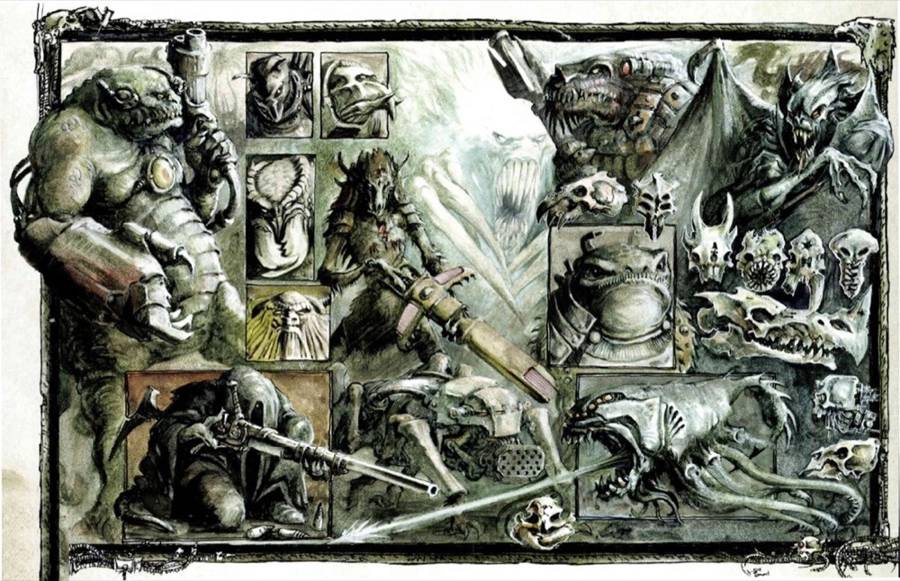 Plate from an Ordo Xenos bestiary showing specimens of several alien species Artwork © Games Workshop | |
| Meaning | Any intelligent non-human species, or a member of one |
| Origin | High Gothic, "stranger" or "foreigner" |
| Doctrine | Aliens are to be shunned, opposed and, where possible, destroyed |
| Enforced by | Ordo Xenos of the Inquisition; Deathwatch; Adeptus Ministorum |
| Major species | Aeldari; Orks; Necrons; Tyranids; T'au; Drukhari |
| Exceptions | Sanctioned xenos under a Rogue Trader's warrant or Inquisitorial licence; the illicit "Cold Trade" |
| Related doctrine | "Suffer not the alien to live" |
Xenos (pronounced ZEE-nohs or zen-OHS; plural xenos) is a High Gothic word meaning "stranger" or "alien". The people and adepta of the Imperium of Mankind use it for any intelligent species that is not human, and the Adeptus Terra uses it above all of intelligent enemies and off-world forces. The word also names the body of Imperial doctrine that governs the treatment of aliens. That doctrine holds that mankind alone is destined to rule the galaxy under the Emperor of Mankind, that alien species are rivals and dangers to be shunned and, where possible, destroyed, and that alien technology, ideas and influence corrupt those who touch them. It is summed up in the maxim "suffer not the alien to live".[1][2]
Imperial hostility to aliens is ancient. The first human interstellar civilisation, in the Age of Technology, competed with alien species, and when it collapsed into the Age of Strife in the 25th millennium, the isolated colonies were preyed on by hostile aliens for many millennia. The Emperor held that only unity, bought at nearly any price, could save mankind from a galaxy more dangerous than earlier scholars had believed. The Great Crusade (c. 798.M30–005.M31) made the extermination of threatening alien life one of the Imperium's central aims, and many species were destroyed. Human realms that had learned to live with aliens, such as the Interex, suffered the same fate.[1][3]
In the 41st millennium the principal intelligent starfaring xenos are the Aeldari of the craftworlds, the Drukhari, the Necrons, the Orks, the T'au and the Tyranids, though countless other species, most of them hostile, have been met. The Ordo Xenos of the Inquisition and its Chamber Militant, the Deathwatch, exist to oppose them. The doctrine nevertheless admits exceptions: some aliens are tolerated as mercenaries, guides or trading partners, and a few Imperial servants have the right to treat with them. In the Era Indomitus, Roboute Guilliman has accepted aid from some aeldari, a policy that remains disputed among the clergy.[1][4][3]
Doctrine
[edit]Imperial Creed
[edit]The Adeptus Ministorum teaches that humanity alone is the sacred form of intelligent life chosen by the Emperor to spread among the stars, and that every other intelligent species is an abomination and an affront to his plan. These beliefs have reinforced the old xenophobia of the state. Much of the Imperium, led by the zeal of the Ministorum, holds that all aliens must be exterminated, even those that are entirely peaceful, and when the masses are stirred to fear and fanaticism they demand destruction over cooperation. Imperial citizens are taught from a young age to fear and hate the alien, and soldiers of the Astra Militarum are drilled in the belief that mankind is superior to all inhuman things.[3][1]
Imperial law
[edit]In the broadest terms of the Imperial Creed, no human may deal with a xenos except by violence. The Inquisition and the Adeptus Arbites keep constant watch for contamination, and unauthorised trade in alien goods, the use of alien technology and possession of alien texts are punished severely, up to the purging of whole worlds. Such watchfulness has not ended the "Cold Trade", the black market in xenos goods, which draws high prices in the hive worlds.[3][1]
The Great Crusade
[edit]The Imperial Truth did not regard aliens as spiritually unclean, but it held that humanity's survival required the removal of rival species from the space the Imperium claimed. The Legions were the principal instruments of the policy. The Imperium rarely tried diplomacy, and when it did, it was usually offered only to human realms. Advanced species such as the Aeldari were often left alone while they did not threaten human interests. Even where common ground existed, as in the first encounter with the human and alien alliance called the Diasporex, distrust led to violence. The destruction of the Interex in 002.M31 is remembered as one of the events that foreshadowed the Horus Heresy.[3][5][a]
The Manifold Dangers of the Alien
[edit]The doctrine of the Ordo Xenos recognises five broad ways in which the alien can harm mankind. The threat of discord is the most insidious: contact with alien ideas may inspire envy, apostasy or even adoration, leading people into heresy and rebellion, and the risk rises the further one goes from the centres of Imperial civilisation. The threat of temptation arises because the alien offers gifts, technology or alliances to the weak or avaricious; there is a long roll of traitors who succumbed, and the lost secrets of extinct xeno civilisations are an equal hazard to those who disturb their tombs.[3]
The threat of corruption is bodily and genetic taint, by parasitism, as with the genestealer, or by the crime of transgenic blasphemy, the deliberate mixing of human and non-human tissue. The threat of dominion comes from aliens with powers to command humans by psychic or other means, even forcing worship as false gods. The threat of destruction is overt invasion, from the great Ork Waaaghs and Tyranid assaults to the attacks of the enigmatic Thyrrus; some non-sentient creatures, such as ecology-destroying vermin, are too hazardous to be allowed to live.[3]
Institutions
[edit]The Inquisition's Ordo Xenos holds primary responsibility for alien threats. Its Inquisitors investigate alien activity, suppress xenos cults and collaborators, and confiscate alien artefacts, with the Deathwatch as its Chamber Militant. The Adeptus Astartes, the Astra Militarum and the Imperial Navy fight the great alien wars, while the Ecclesiarchy preaches the doctrine. The Adeptus Mechanicus treats alien technology with suspicion, although some of its magi study it.[1][3]
Major xenos species
[edit]Hundreds of sentient species have existed, but only a few have built interstellar empires or are too powerful for the Imperium to exterminate. The Aeldari of the craftworlds, an ancient and dying people, once held a galaxy-spanning empire; their technology still exceeds the Imperium's, and they hold humanity in disdain while assisting it against common foes when it suits them. The Drukhari, the dark kin of the Aeldari, dwell in Commorragh in the Webway and raid realspace for slaves; humans often cannot tell them from their cousins. The Necrons, so old that even the Aeldari consider them ancient, have lain dormant under their tomb worlds for millions of years and have begun to awaken in the last centuries of the 41st millennium.[3][6]
The Orks are a violent green-skinned species whose spores may make them immune to extinction. The T'au Empire, a young realm of the Eastern Fringe led by the Ethereal caste, expands by diplomacy and force under the doctrine of the Greater Good, and is unique among the major powers in winning other species as allies; some human worlds have found the Greater Good attractive. The Tyranids, an extragalactic swarm directed by a Hive Mind, strip worlds of their biomass; several hive fleets have been identified, and it is feared that all incursions so far are only a vanguard.[3][7]
| Species | Imperial assessment | Notable war with the Imperium |
|---|---|---|
| Aeldari | Ancient, psychic, treacherous; sometimes allied | Great Crusade (M30) |
| Drukhari | Raiders and slavers from the Webway | Constant raiding |
| Orks | Most numerous; constant threat | Ullanor Crusade (c. 999.M30–000.M31); War of the Beast (544–546.M32) |
| Necrons | Ancient machine race; awakening | Time of Ending (late M41) |
| Tyranids | Extragalactic devourers | Hive Fleet Behemoth (745.M41) |
| Genestealer Cults | Hidden infection of human worlds | Recorded from M41 |
| T'au Empire | Young, expansionist, seductive | Damocles Gulf Crusade (742–745.M41) |
| Leagues of Votann | Classification disputed: abhuman or xenos | Era Indomitus (M42) |
Minor species
[edit]Many lesser species are recorded: the Kroot and Vespid, which serve the T'au; the Hrud; the Megarachnids; and mercenaries such as the Caradochians of the Tollovian Cluster. The Kroot have been paid in flesh to fight beside human planetary defence forces. The danger is that those who accept a small compromise, such as hiring a brute labourer, may be a short step from a covenant with the Hrud or the Ork.[3]
Sanctioned xenos
[edit]Despite the doctrine, peaceful contact with xenos happens frequently, usually as short alliances of convenience. A number of species hire themselves out as mercenaries, and some Imperial commanders use them as expendable troops. Rogue Traders have the authority to treat with aliens legitimately, to trade, ally or hire, and in the fringe regions, such as the Calixis Sector and the Koronus Expanse, a procedure for sanctioning xenos has arisen. A sanctioned alien bears a visible brand or tattoo, usually on the face or hands, and must remain under a human sponsor who vouches for it; should the xenos cease to serve, its life is forfeit. Sanctioning is expensive and rare, offered in the Calixis Sector by a handful of Administratum ordinates at Port Wander recruited by interested Inquisitors, and most Imperials still regard the sanctioned with caution and hostility.[3][4]
The most significant exception in Imperial history is the return of Roboute Guilliman in 999.M41, achieved by the archmagos Belisarius Cawl with the help of the Ynnari. The Lord Commander has since accepted aeldari aid on several occasions, a policy criticised in sections of the Ecclesiarchy.[3]
Timeline
[edit]| Date | Event |
|---|---|
| M25 | Collapse of the first human interstellar civilisation; the Age of Strife begins |
| c. 839–890.M30 | Rangdan Xenocides |
| c. 999.M30–000.M31 | Ullanor Crusade against the Orks |
| 002.M31 | Destruction of the Interex |
| 544–546.M32 | War of the Beast |
| 742–745.M41 | Damocles Gulf Crusade; first war with the T'au |
| 745.M41 | First Tyrannic War |
| 997.M41 | Kryptman's measures against Hive Fleet Leviathan |
| 999.M41 | Guilliman restored with Aeldari aid |
See also
[edit]
Notes
[edit]- ^ The Interex date follows the Imperial chronologies of the Great Crusade; accounts of the war differ on whether the Interex fleet was destroyed in a single year.
References
[edit]- ^ a b c d e f Dark Heresy: Core Rulebook (RPG). Games Workshop. Warhammer 40,000: Rulebook (6th edition). Games Workshop. pp. 196-213.
- ^ Priestley, Rick. Codex Imperialis. Games Workshop.
- ^ a b c d e f g h i j k l m "Xenos". Warhammer 40k Wiki (Fandom). Drawing on Dark Heresy: Core Rulebook (RPG), Deathwatch: Core Rulebook (RPG) pp. 358-374, and Rogue Trader: Core Rulebook (RPG) pg. 359.
- ^ a b Rogue Trader: Core Rulebook (RPG). Games Workshop. pg. 359. Rogue Trader: The Navis Primer (RPG). Games Workshop. pp. 133-135.
- ^ Abnett, Dan (2006). Horus Rising (novel). Black Library. pg. 199.
- ^ Codex: Eldar (4th edition). Games Workshop. Codex: Necrons (5th edition). Games Workshop.
- ^ Codex: Tau Empire (4th edition). Games Workshop. Codex: Tyranids (5th edition). Games Workshop.