
Rangdan Xenocides
| Rangdan Xenocides | |
|---|---|
| Part of the Great Crusade | |
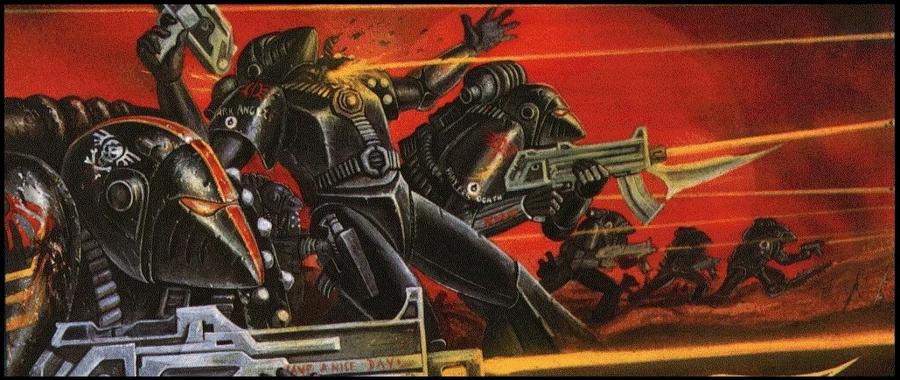 Dark Angels Legionaries in battle in the years of the Great Crusade; no pict of the Xenocides themselves survives in the open archives Artwork © Games Workshop | |
| Date | c. 839–890.M30 (three campaigns) |
| Location | The Halo Stars and the northern and eastern fringe of the galaxy; Advex-mors, Xana II, Taxal, Bloch |
| Result | Imperial victory at ruinous cost; the Rangda exterminated; records sealed or destroyed |
| Belligerents | |
Imperium of Mankind Dark Angels  Space Wolves  Death Guard  Raven Guard  White Scars  Nine Space Marine Legions[a]  Titan Legions[b]  Mechanicum[c]Imperial Knights[d]  Imperial Army | The Rangda The Rangda[e]Armada and war-moons[f]Slave cohorts[g]Slaugth (some accounts) |
| Commanders and leaders | |
Lion El'JonsonLeman RussJaghatai Khan Emperor of MankindAnacharis Scoria | Not recorded[h] |
| Units involved | |
Legio Gryphonicus[i] Taghmata[j]House MalinaxHouse OrhlaccOrder of Broken Claws (afterwards) | War-moons and Barq transports[k]Slave cohorts[l] |
| Strength | |
| 300,000+ Space Marines[m][1]3 Titan Legions | Thousands of ships[n]Over a dozen war-moonsSlave cohorts |
| Casualties and losses | |
| 80,000+ Legionaries killed[o][1]48 Imperial Knights killed[p]Millions of Imperial Army killed | Exterminated[q] |
| 19 star systems laid waste[r] | |
The Rangdan Xenocides were three wars fought by the Imperium of Mankind against a xenos power known as the Rangda between about 839.M30 and 890.M30, in the mid years of the Great Crusade. They were the most terrible campaigns of the crusade before the Horus Heresy. They cost the Legions more than eighty thousand Space Marines, took the Emperor himself into the field, and brought the Imperium, according to those few of its officers who survived to say so, to the edge of ruin. Most of what is known about them has been lost, since the Dark Angels, who suffered most in the fighting, ordered the records sealed or destroyed for the good of the Imperium.[1][2]
Imperial accounts differ on almost every particular, including what the Rangda were. They held a domain on the edge of the galaxy, among the Halo Stars, and fought with a technology and a ruthlessness that matched the Imperium's own. The Imperium met them again and again in the northern and eastern fringe and in the end destroyed them to the last, in a campaign of extermination of about 889–890.M30 conducted jointly by the Dark Angels and the Space Wolves. The wars removed the Dark Angels from their place as the largest Legion, and they raised the Ultramarines, the Legion least affected by the fighting, to the position it holds in the Imperium's remembered history.[1]
Background
[edit]The edge of the galaxy
[edit]By the 830s.M30 the Great Crusade had been running for forty years. Its fleets had passed the first rings of rediscovered worlds and were beginning to push into the thinly settled regions that lay beyond the Eastern Fringe. At that distance the Warp's storms, which had cut Terra off from the rest of the galaxy in the Age of Strife, had also masked the activities of alien powers, and the Imperium was now moving into the territory of species that had never heard of it.[3]
The Rangda are the least understood of these. The Imperial name appears to be a corruption of a word in their own communications, or of a name given them by other peoples, and the Rangdan Cerabvores, the formal designation used in the Legion's interdiction files, has never been explained. They had an empire that stretched along the galactic rim. They kept enslaved populations of other species under neural shackles, and they led their conquests with armadas, war-moons and bio-engineered monsters. Their intelligence and their cruelty were beyond question.[1]
What the Rangda were
[edit]The question has never been settled. A few blurred picts of fallen Rangdan warriors survive, and some Mechanicum fragments, and what they show are tall, monstrous forms whose anatomy the Legion surgeons found hard to describe. One account in the files of the Death Guard names the Slaugth, a species of xenos with a talent for psychic murder, as accompanying the Rangda in their wars, and a record of the War Hounds, the Legion later called the World Eaters, states that its first Master of Ordnance, Juljak Nul, was horribly mutilated by Slaugth murder-minds on a Rangdan world and had to be entombed in a Dreadnought. Some scholars take this as a hint at the true nature of the Rangda. The First Legion's own archives, which would settle the point, have not been opened since the 30th millennium.[1]
First Xenocide
[edit]The first encounter was at Advex-mors, a small world on the periphery of the Rangdan domain, which an Expeditionary Fleet reached in 839.M30. The Dark Angels assaulted it, and in four solar months of combat the Legion lost about five thousand of its battle-brothers. Advex-mors was destroyed. It would prove to have been a minor outpost, a station at the edge of the Rangda's real territory, and the Rangda paused in their conquests elsewhere to turn toward the human fleets swarming around it. The victory was only the prelude.[1]
Second Xenocide
[edit]The armada
[edit]In 862.M30 the Rangda came to Imperial space in force. The armada comprised thousands of ships and more than a dozen war-moons, a force far greater than any garrison or expeditionary fleet that the Imperium had in the region. It struck the northern fringe of the Imperium like a thunderbolt, destroyed the defending fleets and took the colonies of the fledgling human worlds, whose people were forced into neural shackles. Only the Expeditionary Fleets of the White Scars, and of the Raven Guard, delayed the advance long enough for the Imperium to rally, and they paid dearly.[1]
Xana II
[edit]The decisive stand was made on the isolated Forge World of Xana II, where the Legions held the Rangdan blockade at bay for eight solar months in about 862–863.M30.[s] Three thousand Legionaries and hundreds of thousands of Mechanicum thralls died in the defence. The siege was broken at last by the combined onslaught of the Dark Angels and the Death Guard, which shattered the Rangdan blockade and cut a path through the slave cohorts on the surface. The forge world became the beachhead for the counter-attack. Its Titan Legions, the Legio Gryphonicus, the Legio Vulturum and the Legio Kydianos, and its Xanite Mechanicum served alongside the Dark Angels for the rest of the war.[1]
The Halo Stars
[edit]What followed was more than two solar decades of war among the Halo Stars. It cost millions of lives and laid waste nineteen inhabited star systems. Contingents from nine Space Marine Legions were drawn into the fighting, and at the height of the war more than three hundred thousand Space Marines were deployed in the climactic Imperial assault on Taxal, led by Lion El'Jonson in about the 870s.M30.[t] The battle honour was not given to any one commander, because the war was too widespread, but three primarchs are known to have led their warriors against the Rangda, and the primarch of the Dark Angels is held to have been the foremost of them.[1]
The Imperium forbade any further expeditions beyond the exclusion posts established on the worlds of Endyris and Morox. A single incident of 881.M30 shows the character of the war. A Rangdan transport, a Basemekanic Barq, broke through the cordon on the galactic northeast and fell upon the world of Majind, and the Death Guard in pursuit were decimated when the bioweapon aboard was activated by means that nobody understood. Only the quick action of the Space Wolves prevented a catastrophe.[1]
The last battle of the Second Xenocide, a chance meeting with a battered Rangdan fleet, was fought in 882.M30. It was the broken remnant of the armada. The Imperium's plain intention was to forget what had happened. The worlds that had been tainted beyond recovery were abandoned, and the survivors of the war were sworn to silence or eliminated, because the Rangda had to vanish if the Imperium was to rebuild itself. The legend that grew later, composed in part by the Remembrancers and in part by ideologues who wanted to promote the glory of the crusade, was made up of as much invention as fact.[2]
The Labyrinth of Night
[edit]One thing is attested by several sources, though the records of it are sealed. The threat was at last checked by the Emperor, who went to the war in person and broke what the Dark Angels' reports call the Labyrinth of Night. The nature of the thing is not given. After it, in about 882.M30, a decade of bio-pogroms purged the Rangdan taint from the human worlds it had touched, a campaign that left entire inhabited sectors lifeless.[1]
Third Xenocide
[edit]The last hunt
[edit]The Rangda had been wounded, not destroyed. They had returned to their ancient homeworlds and, nourished by hatred, had grown strong again. The nests were discovered by chance by a roving company of the White Scars after the edict of exclusion on the borders of Rangdan space was lifted in 887.M30. Jaghatai Khan's sons took the news to Lion El'Jonson and Leman Russ, two primarchs who were often at odds and were united in this by a single bleak purpose: if the Rangda still lived, they must be destroyed utterly before they could return.[1]
The Third Xenocide was not a war in the ordinary sense. The Dark Angels and the Space Wolves scoured the last Rangdan worlds clean from orbit and then went down to verify the death of every hive and fortress with blade and flame. They were joined by the Mechanicum of Xana II, which sent the Taghmata of Magos Dominus Anacharis Scoria and the Knights of House Malinax. In the space of a single Terran year, about 889–890.M30,[u] the galaxy was wiped clean of the Rangda, their formations torn down and their works brought to ruin. Neither primarch showed any mercy, and both took a savage and final satisfaction in the extermination.[1]
Rival accounts
[edit]The Third Xenocide is the least well documented of the wars, and several Imperial accounts reject the outline given above. One holds that it was an apocalyptic war in which fifty thousand Dark Angels were killed repelling a Rangdan invasion that came close to destroying the whole northern Imperium. A further source claims that it was a long series of purges by the Dark Angels and Space Wolves, extending to Exterminatus on Rangda-tainted worlds that still held loyal human populations, and that it was therefore a campaign of much greater scale than the usual account allows, with countless battles over the north-west of the galaxy. The figure of fifty thousand Space Marines lost in the Third Xenocide, the one on which most sources agree, is part of both versions.[1]
Participants
[edit]The Legions
[edit]Nine Legions took part, by the record, and their contributions varied. The Dark Angels fought in all three wars and bore the brunt of the first and last. The Space Wolves were the instruments of the final extermination and the force that stopped the transport at Majind. The Death Guard were at Xana II and at Majind and lost so many that the Legion had to be refilled with an emergency intake from the induction pools of the 18th Expedition, a levy that brought recruits who were neither of Terra nor of Barbarus into the ranks. The White Scars discovered the last nests, and the Raven Guard held the line in the opening of the Second Xenocide. Two of the lost Legions, the II and XI, are mentioned in a fragment of the Imperial Infantryman's Uplifting Primer as having taken part in the campaigns, though what they did is not recorded.[1]
The Alpha Legion
[edit]The appearance of the Alpha Legion in Imperial records is traditionally placed in the Rangdan war, either in the decade before the Farinatus Extermination of 972.M30 or in the darkest days of the Third Xenocide, a discrepancy of many decades. A self-styled Alpharius, commanding Alpha Legion forces before the rediscovery of the primarch, is said to have appeared in the exclusion zone and offered his aid to the Lion, hoping that the Dark Angels would keep their standing and the Lion would one day be named Warmaster. The Lion refused. A different account, told by Alpharius himself and not supported by independent testimony, has it that he came to the Rangdan war to follow a rumour of his twin brother Omegon and found him on Bar'Savor, where an Alpha Legion fleet cleansed the world of Slaugth.[1]
The Knights
[edit]House Orhlacc, a house of the Imperial Knights, made its martial reputation at the world of Bloch in the final days of the war, c. 890.M30. Forty-eight Knights of the house were lost in a desperate last stand, in which the house fought alongside the Ordo Reductor to hold back a counter-attack. For the sacrifice the Emperor himself gave House Orhlacc the rare distinction of a Memento Mori.[1]
Aftermath
[edit]The Order of Broken Claws
[edit]After the Second Xenocide the Dark Angels created a chantry order, the Order of Broken Claws, to study the Rangda and prepare against their return. Its adepts were drawn from the Hekatonystika, the Legion's secretive corps of researchers, and were trained to stand against the worst of the Rangdan bio-forms using the anatomical data gathered by the Legion's scout-hunters and the Dreadwing cheirophages. After the Third Xenocide the order was installed in a chantry on Advex-mors, where the first battle had been fought. The world was by then little more than plains of fractured glass formed by atomic fire. The order kept the last set of codices that detailed the Rangda and their weaknesses.[1]
Some Imperial reports erroneously give the site of the chantry as the Rangdan homeworld rather than Advex-mors. Several historitors suspect that the error was made on purpose, to lend weight to the official claim that the Rangda were entirely exterminated. The sentinels placed by the First Legion are still said to be watching, in case the claim is false.[1]
The balance of the Legions
[edit]The wars changed the balance of power within the crusade. The Dark Angels had been the largest Legion, and their losses reduced them. By 899.M30 the Ultramarines, who had been spared the worst of the fighting, were on the verge of becoming the largest Legion, with about 166,000 Space Marines. The Death Guard were also weakened. The wars also freed Horus and the Luna Wolves, who had been occupied in the western campaigns, to move into the ascendant, and the next decades of the crusade fell to them and to the Legions that had kept their strength.[1]
The silence
[edit]The wars were not publicly mentioned. The citizens of the Imperium learned only that a distant war had been fought and won. The Dark Angels' decision to seal their records was in keeping with the Legion's culture of secrecy, and the Emperor's choice not to dispute it can be read as agreement that the survival of the Imperium was better served by forgetting what it had learned. The resulting gap in the chronicle has been filled by rumour, and the Inquisition has not discouraged it.[1]
Timeline
[edit]| Date | Event |
|---|---|
| 798.M30 | The Great Crusade begins. |
| 839.M30 | First Xenocide: the Dark Angels destroy Advex-mors, losing some 5,000 Legionaries. |
| 846.M30 | Lion El'Jonson rediscovered on Caliban and given command of the I Legion. |
| 862.M30 | Second Xenocide: the Rangdan armada strikes the northern fringe; the White Scars and Raven Guard delay it. |
| c. 862–863.M30 | Siege of Xana II, broken by the Dark Angels and the Death Guard.[v] |
| c. 862–882.M30 | War in the Halo Stars; assault on Taxal under the Lion; nineteen systems laid waste. |
| 881.M30 | The Majind incident: a Basemekanic Barq breaks the cordon; the Space Wolves contain it. |
| 882.M30 | Last battle of the Second Xenocide; the Emperor breaks the Labyrinth of Night; exclusion posts set at Endyris and Morox; the Order of Broken Claws founded. |
| c. 882–892.M30 | A decade of bio-pogroms purges the Rangdan taint from human worlds.[w] |
| 887.M30 | The edict of exclusion lifted; the White Scars discover the surviving Rangdan nests. |
| c. 889–890.M30 | Third Xenocide: the Dark Angels and Space Wolves exterminate the Rangda; House Orhlacc's stand at Bloch.[x] |
| 899.M30 | The Ultramarines near 166,000 Legionaries and overtake the weakened Dark Angels as the largest Legion. |
See also
[edit]
Notes
[edit]- ^ Contingents of nine Legions in all.
- ^ Of Xana II.
- ^ Of Xana II.
- ^ Of Houses Malinax and Orhlacc.
- ^ Also called the Rangdan Cerabvores.
- ^ Of the Second Xenocide.
- ^ Under neural shackles.
- ^ No Rangdan leader is named in the surviving records.
- ^ With Legio Vulturum and Legio Kydianos.
- ^ Of Anacharis Scoria.
- ^ The transports were Basemekanic Barq.
- ^ Of the Rangdan surface garrisons.
- ^ At the height of the Second Xenocide, at Taxal. Contingents of nine Legions fought across the three wars.
- ^ In the Second Xenocide.
- ^ Among them c. 5,000 Dark Angels at Advex-mors, 3,000 at Xana II and c. 50,000 in the Third Xenocide.
- ^ Of House Orhlacc, at Bloch.
- ^ To the last, with all fleets, war-moons and worlds.
- ^ Hundreds of thousands of Mechanicum thralls died at Xana II. Whole sectors were left lifeless in the bio-pogroms.
- ^ Date estimated from the sequence of events.
- ^ Date estimated from the sequence of events.
- ^ Date estimated from the sequence of events.
- ^ Date estimated from the sequence of events.
- ^ Date estimated from the sequence of events.
- ^ Date estimated from the sequence of events.
References
[edit]- ^ a b c d e f g h i j k l m n o p q r s t u v Brooks, Mike. Alpharius: Head of the Hydra (novel). Black Library, "Hydra Dominatus". Bligh, Alan. The Horus Heresy Book One: Betrayal (Forge World Series). Black Library, pp. 99, 266.
- ^ a b Bligh, Alan. The Horus Heresy Book Two: Massacre (Forge World Series). Black Library, pg. 19. The Horus Heresy Book Three: Exterminatus, (Forge World Series) by Alan Bligh, pp. 82, 162.
- ^ The Horus Heresy Book Four: Conquest, (Forge World Series) by Alan Bligh, pg. 124. Bligh, Alan. The Horus Heresy Book Five: Tempest (Forge World Series). Black Library, pp. 96, 221.