
Adeptus Arbites
| Adeptus Arbites | |
|---|---|
| Imperial law enforcement | |
 The scales and the fist, seal of the Adeptus Arbites Artwork © Games Workshop | |
| Overview | |
| Also called | The Arbites, the Arbitrators |
| Established | Before the Horus Heresy (30th millennium) |
| State | Imperium of Mankind |
| Leader | The Grand Provost Marshal, who sits among the High Lords of Terra |
| Seat | The Hall of Judgement, Terra |
| Parent body | Adeptus Terra |
| Seat on worlds | The precinct-fortress or precinct-courthouse |
| Law enforced | The Lex Imperialis, in the Book of Judgement |
| Recruited from | The Schola Progenium |
| Wargear | Carapace armour, shock maul, combat shotgun, suppression shield |
| Motto | We determine the guilty. We decide the punishment. |
| Adeptus Terra Grand Provost Marshal Lex Imperialis | |
The Adeptus Arbites are the guardians of Imperial law. Their officers, the Arbitrators, enforce the Lex Imperialis, the law of the Imperium of Mankind, on every world they serve. They do not police the streets of a hive or the villages of a feral world, which is left to the planetary Enforcers. They are concerned with the larger offences, rebellion, secession, the corruption of governors, defiance of the tithe and the beginnings of heresy and xenos taint, which threaten Imperial rule itself.[1]
An Arbitrator is both judge and executioner. He may arrest, interrogate and sentence any citizen who has broken Imperial law, and he may do it on the spot. He may take a planetary governor into custody, declare martial law and take control of a world when its government has failed. Only the highest institutions of the Imperium stand above him in law, and few citizens ever meet an Arbitrator without a very great fear.[1]
Arbitrators are recognised by their dark, heavy carapace armour and sealed helms, and by the great fortress-courthouses they maintain, which dominate the districts of every capital. They are loved nowhere. They are not meant to be.[1]
History
[edit]Origins
[edit]The Adeptus Arbites was founded before the Horus Heresy, in the 30th millennium, as the branch of the Adeptus Terra charged with enforcing the law of the Imperium.[2] No record gives the year of its founding.[a] The law it serves is called the Dictates Imperialis, or Lex Imperialis: the decrees of the Emperor in ancient times, together with the rulings of the High Lords of Terra over ten thousand years and the precedents of the Arbites themselves. It is written into the Book of Judgement, which is kept in the Hall of Judgement on Terra and grows by new volumes every day. The head of the Arbites, the Grand Provost Marshal, is one of the High Lords of Terra.[1]
The Arbites are separated from the military and from the local powers they watch. Their officers are drawn from the Schola Progenium, and they are never posted to the world where they were born. A new Arbitrator is meant to be a stranger to the people he judges, and so is thought to be free of their favours.[1]
The long watch
[edit]Ten thousand years of service have given the Arbites an unglamorous history. Their precinct-fortresses are often the last bastion of Imperial rule during revolutions, rebellions and invasions, holding out to the end while the Arbitrators send word to other Imperial agencies.[1]
Organisation
[edit]Command
[edit]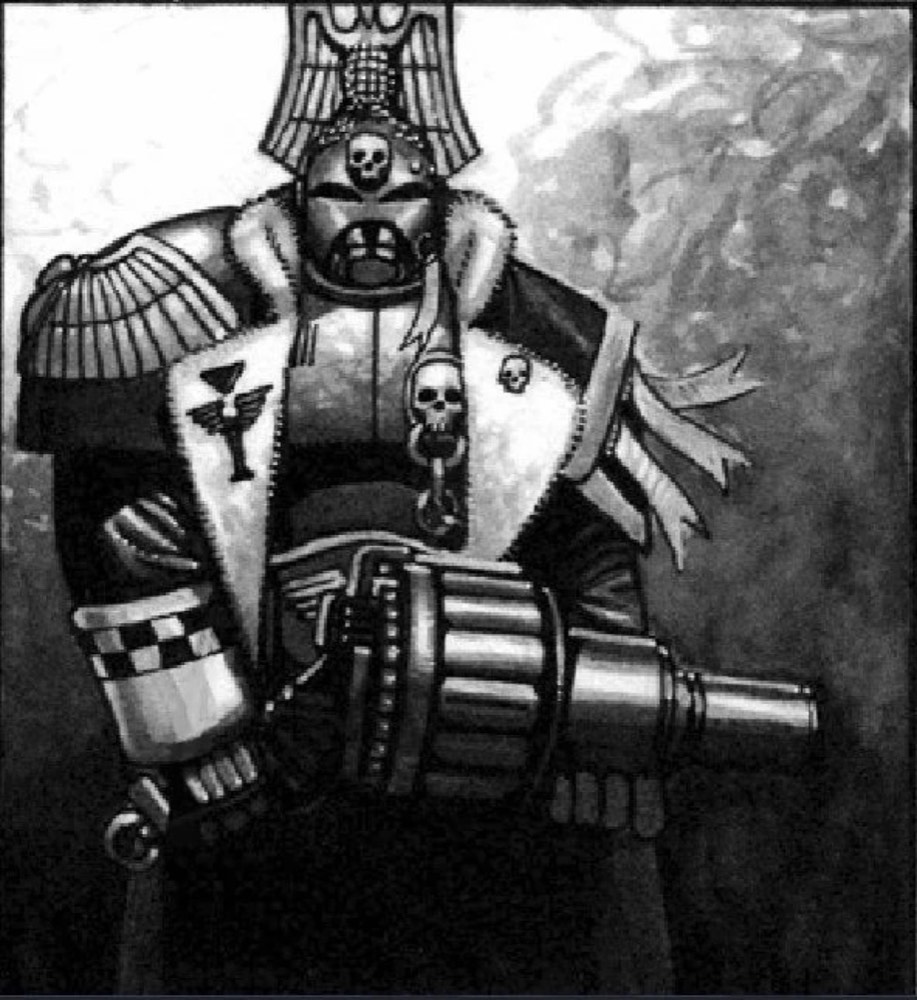
At the head of the Arbites is the Grand Provost Marshal, who resides in the Hall of Judgement on Terra and sits among the High Lords. Below him are the Lord Marshals, each responsible for a sector. A Lord Marshal supervises the High Marshals of the individual precinct-fortresses, and beneath them are the Marshals, Judges, Proctors, Investigators, Arbitrators and Regulators.[1]
The rank of Judge is the one most often wrongly used for all Arbitrators. A Judge is a specialist in law, trained to hear a case and to pass sentence. Enforcement is the work of the Arbitrators, who may carry out an arrest, interrogation or execution in the field. Beneath the Arbitrators are the Enforcers, the local planetary police, who are not members of the Arbites but may be placed under their command.[1]
Precinct-fortresses
[edit]The Arbites have their base on a world in a precinct-fortress, a severe armoured building in the capital or the greatest hives, close to the governor's palace. It contains the Arbitrators' barracks, an armoury, cells, a court of judgement and, in larger precincts, interrogation rooms, a medicae and an astropathic shrine. Its walls are as thick as those of a bunker and its heavy weapons can cover the nearby streets. On a world far from help it may be the one structure that does not fall in a rebellion, and the Arbitrators inside are expected to hold it to the last round.[1]
The governors of Imperial worlds resent them, and sometimes with good reason. A governor who falls behind in his tithe, delays a request for troops, or tries to make his world a private fief finds that the precinct-fortress is the one building in the city he cannot order about.[1]
Recruitment and training
[edit]Arbitrators are recruited from the Schola Progenium, where they are brought up to venerate the Emperor and the law. They are trained in a great number of skills, from unarmed combat and the use of weapons to the study of the Lex Imperialis, which can take decades to master. A recruit is posted away from his home world, and his new posting is chosen to place him among people he does not know. Few become friends with the people they serve.[1]
Specialist cadres have a place in the Arbites. The Chasteners carry out interrogations and punishments. Chaplains look to the spiritual condition of the officers. Cyber-mastiff handlers train the augmented hounds that hunt fugitives. Arbitrator detectives conduct the long investigations that expose corruption in high places.[1]
The Lex Imperialis
[edit]The law of the Imperium is old, long and in places irrational. It has been drawn from the decrees of the Emperor, the High Lords and a host of lesser authorities over ten thousand years, and it takes a Judge decades to study a single case. The Arbites enforce only the Dictates Imperialis, the law of the Imperium itself, and do not concern themselves with the laws of a world, a hive or a district. Murder and theft are neglected unless they touch the interests of the Imperium, harm an Imperial servant or threaten a world's ability to pay its tithe.[1]
The penalties are severe. The usual punishment is death, either at once or by sentence to a penal legion of the Astra Militarum. Other punishments include public lashing, burning for certain religious crimes and, in cases of heresy by the clergy, arco-flagellation by arrangement with the Ecclesiarchy. A citizen has no right to a trial beyond the judgement of an Arbitrator, and an Arbitrator who is not sure may refer a case to a Judge in a precinct-fortress. Imperial justice is quick and sure, though it is not always just.[1]
It has been known for a Judge seconded to an Inquisitor to turn on him when he broke the codes of Imperial law, and Radical Inquisitors are warned not to recruit them.[3]
Powers and limits
[edit]An Arbitrator may arrest, interrogate and execute planetary, sub-sector and sector governors, and, with permission of the Commissariat, officers of the Astra Militarum and the Imperial Navy. He may impose martial law where a world's government has failed, and hold it until a military command can be established, commonly under a force of the Guard. Only the very highest institutions stand above his law, among them the Inquisition, the Adeptus Astartes and the Navis Nobilite. The respect given to the Arbites by these bodies reflects the mutual terror in which the Arbites are held.[1]
Wargear
[edit]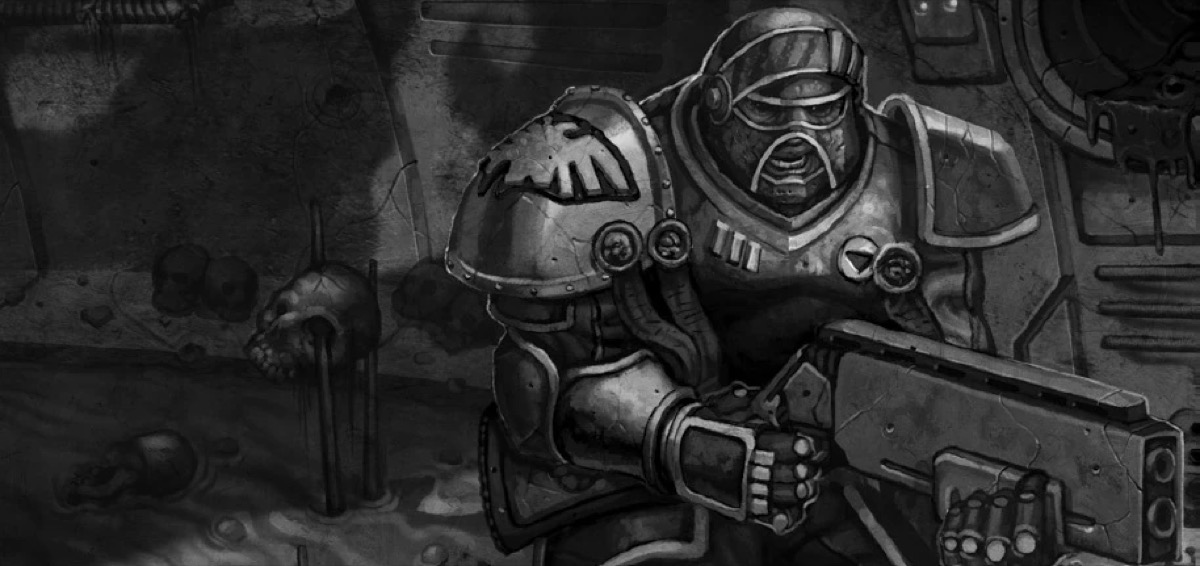
An Arbitrator wears carapace armour, a dark suit of plates over a body-glove that gives protection against everything short of a heavy weapon. He is equipped with the shock maul, a baton that delivers a powerful electrical charge, a combat shotgun of an ancient and reliable pattern, and an Ius autopistol. His riot gear includes a suppression shield, a heavy plate that can be locked together with others to form a wall. In the field he may call on a cyber-mastiff, a trained and partly augmented hound that tracks suspects.[1]
Notable actions
[edit]Pavonis
[edit]During workers' riots on Pavonis the whole Arbites force at the governor's palace was lost, save one Judge, but only after several hours' fighting in the secret tunnels beneath it. In the course of the fight they destroyed the planet's largest arms store and denied it to the rebel Planetary Defence Force.[4]
Ichar IV
[edit]When Hive Fleet Kraken approached in the Second Tyrannic War, the world of Ichar IV rose in revolt under a sect that turned out to be a Genestealer cult. The Arbitrators of the capital, Lomas, held their precinct-fortress for days. When it fell they escaped through a tunnel and seized the city's four power generators, and when they were overrun they destroyed them, which allowed the Ultramarines to retake the planet.[1]
Typhos Prime
[edit]When an Inquisitor released a Genestealer in the fortress-city of Coritanorum to study the Tyranids, a cult grew in the planetary defence force and a civil war followed. The Typhos Arbitrators locked down the cities around it and fought for two years under the command of the local Commissariat.[5]
Relations with other institutions
[edit]The relationship is usually cordial. Inquisitors often seek out Arbitrators as acolytes because of their training, resolve and faith in the Emperor, and Arbitrators often see service with an Inquisitor as a way of enforcing the Emperor's justice. A Judge seconded to an Inquisitor has been known to turn on him if he breaks the codes of Imperial law, so Radical Inquisitors recruit Arbitrators with caution.[3][6]
Arbitrators are authorised to arrest, interrogate and execute officers of the Astra Militarum and the Imperial Navy, although custom dictates that they first seek permission from the Commissariat, the body that enforces military law in both services.[7]
Arbites Shock Troops break up the queue wars that develop outside the government buildings of the Administratum, and Arbitrator cyber-specialists pursue cyber-criminals through its cogitator matrices.[7]
The Arbites exist in part to ensure that planetary governors do not plot against the Emperor's rule, and a governor who is late with his tithes or reluctant to send troops will find the precinct-fortress on his world watching him. Governors often resent this oversight, though in widespread unrest the fortress can shelter them and form the base from which the uprising is crushed.[7]
Timeline
[edit]| Date | Event |
|---|---|
| 30th millennium | The Adeptus Arbites is founded, before the Horus Heresy. |
| Date not recorded (M41) | Workers' riots on Pavonis destroy the Arbites force at the governor's palace. |
| Date not recorded (M41) | An Inquisitor releases a Genestealer on Typhos Prime and a cult takes root in the planetary defence force. |
| c. 992.M41 | Rioting on Ichar IV accompanies the approach of Hive Fleet Kraken in the Second Tyrannic War. |
See also
[edit]
Notes
[edit]- ^ The Imperial records consulted give only the millennium.
References
[edit]- ^ a b c d e f g h i j k l m n o p q Thorpe, Gav. 13th Legion (novel). Black Library, Chs. 4, 6-7. Farrer, Matthew. Cross Fire (novel). Black Library.
- ^ "Adeptus Arbites". Warhammer 40k Wiki (Fandom).
- ^ a b Dark Heresy: Core Rulebook (RPG). Fantasy Flight Games.
- ^ McNeill, Graham. Nightbringer (novel). Black Library.
- ^ Codex: Tyranids (1st edition). Games Workshop.
- ^ Dark Heresy: The Radical's Handbook (RPG). Fantasy Flight Games.
- ^ a b c Dark Heresy: Book of Judgement (RPG). Fantasy Flight Games.