
Planetary Defence Force
| Planetary Defence Force | |
|---|---|
| Militia of an Imperial world | |
 Emblem of the Astra Militarum, to which planetary militias answer Artwork © Games Workshop | |
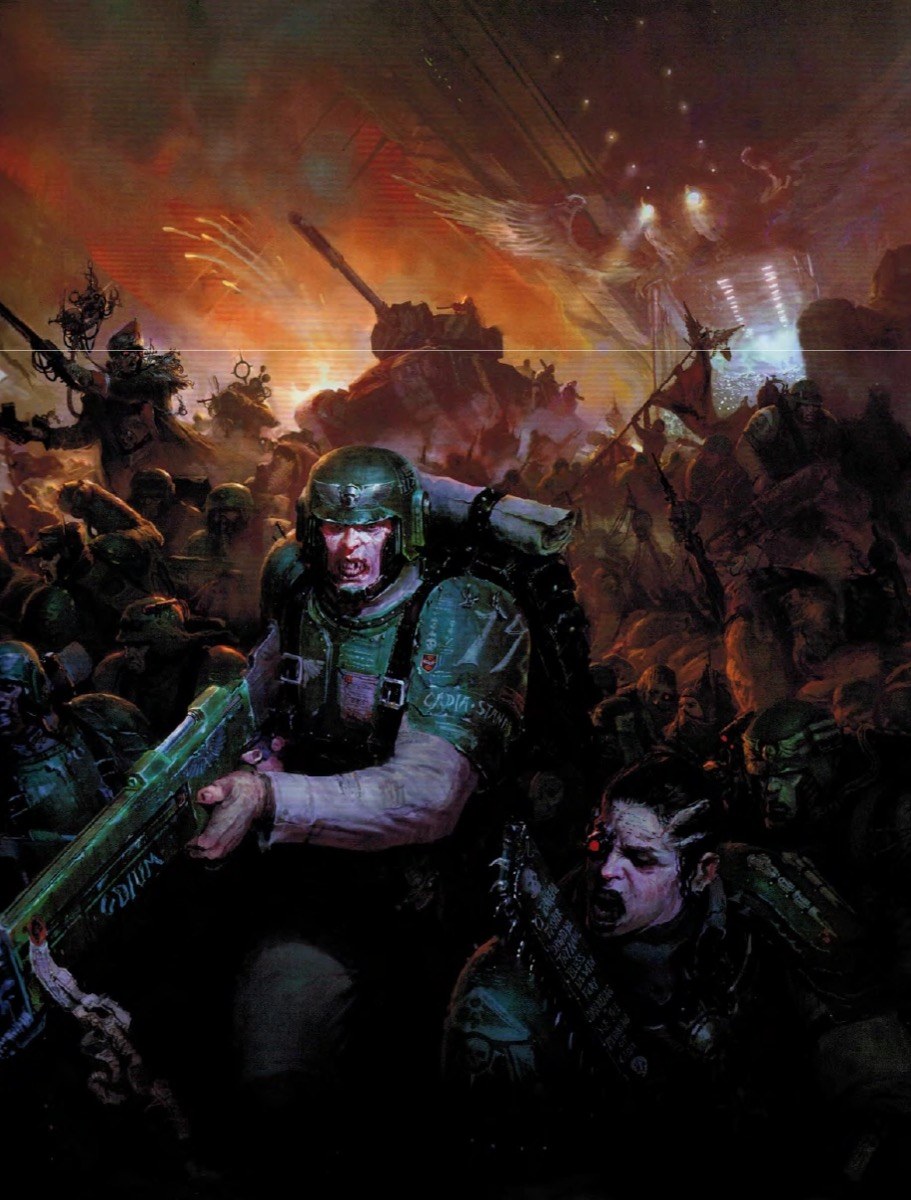 Painted image of militia troops holding a line on a world of the Imperium of Mankind Artwork © Games Workshop | |
| Abbreviation | |
| Other names | Planetary militia, planetary guard, planetary defence militia |
| Type | Planetary militia |
| Raised by | The Planetary Governor of the world, styled Imperial Commander |
| Tithe office | Departmento Munitorum |
| Origin | The Imperialis Militia of the Great Crusade, 798.M30 onward |
| Size | From a few hundred soldiers on a Frontier world to many regiments on a Hive world |
| Commanded by | The planetary governor, or a commander appointed by him or her; Imperial forces take over on arrival |
| Naval counterpart | System Defence Force |
| Feeds | Astra Militarum regiments |
| Overseen by | Sector command; the Inquisition when it distrusts the world |
| Loyalty | Variable; see Suspect loyalties |
The Planetary Defence Force, usually abbreviated PDF and also called the planetary defence militia, the planetary militia or the planetary guard, is the principal military force of a settled world of the Imperium of Mankind. It is controlled by the local planetary government and not by the Imperium directly. The raising, training, arming and leadership of its units rest wholly with the Planetary Governor of the world, and Imperial Law requires every Imperial planet to keep such a standing force, so that the governor, and through him the Imperium, may hold the world against invasion or insurrection.[1][2]
The PDF has no standard form. It is the local military of whatever kind of world it defends, and it may be a drilled regular army, a feudal levy, a tribal host, or on a Hive world little more than legitimised gangs armed by the government to keep down the more anarchic elements of the population. Its first duty is to engage any internal or external threat until Imperial reinforcements, whether the Astra Militarum or the Space Marines, can be mustered by the nearby sector command.[1][3]
The wider Imperial military seldom respects the PDF, for its soldiers are inexperienced. It is nevertheless valued by the Departmento Munitorum as the first line of defence of every Imperial world against invasion and rebellion, and as the chief source of recruits for the Imperial Guard. The best soldiers of a PDF are transferred into Guard regiments and shipped to distant war zones. The loyalty of a PDF is not always certain, and Imperial commanders are accustomed to treat it with caution.[4][5]
PDFs have fought in many of the great wars of the Imperium, among them the three Wars for Armageddon, the defence of Cadia, the invasion of Ultramar and the defence of Rynn's World. Some have become famous enough to be raised into the Guard as regiments in their own right.[3][6]
Chain of rule
[edit]The PDF is the military arm of the lowest level of the Imperial chain of rule. The table below shows where it stands among the offices that surround it.[1]
| Level | Office or division | Example |
|---|---|---|
| Terra | High Lords of Terra; Departmento Munitorum | Terra |
| Segmentum | Segmentum Fortress and the Master of the Segmentum | Segmentum Solar |
| Sector | Sector Governor; sector command | Calixis Sector |
| Sub-sector | Sub-sector governor | A sub-sector of the sector |
| Planet | Planetary Governor; Planetary Defence Force | A single world |
History
[edit]Origins in the Great Crusade
[edit]The PDF descends from the Imperialis Militia of the Great Crusade (798.M30 – 000.M31). When an expedition fleet brought a world to Imperial Compliance, it fell to the militia to secure and hold it. The militia formed the lowest and most common rank of the Imperial Army, the Imperialis Auxilia, within the great body of military and supply services known as the Excertus Imperialis. When a world was declared compliant and set under an appointed and independent Imperial Commander, one of that commander's chief duties was to raise a militia that would protect his domain and sustain his rule.[7]
The militia was meant in part to act as the enforcer of the Imperial Truth, and as the protector of the Iterators and the cadres of administrators who were left behind to oversee the long transition to full compliance. When the crusade hosts departed, such worlds stood alone. If rebellion ignited, the world's own militia was to crush it, and if xenos raiders came from outside, it was to hold until help arrived. The militia was therefore often the only bulwark against disorder, whether it was raised as conscripts from the masses of a hive city, from the yeomanry of a feudal order, or from tribal levies, and in this way it stood watch against the return of Old Night.[7][3]
The Imperialis Militia was never a single galaxy-wide organisation. Except in times of great emergency it did not answer to the chains of command of the Imperial Army. Each militia was a colonial defence force drawn from the people of its own world, and its commander-in-chief was the Imperial Commander of that world. Some were ancient martial classes that dated to the Age of Strife, others were irregular levies called out only in direst need, and most followed the template of command set out in the Principia Militaris only in general terms. Their equipment was as varied as their origins, from gaudy dress uniforms and plasmesh chain to furs and hides, or in a few cases to advanced local patterns of Carapace armour, within a minimum standard issued from the Principia Militaris command.[7]
Staffing
[edit]In theory the militias were irregular armies, whose members were first of all subjects of their world, called to arms only in emergency. In practice many worlds of large population needed a standing army simply to preserve civil order, and the militia came to consist of a professional core supplemented by citizens who served a term under arms and returned to civilian life. The core of commissioned and non-commissioned officers was usually made up of career soldiers, even on worlds with no martial culture, and many were veterans of the Imperial Army retired from the Great Crusade to a post where their skills might still serve the Imperium.[7]
The darker side of the arrangement was the indenture of prisoners and recidivists, and of thousands who were counted as Abhuman or as bearers of mutations below the human norm but not debased enough to warrant extermination. These soldiers served the militia unwillingly. Cadres of veteran Discipline Masters, the predecessors of the commissars, kept them in line by lethal sanction and chemical inducement where they judged it necessary.[7]
The Age of the Imperium
[edit]After the Horus Heresy (005–014.M31) the Imperium rebuilt its government in the Time of Rebirth, and the militias survived the change as the standing forces of the planetary governors. The tithe system that grew up in the following millennia drew on them, so that the Departmento Munitorum came to count a world's PDF among its resources when it assessed the regiments the world owed to the Astra Militarum. The records of those reforms are fragmentary and no source gives a date for the change.[2][a]
Planetary Defence Forces have fought on beside the Guard in every large war since. In the Baran campaign of 224.M41 a single regiment of the Death Korps of Krieg was given the Right of Settlement of the liberated world, and its fortified positions became the cities of the colony. As the generations passed, home-grown planetary regiments replaced the founders and were eventually inducted into the Guard as the Baran Siege Masters.[8]
The Era Indomitus
[edit]The wars of the late 41st millennium fell hardest on the planetary militias, which were the first force every invader met. During the 13th Black Crusade in c. 999.M41 the Cadian Interior Guard defended Cadia against the forces of Chaos and the Agripinaa Home Guard defended Agripinaa, while in the same year the Rynnsguard suffered heavily when Snagrod invaded Rynn's World and broke the Crimson Fists. The opening of the Great Rift in 999.M41 then cut many worlds off from the support of their sector commands, so that their militias had to hold alone.[6][9]
In the early Era Indomitus the militias of many reclaimed worlds are among the first Imperial forces to be rebuilt after the Indomitus Crusade passes. The PDF of Ultramar, which kept a proud tradition of service from the Heresy onward, stood among the best equipped and trained of all such forces.[10]
Organisation
[edit]The size of a PDF depends on the population and the wealth of its world. A frontier world may field a single company of militia. A larger population may permanently support professional corps, including elite special forces. These may be the house troops of a particular noble dynasty under the command of the planetary governor, or even kill squads of storm troopers.[1][4]
Command
[edit]The planetary governor commands the PDF in person or through an officer of his choosing, and in military matters he is styled Imperial Commander. If regular Imperial forces arrive in an emergency, command defaults automatically to them. A governor remains responsible for maintaining the militia and the orbital defences of his world, and because astropathic messages to Terra are often delayed or lost, he must frequently decide the defence of the world alone.[2]
Recruitment for the Guard
[edit]The tithe of the Departmento Munitorum requires a governor to supply regiments to the Astra Militarum, and these troops are often requisitioned from the planet's existing PDF. The best soldiers are transferred, given further training as they are shipped to their destination, and then enter the Guard. In this way the PDF serves a second purpose as a school for the Imperial armies.[2][4]
System Defence Forces
[edit]Wealthy worlds and star systems may add a naval arm. A System Defence Force is a small independent fleet that performs for its system the duties of the Imperial Navy, on a smaller and less well-equipped scale. Its ships may be System Defence Boats, light warships that cannot enter the Warp, though the most powerful forces own warships up to and including heavy cruisers.[1]
Suspect loyalties
[edit]Where regular Imperial forces arrive, the PDF yields them command, but there are many reasons for part or all of a militia to join a revolt against Imperial authority. Infiltration by Chaos or by xenos, in particular the Genestealer cults, can divide a PDF, which may turn traitor or be psychically enslaved by relatives of the cult. The ambition of a corrupt governor or of another body that controls the world may likewise turn the militia against the off-world forces of the Imperium.[6][11]
This risk is a standing cause of mistrust in the Imperium as a whole, and Imperial commanders prefer, when they can, to rely on forces that did not come from the world. Inquisitors are known for their lack of trust in the local PDF of a world they are investigating, and they often keep regular Imperial troops at hand, particularly the Chambers Militant of their own order. Regiments on certain worlds have betrayed their governors when the incentive was right, and Guard records describe the event as common on frontier worlds, while the Administratum reports record it as rare.[5][1]
Notable Planetary Defence Forces
[edit]The Armageddon Defence Force defended its hive world in every one of the Wars for Armageddon, against the forces of Chaos in the first war and against the Orks under Ghazghkull Thraka in the second (from 941.M41) and third (from 998.M41). On Cadia the Cadian Interior Guard and on Tarsis Ultra the Erebus Defence Legion fought beside Space Marines against invaders, the latter in 999.M41 against Hive Fleet Leviathan, before the world was ruined by the Iron Warriors' Warsmith Honsou with the Heraclitus Virus.[12][13]
The Kaerls of Fenris fought beside the Space Wolves in the first battle of the Fang against the Daemon Primarch Magnus the Red, and the PDF of Ultramar, the Ultramar Auxilia, has been a major part of the defence of the realm at the Battle of Macragge and against Honsou's invasion. The Macharian PDF of the Cadian Sector is known for its devotion to the Imperial Creed, and it adorns its veterans with purity seals. The Maccabian Militia of Maccabeus Quintus trace their traditions to the Angevin Crusade of the 39th millennium, and their best soldiers join the Maccabian Janissaries of the Astra Militarum.[7][10][3]
The Vervun Primary defended the hive of Verghast during the Sabbat Worlds Crusade, and the Tartarus Planetary Defence Force held its world when Orks, Guard regiments, Alpha Legion, Aeldari of Biel-Tan and Blood Ravens fought across it in the 41st millennium.[14][3]
Timeline
[edit]| Date | Event |
|---|---|
| Age of Strife | Ancient martial classes that later become part of planetary militias arise on isolated worlds. |
| 798.M30 | The Imperialis Militia is formed on compliant worlds during the Great Crusade.[7] |
| 005–014.M31 | The Horus Heresy tests the militias of the Imperium. |
| M32 | The Kaerls of Fenris fight beside the Space Wolves at the Fang against the Thousand Sons.[3] |
| M36 | The Age of Apostasy leaves many planetary governors, and their forces, isolated from Terra. |
| M39 | The Maccabian Militia begins its tradition of service in the Angevin Crusade.[10] |
| 224.M41 | The 127th Infantry Regiment of the Death Korps of Krieg is given the Right of Settlement of Baran; its settlements later produce the Baran Siege Masters.[8] |
| 941.M41 | The Second War for Armageddon begins, and the Armageddon Defence Force fights beside the Guard.[12] |
| 998.M41 | The Third War for Armageddon. |
| 999.M41 | The 13th Black Crusade, the invasion of Rynn's World, Hive Fleet Leviathan and the opening of the Great Rift all strike planetary militias.[6][9] |
See also
[edit]- Planetary Governor
- Astra Militarum
- Imperial Armed Forces
- Departmento Munitorum
- Governance of the Imperium
- Sector Governor

Notes
[edit]- ^ No record preserves the date at which the Munitorum began to draw on planetary militias through the tithe. The estimate of the early 32nd millennium found in some histories is inferred from the sequence of events.
References
[edit]- ^ a b c d e f Only War: Core Rulebook (roleplaying game). Fantasy Flight Games. p. 50.
- ^ a b c d Warhammer 40,000: Rulebook (8th edition). Games Workshop. p. 27. Only War: Core Rulebook (roleplaying game). Fantasy Flight Games. pp. 51, 334-337.
- ^ a b c d e f Haley, Guy. Baneblade (novel). Black Library. ch. 14.
- ^ a b c Codex: Imperial Guard (4th edition). Games Workshop.
- ^ a b Mitchell, Sandy. For the Emperor (novel). Black Library. Mitchell, Sandy. Death or Glory (novel). Black Library.
- ^ a b c d Codex: Eye of Terror (3rd edition). Games Workshop. p. 24.
- ^ a b c d e f g The Horus Heresy Book Five: Tempest. Forge World. pp. 176-177.
- ^ a b "Swordwind Part 3: The Baran War". Games Workshop (web publication).
- ^ a b Parker, Steve (2012). Rynn's World (novel). Black Library. chs. 1, 6, 7, 9, 11, 13, 15. Aeronautica Imperialis: Rynn's World Air War. Games Workshop. p. 34.
- ^ a b c Codex: Ultramarines (2nd edition). Games Workshop. pp. 12-15. McNeill, Graham. Warriors of Ultramar (novel). Black Library.
- ^ Codex: Tyranids (5th edition). Games Workshop. p. 13.
- ^ a b Codex: Armageddon (3rd edition). Games Workshop. p. 2.
- ^ McNeill, Graham. Dead Sky, Black Sun (novel). Black Library. McNeill, Graham. "The Heraclitus Effect" (short story). Black Library.
- ^ Abnett, Dan. Necropolis (novel). Black Library. ch. 1.