
Time of Rebirth
| Time of Rebirth | |
|---|---|
| First age of the Imperium of Mankind after the Horus Heresy | |
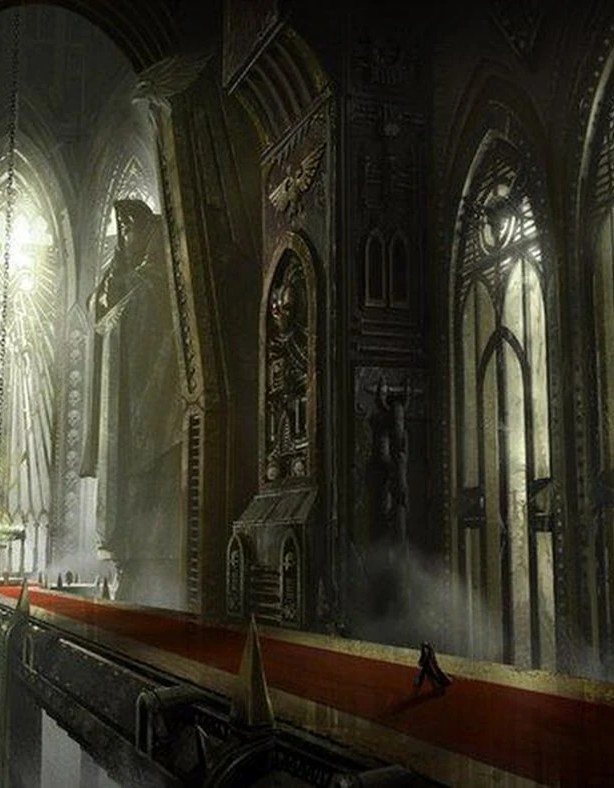 The nave of an early Imperial basilica. The cults of the God-Emperor grew into the state church during the Time of Rebirth Artwork © Games Workshop | |
| Period | 014.M31 to c. 546.M32 |
| Preceded by | Horus Heresy |
| Followed by | The Forging |
| Rulers | Roboute Guilliman (Lord Commander, to 121.M31); the High Lords of Terra |
| Key events | Great Scouring; Codex Astartes; Second Founding; Third Founding; first Black Crusade; rise of the Adeptus Ministorum; War of the Beast |
| Institutions founded | Inquisition; Astra Militarum and Imperial Navy as separate commands; Adeptus Ministorum |
The Time of Rebirth, also called the Age of Rebirth, was the first age of the Imperium of Mankind after the Horus Heresy. It began with the end of the Siege of Terra in 014.M31 and lasted until about the middle of the 32nd millennium, when the War of the Beast and the Beheading of the High Lords closed it. In these five centuries the Imperium recovered from the civil war, drove the Traitor Legions from its space and rebuilt its government around the absence of the Emperor, who sat silent on the Golden Throne.[1]
Almost every institution of the later Imperium took its form in this age. Roboute Guilliman's Codex Astartes broke the Space Marine Legions into Chapters, the Imperial Army was divided into the Astra Militarum and the Imperial Navy, and the High Lords of Terra became the Imperium's ruling council. The age also saw the rise of the worship of the Emperor as a god, which the Emperor had forbidden in life. By the 32nd millennium the cults of the God-Emperor had been united into the Adeptus Ministorum, the state church of the Imperium.[2]
Imperial historians name the age for its rebuilding, but it was not peaceful. The Great Scouring, the Iron Cage, the fall of Guilliman at Thessala, the First Black Crusade and the return of the Orks in strength all fell within it, and the primarchs who had survived the Heresy died, disappeared or withdrew one by one.[1]
Name and extent
[edit]The age is called the Time of Rebirth in most sources and the Age of Rebirth in some. Its beginning is fixed by the end of the Heresy and the Emperor's entombment in the Golden Throne, about 014.M31. Its end is placed in the middle of the 32nd millennium, with the War of the Beast (544–546.M32) and the murder of the High Lords that followed, after which the rebuilt Imperium entered The Forging.[1]
Background
[edit]The Imperium that survived the Siege of Terra was crippled. Nine of the eighteen Legions had turned traitor, and the loyal Legions had lost a large part of their strength at Isstvan V, Calth and Terra. Much of the Imperial Army and the Mechanicum had gone over to Horus. Countless worlds had been destroyed or had declared for the Warmaster, and many others had been cut off by the Ruinstorm for years. The Emperor, the source of all authority in the Imperium, could no longer speak or rule.[3]
The government passed to the surviving members of the Council of Terra and to Roboute Guilliman, who as the senior surviving loyal primarch took the office of Lord Commander and acted as Imperial Regent. Malcador the Sigillite had died at the end of the Siege, and with him the old council. The new High Lords of Terra governed in the Emperor's name, but their powers were not yet fixed, and the first centuries of the age were spent deciding what they would be.[4]
Reconstruction
[edit]The Great Scouring
[edit]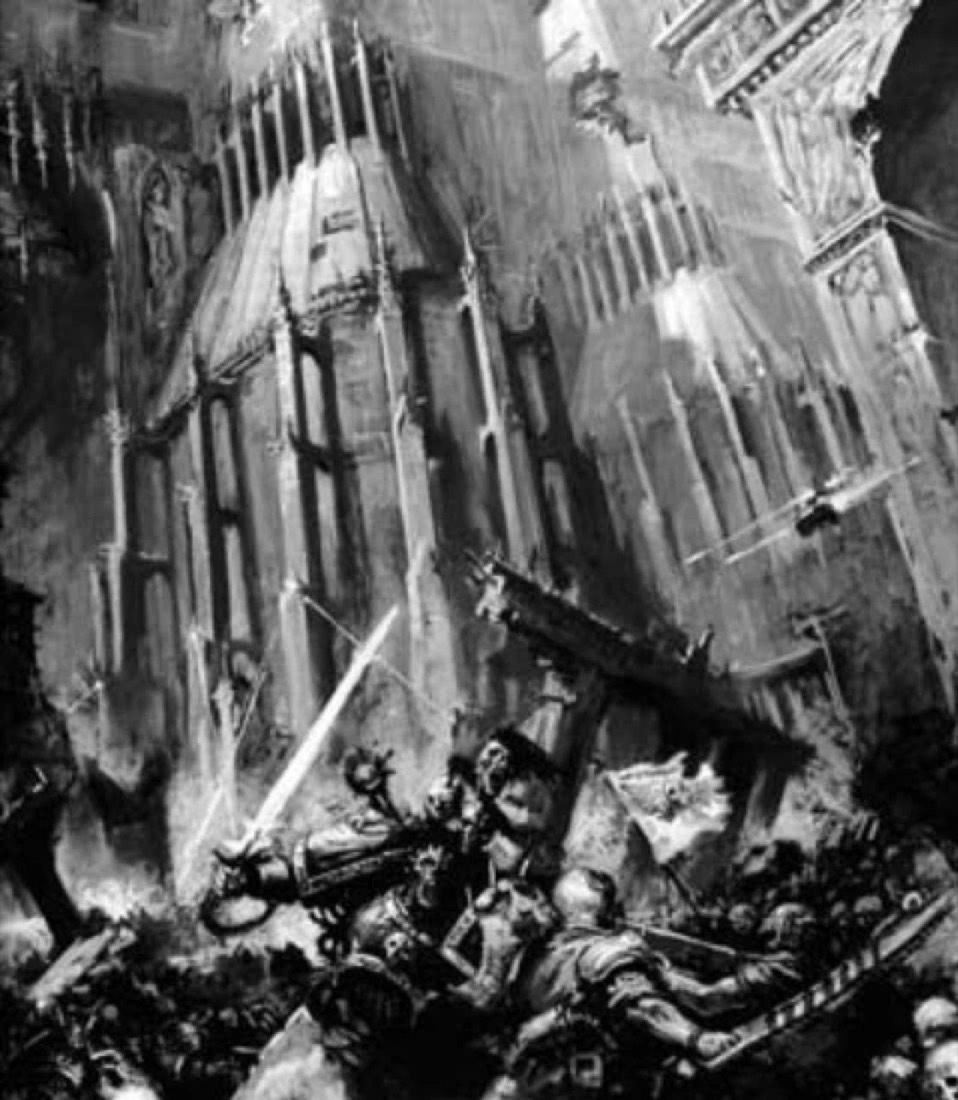
The first task of the age was to drive out the traitors. The Great Scouring, begun in 014.M31, was a counter-offensive across the whole Imperium. The traitor forces that had survived Terra fled before the loyalist Legions, the Imperial Army and the Custodes. Most took refuge in the Eye of Terror and in lesser rifts such as the Maelstrom. Worlds that had sided with Horus were reconquered or, if they were judged beyond saving, destroyed. Isstvan V and Davin were scoured of life. Fighting continued for solar decades before the traitor forces were destroyed or exiled into the Eye, and many corrupted systems were placed under the watch of the newborn Inquisition.[5]
The Codex and the Second Founding
[edit]Guilliman's reforms were meant to make another Heresy impossible. His Codex Astartes divided each loyal Legion into Chapters of about a thousand warriors, so that no commander could again hold the power that Horus had. The Second Founding, in about 021.M31 and in the midst of the Scouring, put this into effect. The Imperial Army was split into the Astra Militarum, which fought on the ground, and the Imperial Navy, which held the ships, so that no officer controlled both the soldiers and the means to move them.[6]
The reforms were resisted. Rogal Dorn refused at first to divide the Imperial Fists, and the quarrel between the two primarchs came close to fighting. It was settled only after the Imperial Fists were trapped in the Iron Cage, a battle against the Iron Warriors, and saved by the Ultramarines. Dorn relented afterwards.[6]
The Inquisition
[edit]The Inquisition had its origin in the agents whom Malcador had recruited during the Heresy. In the Time of Rebirth it became a standing institution, charged with hunting the enemies of the Imperium wherever they were found.[1]
The loss of the primarchs
[edit]The age is also the age in which the primarchs passed out of the Imperium. In 121.M31 Guilliman was mortally wounded by the daemon primarch Fulgrim at Thessala. He was placed in a stasis field in the Temple of Correction on Macragge, which became one of the great pilgrim shrines of the Imperium. Lion El'Jonson disappeared after the destruction of Caliban, Leman Russ departed into the Eye of Terror, and Jaghatai Khan disappeared into the Maelstrom in 084.M31 and Corvus Corax into the Eye of Terror in pursuit of the traitors. Vulkan, reborn after each death, disappeared in the middle of the 31st millennium and reappeared only in the War of the Beast.[4]
Rogal Dorn was the last to fall. In 781.M31 Abaddon launched the First Black Crusade, which opened with the First Battle of Cadia. Dorn is generally believed to have fallen in the fighting, in a last attack on the bridge of the Chaos flagship; his skeletal left fist is kept as a relic aboard the Imperial Fists' fortress-monastery. The Black Crusade ravaged the Segmentum Obscurus for several solar decades. At its end Abaddon recovered the daemon sword Drach'nyen on the world of Uralan in the Eye of Terror, and was recognised by the Chaos Gods as the successor of Horus and Warmaster of Chaos Undivided.[4]
The departure of the primarchs left the Imperium without its greatest leaders. In the Time of Rebirth the High Lords came to depend on the Third Founding, which Dorn himself had urged, and on later Foundings to keep the Adeptus Astartes at strength.[1]
Rise of the Ministorum
[edit]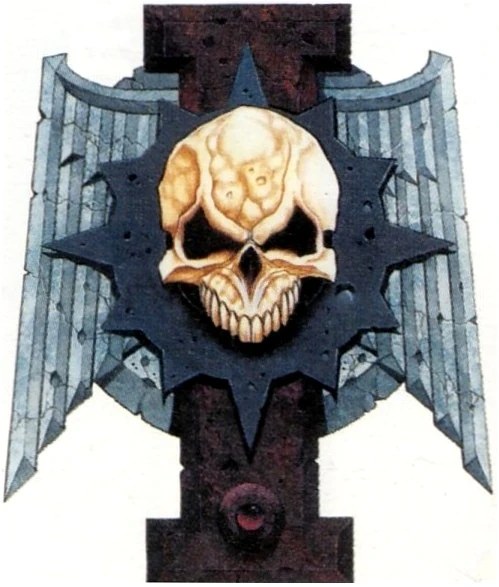
The Emperor had preached the Imperial Truth, which denied all gods, but a cult that worshipped him as divine, the Lectitio Divinitatus, had spread through the Imperial Army and the expedition fleets during the Great Crusade. After his entombment the worship of the Emperor grew quickly. On thousands of worlds cults arose that taught that he had sacrificed himself for humanity and watched over it from the Throne.[2]
Over the centuries most of these cults were gathered into one church by the largest of them, the Temple of the Saviour Emperor. In the 32nd millennium the High Lords recognised it as the state religion of the Imperium and gave it the title of Adeptus Ministorum. A few centuries later the Ecclesiarch Veneris II was given a seat among the High Lords, and three hundred years after that the seat was made permanent. The Ministorum's preachers carried the Imperial Creed to every world, and the faith became one of the bonds that held the Imperium together. It also became a political power, which in later ages would rival the Administratum itself.[2]
Wars of the age
[edit]Apart from the Scouring and the First Black Crusade, the records of the age list many lesser wars. Alien powers that had been defeated during the Great Crusade returned to attack the weakened Imperium, and traitor bands raided from the Eye. The greatest war of the age, the War of the Beast of 544–546.M32, came at its end. Orks led by warlords the Imperium called the Beasts attacked the Imperium on a massive scale, with several assaults on Terra itself. The Imperium halted them only by the most extreme measures, at great cost to the Chapters of the Adeptus Astartes. In the aftermath the Inquisition was divided into the Ordo Xenos and the Ordo Malleus, the Deathwatch was raised, the office of Lord Commander was abolished, and the Captain-General of the Adeptus Custodes was given a seat among the High Lords.[7]
The same year the Grand Master of Assassins had the High Lords murdered in the Beheading. The Grand Master, who ruled as Lord Protector for nearly a standard century, grew into a tyrant and was removed by a Space Marine force under the Lord Commander, Maximus Thane. The years of disorder that followed, until the Ultramarines Chapter Master Agnathio restored the council in 646.M32, are usually counted as the beginning of The Forging.[1]
Legacy
[edit]The Time of Rebirth gave the Imperium the shape it has kept for ten thousand years: Chapters rather than Legions, a divided military, a council of High Lords ruling in the name of a silent Emperor, and a state church that worships him.[1]
Timeline
[edit]The principal dated events of the age, from the end of the Siege of Terra to the Beheading. See also 31st millennium and 32nd millennium.
| Date | Event |
|---|---|
| 014.M31 | The Emperor of Mankind placed on the Golden Throne; Roboute Guilliman becomes Lord Commander of the Imperium. |
| From 014.M31 | The Great Scouring drives the Traitor Legions into the Eye of Terror; it lasts for solar decades. |
| c. 021.M31 | In the midst of the Scouring, the Second Founding breaks the loyal Legions into Chapters. |
| 084.M31 | Jaghatai Khan disappears into the Maelstrom. |
| 121.M31 | Guilliman mortally wounded by Fulgrim at Thessala. |
| 211.M31 | Leman Russ leaves Fenris and is not seen again. |
| 781.M31 | The First Black Crusade; Rogal Dorn reported killed. |
| Early M32 | The Temple of the Saviour Emperor is recognised as the state religion; the cults of the Emperor are united as the Adeptus Ministorum. |
| 200.M32 | Ecclesiarch Veneris II joins the High Lords of Terra. |
| 544–546.M32 | The War of the Beast. |
| 546.M32 | The Beheading of the High Lords closes the age. |
| 646.M32 | Agnathio restores the council of twelve High Lords. |
See also
[edit]

References
[edit]- ^ a b c d e f g Haley, Guy. The Beheading (novel). Black Library.
- ^ a b c Warhammer 40,000: Rulebook (8th Edition), pp. 40-47, 50-53, 123, 134, 152, 164-166. Games Workshop.
- ^ Black Legion - A Codex: Chaos Space Marines Supplement (6th Edition) (Digital Edition), pp. 26-28, 65. Games Workshop.
- ^ a b c Warhammer 40,000: Rulebook (6th Edition), pp. 168-177. Games Workshop.
- ^ Warhammer 40,000: Rulebook (5th Edition), pp. 122-129. Games Workshop.
- ^ a b Haley, Guy. The Beheading (novel). Black Library.
- ^ Warhammer 40,000: Rulebook (8th Edition), pp. 40-47, 50-53, 123, 134, 152, 164-166. Games Workshop.