
Koronus Expanse
| Koronus Expanse | |
|---|---|
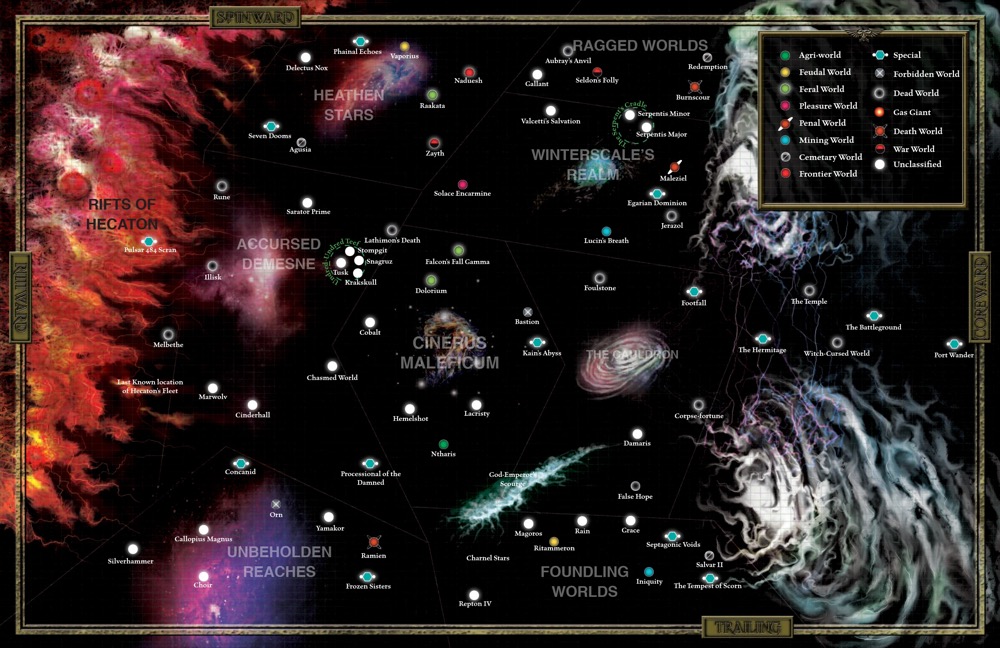 Chart of the Koronus Expanse, showing its named regions and the worlds of the Halo Stars Artwork © Games Workshop | |
| Type | Unexplored frontier region beyond an Imperial sector |
| Segmentum | Segmentum Obscurus, on the Halo Stars |
| Sector capital | None; administered from the way station of Port Wander under the Calixis Sector |
| Sub-sectors | Rifts of Hecaton, Heathen Stars, Accursed Demesne, Cinerus Maleficum, Foundling Worlds, Unbeholden Reaches, Winterscale's Realm, Ragged Worlds |
| Notable worlds | Port Wander, Footfall, Solace Encarmine, Maleziel, Furibundus, Grace, Rain, Iniquity |
| Governing body | The Calixian Warrants of Trade, granted to the Rogue Trader dynasties; Navis Imperialis wardens at Port Wander |
| Status (as of M42) | Partly settled by Rogue Traders and Imperial colonists; contested by Orks, Aeldari, Chaos cults and rival dynasties |
The Koronus Expanse is the name given by the authorities of the Imperium of Mankind to a dangerous and largely unexplored region of the Halo Stars, beyond the Calixis Sector on the northwestern edge of the galaxy. It is entered only through the Koronus Passage, which Rogue Traders call "the Maw", a navigable route through the great warp storms that guard the region. The passage ends at the way station of Port Wander, in the Rubycon II system, and beyond it the Expanse is a scattered region of stars, worlds and warp anomalies.[1]
The Expanse was untouched by the Great Crusade. Its worlds are a mixture of heathen Human colonies, Imperial outposts, xenos ruins and realms of pirates and cultists. Scholars of the Inquisition regard it as a frontier where the Imperium's claim is thin, and where records are unreliable, since most of what is known comes from the logs of Rogue Traders, who have every reason to exaggerate their finds or hide them.[1][a]
History
[edit]Before the Rogue Traders
[edit]The Expanse was known to the Imperium only as a rumour until the Age of Apostasy. During the reign of Goge Vandire (100–600.M36), the Ecclesiarch Sebastian Thor granted the Haarlock Charter to the Free Captain Mordercai Haarlock. Solomon Haarlock's fleet undertook the 13-year Great Voyage (723–736.M36) and charted a volume of space it named the Calyx Expanse, the first known survey of the region. Haarlock's chart is preserved in the Koronus Fragments, which were recovered in 101.M38 during preparations for a proposed Crusade that was never launched.[1]
The Age of Plunder
[edit]The stories brought back from the Expanse drew many Free Captains and Rogue Traders in the late 37th and 38th millennia. The Angevin Crusade (322–384.M39) forged the Calixis Sector from the border region of the Expanse, and Calixian forces raised the first Imperial claims on its nearer worlds. In 997.M40 the Rogue Trader Purity Lathimon discovered the Maw, which made the passage a regular route for merchants.[1]
The Calixian Warrants of Trade were granted in 055.M41, allowing the Lord Sector Calixis and his successors to license Rogue Traders to trade and settle within set limits. The warrants gave the Expanse a legal footing, but they also encouraged the rapid, reckless exploitation that many later Imperial reports condemn.[2]
The 41st millennium
[edit]Port Wander was founded by the Navis Imperialis in 917–924.M40, and it became the Expanse's main anchorage. The Ork WAAAGH! of Gulgrog smashed through the Maw in 422.M41 and laid siege to the station, and the Imperial defenders held it only after a long war. The Gothic War (139–160.M41) reached the Expanse only through its rumours, but Aeldari raiders struck Rogue Trader fleets in orbit of the Dead World in 152.M41.[1]
Many Rogue Traders have vanished in the Expanse. Kobras Aquairre, a merciless figure who sailed through the Maw in 101.M41, is recorded as having died in 151.M41 after a decade without a report from his armada, although some accounts place him in the Rifts of Hecaton until 201.M41. The dynasty of Winterscale founded its own realm in 188–274.M41, and Parsimus Dewain founded the city of Footfall in 410.M41, which he governed until his death in 498.M41.[1]
Geography
[edit]The Expanse is divided into named regions, some of which are marked on the Imperial charts. The Rifts of Hecaton lie in a belt of volatile stars, and it is there that the warp rifts are said to have swallowed whole fleets. The Heathen Stars hold worlds of ancient Human colonies that have not been reached by the Imperium since the Age of Technology. The Accursed Demesne and the Cinerus Maleficum are regions of dying stars, where the warp is thin and unpredictable.[1]
On the far side of the Expanse are the Foundling Worlds, a cluster of young Imperial colonies, and the Unbeholden Reaches, where no Imperial survey has been completed. The Ragged Worlds and Winterscale's Realm lie nearer to the Passage and are the best-settled regions. The Expanse has no established warp routes, and only a few of its stars can be approached with some confidence.[1]
Notable worlds
[edit]Port Wander is the way station at the mouth of the Maw. Its void station is the only Imperial anchorage in the Expanse, and it is administered by the Navis Imperialis under the authority of the Calixian Warrants. Its records are the main source of Imperial knowledge of the region.[1]
Footfall is a palace-city world founded by Parsimus Dewain and later under the tyranny of Tarn Marvolus. Solace Encarmine and Maleziel are settled worlds of Winterscale's Realm, and Furibundus is a system of frontier mining worlds. Grace, Rain and Iniquity are among the Foundling Worlds, which have been settled by Rogue Traders and their clients.[1]
Governance
[edit]Imperial authority in the Expanse rests on the Calixian Warrants of Trade. Under them, the Lord Sector Calixis and his heirs license Rogue Trader dynasties to hold worlds and trade within set limits. The dynasties govern their own domains with broad powers, and the Navis Imperialis keeps a small garrison at Port Wander to enforce the warrants.[2]
The Inquisition takes a limited interest in the Expanse through the Calixian Conclave and the Ordo Xenos. Its agents are often in conflict with Rogue Traders over the handling of xenos artefacts and the treatment of heretical colonies.[3]
Military
[edit]There is no sector battlefleet in the Expanse. Warfare is conducted by Rogue Trader fleets and their private armsmen, with occasional support from Battlefleet Calixis when a threat reaches the Maw. The Expanse's principal enemies are the Orks of the Expanse, the raiders of Chaos and the Aeldari, who maintain craftworlds beyond the regions the Imperium has surveyed.[1]
Timeline
[edit]| Date | Event |
|---|---|
| c. 723–736.M36 | Solomon Haarlock's Great Voyage charts the Calyx Expanse[b] |
| 395.M36 | The Haarlock Charter is granted by Sebastian Thor |
| 101.M38 | The Koronus Fragments are recovered during preparations for a Crusade |
| 322–384.M39 | The Angevin Crusade forges the Calixis Sector from the Expanse's border region |
| 997.M40 | Purity Lathimon discovers the Koronus Passage, the Maw |
| 917–924.M40 | The Navis Imperialis founds Port Wander in the Rubycon II system |
| 055.M41 | The Calixian Warrants of Trade are granted for the Expanse |
| 101.M41 | Kobras Aquairre enters the Expanse through the Maw |
| 139–160.M41 | The Gothic War is fought in neighbouring space; the Expanse feels its effects through trade |
| 188–274.M41 | The dynasty of Winterscale forms its realm |
| 410.M41 | Parsimus Dewain founds Footfall |
| 422.M41 | WAAAGH! Gulgrog breaks through the Maw and besieges Port Wander |
| 498.M41 | Death of Parsimus Dewain |
| Era Indomitus | Rogue Trader realms are contested by Orks, Aeldari and Chaos cults as the Imperium turns to its frontier worlds |
See also
[edit]

Notes
[edit]References
[edit]- ^ a b c d e f g h i j k Warhammer 40,000: Rogue Trader (PC Game). Rogue Trader: Edge of the Abyss (RPG), pp. 48, 59, 63-65.
- ^ a b Rogue Trader: Fallen Suns (RPG), pp. 4, 7-12, 19-24, 28, 44-47. Black Crusade: Core Rulebook (RPG), pp. 320, 344-345.
- ^ Only War: Core Rulebook (RPG), pp. 330-348. Rogue Trader: Core Rulebook (RPG), pp. 113, 336-362.