
Warp travel
| Warp travel | |
|---|---|
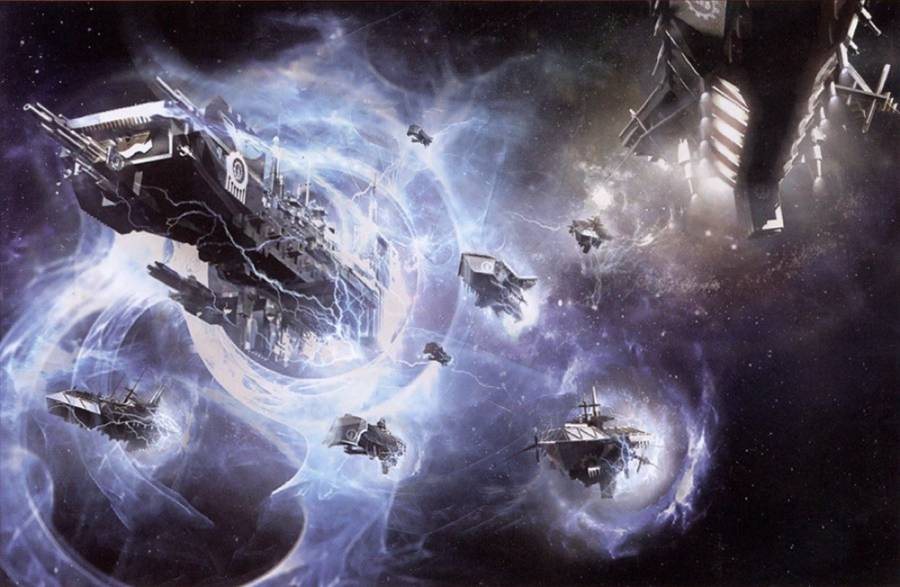 A fleet of the Imperial Navy translating from the Warp into realspace, from a pict-capture of the Great Crusade Artwork © Games Workshop | |
| Type | Faster-than-light travel through the Immaterium |
| Developed | The 18th millennium, in the Dark Age of Technology |
| Requires | A warp drive, a Geller field, and usually a Navigator |
| Guided by | The Astronomican |
| Overseen by | Imperial Navy, Navis Nobilite, Adeptus Mechanicus |
| Alternatives | Webway; Necron dolmen gates |
| Present state | Perilous and divided by the Great Rift since 999.M41 |
Warp travel, also called warp translation or the warp jump, is the means by which the Imperium of Mankind and most other starfaring powers cross the distances between stars. A ship with a warp drive opens a passage from realspace into the Warp, also known as the Immaterium, a dimension of thought and emotion in which distance, time and direction do not behave as they do in the material universe. It travels there under the protection of a Geller field and the guidance of a Navigator, and returns to realspace at its destination. A voyage that would take thousands of years at sublight speeds may take weeks or months in the Warp.[1][2]
The Warp is not a road. Its tides and storms shift without pattern, and no two crossings are alike. A ship may arrive years before it left, or centuries after, or not at all. A fraction of all vessels that enter it are never seen again, and the Imperium accepts the loss as the cost of holding a galaxy-wide domain together. Every part of the Imperium's government, from the collection of the Imperial tithe to the movement of armies, is shaped by the fact that travel is slow, uncertain and dependent on a small number of people with rare gifts.[2]
Since the opening of the Great Rift in 999.M41 the Imperium has been divided between the Imperium Sanctus and the Imperium Nihilus, and the safe crossing of the Warp has become harder than at any time since the Horus Heresy. The Webway and the dolmen gates of the Necrons provide other means of crossing space, and each has its own dangers.[3]
Principles
[edit]The warp drive
[edit]A warp drive is a large engine that tears a hole between realspace and the Warp. The Imperial Navy builds its drives to many patterns, and the drive was invented by mankind in the 18th millennium, in the early Dark Age of Technology, together with the Geller field. Before it, travel between the stars was limited to sublight speeds and took generations.[4] A drive cannot be used deep inside a star's gravity well, where realspace is too firmly fixed to be breached. A ship must first travel under sublight power to a jump point, a region far from the system's sun and its largest worlds. For a system with a heavy primary star this journey may take days or weeks, and in that time a fleet is vulnerable to attack. The same restriction governs arrival: a ship leaves the Warp at the edge of a system, not at its worlds.[1]
The moment of entry is called translation. The hull is sealed, the Geller field is raised, and the drive is brought up to power. The ship sinks into the Warp as a stone sinks into water. Inside the field the crew lives as it does in realspace, but outside the hull the Immaterium presses at the shield, and the sensors show what the Navigator describes as a sea of colour and faces.[1]
Navigators and the Astronomican
[edit]A ship in the Warp cannot be steered by instruments, because the Warp has no fixed directions. The task falls to a Navigator, a member of one of the noble houses of the Navis Nobilite. A Navigator has a mutation, the third eye, that lets him look directly into the Warp without being destroyed by it. He finds the way by the light of the Astronomican, the psychic beacon projected from Terra by the Emperor of Mankind on the Golden Throne. To a Navigator the Astronomican is a bright point in the Warp, and from its position and the shape of the currents around it he judges the course. Without it, the Navigator is blind.[1][5]
Navigator houses hold their charters from the Adeptus Terra, and without a Navigator no ship of the Navy will make a long voyage. Their art is hereditary and jealously held. A good Navigator can often feel the currents ahead and warn of storms, and a ship with a gifted one may cut weeks from a crossing.[5]
Time in the Warp
[edit]Time in the Warp has no fixed relation to time outside it. A journey of the same distance may take a week one time and a year the next. Ships have left a system and arrived at their destination before they set out, and others have emerged into realspace centuries after their crews believed they had entered the Warp. The effect is stronger in storms. Crews also age at their own rate, so a returning ship may carry men who are older or younger than the date suggests. The Imperium keeps its records in Terran Standard time, and every report from a distant world is understood to describe events that are already past.[1]
Routes and jumps
[edit]Short jumps
[edit]A ship without a Navigator may make a calculated jump, which the Navy calls a blind jump. The drive observes the currents of the Warp from realspace and sets a course on the assumption that they will not change in flight. No calculated jump of more than four light-years is held to be safe, and a piloted jump may cover thousands. A ship that jumps blind has no way to avoid a storm, and may emerge in the wrong place, or deep within a star.[1]
Stable routes
[edit]Over the millennia the Navy and the Navigator houses have recorded the more reliable courses between worlds. These are called warp routes. They follow currents that stay predictable for decades or centuries, and an Imperial trade lane or pilgrimage route will often follow such a course for its whole length. A warp route is never safe: a stable current may fail in a night, and a route that served for a thousand years may close.[1][2]
Worlds that lie on a stable route prosper. Worlds that lie off it may be visited once in a century, or not at all. The Black Ships that collect the psykers of the Imperium follow such routes, and a world that falls out of its schedule through the shifting of the Warp may not be visited again for generations.[2]
The Great Rift
[edit]The opening of the Great Rift, also called the Cicatrix Maledictum, in 999.M41, was the greatest single blow to Warp travel since the Horus Heresy. The Rift is a wound in realspace and the Warp that crosses the galaxy from the Eye of Terror to the Hadex Anomaly and divides the Imperium in two. The light of the Astronomican cannot be seen across it, and in the Imperium Nihilus it can scarcely be seen at all. In the years that followed, thousands of worlds were swallowed by the Noctis Aeterna, the long night, and a large share of the ships that entered the Warp in those regions were lost or scattered.[3]
Navigators of the Imperium Nihilus have had to find their way without a beacon, by the memory of old charts and the guidance of the stronger houses. The Rift has cut off whole regions from the light of the Astronomican, and Imperial scholars hold that the Navigators who work there do so under conditions harsher than any since the Age of Strife.[3]
The best known passage through the Rift is the Nachmund Gauntlet, one of only two confirmed stable passages through the Rift. It crosses from Vigilus in the Imperium Nihilus to Sangua Terra in the Imperium Sanctus, and is held open by the blackstone in the crusts of those two worlds. Many ships that have tried the passage have been destroyed.[3]
Alternatives
[edit]The Webway
[edit]The Aeldari and the Drukhari travel through the Webway, a labyrinth of tunnels that runs between realspace and the Warp and is not subject to its storms. The Webway allows rapid passage across the galaxy, and its gates are guarded by ancient powers. The Emperor built a Webway beneath the Imperial Palace, whose unfinished state became one of the central matters of the Webway War in 004–014.M31. The Imperium has seldom used it, and the Inquisition regards its use as a matter for the Ordo Xenos.[6]
Necron dolmen gates
[edit]The Necrons have no psykers and leave no imprint in the Warp. Their dolmen gates are living stone portals that open on a portion of the Webway made by the Old Ones, and they remain the only means the Necrons have of crossing the Warp. They were first made in the War in Heaven, before which the Necrons relied on slow sublight stasis-ships. Most gates still scattered across the galaxy have been destroyed or have failed with age, but those that survive allow a dynasty to strike across a wide area without warning.[6]
Notable disasters
[edit]The Imperium has lost many fleets in the Warp. The following are among the best recorded.
- The Eisenstein, 005.M31. The frigate fled Isstvan III with a damaged Geller field and carried the first warning of Horus's treachery. It survived, with daemons loose aboard.[7]
- The Ruinstorm, 007.M31. The storm unleashed by Erebus of the Word Bearers at Calth blocked large parts of the galaxy to travel and communication, and the loyalist Legions could rarely navigate the Warp through it. It began to wane in c. 011.M31 and dissipated after the war.[7]
- The Aletris. The flagship of the Rogue Trader Emanuel Hadex followed its captain into the Hadex Anomaly, where time ran loose and the fleet mutinied. Its crew died and the ship drifted, and the Navy found it in 779.M41 at the edge of a ring of derelicts.[8]
- The Noctis Aeterna, 999.M41. The long night that followed the opening of the Great Rift darkened the Astronomican across the greater part of the galaxy and wrecked or scattered many fleets, among them ships of the early Indomitus fleets.[3]
Timeline
[edit]| Date | Event |
|---|---|
| M18 | The warp drive and the Geller field are developed in the Dark Age of Technology. |
| M25 | Warp storms isolate the human worlds in the Age of Strife for about five thousand years. |
| Early M30 | The Fall of the Aeldari and the birth of Slaanesh open the Eye of Terror. |
| 798.M30 | The Great Crusade sets out from Terra, guided by the Astronomican and the first Navigator houses. |
| 004–014.M31 | The Webway War is fought beneath the Imperial Palace. |
| 005.M31 | The frigate Eisenstein escapes Isstvan III with a failing field. |
| 007.M31 | The Ruinstorm is raised at Calth and begins to cut Terra off. |
| 009.M31 | The Imperium Secundus is founded by Roboute Guilliman, isolated by the storm. |
| 014.M31 | The Emperor is enthroned on the Golden Throne; the Astronomican is sustained from it. |
| 656.M40 | The Hadex Anomaly comes into being in the Jericho Reach. |
| 139–160.M41 | The Gothic War is fought in the Gothic Sector. |
| 779.M41 | The Navy finds the wreck of the Aletris at the edge of the Hadex Anomaly. |
| 999.M41 | The Great Rift opens; the Noctis Aeterna begins. |
| 999.M41 | The Nachmund Gauntlet is found to be a stable passage through the Rift, between Vigilus and Sangua Terra. |
See also
[edit]
References
[edit]- ^ a b c d e f g Wraight, Chris. The Path of Heaven (novel). Black Library, Ch. 3.
- ^ a b c d Codex: Chaos Daemons (8th Edition), pp. 6-9, 26-27. Games Workshop.
- ^ a b c d e Warhammer Fantasy Chaos Daemons Army Book (8th Edition), pg. 13 (Map of the Realm of Chaos). Games Workshop.
- ^ Codex: Chaos Daemons (6th Edition), pp. 6-20. Games Workshop.
- ^ a b Codex: Chaos Daemons (4th Edition), pp. 6, 8-9, 14-16, 25, 44. Games Workshop.
- ^ a b Realm of Chaos: Slaves to Darkness (1st Edition), pg. 212. Games Workshop.
- ^ a b Warhammer 40,000: Rogue Trader (1st Edition), pp. 130-132. Games Workshop.
- ^ Dark Heresy: Enemies Beyond (2nd Edition) (RPG), pg. 136. Games Workshop.