
Geller field
| Geller field | |
|---|---|
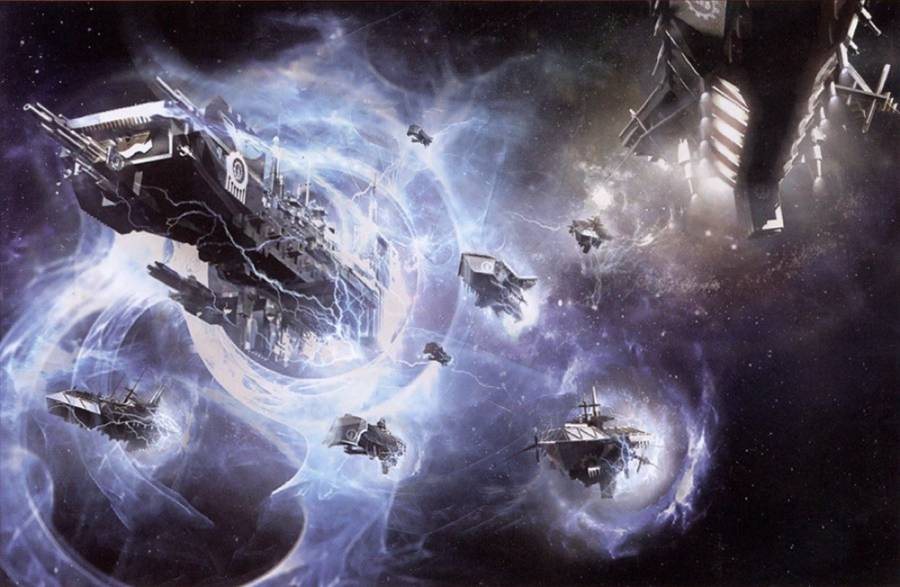 Ships of the Iron Hands fleet breaking from the Warp with their Geller fields still lit, from a pict-capture of the Horus Heresy era Artwork © Games Workshop | |
| Type | Protective field projected around a warp-capable starship |
| Invented | c. M18, in the Dark Age of Technology |
| Purpose | Maintains a bubble of realspace during warp transit; keeps out daemons and warp energy |
| Makers | Adeptus Mechanicus forge worlds |
| Used with | The warp drive; Navigator guidance |
| Spelling | Geller (Navy and Administratum); Gellar (older Mechanicus texts) |
A Geller field, also spelled Gellar field, is a protective energy field projected around a starship while it travels through the Warp. It maintains a small bubble of realspace around the vessel, in which the laws of the physical universe continue to hold, and keeps out the energies of the Immaterium and the daemons and other entities that live there. Without it no crew could survive a warp jump. The device that projects the field is formally called a Geller field generator.[1][2]
Geller fields were developed together with the warp drive around the 18th millennium, during the Dark Age of Technology. Every warp-capable ship of the Imperium carries one, and its failure is among the most feared disasters in the void: a ship whose field fails in the Warp is usually lost with all hands, and may return centuries later as a space hulk or as a vessel of Chaos.[1]
Operation
[edit]A starship enters the Warp by using its warp drive to tear a passage between realspace and the Immaterium. Once inside, it is surrounded by a medium that responds to thought and emotion and that is filled with predatory entities drawn to living souls. The Geller field projects a membrane of stable reality around the hull, sustained by the ship's sublight reactors, within which the crew can live and work. Entities of the Warp cannot cross the boundary except in rare circumstances.[1]
For the field to work the ship must be completely sealed. No hatch, launch bay or hull breach may be open, because any gap in the envelope is a way in. The field must be kept up for the whole of the transit, and the Navy's manuals prescribe constant prayers and rites to the machine spirit of the generator, which tech-priests maintain in shifts.[1][3]
The Geller field is distinct from the void shields, which protect a ship against weapons in realspace, and from the Navigator's art, which steers the ship by the light of the Astronomican. A ship needs all three to make a safe journey.[2]
History
[edit]Dark Age of Technology
[edit]According to the records of the Mechanicus, the warp drive and the Geller field were developed together around the 18th millennium, and made possible the great expansion of humanity across the galaxy. The name is said to come from an artificer of that age, of whom nothing else is known.[3][a] The original designs were lost in the Age of Strife (c. M25 – M30), and the fields built since are reconstructions.[3]
Great Crusade and Heresy
[edit]By the time of the Great Crusade (798.M30 – 000.M31), the Mechanicum built Geller fields to several patterns. Some of the older patterns did not rely on machinery alone: they drew their field from the dreams of a psyker held in a coma, whose mind projected an aura of normality around the ship. Such psykers died after a few voyages and had to be replaced.[3]
The best-known Geller field failure in Imperial history is that of the frigate Eisenstein, which fled the Isstvan system in 005.M31 carrying Battle-Captain Nathaniel Garro and the first warning of the treachery of Horus. Its field was damaged in the flight, and the ship survived its journey through the Warp only barely, with daemons loose aboard.[4]
Imperium
[edit]In the 41st millennium Geller fields are built at many forge worlds. The forge world of Belecane in the Calixis Sector is known for its void shields and Geller fields, among them the experimental Belecane-pattern 90.r field, which allowed fast passage through the Warp but suffered an unexplained flicker in long use and is rarely fitted.[5] The Imperium accepts that a small but steady share of its warp traffic is lost every year, and much of that loss is attributed to failing fields.[1]
The opening of the Great Rift in 999.M41 placed new strains on every Geller field. The storms of the Rift are more violent than those of the old Warp, and many ships of the Indomitus Crusade were lost before the Mechanicus and the Navy revised their rites and settings for crossing it.[6]
Failure
[edit]When a Geller field weakens, the first signs are cold spots, voices, apparitions and malfunctioning machinery. If it fails entirely, the Warp floods the ship. Daemons may enter in force, crews may go mad or be mutated, and the ship itself may be torn apart or swallowed. Ships lost in this way sometimes drift back into realspace after centuries, fused with other wrecks into space hulks, or carrying crews that have become something else. Outbreaks of the mutating disease called Gellerpox, recorded among the crews of ships whose fields failed, are attributed by the Inquisition to the influence of Nurgle.[1][7]
Xenos equivalents
[edit]Other species either use their own forms of the field or avoid the Warp altogether. The Leagues of Votann use a field they call a Geller Rampart, of more advanced design and far more reliable than Imperial patterns. Orks cross the Warp in ships with no recognisable field, apparently protected by their own collective psychic presence. The Aeldari travel by the Webway, and the Necrons by their own means, without entering the Warp. The T'au Empire has until recently travelled in realspace only.[8]
Timeline
[edit]- c. M18: the warp drive and the Geller field developed in the Dark Age of Technology
- c. M25 – M30: original designs lost in the Age of Strife
- Late M30: psyker-dream patterns in use in the Great Crusade
- 005.M31: the Eisenstein crosses the Warp with a failing field
- 999.M41: the Great Rift opens; field rites revised for the Indomitus Crusade, c. 000.M42
See also
[edit]
Notes
[edit]- ^ The spelling "Gellar" appears in many Mechanicus and Rogue Trader texts. The Navy and the Administratum standardised on "Geller" in the 41st millennium, but both forms are in use.
References
[edit]- ^ a b c d e f Codex: Space Marines (9th Edition), pg. 10. Games Workshop. Wraight, Chris. Wrath of Iron (novel). Black Library.
- ^ a b Wraight, Chris. Wrath of Iron (novel). Black Library, Ch. 1. Codex Heretic Astartes - Death Guard (8th Edition), pg. 22. Games Workshop.
- ^ a b c d Codex: Space Marines (8th Edition) (Revised Codex), pp. 52-55. Games Workshop. Codex Supplement: Iron Hands (8th Edition), pp. 6-12, 14, 22-34, 50-51. Games Workshop.
- ^ McNeill, Graham. Fulgrim (novel). Black Library. Dembski-Bowden, Aaron. The First Heretic (novel). Black Library.
- ^ Kyme, Nick. Promethean Sun (novella). Black Library. McNeill, Graham. Angel Exterminatus (novel). Black Library.
- ^ Abnett, Dan. Brothers of the Snake (novel). Black Library. Mitchell, Sandy. Innocence Proves Nothing (novel). Black Library.
- ^ Green, Jonathan. Iron Hands (novel). Black Library. McNeill, Graham. Mechanicum (novel). Black Library.
- ^ Hoare, Andy. Rogue Star (novel). Black Library. Mitchell, Sandy. Scourge the Heretic (novel). Black Library.