
Erebus
| Erebus | |
|---|---|
| Dark Apostle of the Word Bearers | |
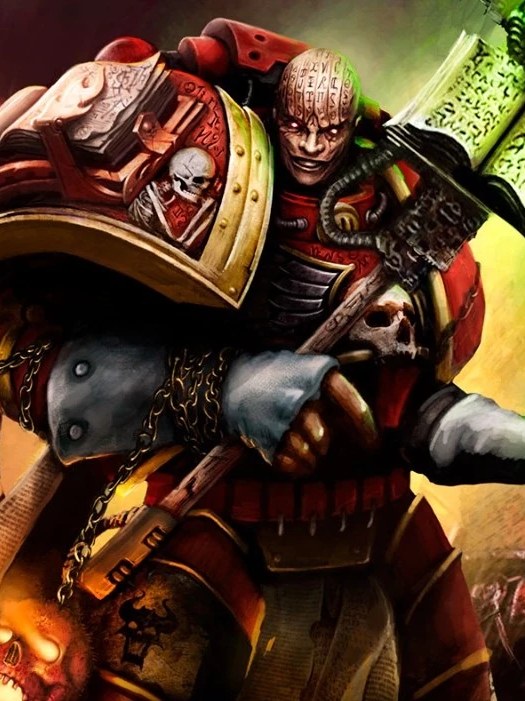 Erebus with his crozius, the text of the Book of Lorgar on his scalp Artwork © Games Workshop | |
| First Chaplain of the Word Bearers | |
| Tenure | Until the end of the Heresy |
| Primarch | Lorgar |
| Predecessor | Unrecorded |
| Successor | Unrecorded |
| Dark Apostle, Dark Council of Sicarus | |
| Tenure | From the end of the Heresy – present |
| Rival | Kor Phaeron |
| Predecessor | Unrecorded |
| Successor | Incumbent |
| Born | Colchis, in the late 30th millennium (year unrecorded) |
| Status | Active (reported at the Fall of Cadia, 999.M41) |
| Allegiance | Chaos; formerly the Imperium of Mankind |
| Other titles | The Hand of Destiny |
| Wargear | Crozius; the athame; artificer armour |
| Known for | The fall of Horus on Davin; the Isstvan III atrocity; the Ruinstorm; the murder of Argel Tal and of Garviel Loken |
Erebus, who calls himself the Hand of Destiny, is a Chaos Space Marine of the Word Bearers Legion. He was First Chaplain of the Legion at the end of the Great Crusade, and Imperial historians count him, with Kor Phaeron, among the chief authors of the Horus Heresy. He helped turn his primarch Lorgar to the Ruinous Powers, arranged the wounding of the Warmaster Horus on Davin, and presided over the rites that delivered Horus to the gods of the warp.[1][2]
During the Heresy he served Horus as spiritual counsellor and accomplice, planned the purge of loyalists at Isstvan III, and raised the warp storm called the Ruinstorm after the Battle of Calth. He made many enemies on his own side. He survived the Siege of Terra, where he fought aboard the Vengeful Spirit and murdered the loyalist Garviel Loken after Horus's death. Since then he has served as a Dark Apostle on the Dark Council of the Word Bearers, contending with Kor Phaeron for control of the Legion.[3]
Early life
[edit]Erebus was born to common parents on Colchis in the late 30th millennium. Word Bearers lore, which he does not dispute, holds that the name was not his. As a boy he was compared unfavourably with a pious and studious child of his village named Erebus; he strangled that child, copied his facial tattoos and left to enter the priesthood of the Covenant of Colchis in the capital, Vharadesh, under the dead boy's name.[2]
The Covenant worshipped four Great Powers that were the Chaos Gods under another guise. Erebus at first cared little for its teachings, but later recounted a moment of revelation before a cracked mirror, in which he saw his face divided into four and understood the gods had always guided him. When Lorgar overthrew the Covenant and preached the coming of a single god, Erebus went into hiding and then reappeared as a follower of the new faith. He was, by his own account, the only man on Colchis unmoved when the Emperor of Mankind arrived; he saw the being the gods called the Anathema and resolved to bring him down.[2]
Great Crusade
[edit]Erebus was among the first Colchisians made into Space Marines of the XVII Legion, then called the Imperial Heralds. He rose through the Legion's chaplaincy, a rank Lorgar created, and had passages of the Book of Lorgar tattooed across his scalp.[2]
After the Emperor rebuked the Legion at Monarchia on Khur for worshipping him as a god, Erebus and Kor Phaeron told the humiliated Lorgar that there were other gods willing to accept worship. They guided him to the warp realm he later called the Eye, and in the decades before the Heresy the Word Bearers raised secret temples to the Dark Gods on the worlds they conquered. Erebus was the Legion's agent in the wider Crusade, and his mission was to turn the Warmaster.[2]
The Interex and Davin
[edit]Attached to the 63rd Expedition, Erebus cultivated the warrior lodges of the Luna Wolves. In contact with the Interex, he stole the Kinebrach Anathame, a daemon-bound blade, from the Hall of Devices on Xenobia, and laid evidence to make the theft appear the work of the Imperium. The resulting war ended Imperial hopes of peaceful union with the Interex.[4]
He gave the blade to Eugen Temba, the corrupted commander on Davin, so that Horus would be wounded by it in combat on Davin's moon. When the Apothecaries could not heal the Warmaster, Erebus persuaded the Mournival to take him to the Serpent Lodge on Davin. There Erebus guided Horus through visions, acting for the gods, which showed a future in which the Emperor was worshipped as a god while his sons were forgotten. Horus accepted the gods' offer and was healed.[4]
Horus Heresy
[edit]Erebus remained at Horus's side as his counsellor. With the Warmaster he planned the virus bombing of Isstvan III to rid the traitor Legions of their loyal elements, and he made sure that Garviel Loken, who suspected him, was sent to the surface.[1] He was present when the conspiracy struck at the Drop Site Massacre, and the Vengeful Spirit became, under his direction, a temple in which sacrifices were made to the warp.[4]
Calth and the Ruinstorm
[edit]Erebus accompanied Kor Phaeron's fleet to Calth, where the Word Bearers attacked the Ultramarines. While Kor Phaeron's host fought on the surface, Erebus completed a great sacrifice that tore open the warp across the region. The Ruinstorm that followed divided the galaxy for the rest of the war, cutting off Ultramar and the eastern Legions from Terra.[1]
The Shadow Crusade and Signus
[edit]During the Shadow Crusade against Ultramar, Erebus killed the Word Bearer Argel Tal, commander of the possessed Gal Vorbak, with the athame. He claimed to have foreseen that Argel Tal would prevent the World Eater Khârn from becoming the chosen of Khorne, and that the traitors would lose the war if he did. Khârn, Argel Tal's friend, beat Erebus almost to death on the Conqueror, and Erebus escaped only by teleporting off the ship.[2]
At Erebus's urging, Horus sent the Blood Angels to the Signus Cluster, where the daemons of the warp were to break Sanguinius and win him for Chaos. The plan failed. When Erebus blamed the failure on Horus, the Warmaster cut the tattooed skin from his face with his own athame.[1]
Siege of Terra
[edit]Erebus came to Terra with the traitor host. In the final days of the Siege, when the Vengeful Spirit and Terra overlapped in the warp-born Inevitable City, his sorcery aided Ezekyle Abaddon's Justaerin against the Custodes of Constantin Valdor. He attacked the group of the old soldier Ollanius Persson, killing most of them, and on another occasion halted Abaddon's warriors with a single word of the Enuncia, the primordial language of power.[3]
After Horus's destruction Abaddon spared Erebus for the knowledge he held about the warp, though survivors of the Sons of Horus recorded that Abaddon meant to kill him once he was no longer useful. Before leaving the ship Erebus stabbed Garviel Loken in the back with his athame and killed him. He claimed that Loken would have betrayed him in turn, and explained that the killing was needed to create the daemon Samus and close a loop of fate begun years before on Isstvan.[3] Other testimony holds him responsible for the deaths of Erda, the perpetual known to the Emperor, and of the Word Bearer Barthusa Narek.[3]
After the Heresy
[edit]Erebus fled with his Legion into the Eye of Terror. He is a Dark Apostle and one of the most influential members of the Dark Council that rules the daemon world of Sicarus in the absence of Lorgar, who has withdrawn into contemplation. His long rivalry with Kor Phaeron for control of the Legion continues. Kor Phaeron once organised the secret society called the Brotherhood to remove him; the Dark Apostle Marduk warned Erebus, and Kor Phaeron disowned the plot.[2]
During Abaddon's Thirteenth Black Crusade in 999.M41, Erebus led a Word Bearers army across the Cadian Sector. He sacrificed millions of captives to summon daemons against the Imperial defenders of the Cadian Gate. His activities since the opening of the Great Rift are not well recorded.[5]
Character
[edit]Erebus regards himself as the instrument of the gods' will in the material world, and his methods are deceit, patience and murder of allies as readily as enemies. Many traitors who worked with him came to hate him, among them Horus, Khârn and Abaddon. He tends to explain his acts as steps in a pattern of fate that only he can see, and Imperial analysts note that many of his schemes failed or turned against him even as the larger plan succeeded.[1]
Timeline
[edit]| Date | Event |
|---|---|
| Late M30 | Erebus is born on Colchis; the year is not recorded. |
| 857.M30 | Lorgar is found; Erebus is among the first Colchisians made into Space Marines of the XVII Legion. |
| 964.M30 | The rebuke at Monarchia on Khur; Erebus and Kor Phaeron lead Lorgar toward the Ruinous Powers. |
| 002.M31 | Erebus steals the Kinebrach Anathame from the Interex on Xenobia. |
| 004.M31 | Horus is wounded on Davin and turned in the Serpent Lodge. |
| 005.M31 | Erebus helps plan the purge at Isstvan III. |
| c. 005–006.M31 | Erebus urges the Signus Campaign; after its failure Horus flays his face.[a] |
| 007.M31 | Erebus raises the Ruinstorm at the Battle of Calth. |
| c. 007–008.M31 | Erebus kills Argel Tal during the Shadow Crusade.[b] |
| 014.M31 | At the Siege of Terra Erebus aids the Justaerin and stabs Garviel Loken. |
| After the Siege of Terra | Erebus flees with the Word Bearers to the Eye of Terror. |
| 999.M41 | Erebus leads a Word Bearers army in the Thirteenth Black Crusade. |
See also
[edit]

Notes
[edit]References
[edit]- ^ a b c d e Abnett, Dan. Horus Rising (novel). Black Library, pp. 315-319, 326, 347-348. McNeill, Graham. False Gods (novel). Black Library, pp. 31-32, 36, 42-43, 45-52, 54, 56-60, 76, 89, 103-106, 109-110, 112-113, 116, 132, 174-177, 191, 198, 205-207, 210-211, 260, 265-267, 271-273, 277, 293-295, 298, 341-342.
- ^ a b c d e f g Swallow, James. Nemesis (novel). Black Library, pp. 13-15, 17-19, 244-245, 249, 273-274, 324-326, 354-355, 387-391, 404-408. Swallow, James. Fear to Tread (novel). Black Library, pp. 30-31, 90, 96-97, 111, 120, 151, 178-179.
- ^ a b c d Dembski-Bowden, Aaron. Betrayer (novel). Black Library, pp. 12-13, 78-80, 106, 112, 114-118, 123-128, 142-143, 149-153, 158, 169, 185, 196, 203-204, 209-210, 219-222, 227-229. Kyme, Nick. Vulkan Lives (novel). Black Library, pp. 9, 210-211.
- ^ a b c Reynolds, Anthony. Dark Disciple (novel). Black Library, pp. 13, 18-19, 21, 115-116. Reynolds, Anthony. Dark Creed (novel). Black Library, pp. 4-5, 9, 22, 53, 56, 99, 102, 156-157, 159-160, 164, 167-168.
- ^ Dembski-Bowden, Aaron. The First Heretic (novel). Black Library, pp. 9, 61-64, 66, 68-73, 81-83, 88-89, 117, 159, 163, 166, 228, 269-270, 278, 295, 301, 318, 323, 361-362, 367-368, 370-371, 380, 382, 385-386, 393-394, 414-420, 432, 437. Bligh, Alan. The Horus Heresy - Book Two: Massacre. Black Library, pp. 138, 143, 155, 255, 258.