
Lucius the Eternal
| Lucius the Eternal | |
|---|---|
| The Soulthief, Blade of Aeons, Champion of Fulgrim | |
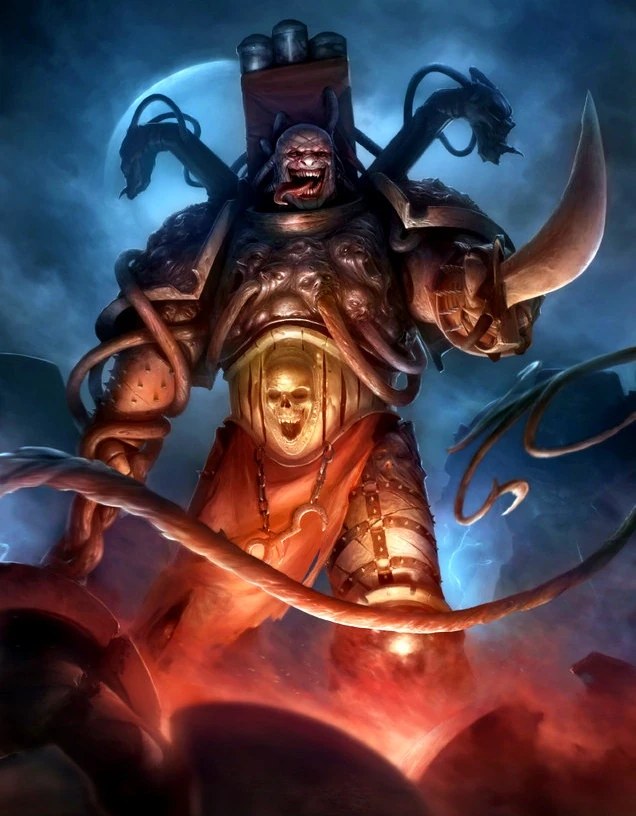 Lucius in the Armour of Shrieking Souls, with the Lash of Torment and the Blade of the Laer Artwork © Games Workshop | |
| Captain of the 13th Company, Emperor's Children | |
| Tenure | Late M30 – c. 006.M31[a] |
| Superior | Lord Commander Eidolon |
| Predecessor | Unrecorded |
| Successor | Unrecorded |
| Champion of Fulgrim; master of the Faultless | |
| Tenure | c. 006.M31 – present |
| Patron | Slaanesh; Fulgrim |
| Predecessor | Unrecorded |
| Successor | Incumbent |
| Born | Chemos, late M30 |
| Recruited | c. 900.M30, from the Golden Sword contest of Chemos[a] |
| Deaths | Many; first recorded at the hands of Lord Commander Cyrius, early M31 (estimated) |
| Status | Active in the Era Indomitus |
| Allegiance | Imperium of Mankind (until 005.M31); Chaos (Slaanesh) |
| Legion | III Legion, the Emperor's Children |
| Homeworld | Chemos |
| Wargear | Armour of Shrieking Souls; Lash of Torment; Blade of the Laer; Commorrite stimm-rack |
| Known for | His swordsmanship; his return from death in the body of his killer |
Lucius the Eternal, once Captain Lucius of the 13th Company of the Emperor's Children, is a Chaos Space Marine champion of Slaanesh and one of the most famous swordsmen in the history of the Space Marine Legions. A native of Chemos, he was recruited into the III Legion in the Great Crusade and was reckoned its finest blade. He turned traitor with his Legion in the Horus Heresy, betrayed his old friend Saul Tarvitz on Isstvan III in 005.M31, and fell into the worship of the Prince of Pleasure.[1][2]
Lucius cannot be killed for long. Whoever slays him and feels any pride or pleasure in the act is slowly transformed into Lucius, who emerges from the killer's body while the killer's face and soul are added to the screaming faces on his armour. He has stalked the galaxy for about ten thousand years under this curse, leading warbands of the Emperor's Children in search of worthy opponents. He fought in the Thirteenth Black Crusade in 999.M41 and remains active in the Era Indomitus.[3][4]
Early life
[edit]Lucius was born on Chemos, the grim industrial homeworld of Fulgrim, in the late 30th millennium. He was gifted at everything he tried, but his patrons found that his only true interest was the duel. By the time he came of age he had outgrown the swordmasters of Chemos, and several beggars and brigands had died on his blade in fights he claimed they had started. At the annual Golden Sword contest held by the Elders of Chemos, in about 900.M30 by Imperial estimate, he killed a famous champion twice his age, and the champion's followers stormed the lists. A sergeant of the III Legion who had watched the contest took him away before he could be killed, and offered him the chance to become a Space Marine.[1][a]
Great Crusade
[edit]As a Space Marine Lucius outfought every peer and every training machine of his Legion. He came to the notice of Lord Commander Eidolon and fought on a dozen worlds brought to compliance by the 28th Expedition. Imperial accounts credit him with breaking the gholem guardians of Hallelujah Prime, hunting the xenos called the Ragged Fiends under Olchite Mount, and taking the head of the "False Dorn" at Siegebreak, all in the last decades of M30. He was rewarded with command of the 13th Company.[1][5]
Lucius was vain and petulant, and his friend Captain Saul Tarvitz of the 10th Company tried for many years to curb these faults. After Garviel Loken of the Luna Wolves broke his nose in the training cages, and after a meeting with the corrupted remembrancer Serena d'Angelus, Lucius began to scar his own face and body. He told his brothers the scars were a mark of devotion. The Legion later learned that they were the first sign of his fall.[5]
During the campaign against the Laer on Laeran, in c. 004.M31, Fulgrim took a xenos sword from the Laer temple. The daemon bound within it later took control of the primarch. The blade itself, bereft of its spirit, was later given to Lucius, and he has carried it since as the Blade of the Laer.[2]
Horus Heresy
[edit]When Horus rebelled in 005.M31, Lucius chose the Warmaster. On Isstvan III he was sent to the surface with the loyalists marked for death, and was meant to be among them, but he betrayed them and joined the Traitors. He then fought the loyalists he had come down with, among them Tarvitz and Loken, and was badly wounded by Loken. Accounts of these duels differ, but Tarvitz died in the final bombardment of the Choral City in the same year.[2][5]
He fought at the Drop Site Massacre on Isstvan V in c. 006.M31. Afterwards he followed Fulgrim through the Legion's descent into the cults of Slaanesh. Imperial records place him at Iydris in c. 008.M31, where Fulgrim became a Daemon Prince, and at the Siege of Terra in 014.M31. One account of Iydris describes Lucius being killed by the Raven Guard warrior Nykona Sharrowkyn and waking again in the apothecarion of Fabius Bile. The Ordo Malleus treats this as the first sign of his curse, though Sharrowkyn took no pleasure in the kill.[2][3][b]
After the Heresy
[edit]The death at the hands of Cyrius
[edit]In the Eye of Terror, the Emperor's Children held gladiatorial contests between their raids. Lucius won them all, until Lord Commander Cyrius, wishing to humble him and to become Fulgrim's favourite, entered the final of the contest called the Scarlet Blade. Lucius fought almost unarmoured, laughing at every wound. His sword broke on Cyrius's plate, and Cyrius beat him to death on the arena sands. Over the following weeks Cyrius changed. His hair fell out, scars rose in his flesh, and the figures on his armour twisted into laughing daemons. At the next contest Lucius walked onto the sands again, with Cyrius's face moaning on his armour. Fulgrim is said to have smiled.[3][c]
The Eternal Duellist
[edit]Lucius commanded a warband called the Cohors Nasicae in the Legion Wars, and fought at the Battle of Skalathrax, after which the Emperor's Children broke apart into warbands. He kept his flagship, the Diadem, and served Fulgrim as his champion, on one occasion killing a clone of the primarch made by Fabius Bile.[3]
Over the following millennia he hunted the best fighters in the galaxy. The Ordo Malleus lists, among others, the Drukhari archon Vraesque, an Emperor's Champion of the Black Templars at Veilfate, and the Ork warboss Two-klaws at Octarius Sigma, all killed in M40 or M41 (estimated). On a moon near Damnos a Necron duellist known as the Phasing Sword killed him, took a cold pride in it, and dissolved within days to release him.[3]
Later Fabius Bile betrayed him and sold him to the arenas of Commorragh. Lucius freed himself and many captive Traitor Astartes, among them the noise marines of the Lucid Circle, and renamed his warband the Faultless. He then joined Lord Commander Eidolon's Phoenix Conclave on the daemon world of Harmony.[3]
The Thirteenth Black Crusade and the Era Indomitus
[edit]Lucius led a host of the Emperor's Children in Abaddon the Despoiler's Thirteenth Black Crusade in 999.M41 and laid waste to the world of Belisar. In the same year he was one of the commanders of the alliance of Chaos and xenos forces that fought on Medusa V. Since the opening of the Great Rift he has expanded the Faultless and fought across both halves of the galaxy, and he has been reported fighting beside Fulgrim since the Daemon Primarch's return to his Legion in the early Era Indomitus.[4][3]
Malleus interrogators report that the curse now wears on him. He no longer remembers how many times he has died, and there are long gaps in his memory between deaths. Each killer who becomes Lucius is a duel he can never fight again.[3]
Character
[edit]Lucius was arrogant, immature and selfish even before his fall, and his skill with a sword was the source of his pride. Since his fall he has come to equate pain with success and fights best only against a worthy foe. The Ordo Malleus holds that he can be truly killed only by someone who feels nothing but mercy in killing him.[3]
Wargear
[edit]- The Armour of Shrieking Souls, his ancient Mark IV plate, changed by Slaanesh. The faces of his killers scream from it, and Lucius can turn their torment into a psychic shriek against his enemies.
- The Lash of Torment, a daemon weapon in which a Daemonette is bound, which strikes on its own.
- The Blade of the Laer, the xenos sword taken by Fulgrim on Laeran in c. 004.M31.
- A Commorrite stimm-rack, implanted by Fabius Bile, which floods him with combat drugs.
- Nineteen, the power sword he carried in the Great Crusade, whose fate is unknown.
Timeline
[edit]| Date | Event |
|---|---|
| Late M30 | Born on Chemos |
| c. 900.M30 | Recruited into the III Legion after the Golden Sword contest (estimated) |
| Late M30 | Captain of the 13th Company |
| c. 004.M31 | Laer campaign; the Blade of the Laer taken |
| 005.M31 | Betrays the loyalists on Isstvan III; wounded by Garviel Loken |
| c. 006.M31 | Drop Site Massacre |
| c. 008.M31 | At Iydris; killed by Sharrowkyn and revived (disputed) |
| 014.M31 | Siege of Terra |
| Early M31 | Killed by Cyrius in the Scarlet Blade; reborn (estimated) |
| Early M31 | Battle of Skalathrax in the Legion Wars |
| M40–M41 | Duels with Vraesque, the Phasing Sword and others (estimated) |
| 999.M41 | Thirteenth Black Crusade; Belisar; Medusa V |
| Early M42 | Leads the Faultless in the Era Indomitus |
See also
[edit]


Notes
[edit]- ^ a b c Dates of Lucius's early career are estimated from the sequence of the Great Crusade; the Legion's own records were lost or defaced after the Heresy.
- ^ Imperial records disagree on Lucius's first death. The older Malleus account names Lord Commander Cyrius as his first true killer. The Iydris account is held by some to be a death that did not meet the conditions of the curse.
- ^ The date of this contest is not recorded. It is placed in the early 31st millennium, after the Heresy and before the Legion Wars.
References
[edit]- ^ a b c Codex: Emperor's Children (10th Edition), pp. 23-24. Games Workshop. Abnett, Dan. Horus Rising (novel). Black Library, Part Two, Ch. 2, pp. 178-181, 191, 194-201, 216-217, 219-227, 249, 252, 255-256, 283, 316-319, 336.
- ^ a b c d Counter, Ben. Galaxy in Flames (novel). Black Library, pp. 21-22, 25, 27-28, 79-80, 82, 108-110, 120-123, 128-130, 152-156, 159-161, 163, 166-168, 176, 207, 211-212, 219-230, 233, 235-238, 247-248, 252-254, 256-260, 266. Swallow, James. The Flight of the Eisenstein (novel). Black Library, pg. 168.
- ^ a b c d e f g h i McNeill, Graham. Fulgrim (novel). Black Library, Chs. 16, 20, pp. 65-66, 187-188, 190, 192-194, 198, 204, 213, 221, 240-243, 245, 262-265, 271-273, 291-293, 323, 325, 329-331, 344-348, 399, 401-404, 412. The Crimson King (novel), by Graham McNeill, Chs. 11, 22.
- ^ a b McNeill, Graham. Angel Exterminatus (novel). Black Library, pp. 52, 89-91, 122-124, 134, 145-146, 152-157, 182, 208-211, 220, 239, 260-262, 268, 271-273, 286-288. French, John. Slaves to Darkness (novel). Black Library, Ch. 15.
- ^ a b c Martin, Ian St.. Lucius: The Faultless Blade (novel). Black Library, Chs. I.VI, Ch. I.VII, Ch. II.VI, Ch. IV.VI, Cover. Reynolds, John. Fabius Bile: Clonelord (novel). Black Library, Ch. 9.