
Low Gothic
| Low Gothic Gothic | |
|---|---|
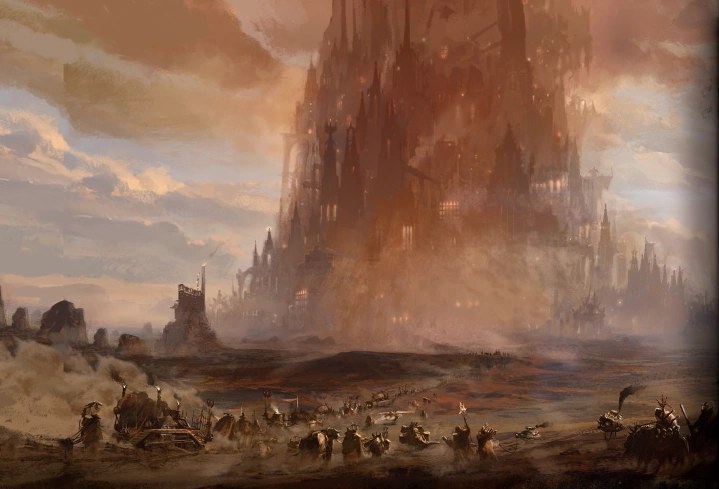 The hive worlds, whose populations number in the billions, are the great reservoirs of Low Gothic speech and its dialects Artwork © Games Workshop | |
| Native to | Imperium of Mankind |
| Era | Diverged from High Gothic c. M31–M32; present |
| Speakers | Uncounted trillions; first language on most Imperial worlds |
| Language family | Terran Gothic group |
| Early form | High Gothic (Imperial Terran) |
| Dialects | Millions; see Dialects |
| Official status | |
| Status | Common tongue of the Adeptus Terra, the Astra Militarum and the Imperial Navy |
| Regulated by | None; the Administratum keeps a "Terran Standard" for its own use |
| Writing system | Imperial script |
Low Gothic, usually called simply Gothic, is the common spoken and written language of the Imperium of Mankind. It is the first language of most of the Imperium's citizens, the working language of the Astra Militarum, the Imperial Navy and the lower ranks of the Adeptus Terra, and the language in which most Imperial worlds conduct trade with each other. It descends from the speech of Terra in the time of the Great Crusade, the same language that survives, frozen, as the liturgical High Gothic.[1][2]
Low Gothic is not one language but a vast continuum of dialects. Across more than a million worlds, ten thousand years of separation, warp-storm isolation and local invention have produced forms that range from the near-standard Gothic of Terra and the Segmentum Solar to frontier creoles that a Terran cannot follow. A planetary aristocracy may speak an ancient local tongue and know only enough Gothic to swear fealty; a feral world may speak no Gothic at all until the Astra Militarum arrives to raise a regiment.[2][3]
History
[edit]Origins
[edit]The ancestor of Low Gothic is the common tongue of Terra in the Age of Technology, which the Emperor of Mankind made the language of his government during the Unification Wars (c. M30) and carried across the galaxy during the Great Crusade (c. 798.M30–005.M31). Many of the worlds the crusade reached had kept a form of it through the Age of Strife, and the crusade's iterators and governors taught the Terran standard where it had been lost.[2][4]
Divergence from High Gothic
[edit]After the Horus Heresy (005–014.M31), the formal speech of the Emperor's court was fixed in law and liturgy and ceased to change. The everyday language of soldiers, labourers and traders continued to evolve. Imperial linguists date the effective split between the two to the period between the Great Scouring (c. 014–020.M31) and the middle of the 32nd millennium, when the vernacular was first written down as a distinct language for the training of Imperial Army recruits.[2][a]
Fragmentation
[edit]Warp storms, wars and the slow pace of interstellar travel have repeatedly isolated whole regions of the Imperium. During the Nova Terra Interregnum (early M35 to 975.M35) the two halves of the Administratum kept separate Gothic standards, and the Segmentum Pacificus dialects still preserve some spellings of the Nova Terran chancery. The Age of Apostasy (early M36 to c. 400.M36) and the long warp storms of The Waning (M38–M41), which isolated whole sectors for centuries, produced further breaks. Each period of isolation left new dialects behind it.[2][5]
The Era Indomitus
[edit]The opening of the Great Rift in 999.M41 cut the Imperium Nihilus off from Terra and from the Astronomican. Imperial records from the first decades of the Indomitus Crusade report that the crusade fleets, drawn from hundreds of worlds, had to adopt a simplified "fleet Gothic" for command, and that the Departmento Munitorum reissued its standard drill vocabulary in 001.M42. Worlds reached again after long isolation in the Imperium Nihilus have been found speaking forms of Gothic that the crusade's interpreters could not understand.[6]
Features
[edit]Compared with High Gothic, Low Gothic has lost almost all of its case system and grammatical gender, and relies on word order and prepositions. Its vocabulary is largely Terran, but it has absorbed many High Gothic words through the liturgy and the law, often with a narrowed or popular meaning: adept for any official, throne for a coin (see Throne Gelt), Emperor as an oath. Military usage contributes a large body of slang. Words from xenos languages are rare and are treated with suspicion by the clergy.[2]
Low Gothic is written in the same Imperial script as High Gothic, though spelling varies widely by world. The Administratum maintains a written "Terran Standard" for its own records, which most adepts learn alongside their local dialect.[1]
Dialects
[edit]No full survey of Gothic dialects exists. The Administratum's Index of Tongues lists more than four million named varieties, but it has not been revised since 812.M40 and is believed to be incomplete. The dialects most often noted in Imperial records include:[2]
- Terran Standard: the speech of the Imperial Palace and the administrative districts of Terra, regarded as correct throughout the Adeptus Terra.
- Hive cants: the dialects of the great hive worlds such as Necromunda, which vary between levels of a single hive and include secret argots of the underhive gangs.
- Militarum Gothic: the drill and field language of the Astra Militarum, taught to every regiment at its founding so that units from different worlds can serve together.
- Navy cant: the shipboard speech of the Imperial Navy, heavy with ancient terms for ship functions.
- Frontier creoles: the mixed languages of the Eastern Fringe, the Halo Stars and the worlds of Rogue Trader dynasties, which sometimes contain words borrowed from xenos speech.
Mutual intelligibility between distant dialects is low. Regimental histories describe soldiers from neighbouring sectors who could communicate only through their officers or through the simplified Militarum Gothic. Many worlds also keep non-Gothic languages of their own, survivals of the Dark Age of Technology colonisation, when some founding groups deliberately revived old Terran tongues as marks of identity.[3][2]
Social role
[edit]Gothic is the language in which the Imperium speaks to its people. Proclamations of the Ecclesiarchy and the Administratum are read in it after their High Gothic originals; sermons of the Imperial Cult are preached in it in most of the Imperium; and the Imperial Infantryman's Uplifting Primer is printed in it. Knowledge of Gothic is usually a requirement for any office, and illiteracy in the standard script is common among the labouring classes of hive and agri worlds.[3][7]
Speaking a strange dialect can carry real danger. Imperial security forces, Arbites and Inquisitors are trained to treat unfamiliar speech as a possible sign of heresy, cult activity or xenos influence, and some planetary codes punish the use of proscribed words. Conversely, the Ordo Hereticus has recorded heretical cults that adopt invented argots to hide their teachings.[8]
Timeline
[edit]| Date | Event |
|---|---|
| c. 798.M30–005.M31 | Imperial Terran spread across the galaxy by the Great Crusade |
| c. 014.M31–mid-M32 | Vernacular diverges from the fixed court language |
| Early M35–975.M35 | Nova Terra Interregnum; rival written standards |
| Early M36–c. 400.M36 | Age of Apostasy; further fragmentation |
| 812.M40 | Last revision of the Administratum's Index of Tongues |
| 001.M42 | Departmento Munitorum reissues the standard drill vocabulary for the Indomitus Crusade |
See also
[edit]
Notes
[edit]- ^ The date is an estimate. The Administratum's earliest recruit primers in the vernacular survive only in copies of the 33rd millennium; the Logos Historica Verita infers the older date from their contents.
References
[edit]- ^ a b Warhammer 40,000: Rogue Trader (1st Edition). Games Workshop.
- ^ a b c d e f g h Dark Heresy Core Rulebook (RPG), pg. 249.
- ^ a b c Warhammer 40,000: Rogue Trader (1st Edition). Games Workshop.
- ^ Dark Heresy Core Rulebook (RPG), pg. 249.
- ^ Warhammer 40,000: Rogue Trader (1st Edition). Games Workshop.
- ^ Dark Heresy Core Rulebook (RPG), pg. 249.
- ^ Warhammer 40,000: Rogue Trader (1st Edition). Games Workshop.
- ^ Dark Heresy Core Rulebook (RPG), pg. 249.