
Heretic
| Heretic | |
|---|---|
| Offender against the Imperial Cult and the Emperor's law | |
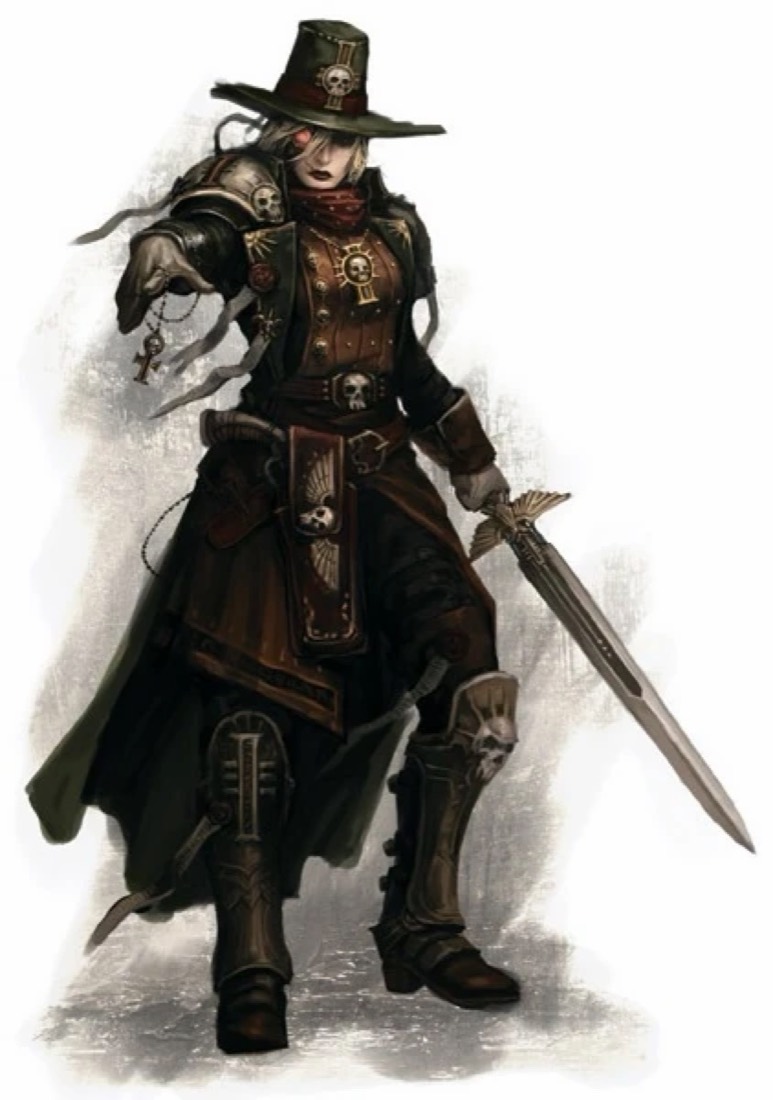 An Ordo Hereticus Inquisitor, the commonest hunter of heretics Artwork © Games Workshop | |
| Offence | Heresy |
| Judged by | The Ecclesiarchy, the Inquisition, the Adeptus Arbites |
| Hunted chiefly by | Ordo Hereticus and the Adepta Sororitas |
| Usual penalty | Death; penance or penal service for the repentant |
| Gravest censure | Excommunicate Traitoris |
| Last resort | Exterminatus |
| Related offence | Treason |
| Notable cases | Horus Heresy (005–014.M31); Reign of Blood (M36) |
A heretic is a person who holds, teaches or acts upon a doctrine that contradicts the beliefs of the Imperial Cult or the laws of the Imperium of Mankind. Because the Cult is the state religion of the realm, the Emperor of Mankind is at once its secular ruler and the one true god of Humanity, and to take up arms against him or his faithful agents is more than treason, it is heresy. All the enemies of the Imperium may thus be called heretics, though in practice the Adeptus Ministorum seldom brands a mere rebel or the killer of a guardsman with the name. Such offenders are ordinary criminals, left to conventional forces, unless the taint of the Renegade or the Traitor lies behind their deeds.[1]
The commission of heresy is often not the expression of an unusual religious view. It is more often the worship of the Ruinous Powers or the aid of Chaos against the Imperium, and the worship of any god other than the Emperor is forbidden. Those who openly turn from the Imperial Creed, or who deny the spiritual authority of the Ministorum, are punished with death. Yet the Imperium is too large and too dependent on its useful deviants to treat every deviation alike. The Ecclesiarchy tolerates the Chapter cults of the Adeptus Astartes, the machine-worship of the Adeptus Mechanicus and the psychic servants of the Adeptus Astra Telepathica and the Navigator Houses, however distasteful the devout find them.[1][2]
The three stages of the Inquisition's answer to heresy are suspicion, investigation and purging. The word is also a political weapon, and an accusation of heresy is a blunt tool that can turn on the one who wields it. The article describes how the Imperium defines the heretic, how heresy is graded and hunted, the penalties it carries, and the cults that grow around it.[1][3]
Definition
[edit]Imperial doctrine
[edit]The Imperial definition of heresy turns on the Emperor's divinity and on the Lex Imperialis. An opinion, act or teaching is heretical if it contradicts the theology of the Imperial Cult, the commandments of the Ecclesiarchy or the law of the Imperium. What does and does not count is generally decided by the high officers of the Ecclesiarchy. Massive divisions of the Ministorum exist only to monitor the myriad sects of the Imperium and judge whether each has stayed within the orthodoxy of the Cult, and many belief systems have been declared heretical by the Ministorum or by the High Lords of Terra over the ages.[1]
Acts of heresy are classified in legalistic grades, first, second, third and so on, according to their severity. The punishments for them range from imprisonment and assignment to an Astra Militarum Penal Legion, to excommunication from the rites and protection of the Ecclesiarchy, to execution and arco-flagellation.[1]
Tolerated deviation
[edit]There are several variant faiths that the Ecclesiarchy tolerates although it disagrees with their tenets. Every Space Marine Chapter is loyal to the Emperor and to its own ancestral Primarch, but few revere the Emperor as a god, since to them he is a man, if the greatest who has lived. This breaks the most important tenet of the Imperial Creed, and has more than once produced tension and open hostility between the two Adepta. Relations are kept cordial all the same, since the Space Marines are the genetic descendants of the Emperor through the blood of the primarchs.[1]
The Cult Mechanicus is a second deviant faith. Its tech-priests worship a Machine God, which is commonly held to be the Emperor in his aspect as the Omnissiah, though many in the Ecclesiarchy have difficulty accepting this. Other Mechanicus sects seem to outsiders to be steeped in idolatry. The Ecclesiarchy tolerates the Cult for the same reason that the Emperor in the Great Crusade had to accept its deviation from the atheistic Imperial Truth, namely that without the tech-priests the Imperium would grind to a halt.[1]
True heretics
[edit]The Ecclesiarchy is most interested in those who reject the Emperor and embrace another power in his place: the servants and slaves of xenos and Warp entities, who are viewed as true heretics. They are hard to find. Among thousands of cults and saints, seemingly faithful practice easily masks heretical deeds, and a church that spans tens of thousands of light years cannot police itself. Even those who obviously bear taint are not always guilty. Psykers and mutants often bear the suspicion of heresy, sometimes unfairly, but are too deeply woven into Imperial society to be purged wholesale, so the Ministorum and the Inquisition depend on investigation and intelligence instead.[1]
The accusation itself is often used as a political weapon, at many levels. A reasoned debate between two cardinals can be ended by a hint of it, and a diocese slow with its tithe can be brought into line by the word alone. It can turn on its wielder, since the accused may have allies or patrons, and war between rival factions has sometimes followed.[1]
Categories
[edit]Heresy of thought
[edit]Heresy of thought covers beliefs and teachings: unorthodox readings of the Emperor's nature, claims to speak with the Emperor's voice without authority, and the teaching of the Imperial Truth in forms the Ecclesiarchy has not approved. Inquisitors of the Ordo Hereticus hold that whether a person means to act on such ideas is irrelevant, since giving them voice spreads the seed. Some of the severest consider that merely holding them is a crime against Humanity.[2]
Heresy of deed
[edit]Heresy of deed covers acts against the Imperial Cult or the civil order: sacrilege, the use of forbidden knowledge, the use of alien technology or any technology not approved by the Adeptus Mechanicus (though the Mechanicus may legally confiscate it), the use of unsanctioned psychic power, and the employment of Warp-based weapons and entities such as daemon weapons, daemonhosts and summoned daemons. Treason and rebellion belong here, and so does the usurpation of power within the Adepta from the Emperor's rightful agents, of which the Horus Heresy and the Reign of Blood are the most notorious examples.[2][1]
Heresy of tolerance and of association
[edit]A person who knowingly harbours rogue psykers, sells arms to rebels or lets kin join a heretical cult may be judged a heretic in their own right, since by inaction they give strength to the enemies of Mankind. The authorities of Terra and of many worlds therefore urge citizens to report heresy, and many do so out of fear or duty. The strictest Witch Hunters go further and hold that association alone is evidence, and that friends and family of a heretic are safest purged with him.[2][3]
Dealing with heresy
[edit]The Inquisition teaches that the identification and destruction of heresy has three stages. In the first, suspicion, acolytes are urged to trust their instincts, which the Ecclesiarchy and the Inquisition both hold to be the Emperor guiding them to his enemies. Acolytes are taught that nothing and no one is beyond suspicion, and the paranoia this breeds is encouraged as a virtue.[3]
In the second stage, investigation, stealth is the main concern, because even the hint of acolytes nosing about sends cultists to ground among the populace. Gathering evidence is often secondary to finding guilty parties, and the clues are meant to lead the investigator to the quarry rather than to prove anything once he arrives. The Inquisition therefore advises striking at the earliest moment, even on circumstantial evidence, since any number of innocent deaths is accepted if a true heretic is found and tens of millions spared corruption.[3]
The third stage is purging. Heretical cults resemble weeds, apparently destroyed and then springing up again, and the teaching of the Ecclesiarchy is that the Emperor rewards thoroughness. If there is the slightest suspicion of involvement, the person must be purged. When a heresy has consumed a whole hive city or continent, the Imperium shows no mercy, and the result may be the destruction of cities or whole worlds by armies, atomic fire or virus bomb.[3]
Punishment
[edit]Excommunicate Traitoris
[edit]The Excommunicate Traitoris is a High Gothic bureaucratic designation, the highest form of Imperial reproach against a citizen, world or organisation that has committed extreme heresy, including mutation, rebellion and corruption by Chaos. A subject so named is banished from the Imperium on pain of death. When the High Lords or an Inquisitor make the declaration, the accused is struck from the annals of Imperial history, their name deleted from the scrolls of honour in the Hall of Heroes and from the archives of Terra by the Deletion Teams of the Historical Revision Unit of the Administratum. If the accused is an Astartes or a Chapter, the Mechanicus destroys the stored gene-seed, and any who are slain are burned. A confessor who repents may die quickly and cleanly, but most flee toward the great Warp rifts, the Eye of Terror or the Maelstrom, and are hunted for the rest of their lives.[1]
Edict of Obliteration
[edit]An Edict of Obliteration, in High Gothic a Damnatio Memoriae, is a frequent feature of major political or religious change. It destroys the images of an elite figure after death or overthrow, and its aim is to preserve the Emperor's honour by erasing every trace of the person who damaged Humanity. For the Adepta that serve the Emperor directly, among them the Ecclesiarchy, the Inquisition and the armed services, it is one of the heaviest punishments.[1]
Exterminatus
[edit]The order of Exterminatus is a death knell for a world and the last resort in the direst cases. It demands the eradication of all life on a planet, and only the highest ranks may give it: a Chapter Master, a Lord High Admiral, a Lord Commander of the Astra Militarum or an Inquisitor. It has been used against planet-wide heresy, uncontrolled mutation or disease, the opening of Warp rifts, and xenos infestation so entrenched that the world is beyond saving.[1]
Lesser penalties range from imprisonment to penal service, from penance under the Ecclesiarchy to the arco-flagellant's fate, which turns the condemned into a mindless fighting servant of the Inquisition. The Ecclesiarchy extends mercy to those who repent, but the Inquisition rarely does.[3]
Heretical cults
[edit]Heresy is contagious and when it spreads a cult usually forms. The cult may grow around a charismatic leader, or deviants may join one for mutual protection. Cults exist for secrecy, since a larger group can better conceal itself from rivals and the authorities, and for power, since a united membership can do what an individual cannot. Most hide behind a more benign front or remain wholly unseen, and each favours a milieu suited to its nature: a cult of mutant labourers confines itself to the shatters and barrens where they live, while a conspiracy of daemon-worship among the nobility keeps to the salons and estates of the elite.[2]
Imperial analysts distinguish three common structures. A charismatic cult rests on the authority of one leader, whether a witch, a sorcerer or a demagogue, who exploits the weaknesses of followers for his own gain or his apocalyptic vision. A mystery cult or secret society is built on hidden knowledge, such as a cache of forbidden lore or a network of power, which an inner circle holds and doles out to the rest. The Cult Mechanicus is arguably the largest mystery cult in the Imperium. A cellular cult divides its members into small cells that know only their own handlers, so that a captured member can betray nothing of the wider body. The structure is very hard to track and destroy, and the Inquisition itself uses it.[2]
Historical cases
[edit]The largest heresy in Imperial history was the Horus Heresy (005–014.M31), which began with the defection of the Warmaster Horus. In the 36th millennium the Reign of Blood and the Plague of Unbelief produced new heresies inside the Ecclesiarchy and the government, and the Ordo Hereticus was founded after them. The Imperium met a further wave in 999.M41, when the opening of the Great Rift spawned apocalyptic cults.[1][3]
Timeline
[edit]| Date | Event |
|---|---|
| c. 739.M30 | The Treaty of Olympus guarantees the autonomy of the Martian cult against the atheist Imperial Truth.[a] |
| c. 798.M30 | During the Great Crusade, Lorgar writes the Lectitio Divinitatus, which first declares the Emperor to be a god.[b] |
| 001.M31 | The Council of Nikaea forbids the use of psychic power by the Astartes. |
| 005.M31 | Horus begins the Horus Heresy at Isstvan III. |
| 014.M31 | Horus is slain at the Siege of Terra and the Heresy ends. |
| M32 | The Ministorum becomes the sole state religion of the Imperium. |
| M36 | Goge Vandire rules through the Ecclesiarchy and the Administratum in the Age of Apostasy. |
| c. 378.M36 | Vandire dies; the Ordo Hereticus is founded soon afterwards.[c] |
| 999.M41 | The Great Rift opens and apocalyptic cults flourish. |
| c. 012.M42 | The Hexarchy conspirators attempt to seize Terra while Roboute Guilliman is away on the Indomitus Crusade; the coup fails.[d] |
See also
[edit]

Notes
[edit]References
[edit]- ^ a b c d e f g h i j k l m n Dark Heresy: Blood of Martyrs (roleplaying game). Games Workshop. pp. 21-22.
- ^ a b c d e f Dark Heresy: Disciples of the Dark Gods (roleplaying game). Games Workshop. pp. 22-25.
- ^ a b c d e f g Dark Heresy: The Inquisitor's Handbook (roleplaying game). Games Workshop. pp. 204-205.